


Why Amazon Quick could be more strategic than recognized
AWS folks are bullish about Amazon Quick and its prospects in the enterprise and possibly with consumers as well. In a land of LLM overload, AWS is pitching Amazon Quick as a front door to work that can connect multiple systems, give you a personal knowledge graph and make life easier.
As noted previously, I've been using Amazon Quick since launch on the Web and it's handy for workflows I can't afford to spend much time on such as monitoring the technology echo chamber. The desktop app version of Amazon Quick is more personal, connects to local files and shockingly doesn't quite sync with the web version. A mobile app for Amazon Quick has also launched.
The plan is to align these flavors of Amazon Quick in the weeks to come. Amazon Quick is just a baby and AWS' efforts in enterprise software are nascent. That said, I'm willing to bet that Amazon Quick is going to be strategically important. It remains to be seen if Amazon Quick or some variant can land consumers, but I wouldn't rule it out. Just add the $20 a month subscription to Amazon Prime and you could see some serious growth.
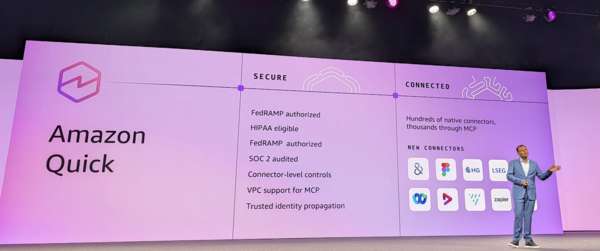
It's early in the Amazon Quick development, but here are a few reasons why AWS may have something.
AWS' footprint can drive enterprise adoption of Amazon Quick. Enterprises today have OpenAI and Anthropic running around whether it's official or not. Governance dictates that this sprawl will have to end soon. Amazon Quick could possibly give you the same productivity boost that OpenAI and Anthropic can. And by the way, the most interested enterprises for Amazon Quick are likely to already have their data in AWS.
The price may be right. AWS is pricing Amazon Quick at $20 per user per month. And there's a discount to the consumption value you get. Power users pay $40 per month. The big win here is that enterprise admins can set billing and metering controls in their AWS consoles. Enterprises want predictability of AI costs, governance and controls.
AWS has the telemetry to build definitive knowledge graphs. AWS can see everything that flows through its cloud. In other words, AWS can see how work gets done. Over time, Amazon Quick can use that data to adapt, automate workflows and it wouldn't be a surprise if process optimization followed. If you can see how work actually gets done, Amazon Quick can have multiple process optimization extensions.
Amazon Quick may have a more straightforward pricing model. Let's face it: Tokenomics is a sick joke and doesn't begin to touch on outcomes. Should you blow through Amazon Quick usage tiers, AWS starts looking at "agent hours," which is time spent on delivering work or an outcome. It's unclear whether hours is the way to measure AI agent, but it aligns with consumption and speaks the language of business. You can directly compare time spent by humans vs AI agents. I'm not necessarily sold on agent hours, but it sure beats tokens.
Amazon Quick has model routing in the background. Customers can request models, define whether frontier capabilities are always wanted and blacklist LLMs. But out-of-the-box, AWS will handle the optimization for you and use the models that deliver results at the lowest cost. Today, enterprises seem to care about the flavor of LLMs used. I'm willing to bet that token sticker shock is going to change that attitude in a hurry. Should the enterprise buyer care about what model is used if most use cases don't need the latest greatest LLMs? In the long run, that answer is going to be hell no.
The door is open for local processing. Today, most of Amazon Quick runs on the cloud, but the desktop version can clearly embed models that work locally. For enterprises that could be appealing.
Amazon Quick is the front end to the AWS moat. It's not a stretch to think that Amazon Quick's moat is likely to be context and the knowledge graph, which was built in a few days for me. AWS Context is coming soon, but is likely powerful given the cloud provider's reach.
AWS sees enterprise software as a layer to be abstracted. AWS would never say enterprise software is just something to be abstracted, but the company is likely thinking along the same lines of OpenAI and Anthropic. I frequently walk through how Anthropic or OpenAI can abstract away enterprise applications. ServiceNow is playing the same game as an AI control tower, but could be abstracted away by something like Anthropic. Why couldn't Amazon Quick do the same thing since AWS is already there? We're in the land of abstraction layer leapfrog and I wouldn't dismiss Amazon Quick in that game.
More from AWS Summit 2026
Larry Dignan is Editor in Chief of Constellation Insights at Constellation Research, where he leads editorial coverage focused on enterprise technology, digital transformation, and emerging trends shaping the future of business. He oversees research-driven news, analysis, interviews, and event coverage designed to help technology buyers and vendors navigate complex markets with clarity and context. ...
Read morePublished
Author
