


Zoho Day 2026 themes to watch: ERP, SaaS, customer value, AI, sovereignty
Zoho Day 2026 featured dozens of takeaways and insights from an enterprise software company that has historically been disruptive with great value for the money. And AI is likely to push the SaaS hunger games more into its favor.
While we could riff on Zoho-specific takeaways it’s worth highlighting the themes that apply to the broader enterprise software sector including buyers and vendors.
- Zoho previews AppOS ahead of enterprise app avalanche
- Zoho just delivered the best SaaS defense vs. AI
Here’s a look.
ERP is back. Zoho launched an ERP platform in January in India and the plan is to launch in other countries in the near future. Think the US. If you couple, Zoho ERP with what Intuit is doing with ERP via Intuit Enterprise Suite and there's nothing but good news ahead for midmarket enterprises. What'll be interesting to watch is how Zoho and Intuit creep up to larger enterprises.
Siva Iswaran, Global Head of Finance and Operations and CEO of Zoho Payment Technologies, said the ERP strategy revolves around a country-specific approach and then expansion. The company is targeting manufacturing, retail, distribution and nonprofits to start.
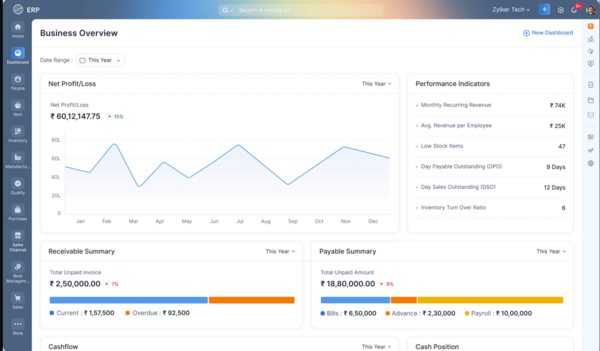
"We are seeing excellent traction in India and customers who want to move from their legacy systems such as SAP and Microsoft Dynamics," said Iswaran, who noted that Zoho's strategy is to provide an integrated platform that serves as a digital nervous system for the enterprise. Zoho is also adding its know-how on Unified Payments Interface and similar digital infrastructure to its ERP flows.
The ERP-fest had me humming Eminem.
Guess who's back, back again?
ERP's back, tell a friend
Guess who's back, guess who's back
Guess who's back, guess who's back
Guess who's back, guess who's back
Guess who's back
(Na-na-na, na, na, na, na, na, na)
(Na-na-na, na, na, na, na)
My take: Systems of record appear to be the most defensible layer of SaaS so it’s not surprising that ERP is in favor again. This ERP scrum in the midmarket will be fun to watch. Expect some large vendor disruption from below.
ERP is back because the mundane suddenly matters again. Vijay Sundaram, Chief Strategy Officer at Zoho, said during his talk that systems of record and APIs are what make AI work along with data. "Your system of record and your APIs and all that kind of infrastructure layer that vendors did have now become strategic assets. Because a lot of the layers of AI and technology depend on it, and all of a sudden, you can see that there is some sort of magnificence in what was mundane," said Sundaram.
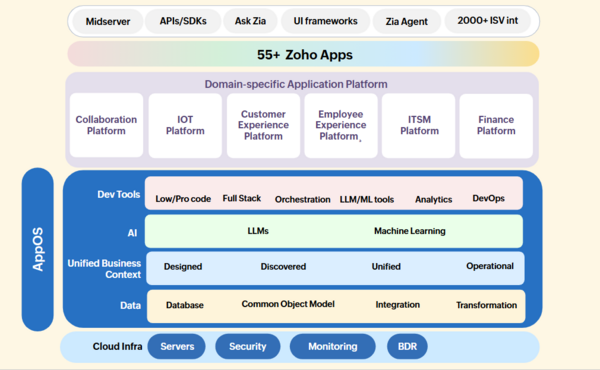
My take: AppOS is an interesting development and on target for the moment. Think of AppOS as an architecture more than a product.
The most jarring thing about AI is that we've gone from digitizing things to digitizing ourselves. Zoho's bet is that productivity is shifting from digitizing around us to intelligence. And that means outcomes.
My take: This digitization of intelligence and therefore humans is what spurs concerns about future jobs.
See: How Zoho Is Rewriting Enterprise Software: ZohoDay 2026 Analyst Roundtable
Don't be confused by the current pricing of premier LLMs because they'll be extracting profits sooner than you'd think. "The investment phase will transition to the extraction phase soon," said Raju Vegesna, Chief Evangelist at Zoho. "We should not be fooled by the current, current economics of the public models by some companies. We've seen this movie too many times where companies invest, keep the product cheap and grow share. Then they flip the switch and you're in the extraction phase and you keep paying the extraction tax."
My take: The open-source model argument is preaching to the choir from this perch. To think open-source models, you need two characteristics: The ability to think global since non-US companies are pushing open-source and the willingness to procure the talent to customize. AWS’ Nova Forge effort may thread the needle for enterprises.
Own your models. Zoho is extremely wary of proprietary model providers and believes open-source models will do to AI what Linux did to software. The core theme from executives revolved around focused models that are private as well as efficient. Focused models with live contextual data often outperform giant generic models for business use cases.
"We also have to own the models,” said Vegesna. "Owning those models allows us to custom train and custom deploy based on custom requirements."
My take: Own your models is good advice.
Build a foundation. With Zoho's preview of AppOS, it's clear the company is focusing on a foundation that can scale applications including efforts produced by AI. Zoho Labs Director Ramprakash Ramamoorthy said the company has built its own database stack and models optimized for its enterprise. Those investments are all about context.
"We've been talking about Zoho's AI strategy for years. We talked about two things, one is right sizing models, and two is finding the right context," said Ramamoorthy. "The basics matter more. Can you have a vector database that really supports your AI workloads very well? Can you optimize your AI models to work on CPUs wherever possible and bring in the GPUs only when you need them?"
Zoho CEO Mani Vembu said the future of AI-driven apps and SaaS will boil down to platforms. "Nobody has had the time to solve the fundamental foundation," said Vembu. "This is the current state of enterprise software. There is a broken foundation and then the thing built on top of it."
My take: You should think about future-proofing your architecture so you have options. And you should watch your AI costs. Nobody is talking about AI efficiency and economics today, but they will.
SaaS margins are going to be squeezed, possibly crushed. A recurring theme from Zoho executives was that AI is going to compress profit margins. Zoho Chief Scientist Sridhar Vembu said, "software has to be more affordable."
"There's no reason to charge a huge amount for simple things anymore. Zoho is probably most adaptable since we offer more. Clearly, customers are going to demand more value," he said. "Expect more value from your vendors including Zoho."
- How CEOs are answering the dreaded LLM disruption question
- SaaS under the microscope: How to evaluate your vendor
- SaaS death knell storyline illogical, but margin compression is here
- Observability stands out in enterprise software wreckage
My take: Zoho is already a SaaS margin wrecking ball. SaaS margins are Zoho’s opportunity.
Sovereignty matters. If someone can pull the plug on one of your systems, are you really sovereign? That question is asked repeatedly by Zoho's customer base, which is diversified globally. As a result, Zoho is building a vertically integrated stack of hardware and software. Zoho is also offering multiple deployment models to allay sovereignty concerns.
My take: Every enterprise vendor will need a sovereignty story.
Customer satisfaction is your business moat. It sounds relatively obvious, but focusing on customers and delivering value is going to be the differentiator amid AI upheaval. "At end of the day, human-to-human relations matter the most, and that is where we are investing," said Vegesna. "Customer satisfaction is the ultimate moat."
Zoho Chief Scientist Vembu put that human interaction theme in the context of adapting to new job roles. "Your people skills are more valuable than broad technical skills. I think that is where we might be heading. Get closer to the customer," said Vembu. "I see our customer support. They've become valuable because we pick up and have real humans talking to humans. We use AI to give them better solutions, faster solutions and more accurate solutions, but there is a human talking. People think of customer support first."
My take: Being more human with customers is going to be the differentiator. The same small subset of companies that excel at customer experience will get the memo. Most companies won’t.
Larry Dignan is Editor in Chief of Constellation Insights at Constellation Research, where he leads editorial coverage focused on enterprise technology, digital transformation, and emerging trends shaping the future of business. He oversees research-driven news, analysis, interviews, and event coverage designed to help technology buyers and vendors navigate complex markets with clarity and context. ...
Read morePublished
Author
