


Zoho just delivered the best SaaS defense vs. AI
Vijay Sundaram, Chief Strategy Officer at Zoho, may have just given the best defense of SaaS in the age of LLMs. SaaS shifted risk from customers to vendors. How many of those customers will want that risk back for a shiny new LLM?
Today, you'd think Anthropic would replace every piece of enterprise software. But you know that already. Sundaram riffed on what's changing in SaaS, the questions to ask and why enterprises need to think through control and risk posture. Recent headlines:
- How CEOs are answering the dreaded LLM disruption question
- SaaS under the microscope: How to evaluate your vendor
- SaaS death knell storyline illogical, but margin compression is here
- Observability stands out in enterprise software wreckage
Speaking at Zoho Day 2026, Sundaram addressed the "so-called demise of SaaS." Sundaram said Zoho isn't surprised by some of the AI fallout. The company expected pricing pressure and margin erosion and that seat demand would fall. Keep in mind that Zoho applies that pressure on rival SaaS companies. The fat margins in SaaS are Zoho's opportunity.
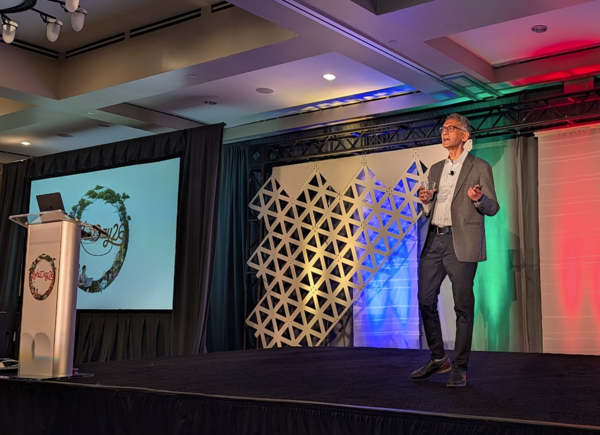
He noted that AI can lead to more competition and do-it-yourself approaches. In addition, the business models behind SaaS will have to adapt.
Sundaram said Zoho is navigating multiple trends.
- AI has moved from the "realm of experimentation to operationalization, possibly institutionalization."
- Innovation has accelerated but so has the expectation of accountability.
- Best of breed approaches that have led to the sprawl of applications are starting to unwind.
- The need to deliver value has also accelerated.
- Your system of record and your APIs are strategic assets.
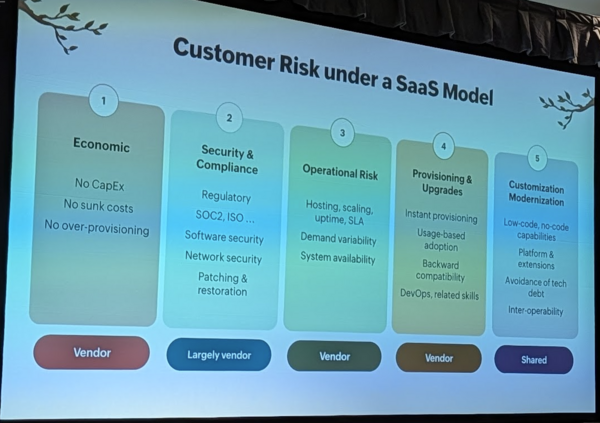
"All of these trends are happening at the same time," said Sundaram. "SaaS is often thought of as a pricing and distribution strategy. But SaaS has actually been a fundamental way where risk got reallocated to the vendor," said Sundaram.
Customer risk for capital expenditures, security and compliance, operational risk, upgrades and provisioning and customization diminished. "SaaS was more than a distribution model. It was an institutionalization of risk transfer," said Sundaram.
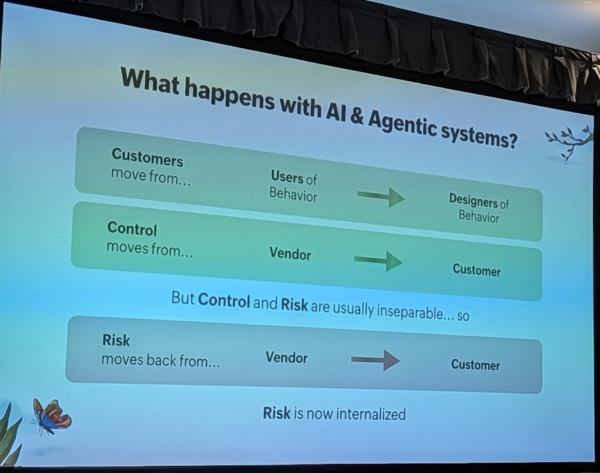
With AI, risk moves from the vendor to the customer. "Risk is now being internalized. Many customers will be ready to do it, and many others won't," said Sundaram.
Figuring out what customers will be able to handle the risk will take time. The big questions aren't answered yet. Sundaram said Zoho's approach to AI will revolve around the following:
- Manically focus on value.
- Be the customer system of record. "This is not just the data. It's all the innate knowledge of the customer. The context you know that AI will need," said Sundaram.
- Drive customization with a platform approach.
- Enable massive automation and AI agents.
Zoho's long-term play: "We open up the system to customer control, we keep the risk," said Sundaram.
Zoho's system of record strategy is notable given that's the turf of other SaaS giants. Sundaram said what used to be mundane infrastructure for enterprises has now become strategic assets as systems of record and APIs are fundamental AI deployments.
"Your system of record and your APIs and all that kind of infrastructure layer that vendors did have now become strategic assets. Because a lot of the layers of AI and technology depend on it, and all of a sudden, you can see that there is some sort of magnificence in what was mundane," said Sundaram.
The upshot is that Zoho is looking to become more of a platform and has the assets to deliver. Zoho Corp., which consists of Zoho, ITSM-focused ManageEngine, Otri and TrainerCentral, kicked off Zoho Day 2026 with a series of 30th anniversary milestones. Zoho Corp. has the following:
- More than 1 million paying customers.
- More than 150 million users globally.
- A 32% increase in customers.
- 20% revenue growth in 2025.
- 19,000 employees.
Zoho Day 2026 includes a bevy of customers, previews of the roadmap ahead and platform strategy. Zoho's growth has been driven by a freemium model that converts registrations to paying customers.
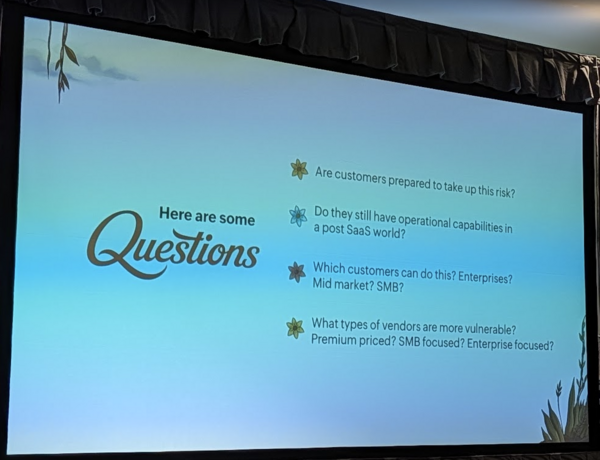
The looming questions for SaaS vendors and customers are as follows. The answers are to be determined.
India as test bed
That final system of record point illustrates how Zoho is becoming more strategic. Zoho launched ERP in January for India. That move highlights Zoho's plan, which revolves around build and launch in India as a test bed and then go global.
Sundaram said:
"India is a test bed for a lot of things we do. There we work with very large customers in India including many of the largest banks, largest automobile companies, largest retail companies and financial services. We have muscle and we have people on the ground and that becomes a test bed for things we do in other parts of the world. Many of you may have heard last year about dealer automation system that we implemented for Mercedes Benz. So now that has moved into other parts, other manufacturers as well, and now we're taking that into other parts of the world. A lot of our vertical strategy is crafted there."
The upshot from Sundaram's talk is that Zoho is moving upstream with the help of large integrators including TCS, Deloitte, PwC India and Cognizant. Those integrators are helping Zoho play bigger in India and that channel approach is going to be replicated elsewhere.
Larry Dignan is Editor in Chief of Constellation Insights at Constellation Research, where he leads editorial coverage focused on enterprise technology, digital transformation, and emerging trends shaping the future of business. He oversees research-driven news, analysis, interviews, and event coverage designed to help technology buyers and vendors navigate complex markets with clarity and context. ...
Read morePublished
Author
