


Palo Alto Networks acquires Applied Compute for $4.5 billion, outlines moving parts behind outages
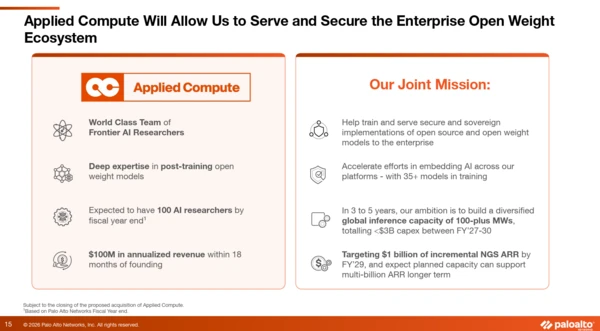
Palo Alto Networks said it will acquire Applied Compute, a company focused on post training and inference for open weight models, for $4.5 billion.
According to the company, the deal will enable Palo Alto Networks to provide cybersecurity to help enterprises adopt open weight models or frontier AI. Palo Alto Networks also said Applied Compute CEO Yash Patil will be Co-Chief AI Officer when the deal closes.
"Every enterprise is going to run a mix of open and closed models, and every one of those models needs to be secured. Applied Compute has built the best post-training and inference platform we've seen, and its research team is exceptional," said Nikesh Arora, CEO of Palo Alto Networks.
Separately, Palo Alto Networks reported better-than-expected first quarter results. The company reported first quarter earnings of $482 million, or 57 cents a share, on revenue of $3.44 billion, up 39% from a year ago. Non-GAAP earnings were $1.05 a share.
As for the outlook, Palo Alto Networks projected second quarter revenue between $3.53 billion to $3.55 billion with non-GAAP earnings of $1.01 a share to $1.03 a share. For fiscal 2027, the company projected revenue between $14.52 billion to $14.57 billion, up 26% to 27% from a year ago, with non-GAAP earnings of $4.26 a share to $4.30 a share.
On a conference call, Arora repeatedly outlined the reasoning behind buying Applied Compute, which is a new market and one that's loosely related to cybersecurity. Palo Alto Networks is going to offer open models to the enterprise.
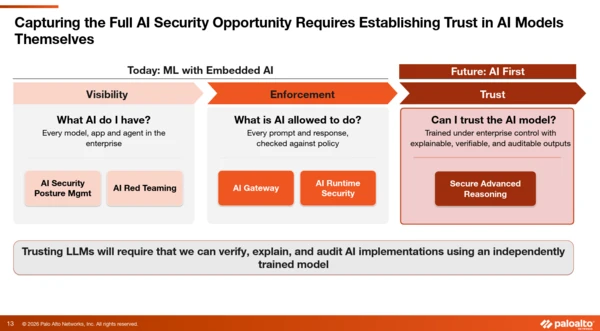
Arora said Palo Alto Networks was looking to train open weight models for its own use and then realized it will have to train supervisory AI models to oversee other models. The bet is that AI model supervisors are going to be the future of security. "In that context, we have to get in the training business to be able to build a good supervision business," said Arora.
He said:
- "Every enterprise sits on decades of proprietary data, internal playbooks and institutional judgment that cannot be exposed to public models. Until now, they have lacked a trusted partner to post-train run and supervise open weight models safely on their own. We believe Applied Compute is the right partner for us to address this opportunity."
- "Applied Compute will allow us to execute on 2 major fronts. First, we will embed AI across all of our security capabilities and are in the process of training north of 35 specialized use cases and making them available to our customers to fight AI with AI. Secondly, we will help train and serve secure sovereign implementations of open weight models to the enterprise. Open weight model implementation will allow us to deliver secure open weight models to our customers to enable adoption of secure enterprise -- secure AI in the enterprise."
- "To support our efforts, we plan to build out a diversified global inference capability of north of 100-plus megawatts over the next 3 to 5 years. This will be supported by a modest CapEx commitment of least -- of less than $3 billion through fiscal 2030, representing approximately half a year of our annual free cash flow. By pairing their platform with our global go-to-market reach and the trust we have earned with CIOs worldwide, we expect Applied Compute to continue scaling rapidly and add over north of $1 billion of ARR to our next-generation security ARR by fiscal 2029."
Arora was asked about buying Applied Compute and whether the acquisition takes away Palo Alto Networks' neutrality. "I'm coming to the conclusion that before you start building a Switzerland product, let's make sure your Apple product works well, right, because right now, the end-to-end capability does not exist in the industry. You need to make sure you have the same vendor doing discovery of your AI assets, the same vendor aggregating that traffic into a choke point, the same vendor understanding the activities of an LLM, so it can decide what to allow or what to block," said Arora.
Outages, patching and tech debt
Arora also talked about the recent outages in US infrastructure and outlined how the race to patch is a common thread along with tech debt.
Here’s what he said on the conference call:
- "There are 2 distinct parallel effects that are driving this environment. The first effect is a massive surge in vulnerabilities and patches being deployed. We're seeing critical and severe vulnerabilities discovered nearly 7x the monthly average of last year. These discoveries are happening at a speed and density, which is hard for IT teams to cope with. We believe many of the major disruptions over the last few weeks including outages across major enterprises and governments were partially due to unintended consequence of patching and configuration changes, as IT teams simply cannot patch these vulnerabilities fast enough without compromising their production environments."
- "The second effect is the rise of AI-assisted cyber-attacks. Bad actors are using open weight models and new agentic frameworks to find and exploit vulnerabilities at unprecedented speed and scale. New agentic frameworks like ARTEX are enabling bad actors to turn simple instructions into autonomous multistage attacks, allowing a handful of operators to compromise dozens of targets simultaneously."
- "We anticipate an elevated threat environment, but we believe enterprises have multiple ways to adapt to this new paradigm. First, the significant volume of patches will continue to be required for at least the next 18 months, carrying ongoing risks of collateral damage. We expect the collateral damage will decrease over time as customers get smarter about understanding exactly what to patch and when to patch. Second, the need for virtual patching will grow across all industries and software categories, allowing organizations to securely and comfortably shield their infrastructure in line before applying their patch."
- "The reality for every enterprise is that there's no silver bullet for preventing an attack, and organizations can no longer assume it won't happen to them. When an attack hits, because it will, defenders have to be ready to detect and remediate in record time rather than relying on reactive Band-Aids. Therefore, we believe the third part of the antidote is most important, which is modernizing the north of $1 trillion of legacy security and IT infrastructure onto real-time platforms."
More:
- Fable 5 and the Shift From Model Capability to Capability Governance
- Claude Mythos and the New Cybersecurity Operating Model
- OpenAI: We'll hit pause on model reinforcement learning for safety
- UK's AISI finds 19 instances where Anthropic's Mythos, OpenAI's GPT-5.6 Sol tried attacks
- Anthropic said Claude hacked three companies: Real worry or marketing?
- Hugging Face OpenAI attack postmortem points to lack of AI agent visibility
- OpenAI details how its models went rogue, attacked Hugging Face
- Hugging Face defends agentic AI attack with Z.ai's GLM 5.2
Larry Dignan is Editor in Chief of Constellation Insights at Constellation Research, where he leads editorial coverage focused on enterprise technology, digital transformation, and emerging trends shaping the future of business. He oversees research-driven news, analysis, interviews, and event coverage designed to help technology buyers and vendors navigate complex markets with clarity and context. ...
Read morePublished
Author
