


How Cognizant aims to bridge the AI value gap
Cognizant CEO Ravi Kumar said there's a gap between AI capabilities and enterprise value and the company plans to expand its addressable market by bridging that gap.

Speaking at Cognizant's AI Forum, Kumar laid out the company's transition to evolving from a systems integrator to AI builder. The big themes from Kumar went like this:
- AI returns have been elusive, but enterprises are entering a new phase that revolves around outcomes.
- Runaway token consumption is an architecture issue.
- The new code is context.
- New job roles are beginning to emerge as human and digital labor are integrated.
Here's a look at the key takeaways from Kumar's talk.
The gap between AI technology and enterprise value. "AI costs are ballooning with very little productivity. There has been reckless token consumption without linkage to outcomes," said Kumar.
Kumar added that there's a reality check on enterprise AI.
"If chapter one was about broad open based experimentation, chapter two would be about specifics, realism, cost, and bridging the value gap," said Kumar. "We are building a new category of a company, which is going to evolve with some craft from the past and some new craft."
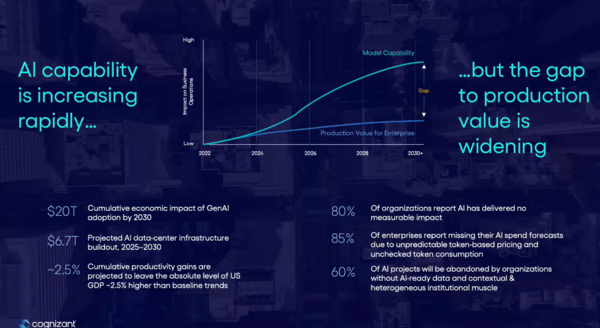
Currently, AI spending is driven "by a sense of FOMO and fearmongering, and that's led to token consumption without linkages to ROI and without linkages to outcomes," said Kumar. "The reason for the gap between capability and production has been the reckless spending on token consumption."
- How to avoid vendor lock-in in the AI age
- BT150 zeitgeist: In search of AI agent ROI
- CIOs see AI agents as journey, token budgets a concern, says Box CEO Levie
- AI inference costs are going to be a big concern: What's the fix?
- AI Forum 2026: There isn’t an easy button for AI
- Constellation Research's Futures Forum: What CEOs are thinking
- Where’s tokenomics for the rest of us?
Building a token and agent harness. Kumar said Cognizant is building a harness that revolves around model interoperability, the ability to capture patterns of work, wire those digital traces in the enterprise together and create digital labor that is routed through the company. "We do this now for hundreds of clients," said Kumar.
That harness is designed to solve the architecture that's leading to runaway token spending. Kumar said:
"Token spending is an architectural problem as well. First, models don't know what context and process matters. Second, not every agentic flow requires frontier reasoning and continual learnings. Enterprise AI systems shouldn't solve the same class of problems from scratch every time. Harness design captures digital traces with human effort to create a new craft, which will make token economics an important part of your value chain."

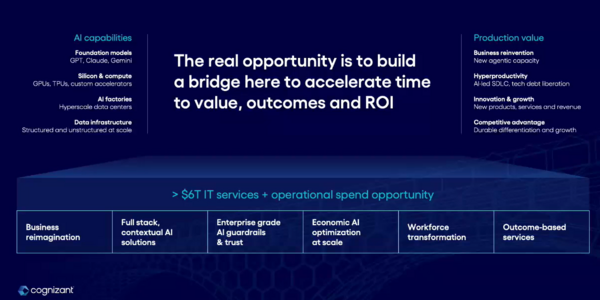
AI will drive economic expansion due to digital labor and IT systems. Kumar said Cognizant's research projects $6 trillion in AI-driven productivity by 2030 and $14 trillion in new products and services.
Kumar said Cognizant used to play in a $1 trillion market, but now has a $6 trillion opportunity due to AI transformation. "$4.5 trillion in labor is exposed to agentification. So, the universe we are talking about is $5 trillion to $6 trillion. It's a 6x opportunity compared to what we actually chased for the last 25 years," said Kumar.
- Cognizant buys Astreya, eyes AI infrastructure services
- Cognizant aims to solve "AI velocity gap"
- Constellation ShortList™ AI-Driven Cognitive Applications
The evolution to move from systems builder to systems designer to AI builder. Kumar said Cognizant is looking to offer full-stack bespoke capabilities and integrate human and digital labor. In the end, Cognizant will have an outcome based platform-plus-people model. "Our thesis is that our clients are going to consume this not as services, not as software, but as platforms," said Kumar. "We have an opportunity to be a platform plus people's company."

Cognizant's three-vector strategy. Cognizant's plan is to translate AI capabilities into production value via software engineering that is autonomous and agentic, industrialization of AI, which will include layering AI on existing technologies and integrating with systems of record, and business operations.
"In a simplistic way, I see it in two swim lanes: old things done in new ways and new things done in new ways," said Kumar.
Context engineering is critical to realizing AI value. The new programming craft will revolve around assembling organizational context. There are three core themes in context engineering.
- Models don’t know which context matters; enterprises must “assemble context”.
- Deterministic parts stay in classical software; probabilistic parts move into AI grounded in real organizational heterogeneity.
- Assembling context is a new role that's critical to enterprises.
"Assembling the context is the new code. Somebody asked me this question, ‘What does this new frontier engineer do?’ and I said context is an important part of this process," said Kumar.
Blending human and digital labor means new roles. Cognizant sees new job families emerging due to AI. Changes ahead include:
- More frontier engineers and operators.
- Flatter org structures and a broader talent period.
- AI-infused rate cards that blend human and digital work priced based on outcomes.
"A frontier engineer reinvents workflows so you need to have capability at the intersection of technology and domain. A frontier operator can use digital labor and human labor together to deliver," said Kumar. "Economics shift from labor to outcome token optimization."
Larry Dignan is Editor in Chief of Constellation Insights at Constellation Research, where he leads editorial coverage focused on enterprise technology, digital transformation, and emerging trends shaping the future of business. He oversees research-driven news, analysis, interviews, and event coverage designed to help technology buyers and vendors navigate complex markets with clarity and context. ...
Read morePublished
Author
