


Physical AI likely to move to the front in 2027
Physical AI and robotics is increasingly turning up on earnings calls and enterprises see a nascent market that's likely to be a big chapter in their AI journeys. What’s unclear is the timeline.
The market is still nascent, but physical AI appears to be gaining momentum (at least in terms of mentions) leading into 2027. Physical AI refers to AI embedded into hardware and physical systems that can sense, perceive and reason. Physical AI is seen as a way to automate plants, transform industrial settings and drive operational efficiencies.
According to the Association for Advancing Automation (A3), North American companies ordered nearly 11,000 robots valued at $723.5 million in the third quarter. Orders in units were up 24.8% from a year ago.
A few headlines to note:
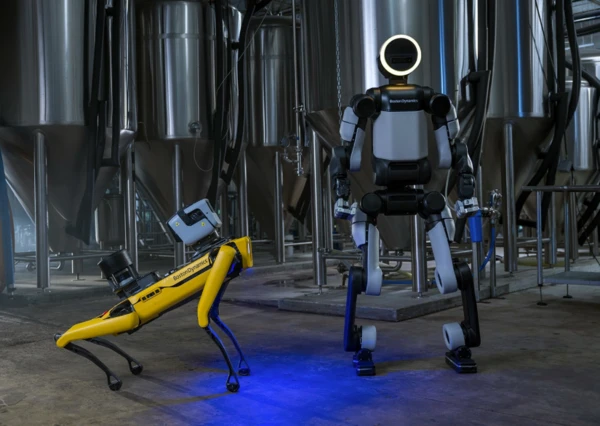
- GlobalFoundries said it will deploy Boston Dynamics' Spot in its manufacturing facilities. GlobalFoundries will also test Boston Dynamics' Atlas humanoid robots early in 2027. "Spot has helped us shift from reactive to predictive maintenance, collecting data across thousands of inspection points to prevent downtime and keep our fabs running more efficiently," said Pradip Singh, chief manufacturing officer at GlobalFoundries. "Scaling Spot and testing Atlas are the next steps in our journey to AI-enabled manufacturing, putting physical AI to work across our operations worldwide."
- Nvidia interim CEO Colette Kress said physical AI revenue nearly tripled in the third quarter from a year ago and is on pace for $25 billion in revenue for the fiscal year. At GTC Berlin, Nvidia expanded its Isaac robotics platform with a new humanoid reference design built on GR00T and Jetson Thor.
- Rockwell Automation said it will acquire Austria-based AGILOX, which makes high-end autonomous mobile robots driven by AI and swarm networking. Rockwell said the purchase will boost its autonomous material movement offering. “The transaction is a great fit with our acquisition priorities, and it accelerates our physical AI strategy, further strengthening our ability to orchestrate fixed and mobile automation across the plant,” said Rockwell Automation CEO Blake Moret.
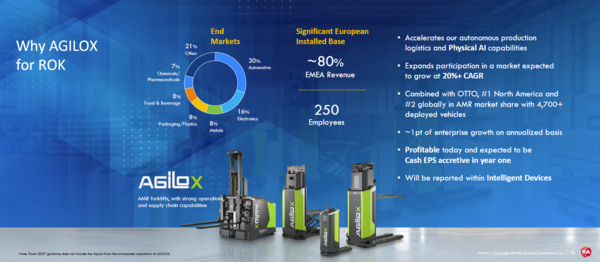
One thing that's clear in the physical AI market is that the usual technology vendors aren't the main players in Silicon Valley. Companies like Rockwell Automation and Honeywell International will be major players as physical AI and enabling technologies will intersect with industrial AI companies.
Speaking on Rockwell Automation's Investor Day, Matheus De A G Bulho, Senior Vice President of Software & Control at the company, said physical AI is about more than the flashy humanoids. "When we talk about physical AI, most people, the image of physical AI that comes to mind is if a robot, a robotic arm or a humanoid or an AMR. And it is very true that robots are a very important part of physical AI," he said. "But it is also true that physical AI is about all of the different types of production assets out there, and they come in many, many forms. That creates a very significant opportunity as our customers look to improve what that type of production asset can do and bringing them forward towards autonomy."
Honeywell International CEO Vimal Kapur set the scene at the RBC Global Industrials Conference this week. Kapur said:
- "What's critical for us is to think about the broader evolution of automation as an industry, and AI is changing that quite rapidly. The physical AI is a bigger opportunity. So longer term, how our business will pivot to take benefit from physical AI and reimagine our offering is name of the game in my mind for next -- it's happening as we speak, but it's going to scale every quarter, every year and just going to make it integral part of our offering."
- "Physical AI is much more than robotics and humanoids. Physical AI is supplements the automation system with a learning system, which runs along with it to tell human what may happen if the current situations are prevailing so that human has more tools at hand to run the facilities better."
- "When you look at a physical AI system, the data is not in public domain. It's not on Internet. We talk about AI and whenever we use any AI tool, it looks at Internet, it looks at your computer and tells you a summary of what can possibly happen. But in case of physical system, the data is in some system."
Kapur added that the progression of physical AI in the future will be semiautonomous and human in the loop before going autonomous. He noted that Waymo took 17 years to get where it is today.
Innodata, which offers pre-built AI training dataset for large language models, sees physical AI as a growth driver. Rahul Singhal, CEO of Innodata, said capital has been pouring into physical AI but the bets are mostly on robot foundational models and companies looking to build consumer and industrial robots.
"Recent research confirms that robotics foundation models improve with the data the same way LLMs do. But because no Internet scale corpus of physical interaction exists, the data must be manufactured through teleoperation, egocentric human video and simulation, all work we've begun doing. And as models move from lab demos to deployment in factories, warehouses and homes, we anticipate demand expanding from one-off pretraining corpora to continuous task-specific data for fine-tuning and evaluation," said Singhal.
That data training issue means that IoT vendors and platforms will have a role in physical AI.
Also see:
- Caterpillar’s AI Autonomy Efforts Accelerate, But Domain Knowledge Drives Returns
- Arm steps up physical AI efforts, bridges edge, cloud AI
- Accelerating Physical AI With Purpose-Built Cloud
- What we can learn from industrial, blue collar AI
- Take the robots. Leave the humanoids (Distillation Aftershots)
Dominic Phillips, CFO of Samsara, said the market is nascent but growing. "We have a unique defensible data advantage. By instrumenting physical assets with IoT hardware, we've created a large growing proprietary data asset that's hard to replicate. Second, we leverage this data using AI and agents to surface operational insights and automate workflows across our platform. Third, we benefit from secular growth in physical AI end markets such as construction, field services, energy and utilities are not only busy building out global infrastructure, they're increasingly using AI to manage greater scale and complexity," said Biswas.
Naturally, every chip vendor from Nvidia to AMD to Arm to Intel is going to have some physical AI play, but it'll make sense to think broader. Enterprise buyers will need to focus on layers that can be swapped out after deployment. If task definitions, training data or fleet telemetry are tied to one robot vendor you're locked in and will have difficulty scaling.
An abridged look at the physical AI vendor stack.
Training and onboard compute: Nvidia, Qualcomm and others.
Sensor, perception and motion: Cognex, RealSense and Sharpa.
Simulation: Nvidia via Isaac, Omniverse and Cosmos and Siemens.
Robot foundation models: Nvidia and Google DeepMind and others.
Robot application development: Nvidia and ROS 2, an open-source ecosystem.
Industrial robots and cobots: FANUC, ABB Robotics, KUKA and Universal Robots.
Humanoids and mobile manipulation: Agility Robotics, Figure, Boston Dynamics, Unitree.
Fleet orchestration and factory control: Rockwell Automation and Siemens.
Larry Dignan is Editor in Chief of Constellation Insights at Constellation Research, where he leads editorial coverage focused on enterprise technology, digital transformation, and emerging trends shaping the future of business. He oversees research-driven news, analysis, interviews, and event coverage designed to help technology buyers and vendors navigate complex markets with clarity and context. ...
Read morePublished
Author
