Results

AI is your new co-founder, core and creative and engineering muse

AI is your new co-founder, core and creative and engineering muse

Artificial intelligence is going to rewrite how businesses operate and enterprises are going to avoid chasing existing markets to create new categories, drop the obsession with transformation and add-on approaches, treat AI as a co-founder and cut the latency from idea to prototype to near zero.

Those are some of the takeaways from the latest DisrupTV episode, which was essentially a college course in an hour.

Christopher Lochhead, 13-time #1 bestselling co-author and "godfather" of Category Design, and Sunil Karkera, Founder & Chief Engineer at Soul Of The Machine, were on DisrupTV providing a glimpse of what it'll take to build an AI-native company.

Here are some of the takeaways from DisrupTV Episode 403.

Avoid the "Existing Market Trap" in AI investments. Lochhead said in doing the research for "The Existing Market Trap: (a Primer) Escaping The 13 Deadly Sins that Destroy Companies, Careers and Portfolios," the data indicates that about $13 trillion in AI startup investments is at risk because too many companies are competing in existing markets rather than creating new ones.

Lochhead said:

"You can't create a new thing and let it be positioned as an old thing. Roughly $13 trillion is about to be lost inside the existing market trap. We have so many AI vendors today chasing existing AI markets. Everybody wants to be ChatGPT, everybody wants to be Claude. Everybody is chasing Nvidia. The big ah-ha here is the companies that will win are companies that choose not to compete in existing markets, but create their own."

AI is core, not an add-on. Successful companies view AI as foundational rather than supplementary, said Lochhead. "AI represents the greatest mega category creating technology in the history of humanity and so but yet, people still suffer from Google Brain. They treat AI like it's Google on steroids. They don't realize they should be creating every single element of their business with AI," said Lochhead. "If you look at the vendors, most of them have the wrong lens on AI."

Lochhead explained that you have to listen to the words and what they're telling you. When a vendor calls AI a companion, copilot or assistant, the company is really saying they're selling software and AI is an add on. "AI is not an add-on to a thing. It is the thing," he said.

Karkera has taken that AI-first approach and ran with it to build a company with digital and human labor. Soul of the Machine has been able to scale with a few dozen humans to do what would have taken hundreds. Soul of the Machine also charges differently with its new model.

Karkera said:

"Pricing is gross margin and milestone and outcome based. We're not charging for head count and equal in time. We're not running a spreadsheet for that. There's a big shift in how things are done. Our biggest team members are actually agents. We consciously use them, we drive them, we plan them and they provide so much augmentation to creativity and engineering."

The "Stop, Change, Start" approach and AI. Lochhead said people need to think of businesses and careers as pre-AI things that have run their course. AI is a co-founder of your career and company. When you build with AI that's what you should be doing. Designing new categories now begins with AI as a co-founder. "Our belief is that if you ae not using proprietary AI to do your work you're out of your mind," said Lochhead, who added that companies that don't use AI from the ground up will fall into the existing market trap. OpenAI and Nvidia created new markets and didn't chase existing demand.

"AI is essentially a giant 'stop, change, start,'" said Lochhead. "We're not transforming old businesses."

Karkera's company, Soul of the Machine, is an example of creating new categories. Karkera is a TCS and Wipro veteran and now is designing his startup to be an AI-native disrupter. "AI definitely is our co-founder," he said. "AI is the new soul of the new machine we're building."

"Vibe Creating" meets "Vibe Coding." New collaborative approaches with AI are transforming work: "Just like we've all heard the term vibe coding, which is how you have a conversation with AI to build software, you converse with software about a set of outcomes that you want to create, and the AI goes and builds that," said Lochhead, who added that AI democratizes technical skills.

Karkera said the AI democratization of technology is real. "I have non engineers in my team who are doing amazing engineering right now. It's basically a function of how much you can stretch your brain in terms of the creativity side, more than how much of algorithmic knowledge you have taught from school," he said.

Creative functions hit the same themes. Every creative effort needs to include AI.

Lochhead explained Vibe Creating.

"There's a vibe creating framework that goes like this: Puke prompt, partner, know. What most people understand is we've all been taught for our whole careers that when you interact with tech, you need to be precise. So when you're working with a spreadsheet, you need to have precise numbers. When you're building a document or a business plan or PowerPoint, you want to be precise. Garbage in, garbage out. We've all heard that a million times. Guess what? That's not how AI works."

Lochhead sat down with his AI, Lucy, said he wanted to work on his new book about the existing market trap and gave it a thesis. The thoughts were put into Lucy, and Lochhead went back and forth.

Forward deployed engineering. Karkera said Soul of the Machine's approach is to put engineers at the source of ideas. It's working since Soul of the Machine is landing enterprises at the expense of much bigger consulting firms.

Karkera explained.

"The forward deployed engineer or creator is right where the ideas are originated, and the latency between idea to concept is zero because of this you're actually creating and seeing while it's being created. That's a completely new way of doing things. There was an idea that was sketched out on paper by one of my customers. I actually took a picture of it and used AI to convert it to a real working prototype within 15 to 20, minutes. Then I added the customers' design system and it became an application by the end of the day."
Data to Decisions Future of Work Innovation & Product-led Growth Marketing Transformation New C-Suite Next-Generation Customer Experience Chief Executive Officer Chief Financial Officer Chief Information Officer

The disconnect between tech euphoria, CFOs is jarring

The disconnect between tech euphoria, CFOs is jarring

The view from the C-suite is increasingly gloomy as executives navigate policy, inflation and the economy that's a reality show with two-week story arcs. It's hard to plan when your conditions change every other day.

Yet, technology companies--including a few that barely have revenue--live in a world full of unicorns and rainbows.

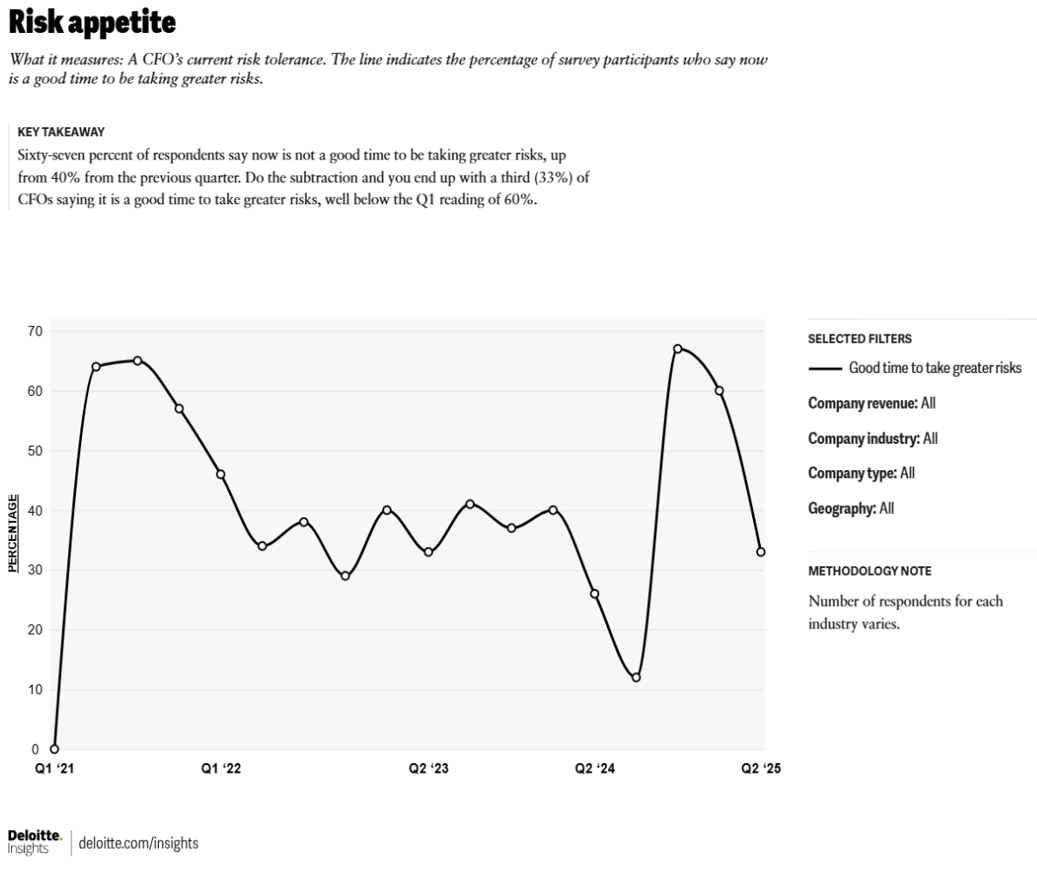
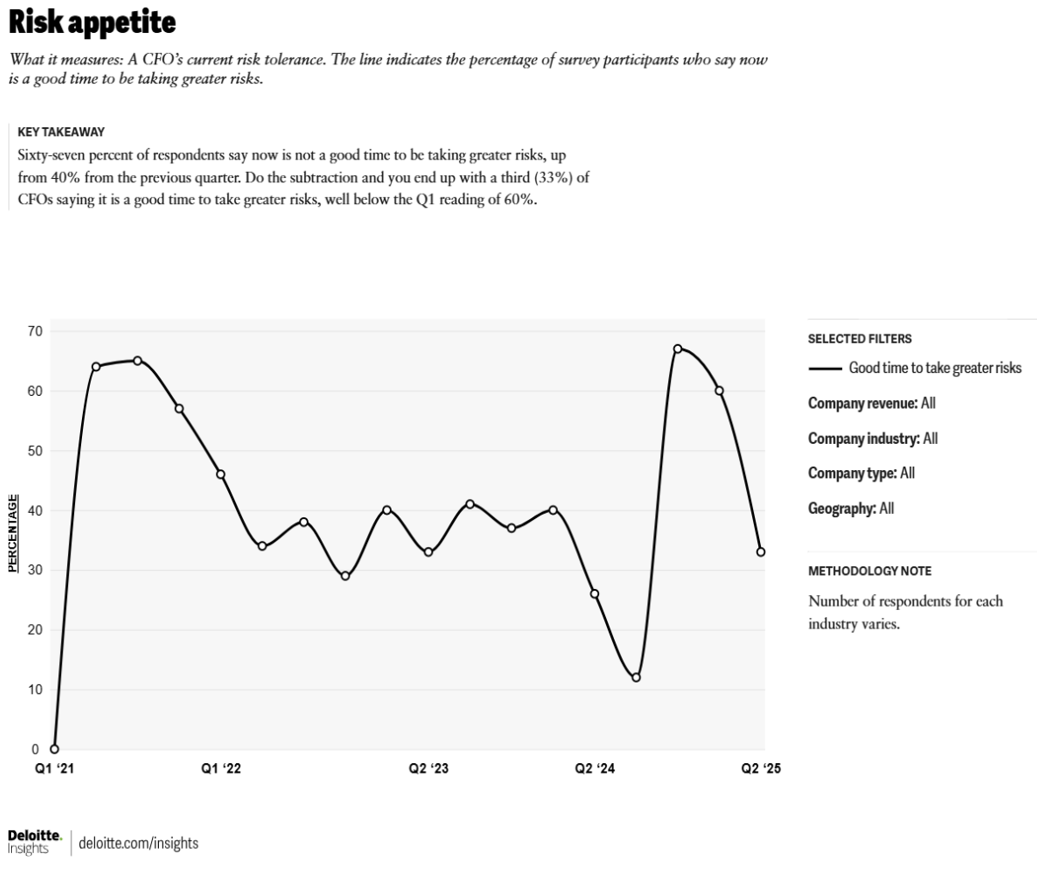
Deloitte's CFO Signals survey found that one in three financial chiefs thought it was a good time to take risks. That reading was the lowest since the third quarter of 2024 and well below the 60% of CFOs in the first quarter who said it was a good time to take risks.

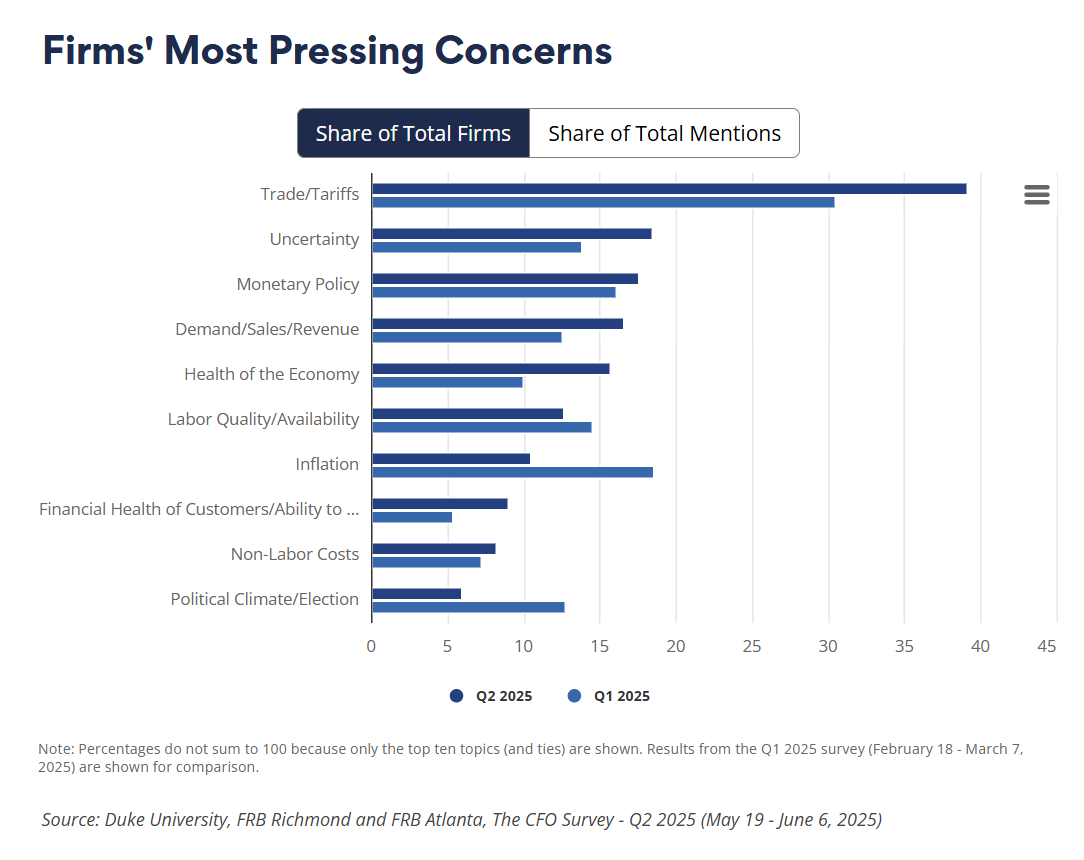
The Deloitte CFO survey follows data from Duke University’s Fuqua School of Business and the Federal Reserve Banks of Richmond and Atlanta. The Duke CFO Survey, which closed June 6, found 40% of respondents said tariffs and trade policy were a pressing concern in the second quarter. That percentage was on par with the second quarter of 2020 when there was a pandemic, supply chain disruptions and inflation.

Get the Insights newsletter

Is the sky falling? Not if you live in the land of AI, quantum, enterprise technology and Wall Street traders.

Yes, we know the line in enterprise technology is that investing in AI and new proofs of concept will boost productivity and save the day. These technology projects and efficiency gains--courtesy of AI agents--will offset inflation, tariffs and whatever else is thrown at companies.

However, the disconnect between CFOs and technology companies is jarring. There is a possibility that CFOs are worrywarts, but it's more likely that technology companies are overconfident in what is an emerging bubble in various categories.

There's also some evidence that technology firms are using Wall Street euphoria to better position themselves for turbulence. See: AI's boom and the questions few ask

Here are a few mileposts to consider.

Emerging tech companies are using stock runs to reposition. Who will be the bag holder?

Quantum computing companies are busy fortifying balance sheets as their stocks continue to surge. The goal for these quantum companies is obvious: Raise cash because quantum computing is going to be a long game.

IonQ is playing the stock run beautifully. The company priced a $1 billion equity offering of more than 14 million shares at $55.49 and pre-funded warrants. The 7-year warrants convert at $99.88 a share.

IonQ acquires Oxford Ionics for $1.07 billion, gets quantum-on-a-chip technology

All that mumbo jumbo aside, the biggest takeaway is that IonQ will have $1.68 billion in cash to commercialize its quantum offerings. IonQ is also a fan of acquisitions.

Meanwhile, D-Wave raised $400 million with an at-the-market equity offering. Quantum Computing Inc. closed a private placement of stock to raise $200 million. D-Wave and Quantum Computing now have cash and cash equivalents of $815 million and $350 million, respectively.

More stock and debt fun with CoreWeave

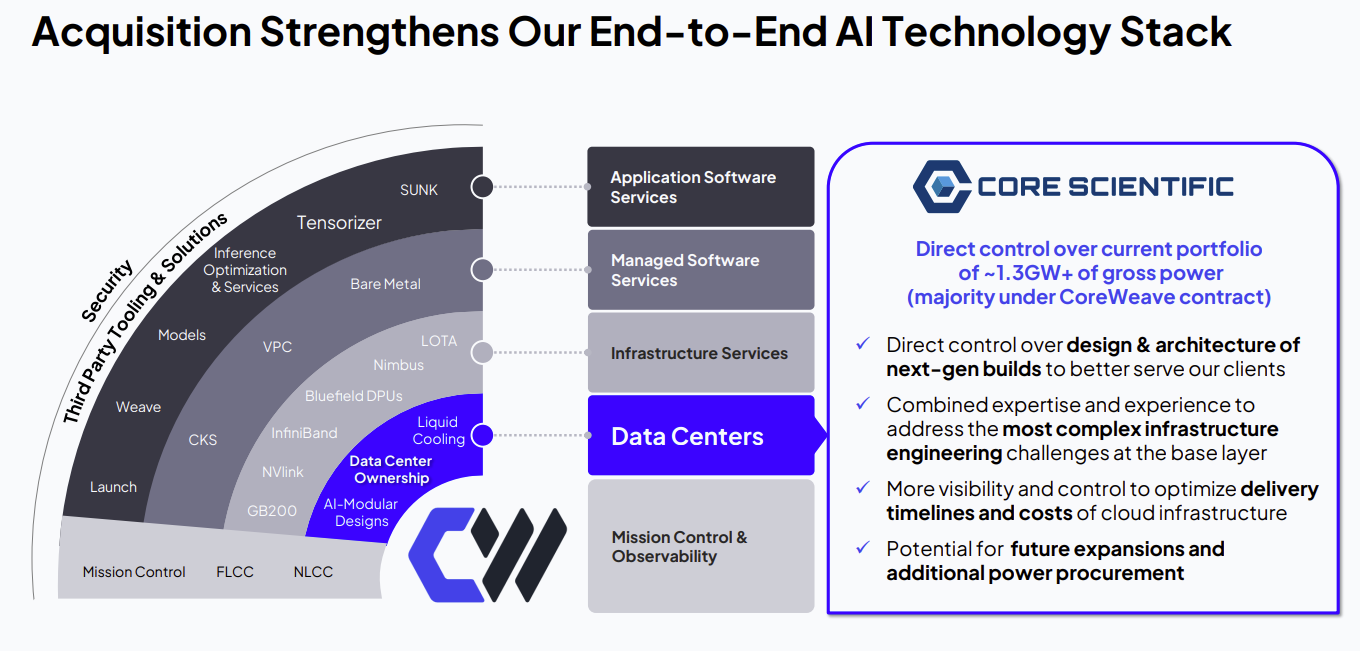
CoreWeave bought Core Scientific for $9 billion in stock. Is CoreWeave getting into bitcoin mining? Nope. CoreWeave depended on Core Scientific for data center capacity. By buying Core Scientific, CoreWeave gets to save on leases and control more of its stack.

Shares of CoreWeave have surged roughly 300% since going public three months ago. Michael Intrator, CEO of CoreWeave, was asked repeatedly by analysts why it had to buy Core Scientific when the existing partnership worked well.

"Owning Core Scientific's high performance data center infrastructure enables us to significantly enhance operating efficiencies and de-risk our future expansion. By controlling the foundational layer of our AI cloud platform, we will enhance the scale, performance and expertise we provide and our customers need to unleash the full potential of artificial intelligence," he said.

There's also a cost of capital issue. Intrator said consolidating Core Scientific allows it to more efficiently finance data centers and lower the cost of capital. "We think it is a pretty material step function in the efficiency of our balance sheet," said Intrator.

CoreWeave as of March 31 had $8.8 billion in debt with cash and equivalents of $1.3 billion.

AI talent free agency goes crazy

Is there anyone that Meta CEO Mark Zuckerberg won't hire? He's building his superintelligence dream team and I'd love to be a fly on the wall to see the ego class in those early meetings.

Super teams and supergroups sometimes work, but more often than not they fail. Management, teamwork and a common cause matter. Zuck has hired a bunch of mercenaries. And who can blame these AI folks for taking up to a reported $100 million in cash and stock? Bloomberg reported that Meta hired Ruoming Pang, who ran Apple's AI models team, with a deal valued at more than $200 million over several years.

OpenAI CEO Sam Altman has countered with its own hiring of AI engineers. Altman had said AI missionaries will top mercenaries on chasing superintelligence.

Anyone who's a big sports fan knows this drill. Pro teams pay out massive contracts to players and many turn out to be busts. This AI talent frenzy will be no different.

Everyday hardware becomes more valuable on AI dreams

And Zuckerberg isn't done. He's also reportedly buying a 5% stake in EssilorLuxottica, which owns Ray-Ban, Oakley and other brands to control distribution of glasses. Meta and EssilorLuxottica have a successful partnership for smart glasses.

Google has also partnered with Warby Parker. Meta obviously wanted to cut rivals off from partnering with EssilorLuxottica.

Watch what tech executives do, not say

Insider sales at tech companies have been picking up as executives cash out. Nvidia executives are selling and the transaction data for the last 60 days is littered with technology companies.

Barchart.com's tracking data for insider trading shows a lot of red. In fact, a spot check of insider buys appears to revolve around non-tech companies.

You can play around with the data, but there are multiple big insider sales at Atlassian, Nvidia, Dell, Rubrik and Oracle to name a few.

Vendors are busy counting demand well into the future

Oracle CEO Safra Catz told employees the company is off to a strong start in fiscal 2026 and the company signed multiple large cloud deals "including one that is expected to contribute more than $30 billion in annual revenue starting in FY28." OpenAI is reportedly Oracle's big contract.

Now that ability to predict future demand is awesome. Way to go Oracle! A cynic would note that a lot can change in two years. OpenAI is a juggernaut today, but who knows how it is positioned two years from now or whether it’ll be able to pay Oracle.

And while we're talking about future AI demand, there's also an agentic AI fatigue emerging among CxOs. Why? Vendors are talking up AI agents that don't quite work yet, promising ROI that's not there yet and raising prices. CxOs are skeptical, pushing back and about 30 seconds from being really pissed off.

Simply put, it's hard to value demand for technology vendors two years from now when CxOs don't have certainty for more than two weeks. Something has to give.

The view from Constellation Research chief distiller Estaban Kolsky

The CFO sentiment is paired with the board sentiment. A recent survey of board members by PwC found that nearly 40% of them are choosing a de-risking path (what I call a wait-and-see approach) for the first time in many years. Indeed, the number has never gone below 50% and is usually in the mid-60% range.

Among the many signals we monitor, board sentiment has been always the most bullish in a down-market (never waste a good crisis is a good mantra for boards to impose risk discipline on executives). When questioned on reasons for their bearish behavior, the number one word that arose is uncertainty. We live in a constant state of chaos, with myriad geo-political hotspots and economic instability. The lack of an explainable vision for the US role in global trade, the dichotomy between economic policies and tax-and-spend initiatives, and the declining consumer-sentiment all bring a thicker air of uncertainty to board discussions.

Leading indicators that had the economy returning to pre-pandemic levels and investment returning to enterprise technology before the year began have all turned negative.

Does this mean there are no opportunities?

Hardly, there has been no better moment for organizations to clean out the technology stacks and make plans for AI-enhanced, cloud-native ecosystems with optimization models implemented on private platforms. The investments in quantum mentioned above are an indicator, as well as investments in AI, enterprise architecture, and data.

Next worry area? Lack of talent – and Meta seems to be equally concerned about that. We will find a way out of that, hopefully without spending billions, soon. It’s going to be a very interesting summer, and a fast-and-furious Q3.

Data to Decisions Future of Work Next-Generation Customer Experience Tech Optimization Chief Executive Officer Chief Financial Officer Chief Information Officer

Why Apple should buy Perplexity and possibly keep going

Why Apple should buy Perplexity and possibly keep going

Apple needs to jump start its AI strategy and the only way it's going to get there is through acquisitions. Here's why a purchase of Perplexity makes sense and why Apple may want to keep shopping.

Bloomberg reported last month that Apple was discussing a purchase of the AI search startup

Let's look at why an Apple purchase of Perplexity, reportedly valued at about $14 billion or so, would make sense.

Apple needs an AI strategy and story. Let's state the obvious: Apple is an AI laggard. Apple's miss on AI is as bad as Microsoft's fail on mobile. I don't think Perplexity will be a magic AI elixir for Apple, but CEO Tim Cook needs a story. Dropping $20 billion on Perplexity is worth it just due to the market cap bump and storyline.

Apple can and should pay up for AI plays because it has to. Would Apple's acquisition of Perplexity be its largest ever? Sure, but Apple has a $3 trillion market cap. Apple bought Beats for about $3 billion in 2014 and had a market cap of roughly $600 million based on news reports at the time. Apple could take $100 billion and spread its bets. There's no shame in buying an AI strategy. If Salesforce can pay $27.7 billion for Slack in 2020, Apple can drop some dough on AI plays. Some will work and others won't.

Like any sports team trying to climb out of the basement, Apple needs to overpay for talent.

Perplexity is a media company that will need content licensing and advertising. If you use Perplexity Pro you get the feel that it's part LLM, part Google News, part search, part answer engine and service. I could see Perplexity folding into Apple News easily, leveraging the advertising business and becoming another $20 a month service to keep you in the ecosystem. Perplexity is even cooking up a browser.

And Apple has relationships with publishers that can keep Perplexity out of courts on a perpetually.

Apple needs an AI platform for developers. Yes, Apple has a devoted developer following but needs to hedge its bets and keep them interested. AI is that hedge. Perplexity would hopefully rev up the developer base.

The Google relationship with Apple may not last. One of the big arguments against the Apple purchase of Perplexity is that it would jeopardize search revenue from Google. First, those funds may not last in the future due to either regulation or competition. Besides, Apple and Google have been competitors and business partners for years.


Data to Decisions Next-Generation Customer Experience Innovation & Product-led Growth apple Chief Information Officer

HPE ups savings targets for Juniper Networks integration

HPE ups savings targets for Juniper Networks integration

HPE raised its savings target for the Juniper Networks acquisition, set its integration teams, said no customer will be left behind and provided the first installment of vision for the combined companies.

Antonio Neri, CEO of HPE, said on a conference call with Wall Street analysts that the integration of Juniper Networks is underway. HPE's networking business will be run by former Juniper Networks CEO Rami Rahim. HPE closed the Juniper Networks deal last week.

The company didn't outline revenue projections but said it will provide three-year guidance at its analyst meeting in October.

"HPE will offer a full stack solution for AI data centers at scale that spans high performing routers and switches, firewall servers, storage and services, with our data center and liquid cooling it and design expertise," said Neri. "We will simplify the deployment and management for AI training and inference."

For now, HPE is focused on the workstreams behind the integration of Juniper. In addition to Rahim running HPE Networking, Neri outlined the following:

  • Phil Mottram, who led HPE Aruba, will focus on growth in emerging markets.
  • John Schultz, Chief Operating and Legal Officer, will lead the integration of Juniper. He has been involved in the split of HPE and HP, the spinoff of HPE's software and enterprise services unit and GreenLake launch.

Neri said:

"Our first integration priority is to maintain continuity momentum across the traditional HP, Aruba and juniper networking businesses. We are fully committed to supporting the life cycle of existing products and protecting the investments our customers have made. No customer will be left behind. Our second priority is to thoughtfully converge our cloud product roadmaps and integrate our go-to-to-market coverage strategies. This will enable us to accelerate cross-selling and upselling across our combined portfolio. Over time, we will align our offerings around a single secure AI native and cloud native architecture."

HPE said it will realize at least $600 million in annual run rate savings over the next three years, up from the original projections of $450 million. A third of the savings will come in year one with the rest spread out evenly over the next two years.

Other key points from the update call:

  • Rahim said Juniper's second quarter finished strong with orders growing 40% from a year ago and revenue up 20%. Enterprise is becoming a strong market.
  • HPE plans to use its scale to leverage Juniper Networks' portfolio globally. HPE has a substantial international footprint.
  • HPE said its savings target was raised due to supply chain efficiencies. HPE's supply chain scale will help Juniper's cost of goods sold. AI and automation will also drive increased savings.
Data to Decisions Tech Optimization HPE Big Data Chief Information Officer Chief Technology Officer Chief Information Security Officer Chief Data Officer

AI150 interview: Dr. David Bray on the need for AI adaptability

AI150 interview: Dr. David Bray on the need for AI adaptability

Corporate boards need to build in structures and processes to adapt quickly to artificial intelligence and a rapid pace of change.

That's one takeaway from a conversation with Dr. David Bray, an AI150 member, principal of LeadDoAdapt Ventures and Distinguished Fellow with the Stimson Center.

Bray emphasized that adaptability is a competitive advantage in today's rapidly changing environment, and boards should focus on empowering their organizations to sense and respond quickly to changes rather than getting bogged down in tactical decisions.

Here are some of the highlights from our conversation:

Separate AI hype from reality. "What boards need to be thinking about is what are they trying to do as a company, and then what are the appropriate AI tools to help them get there," said Bray.

Boards need more agile planning cycles. "Boards need to be more nimble," said Bray. "I would say every four weeks, you need to be updating your plan because things are changing so rapidly."

Human-AI collaboration is essential. "What humans do is they help provide the context for what data and possibly AI as it helps analyze it are seeing," said Bray. "It's really this idea of collective intelligence."

Organizations need decision elasticity. Bray said: "Future organizations really are trying to turn to their humans and say, 'Look, there's so much going on. You can only be in so many places at once'... Let the AI be the alert when something changes."

Encourage diverse thinking. "I come from a world in the intelligence community that if we force everybody to think the same, we're actually doing a disservice to what we're supposed to be doing," said Bray.

Data to Decisions Chief Information Officer

Samsung lays out digital health plans with Xealth acquisition

Samsung lays out digital health plans with Xealth acquisition

Samsung launched its latest devices--Galaxy Z Fold7, Z Flip7 and Watch8 Series--but the more interesting development may be the company's big bet on digital healthcare via the acquisition of Xealth.

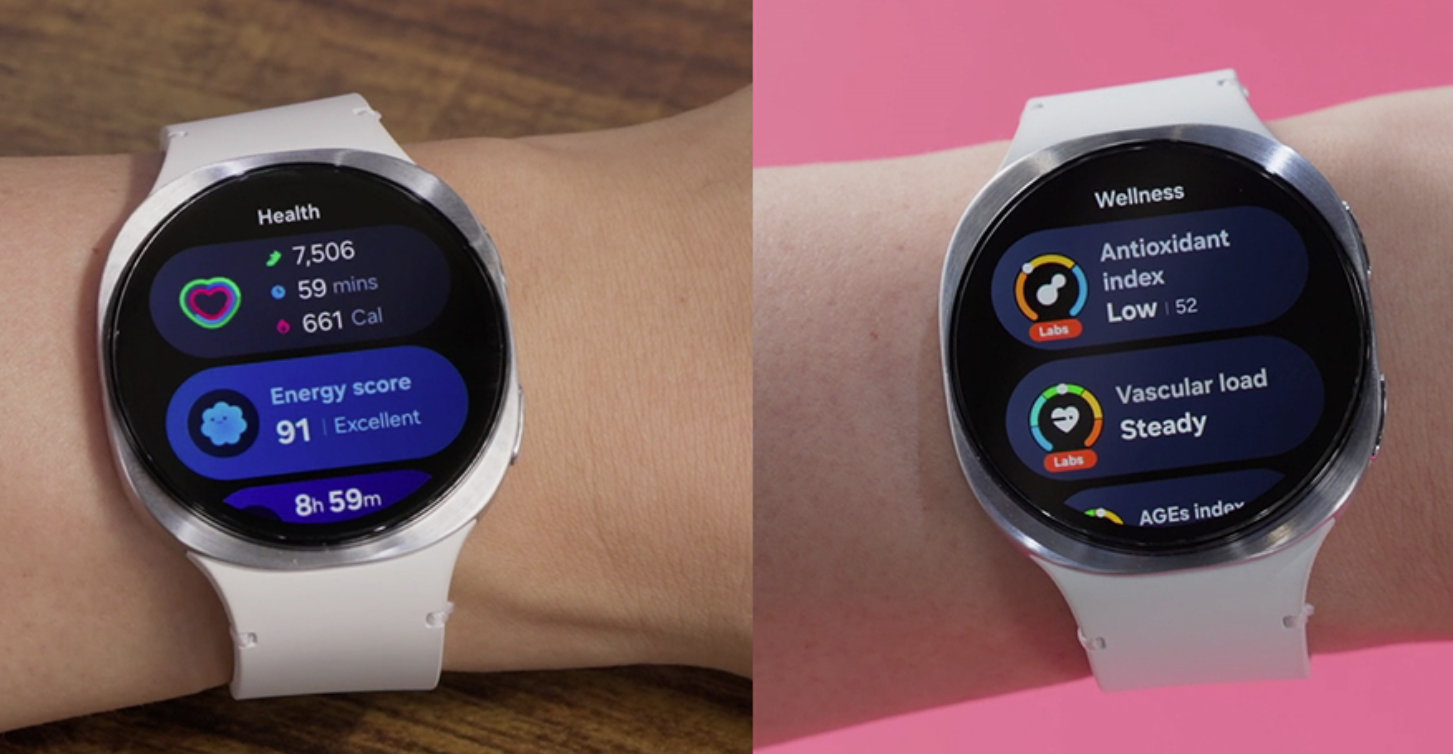
The company fleshed out its digital health plans during its Unpacked event. Not surprisingly, Samsung outlined its sensor technology and updates for Galaxy Watch8 that revolved around health.

Samsung outlined sleep experience features, a health coach, a feature called Vascular Load that monitors stress levels on your vascular system, and an Antioxidant Index, which measures carotenoid levels in five seconds. The upshot is Samsung is looking to create an ecosystem for Galaxy Watch8, Galaxy Ring and its devices.

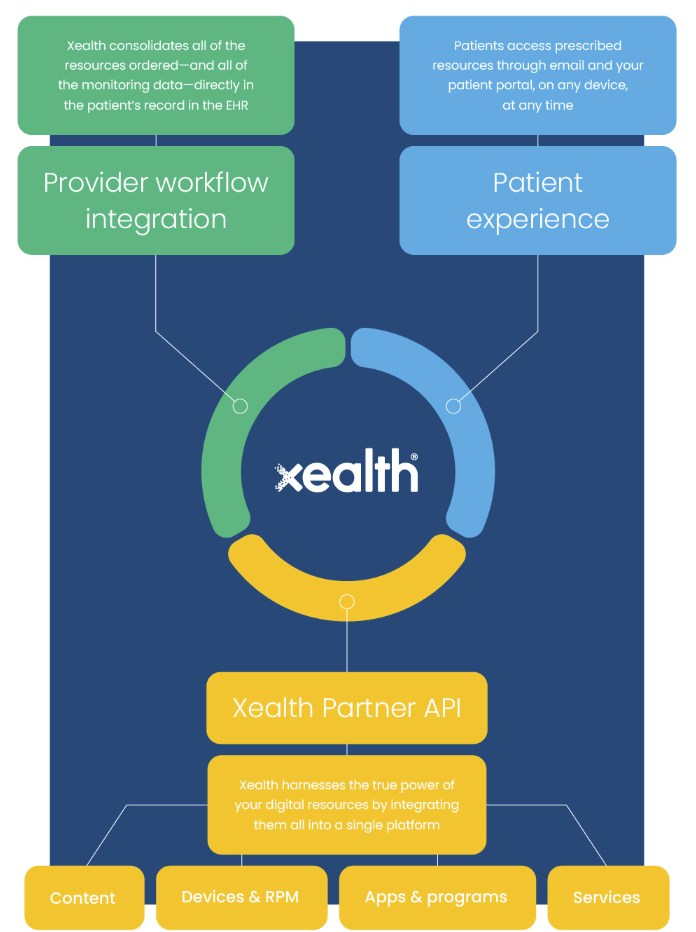
In Samsung's health strategy, the devices are collecting data, but without an ecosystem and integration the data doesn't count for much. That's where the acquisition of Xealth comes in. Xealth is a platform that combines healthcare workflows, patient experiences and an API that connects systems.

Xealth's platform includes the following interconnected modules:

  • Digital care management within the electronic health record.
  • Xealth digital command center, which has customized reporting and analytics of patient and provider engagement, activation and usage.
  • Xealth integration suite, which integrates multiple health systems with a clinical rules engine.

According to Samsung, the Xealth acquisition "will help advance Samsung’s transformation into a connected care platform." The general idea is to combine wellness, medical care and prevention to people via data. Samsung said it is looking to unify health information and connect with clinical records and physicians via Xealth, which is a spin-off of Providence health system.

TM Roh, President and Acting Head of the Device eXperience (DX) Division at Samsung Electronics, said Xealth and its expertise will "be an anchor to accelerate Samsung’s efforts to support health systems and digital health partners through a truly connected care."

Mike McSherry, CEO of Xealth, said at Samsung Unpacked that the combination of his company and the consumer electronics giant can simplify home health care. Xealth has more than 500 hospitals and 70 digital health vendors in its ecosystem.

"Together with Xealth, Samsung will be able to bring to reality a shared vision of connected care by simplifying it in two ways," said McSherry. "First, Samsung will bring the context of wellness data to help physicians make better decisions and monitor how patients are doing within their care workflows. And second, Samsung will make care more actionable and convenient like reminding you to take medications or remotely monitoring health conditions. We will meet people where they are and help them by making it easier to do the right thing."

The acquisition will put Samsung into an ecosystem that includes Xealth's investors including Advocate Health, Banner Health, Cleveland Clinic, MemorialCare Innovation Fund, Cerner, McKesson Ventures, Novartis, Philips, and ResMed as well as Providence Ventures and the Froedtert and Medical College of Wisconsin Health Network.

Data to Decisions Next-Generation Customer Experience Future of Work Innovation & Product-led Growth Tech Optimization AR Chief Information Officer

Apple names new chief operating officer, Williams to retire

Apple names new chief operating officer, Williams to retire

Apple said Jeff Williams, chief operating officer, will retire at the end of the year and Sabibh Khan, senior vice president of operations and architect of the company's supply chain, will take over this month.

Williams, who also oversees Apple design and Apple Watch, will continue to report to CEO Tim Cook before he retires at the end of the year. After Williams retires, Apple's design team will report directly to Cook.

As for the big picture, Williams was seen as a potential successor to Cook. Now John Temus, senior vice president of hardware engineering, is seen as a Cook successor.

In a statement, Cook said Williams helped create Apple's global supply chain, launched Apple Watch and oversaw its development and launched the company's health strategy.

Kahn becomes chief operating officer at an interesting time as Apple tries to expand its manufacturing footprint in the US and respond to a bevy of challenges due to geopolitics, tariffs and sustainability goals. Cook said Kahn, a 30-year Apple veteran, "has helped pioneer new technologies in advanced manufacturing, overseen the expansion of Apple’s manufacturing footprint in the United States, and helped ensure that Apple can be nimble in response to global challenges."

According to Apple, Kahn has been vice president of operations since 2019.

Concerns about executive turnover have been prominent in the last two years. Those concerns aren't likely to go away considering Meta has reportedly hired the head of Apple's foundation models team


Data to Decisions Next-Generation Customer Experience Tech Optimization Matrix Commerce Marketing Transformation Revenue & Growth Effectiveness apple Supply Chain Automation Cloud Digital Transformation Disruptive Technology Enterprise IT Enterprise Acceleration Enterprise Software IoT Blockchain ERP Leadership Collaboration M&A Chief Information Officer Chief Supply Chain Officer Chief Sustainability Officer Chief Experience Officer

Digital Asset Management: The Last Mile Of CX Delivery

Digital Asset Management: The Last Mile Of CX Delivery

Don't miss this CR #CX Convo! Liz Miller sits down with Adobe's Shelly Chiang to unpack the game-changing potential of modern Digital Asset Management (#DAM). 

Key Insights:
📌 DAM is no longer just a digital filing cabinet
📌 #AI is transforming how teams discover, use, and activate content
📌 Modern DAM breaks down silos across marketing, sales, HR, and global teams
📌 Intelligent search means finding the RIGHT asset in seconds, not hours

Looking to turn your content into a strategic advantage? This convo is a must-watch for #marketing leaders trying to scale creativity and drive efficiency.

Watch the full interview!

On CR Conversations <iframe width="560" height="315" src="https://www.youtube.com/embed/RjgUh4vrHk4?si=oHwHF7VbWLjZbB2O" title="YouTube video player" frameborder="0" allow="accelerometer; autoplay; clipboard-write; encrypted-media; gyroscope; picture-in-picture; web-share" referrerpolicy="strict-origin-when-cross-origin" allowfullscreen></iframe>

CFOs lose appetite for risk in Q2 amid economy worries, says Deloitte

CFOs lose appetite for risk in Q2 amid economy worries, says Deloitte

Chief financial officers are paring expectations for the economy, revenue, earnings and capital investments for the second quarter as they become more risk averse, according to Deloitte's latest CFO Signals report.

Deloitte's quarterly report showed that CFO sentiment fell in the second quarter as the CFO confidence score was 5.4, indicating medium confidence, down from 6.4 in the first quarter. The first quarter tally indicated high confidence among CFOs.

By the numbers:

  • 23% of CFOs rate the North American economy as good now. In the first quarter, half of CFOs said the North American economy was good.
  • 46% of CFOs said the US stock market was undervalued with 41% saying it was overvalued.
  • 53% of CFOs said debt financing was attractive.
  • One in three CFOs believe it's a good time to take on risk. That reading is the lowest since the third quarter of 2024 and well below the 60% of CFOs who thought the first quarter was a good time to take risk.

The top external and internal risks for CFOs were worth noting. CFOs were worried about the following external risks.

  • 53% of CFOs said the economy was top external risk.
  • 51% cited cybersecurity.
  • 43% said interest rates.
  • 42% supply chain disruptions.
  • 42% said inflation.
  • 37% said geopolitics followed by 32% who cited taxes.

The top internal risks included the following:

  • 46% of CFOs were worried about talent.
  • 46% were worried about lack of ability and resilience.
  • 45% cited cost management.
  • 43% cited efficiency and productivity.
  • 43% cited data compatibility and accessibility.
  • 43% cited technology deployment including AI.
  • 36% cited strategy execution.
Data to Decisions Tech Optimization Revenue & Growth Effectiveness New C-Suite business finance Chief Financial Officer

Ingram Micro confirms ransomware attack, eyes recovery

Ingram Micro confirms ransomware attack, eyes recovery

Ingram Micro, a large technology distributor, said the company has been hit with a ransomware attack that took down its systems.

The press release confirms reports from BleepingComputer as well as comments on Reddit about the outage. Ingram Micro systems have been down since Thursday. The company said Tuesday that it has been restoring systems, but is taking orders via phone and email in many cases.

In a statement, Ingram Micro said:

"Ingram Micro recently identified ransomware on certain of its internal systems. Promptly after learning of the issue, the Company took steps to secure the relevant environment, including proactively taking certain systems offline and implementing other mitigation measures. The Company also launched an investigation with the assistance of leading cybersecurity experts and notified law enforcement.

Ingram Micro is working diligently to restore the affected systems so that it can process and ship orders, and the Company apologizes for any disruption this issue is causing its customers, vendor partners, and others."

According to BleepingComputer, Ingram Micro was hit by the SafePay ranswomware attack.

On July 7, Ingram Micro had posted an update. Ingram Micro said it has made progress restoring systems, but is using its unified support organization to fulfill orders. The company said:

"Today, we made important progress on restoring our transactional business. Subscription orders, including renewals and modifications, are available globally and are being processed centrally via Ingram Micro’s support organization. Additionally, we are now able to process orders received by phone or email from the UK, Germany, France, Italy, Spain, Brazil, India, China, Portugal and Nordics. Some limitations still exist with hardware and other technology orders, which will be clarified as orders are placed. To place subscription orders, customers should contact Unified Support. For general inquiries, customers should contact their sales representative."

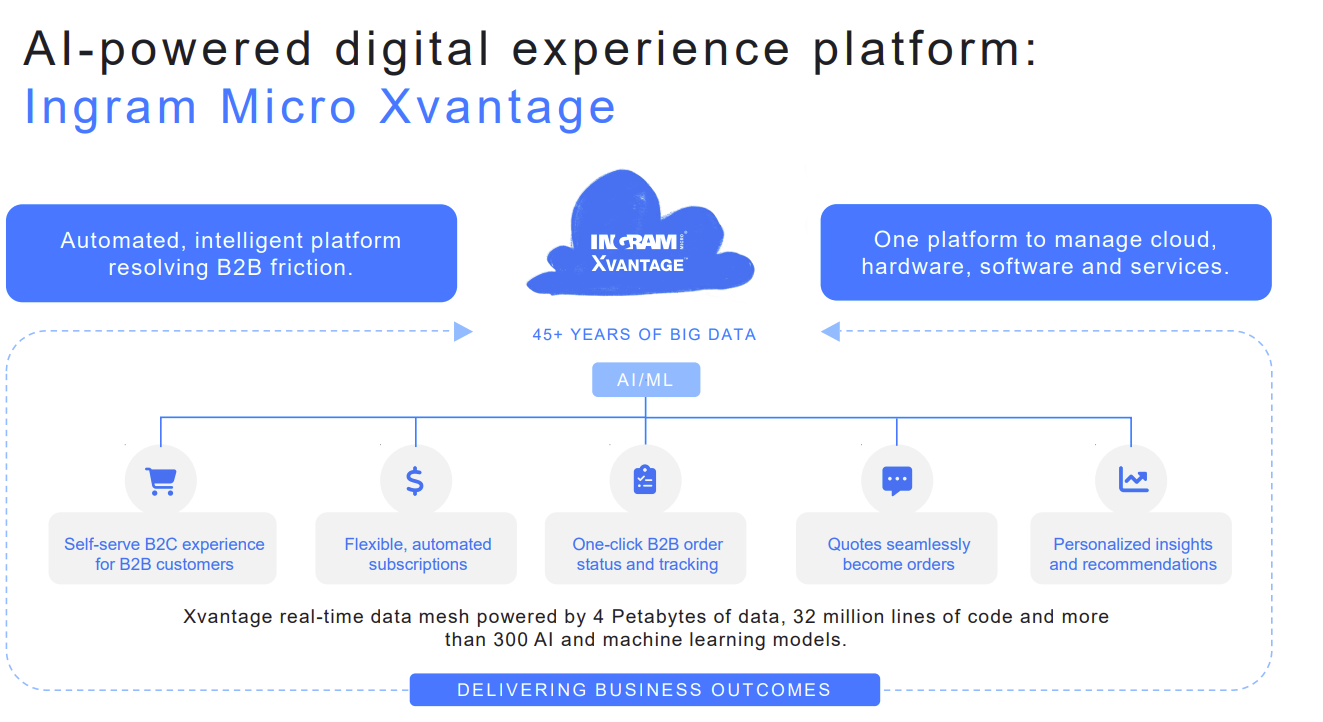
Ingram Micro didn't detail what systems have been impacted, but the company's recently announced Xvantage distribution platform is reportedly one of them. Ingram Micro had scheduled a preview of Xvantage components for July 17.

Xvantage was launched in 2022 and now uses AI to automate quote creation, order management and real-time tracking.

The thing to watch now is whether Ingram Micro pays the ransom to get its systems back or continues to take a sales hit. Ingram Micro's outage occurred before a long July 4th holiday weekend when business was likely to be slow. Each day Ingram Micro is down, there will be a sales hit. Ingram Micro will also have to detail costs associated with the attack.

Based on Ingram Micro's first quarter sales of $12.28 billion, the company stands to lose more than $136 million in sales for each day it can't fulfill orders. For instance, Clorox had to issue a profit warning due to a cyberattack and saw sales decline more than 20%.


Digital Safety, Privacy & Cybersecurity I am Team Leader at the Nominee Organization (no vendor self nominations) Distillation Aftershots Security Zero Trust Chief Information Officer Chief Information Security Officer Chief Privacy Officer