Results

Accenture reshuffles exec deck as Q3 new bookings light

Accenture reshuffles exec deck as Q3 new bookings light

Accenture launched Reinvention Services, a business unit that will bring together its AI assets in one integrated unit. Manish Sharma, Accenture's CEO of the Americas, will become chief services officer.

The launch of a new services unit comes after the company reported better-than-expected fiscal third quarter earnings but showed a decline in bookings.

In addition to Sharma's role change, Accenture said John Walsh, chief operating officer, will become CEOs of the Americas. Kate Hogan, current chief operating officer of the Americas, will take on that same role for all of Accenture. Karthik Narain, Group Chief Executive and Chief Technology Officer, is leaving to "pursue other opportunities."

Accenture CEO Julie Sweet said Reinvention Services will be able to move faster, deliver AI-enabled assets and platforms and embed data and AI in services delivery. The new organizational structure launches Sept. 1.

Other executives in the Accenture reshuffle include:

  • Jason Dess, current lead of CFO and enterprise value, will become group chief executive of consulting. Dess succeeds Jack Azagury, who is leaving Accenture.
  • Song will be led by Ndidi Oteh, who is the lead exec for Song in the Americas.
  • Rajendra Prasad, currently Accenture’s chief information and asset engineering officer, will succeed Narain. Accenture's Karthik Narain on human, AI collaboration, trust
  • Kate Clifford, currently chief HR officer of the Americas, will become global chief leadership and HR officer and succeed Angela Beatty, who is also leaving the company.

Accenture reported third quarter earnings of $3.49 a share on revenue of $17.7 billion, up 8% from a year ago. Generative AI new bookings were $1.5 billion. However, new bookings of $19.7 billion were down 6% from a year ago. In the second quarter, Accenture noted customers were becoming more cautious about projects.
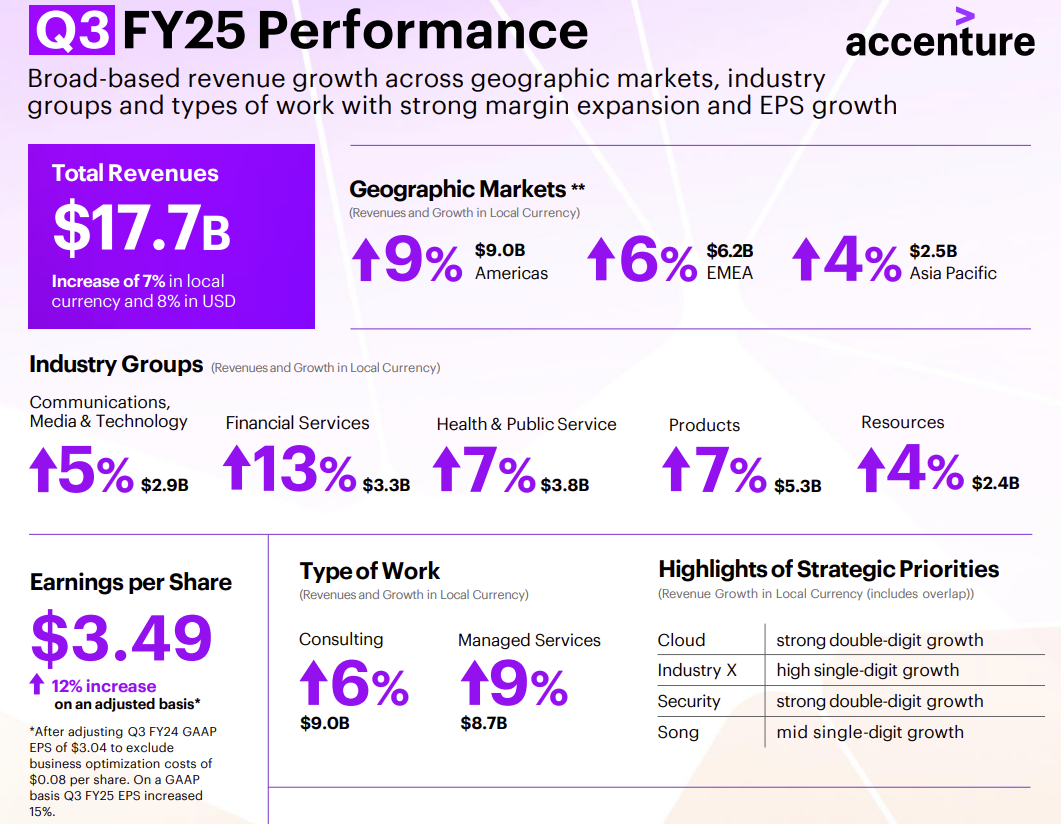
As for the outlook, Accenture said it now expects fiscal 2025 revenue growth of 6% to 7% with earnings of $12.77 a share to $12.89 a share. Fourth quarter revenue will be between $17 billion and $17.6 billion.

Sweet said Accenture had 30 clients in the quarter with bookings topping $100 million. Accenture saw solid growth across its core industries with financial services revenue up 13%.

On a conference call with analysts, Sweet said:

  • "We continue to see a significantly elevated level of uncertainty in the global economic and geopolitical environment as compared to calendar year 2024. In every boardroom and every industry, our clients are not facing a single challenge. They are facing everything at once, economic volatility, geopolitical complexity, major shifts in customer behavior."
  • "We have leaders who leave Accenture and pursue other opportunities. Our leaders are in demand, as you might imagine. And we have a deep bench of leaders."
  • "The GenAI demand continues to be very, very strong. And now it's getting big enough that it's going to fluctuate a little bit. But you'll see GenAI is just being more and more embedded into everything we do."

New C-Suite Data to Decisions Next-Generation Customer Experience accenture Chief Information Officer

Microsoft advances quantum computing error correction, sees on-premise traction

Microsoft advances quantum computing error correction, sees on-premise traction

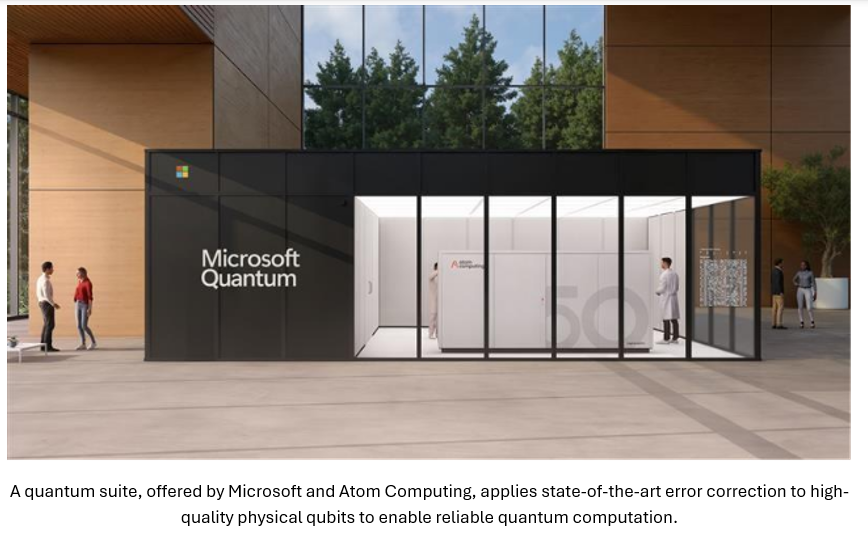
Microsoft said it has developed quantum computing error-correction codes that can create a 1,000-fold reduction in error rates. The company also said it is landing on-premise interest for its Microsoft Quantum compute platform, a collaboration between Microsoft and Atom Computing.

The company said its four-dimensional geometric codes require few physical qubits per logical qubit and can check for errors in a single shot. Error correction is a huge topic in quantum computing and companies are using physical qubits with high fidelities and applying error correction codes to solve problems.

With Atom Computing, Microsoft created and entangled 24 reliable logical qubits. Microsoft used its qubit-virtualization system combined with Atom Computing's neutral atoms. Matt Zanner, Senior Director of Microsoft Quantum, said Atom Computing's neutral atom approach means it can adjust to error correction advances quickly.

Microsoft said that its family of 4D geometric codes are suitable for qubits with neutral atoms, ion traps and photonics. These 4D geometric codes require fewer physical qubits to make each logical qubit, have fast clock speeds and improve the performance of quantum hardware.

The error-correction codes, available in Microsoft Quantum compute platform, will enable the system to deliver 50 logical qubits in the near term and scale to thousands later.

According to Microsoft, its Microsoft Quantum compute platform will include error correction, cloud high performance computing, AI models and the company's science platform, Microsoft Discovery. The system has hardware, software and access to experts to refine quantum computing use cases.

Constellation ShortList™ Quantum Computing Platforms | Quantum Computing Software Platforms | Quantum Full Stack Players

For its part, Atom Computing is offering the hardware in the Microsoft Quantum compute platform. Atom Computing's approach can scale and work in tight spaces. Zanner also said that error correction codes will be tuned to Atom Computing's hardware.

Zanner said the Microsoft Quantum compute platform is a full stack offering with a Copilot interface and it has been seeing interest for on-premises deployments.

"The interest in Microsoft Quantum compute platform ranges from national quantum programs such as countries or groups of countries that want to be local hubs in region," said Zanner. "Academia is also interested and it's about creating quantum jobs. We're also seeing use cases from individual companies or consortiums to align quantum computing around a specific domain."

Zanner said there is still plenty of interest in quantum computing via the cloud, but he has been surprised by the on-premises approach. "We said we were ready to do a commercial offering and we had a bunch of customer conversations to validate it. And now we're in active conversations with several customers that are interested in pursuing it commercially," said Zanner.

He added that there are perks to having an on-premises quantum computer in that you can do tours with dignitaries and advance collaboration with academics and governments. "There's quantifiable value having a physical demonstration of quantum computing," said Zander.

Recent developments:


Data to Decisions Tech Optimization Innovation & Product-led Growth Microsoft Quantum Computing Chief Information Officer

What genAI, cognitive debt will mean for enterprises and future workforce

What genAI, cognitive debt will mean for enterprises and future workforce

Generative AI has been seen as a boon for productivity, but it may not be making the workforce any smarter. In fact, enterprises may want to start thinking about cognitive debt from AI usage and a thin bench of critical thinkers.

A study (abstract) from a team at MIT looked at 54 participants using OpenAI's ChatGPT for essays. The participants were divided into brain-only users, search engine users and large language model (LLM) users. The study then used electroencephalography (EEG) to assess cognitive load during essay writing and scored the essays.

The punchline:

"Self-reported ownership of essays was the lowest in the LLM group and the highest in the Brain-only group. LLM users also struggled to accurately quote their own work. While LLMs offer immediate convenience, our findings highlight potential cognitive costs. Over four months, LLM users consistently underperformed at neural, linguistic, and behavioral levels. These results raise concerns about the long-term educational implications of LLM reliance and underscore the need for deeper inquiry into AI's role in learning."

Apply this to the workforce and there are multiple threads to ponder:

  • This study was focused on students and those folks will become your managers and executives in the future. If you hollow out critical thinking with AI then you'll have a bunch of know-nothings in the future. You may be trading productivity today for dumbasses in the future. 
  • Executives are telling employees to get on the AI bandwagon and leverage new ways to work. What happens if you introduce cognitive debt to employees with strong critical thinking and institutional knowledge.
  • Generative AI (and the AI agents that will follow) is going to hollow out the bench of employees. It's already a tough hiring season for university graduates as AI eliminates entry level jobs. How will those employees develop in the future?
  • Tests used for hiring should be AI free given the ease of spinning up minimal viable products, essays and code.
  • If you're a worker, know how to leverage AI but don't lean on it too much. Using tools is a balancing act. Think about GPS, which has led to a generation (maybe two generations) that can't read a map. Reading a map old school is still a good brain workout. You may have to go out of your way to exercise your brain just like you do for muscles when you go to a gym.
  • Keep context in mind. AI is no different than smartphones or any other technology. You'll have folks on one side saying the end of society is here. And you'll have optimists telling you a new technology will solve all of your problems. The truth is in the middle.
Data to Decisions Future of Work Next-Generation Customer Experience Innovation & Product-led Growth New C-Suite Tech Optimization Chief People Officer Chief Information Officer Chief Experience Officer

Data Lakes, AI Agents, and Enterprise Transformation | CRTV Episode 107

Data Lakes, AI Agents, and Enterprise Transformation | CRTV Episode 107

In the latest episode of ContellationTV, co-host analysts Holger Mueller and Liz Miller kick off by covering #enterprise tech news. Their analysis includes 1) the #agenticAI frameworks race heating up, vendors' competition on #data integration and developer velocity, and #Oracle's capex investments signaling tech transformation.

Next, Liz sits down with Pegasystems' product marketing leader Tara DeZao, for a CR #CX Convo at PegaWorld 2025. A few key takeaways from their convo include:

- Marketers learning to partner with #AI, not fear it
- AI as a collaborative tool for content creation
- Focusing on customer journey optimization
- Breaking down organizational silos through intelligent workflows

Finally, Holger interviews Miran Badzak and Edward Calvesbert from IBM about the launch of Watsonx.data, a hybrid lakehouse supporting structured and unstructured data. They share how IBM's Db2 introduces vector embedding and similarity search capabilities. Other topics include:

- AI-powered database management tools
- #Quantum computing roadmap taking shape

Watch the full episode to learn about the future of enterprise #technology! 
__

00:00 - Introduction
00:45 - Enterprise Tech News
17:17 - CX Convo with Tara DeZao, Pegasystems
28:42 - Interview with Miran Badzak and Edward Calvesbert

On ConstellationTV <iframe width="560" height="315" src="https://www.youtube.com/embed/MbigkpWoPzI?si=AyZUx_yF8m8hqQD2" title="YouTube video player" frameborder="0" allow="accelerometer; autoplay; clipboard-write; encrypted-media; gyroscope; picture-in-picture; web-share" referrerpolicy="strict-origin-when-cross-origin" allowfullscreen></iframe>

OpenAI vs. Microsoft: Why a breakup could be good

OpenAI vs. Microsoft: Why a breakup could be good

OpenAI and Microsoft are going to be rivals as the companies increasingly appear to be tilting away from the frenemy and partner model that has paid off so well for both companies.

A year ago, we riffed on the growing debate about whether OpenAI and Microsoft were symbiotic or becoming frenemies. Based recent news, it appears the two companies may be blowing right past frenemies to become rivals.

Here's a recap of what has transpired in recent days:

  • The Financial Times reported that Microsoft was prepared to walk away from OpenAI talks if they can’t agree on critical issues. Microsoft has access to OpenAI’s technology until 2030.
  • The Wall Street Journal reported that OpenAI and Microsoft tensions are boiling over. OpenAI wants to lesson Microsoft's distribution power over its AI portfolio and get buy-in on a plan to convert from a non-profit and go public.
  • OpenAI CEO Sam Altman is chasing superintelligence--much to Mark Zuckerberg and Meta's chagrin--and needs more compute. Reuters reported that OpenAI was even in talks with Google Cloud for capacity. OpenAI already leverages Oracle Cloud Infrastructure and Microsoft Azure, which used to exclusively provide infrastructure to the LLM giant.
  • OpenAI's enterprise business is surging as companies buy direct for LLMs and AI agents, said Altman at Snowflake Summit 2025. OpenAI recently landed a deal with Mattel and has launched OpenAI for Government. Those two efforts were just the latest in a long line of enterprise deals with Lowe's, Booking.com and Wayfair.
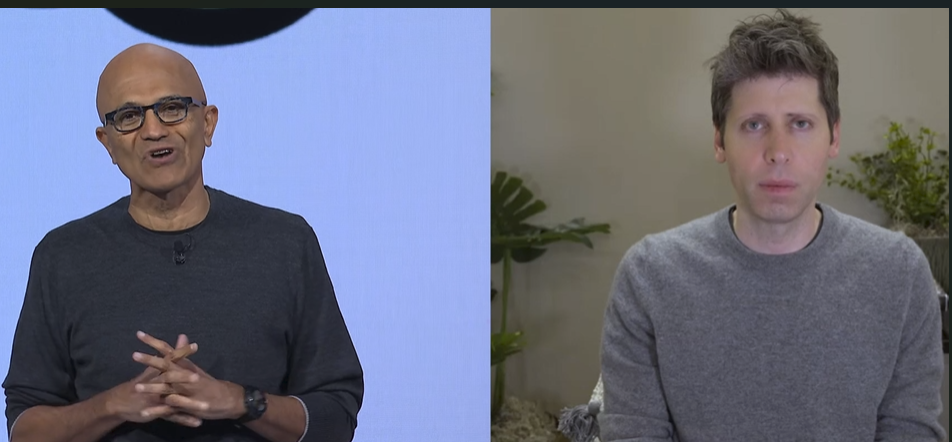
  • The body language between a video interview between Microsoft CEO Satya Nadella and Altman at Build was uncomfortable. For its part, Microsoft has been developing its own models to lessen its dependence on OpenAI. It wouldn't be the least bit surprising to see Copilot get a model transplant.

Individually, these headlines don't necessarily mean that OpenAI and Microsoft are veering to a messy divorce. And even if the breakup is messy both companies have raked in dough and will pocket billions of dollars. The two companies are the best technology partnership ever.

A few thoughts:

  • In the long run, Microsoft diversifying its models available on its platform is critical. Microsoft Azure AI Foundry has more than 1,900 models, but is still associated with OpenAI.
  • From the OpenAI perspective, a glidepath away from Microsoft makes sense. The companies will compete for enterprises, agentic AI dominance and industry services. And lesser businesses such as search will feature OpenAI vs. Microsoft too.
  • Enterprise buyers will benefit from a breakup too. I use both OpenAI ChatGPT and Microsoft Copilot (as well as Grok, Google Gemini and Anthropic Claude) and the Microsoft-OpenAI partnership remind me of Samsung and Android. The former puts layers on top of the original and gums up the experience.

Holger Mueller, an analyst at Constellation Research, said:

"Nothing lasts forever, and that applies as well to the special relationship between OpenAI and Microsoft. Apparently, Microsoft doesn't want to spend the capital to run OpenAI exclusively. Sam Altman has been looking for alternative sources to pay for the capacity needed for open AI to run its ever more hungry models. And it looks like Oracle is going to get a chunk of that business. In the meantime, Microsoft is betting on its new in-house chip  architecture. Time will tell if this was a premature breakup or not."

Data to Decisions Future of Work Next-Generation Customer Experience Innovation & Product-led Growth Tech Optimization Digital Safety, Privacy & Cybersecurity openai Microsoft ML Machine Learning LLMs Agentic AI Generative AI Robotics AI Analytics Automation Quantum Computing Cloud Digital Transformation Disruptive Technology Enterprise IT Enterprise Acceleration Enterprise Software Next Gen Apps IoT Blockchain Leadership VR Chief Information Officer Chief Executive Officer Chief Technology Officer Chief AI Officer Chief Data Officer Chief Analytics Officer Chief Information Security Officer Chief Product Officer

DataBricks Data & AI Summit Key Takeaways

DataBricks Data & AI Summit Key Takeaways

Constellation Analysts Holger Mueller and Michael Ni share insights, predictions, and more from Databricks' recent Data & AI Summit.

Data to Decisions Future of Work Innovation & Product-led Growth New C-Suite Tech Optimization Chief Information Officer Chief Digital Officer Chief Analytics Officer Chief Data Officer Chief Technology Officer Chief Product Officer On ConstellationTV <iframe width="560" height="315" src="https://www.youtube.com/embed/YFv0JwUnyoo?si=ropMhMHZI450Q5Uu" title="YouTube video player" frameborder="0" allow="accelerometer; autoplay; clipboard-write; encrypted-media; gyroscope; picture-in-picture; web-share" referrerpolicy="strict-origin-when-cross-origin" allowfullscreen></iframe>

AWS re:Inforce 2025: Takeaways from the Amazon, AWS CISOs

AWS re:Inforce 2025: Takeaways from the Amazon, AWS CISOs

Amazon Web Services is using its Nova models for tailored use cases including cybersecurity. Other takeaways from a chat with Amazon and AWS chief information security offers included the combination of physical and cybersecurity and how humans and AI code differently.

AWS recently launched Amazon Nova Premier, its most capable LLM. AWS launched Nova models last year and has been courting developers.

Eric Brandwine, VP and Distinguished Engineer at Amazon, said:

"We are very proud of the work that we've done with Nova, and we are absolutely using it internally. One of the things that we can do because we have this AI organization, is fine tune the model for different use cases, and so we've been able to come up with Nova variants that are tuned to specific security workloads, and that has shown significant dividends."

At AWS re:Inforce 2025 during an analyst Q&A, Brandwine was speaking on a panel with AWS CISO Amy Herzog and Amazon CISO CJ Moses. At Amazon, security chiefs rotate among units. For instance, Moses and Herzog swapped roles.

Herzog said Nova is an example of Amazon building tools and building blocks. Models are no different. "Choice is so deeply ingrained that it might not be top of mind to talk about one versus the other," said Herzog. "You have a job and there are a bunch of different models that you could choose from for that job. You pick the best one."

Other topics:

Physical security. Moses said physical security falls under him as CISO. "We did it for the reasons of making sure that we have the best visibility across all of those areas," said Moses. "A piece of information about a workplace incident will become the information that we need to stack on to other things to determine where we have a scrambled employee that potentially could become an insider."

Areas of non-obvious data connections that may prove out include cybersecurity and freight intelligence from an incident in a building. "We actually use the data, because the worst thing you can do is have intelligence and not actually act on it," said Moses. "And the whole idea for us is to make sure we're not siloed with that data, and secondarily, that we're able to act on it."

AWS is AWS' largest security customer. Security is required just to run a cloud. "The amount that you invest in security to secure an online retailer is very different from what you invest to secure a cloud. And so we've got all of these smart, clever people. They're operating with different constraints. They have different creative ideas, and we get to go reap them all and apply them across the company," said Moses.

Security's different lens. Herzog said security is a prerequisite and you can't get carried away with new technologies that may hurt your cybersecurity posture.

Herzog said:

"If developer productivity goes up by this amount and we need to keep pace with it, what does that without lowering the security bar? What does that look like? What ideas do you have? Recognize the changes that are happening, but then really keep the outcomes that we want to achieve--protecting our customers at speed and at scale."

Solving problems never ends. Brandwine said that internally AWS talks about the security ratchet. "It always gets tighter," he said. "It's a travesty to spend time solving a problem we've already solved before, or relearning an old lesson. So we have this deep investment in automation, automated reasoning, in using existing techniques and new techniques. We reason about our services. We say this will always be true, and then we make the machine make that always true, so we can spend our time on the new things. When you solve a problem, you're not free. You just go work on the next problem."

Why AWS and Amazon don't talk about security more in public. "If you're bringing things up to customers that they can't act on or do anything about directly themselves, you're essentially fear mongering," said Moses. "We don't believe on unnecessarily worrying our customers, especially when those things are things that are within our control. The industry itself does a good enough job on (fearmongering) that we don't need to add to the flames. We'd rather be the ones that are putting the flames out."

AI security is just security. Herzog said, "you can't just separate genAI from the rest of the conversation." "The playbook is the same as always. What are you trying to accomplish?," said Herzog. "There are definitely technical challenges that we are starting to get ahead where we might be in a few years. But I think that's a different conversation."

Brandwine said:

"There are absolutely interesting novel attacks against LLMs, and some of these have been applied to commercially deployed services. But the vast majority of LLM problems that have been reported are just traditional security problems with LLM products. You've got to get the fundamentals right. You've got to pay attention to traditional deterministic security."

Secure code and AI vs. human. Brandwine said Amazon has multiple checks on AI-generated code. One thing to watch is AI and humans write code differently. "We're getting significant success internally, but what we're finding is that the way that the human would write the code is not necessarily the way that the model would write the code. And if you want the model to evolve the code, you might want to structure it a bit differently," said Brandwine.

Data to Decisions Digital Safety, Privacy & Cybersecurity Innovation & Product-led Growth Future of Work Tech Optimization Next-Generation Customer Experience AI GenerativeAI ML Machine Learning LLMs Agentic AI Analytics Automation Disruptive Technology cybersecurity Chief Information Officer Chief Information Security Officer Chief Privacy Officer Chief AI Officer Chief Experience Officer

AWS re:Inforce 2025: How customers are using AWS security building blocks

AWS re:Inforce 2025: How customers are using AWS security building blocks

For Amazon Web Services customers, the continuum between security services and the rest of the cloud vendor's portfolio covering storage, data, AI and compute tends to blend together.

The primary takeaway from re:Inforce 2025 is that AWS isn't trying to make money in security. Yes, AWS has security products like GuardDuty, Inspector and SecurityHub sold separately, but a lot of AWS security additions are built into existing services.

What's clear is that AWS has a lot of visibility into its platform data and can handle emerging threats with AI. Whether security innovation turns into a separate product or handy feature in an existing service, say Amazon Bedrock, falls into the to-be-determined category.

These customer vignettes from AWS re:Inforce highlight the cloud provider's security strategy that is more about providing building blocks where security is built-in, but not necessarily the main show.

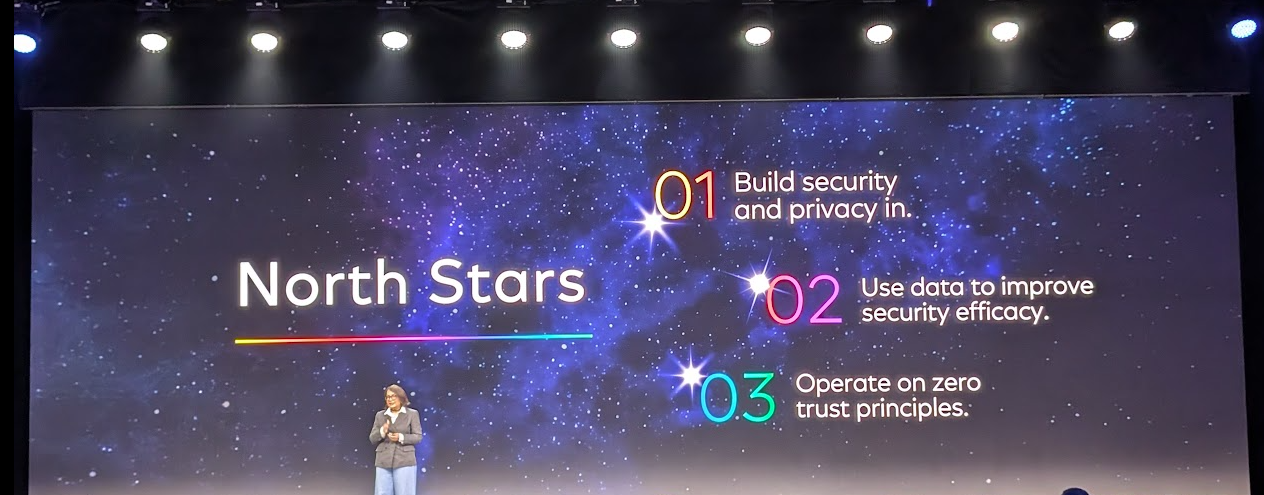
Comcast: Three North Stars

Noopur Davis, Comcast's Global CISO, Chief Product Privacy Officer, said the company has been an AWS customer for six years. Comcast has adopted AWS frameworks and used the cloud provider's building blocks to enable its developers build in cybersecurity throughout the software development lifecycle.

"We take a long-term view of security. Our first North Star is privacy, followed by data security and operate on zero trust," said Davis, who oversees a team of 2,000 cybersecurity pros.

Davis added that Comcast began integrating generative AI in April 2023 and had to develop frameworks for models, the data feeding models and guardrails.

Comcast has developed an AI workbench that will build in security across the software development lifecycle. According to Davis, security and data practices are comingled and part of a broader transformation effort.

Davis outlined the following security projects:

  • The company is using AI and its data for threat modeling, pen testing and code remediation.
  • Comcast is integrating security into its development workbenches.
  • AI bots are used for governance, regulatory and compliance processes.
  • Comcast has developed on AI-enabled risk engine across its platform.

For Comcast, using AWS for data pipelines and modeling has improved the company's ability to use AI for cybersecurity.

Comcast is a partner and as well as a customer. At re:Invent 2024, the cable giant said it was shifting its 5G wireless core services to AWS. In 2023, Comcast took its internally developed cybersecurity data fabric commercial with AWS and Snowflake via a product called DataBee.

DataBee, which uses AWS compute and storage, was the first product from Comcast Technology Solutions new cybersecurity division formed in 2022.

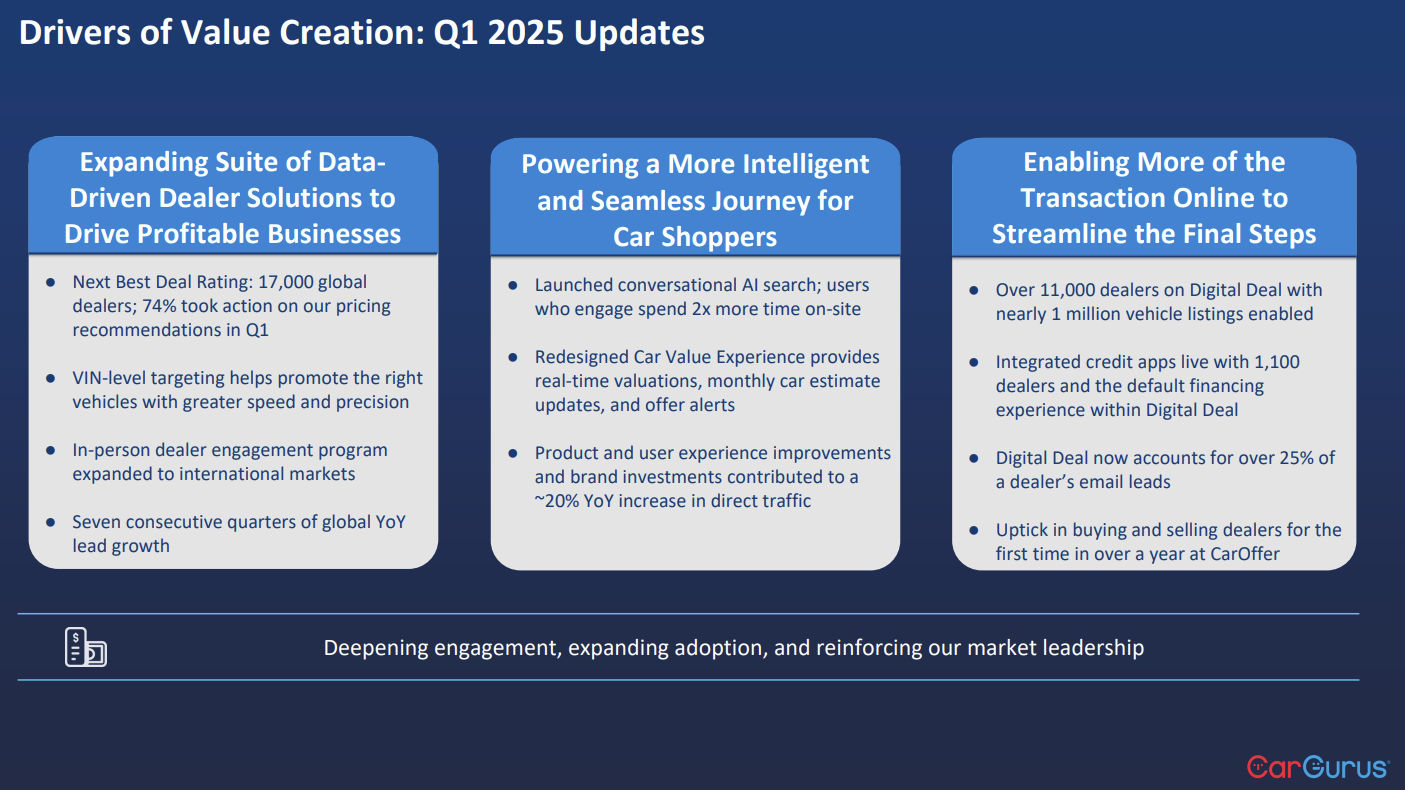
CarGurus: Data protection, data lineage, AI governance

Kelly Haydu, VP Information Security, Technology & Enterprise Applications at CarGurus, said the auto marketplace is powered by data. "Data is the fabric of a company," said Haydu, who added that securing that data requires understanding data flows incoming and outgoing.

CarGurus was an early adopter of generative AI and began incorporating the technology two-and-a-half years ago. As a result, CarGurus had to develop AI risk management and governance strategies early.

In 2022, CarGurus moved to AWS as the preferred cloud provider. To secure data, CarGurus relies on Cyera, a startup focused on data protection. CarGurus has also created a bevy of security frameworks including some that evaluate emerging technologies as markets change.

Haydu said:

"We have a great handle on our data today, but as AI starts to come on more and more I need to know when the piece of technology is introduced. When the machines are talking to the machines and the agents are talking to the agents, we needed to have an automated way to understand the data sources from inception to at rest in our databases, and that's called data lineage. Understanding the life cycle of that data will continue to be important as more data comes into our ecosystem in the upcoming years."

Going forward, CarGurus will continue to evolve as the company expects to ingest more data and leverage AI and automation as it scales. Haydu said data security has four evolving categories:

  • AI and automation. "What we're going to see in the future is more dynamic, real-time analysis of the data coming in from platforms," said Haydu. "It's going to be about contextual analysis with machines versus having a scan that has to happen."
  • Integration across data fabrics.
  • Risk management. Haydu said risk management is going to focus on individuals and their access, environments with data sensitivity.
  • Zero trust architecture, which will be adopted into platforms.

Santander: Addressing risk, security frameworks, regulators

Jamie Nash, Head of Technology and Operations Risk at Santander, implemented a digital banking platform called Open Bank in 18 months with AWS and Deloitte.

She said it's critical to have a security framework that can be shared with regulators. Nash added that data sovereignty remains a big concerns for financial institutions.

Nash said Santander used AWS Risk and Compliance Navigator Framework as the primary blueprint. Santander had an existing risk framework that was adapted for cloud computing with the help of AWS and Deloitte. The move took traditional banking security controls to cloud equivalents.

Santander addressed data sovereignty by doing the following:

  • Keeping all customer data within the US.
  • Architecting Open Bank so it could maintain compliance.
  • Keeping existing customer reference data on-prem instead of moving to the cloud.
  • Open Bank was focused on new customers to avoid data migration issues.
  • As for regulators, Nash said Santander was in early communication about open bank to speed up approvals.

"The biggest concern was the regulatory component and it was the most daunting aspect, because we are obviously very highly regulated," said Nash. "We don't see a lot of banks moving their full tech stack in the cloud in one fell swoop. We had to explain and educate our regulators."

Data to Decisions Digital Safety, Privacy & Cybersecurity Innovation & Product-led Growth Future of Work Tech Optimization Next-Generation Customer Experience AI GenerativeAI ML Machine Learning LLMs Agentic AI Analytics Automation Disruptive Technology cybersecurity Chief Information Officer Chief Information Security Officer Chief Privacy Officer Chief AI Officer Chief Experience Officer

Salesforce raises prices across multiple products including Slack

Salesforce raises prices across multiple products including Slack

Salesforce has raised prices across multiple products as it continues to hone pricing for AI and Agentforce.

In a post, Salesforce outlined the moving pricing parts. The latest changes come after the recent launch of Flex Credits, a consumption-based model, along with flexible Agentforce pricing.

According to Salesforce, new Agentforce add-ons and Agentforce 1 Editions are generally available for Sales Cloud, Service Cloud, Field Service and Industries Cloud. Those plans replace Einstein add-ons and Einstein 1 Editions.

In addition, Salesforce said Enterprise and Unlimited Edition prices are going up Aug. 1 and Slack plans are seeing price increases.

For Slack, Salesforce is including new AI features for all paid plans. Salesforce channels will be added to all Slack plans. The upshot here is that Salesforce sees Slack as a user interface across its platform.

As for Salesforce customers, there will be a bit of number crunching as license go up and the company works in consumption-based models.

Here's a look at some of the moving pricing parts:

  • New Agentforce add-ons will start at $125 per user per month. These add-on plans include pre-built Agentforce templates by role and industry, unlimited use of genAI and Agentforce for employees for licensed users, access to integrated AI capabilities, and analytics via Tableau Next.
  • Agentforce 1 Editions start at $550 per user per month. These plans include what's in Agentforce add-ons, 1 million Flex Credits per org per year, the ability to swap licenses with Flex Credits and Data Cloud with 2.5 million Data Services Credits per org and new Slack Enterprise +.
  • Enterprise Editions and Unlimited Editions for Sales Cloud, Service Cloud, Field Service, and select Industries Clouds will go up 6% on Aug. 1. Salesforce Foundations, Starter, or Pro Editions pricing is unchanged.
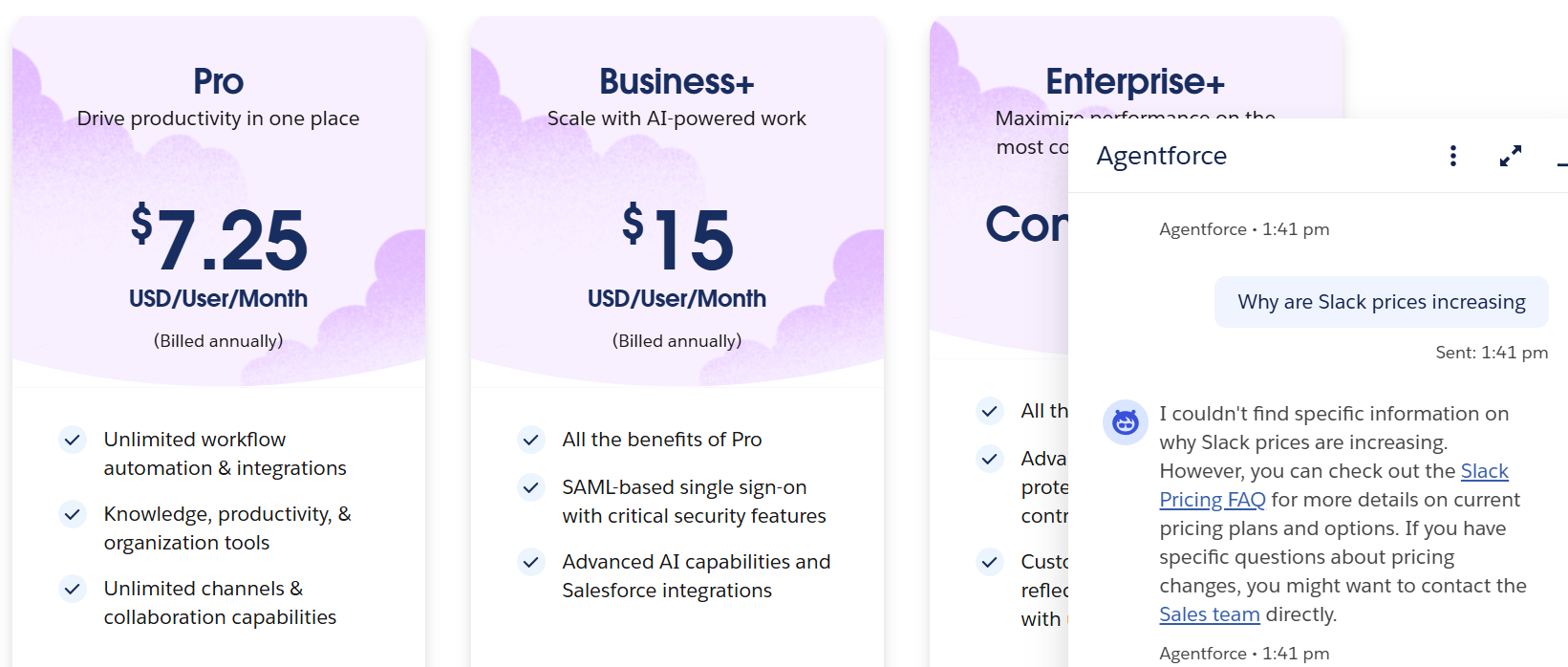
  • Salesforce said Slack's Business+ plan is now $15 per user per month, up from $12.50 per user per month, and adding a new Enterprise+ plan, which includes enterprise search. If you're a Salesforce Business+ subscriber on a monthly billing cycle the new price is $18 per user per month.
  • Salesforce is also rolling out Slack across Salesforce channels and various records. Slack Pro pricing will stay the same. The last time Slack customers saw a price increase was 2022.
Data to Decisions Future of Work Marketing Transformation Matrix Commerce Next-Generation Customer Experience Innovation & Product-led Growth Tech Optimization Digital Safety, Privacy & Cybersecurity salesforce ML Machine Learning LLMs Agentic AI Generative AI Robotics AI Analytics Automation Quantum Computing Cloud Digital Transformation Disruptive Technology Enterprise IT Enterprise Acceleration Enterprise Software Next Gen Apps IoT Blockchain Leadership VR Chief Information Officer Chief Executive Officer Chief Technology Officer Chief AI Officer Chief Data Officer Chief Analytics Officer Chief Information Security Officer Chief Product Officer

AWS re:Inforce 2025: SecurityHub, AI and proactive defense

AWS re:Inforce 2025: SecurityHub, AI and proactive defense

AWS Chief Information Security Officer Amy Herzog said cybersecurity is becoming more about the time to act than time to detect due to the sheer scale of incidents and alerts. Herzog pitched a more active defense approach amid emerging AI use cases.

Speaking at AWS re:Inforce 2025 in Philadelphia, Herzog's message echoed what was heard previously from AWS about security by design. The twist is that AWS is rolling up its various security services into one package that can automate security processes and various chores that eat up response time.

AWS launched Security Hub to give enterprises the ability to be more proactive about security as AI-driven attacks emerge.

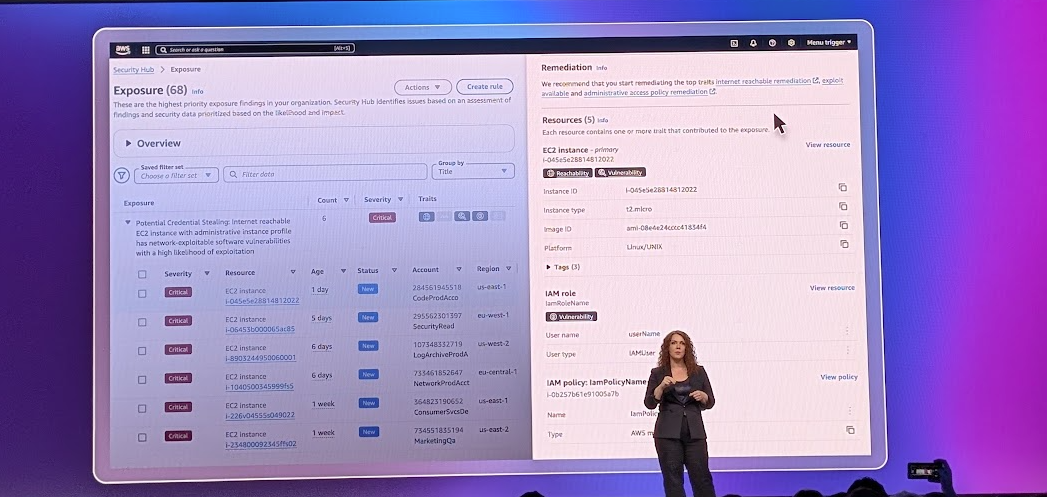
AWS Security Hub provides a unified cloud security system that combines threat detection, signals and simplified and prioritized alerts. "Security Hub combines signals from across AWS security services and then transforms them into actionable insights, helping you respond at scale," said Herzog.

In a demo, Herzog walked through how Security Hub can aggregate everything across AWS' various security tools. Security Hub is also designed to alleviate alert fatigue. "It's about time to act more than the time to detect through automated correlation, rich context and actionable insights," said Herzog.

Herzog said that companies with more mature security and compliance frameworks are better suited to adopt generative AI and ultimately agentic AI. One key message: Security is an enabler not a blocker to AI innovation. 

AWS also touted how it is using generative AI to perform code patches and automate processes. The upshot here is that AWS is providing multiple security services even as it uses its AWS Marketplace to connect customers to a big ecosystem of vendors. What AWS is doing now is connecting those various security building blocks and automating various security workflows.

The cloud giant also launched a proactive network security analysis tools for AWS Shield and Amazon GuardDuty's expansion into container-based environments.

Here's a look at what was announced:

Identity and Access Management (IAM): AWS IAM Access Analyzer internal access findings is available to find out who has access to S3 buckets and other services.

"You can use the internal access guidance to see exactly who in your company has access to specific resources and information from one dashboard. You can monitor both internal and external access in one view."

AWS IAM, which handles 1.2 billion API calls per second, is also adding long-term credential management, data protection and access and control. The general idea is that there are no long-term credentials.

Multifactor authentication is also 100% enforced across the AWS security layer.

AWS Certificate Manager with exportable public certificates. Herzog said "we know that management of digital certificates is a challenge" so the company is now enabling certificates to run inside AWS as well as outside.

AWS Shield Network Security Director in preview: "Network Security Director starts by performing an analysis of your network, building anthropology based on the resources connections, networking services, which has been implemented, it then assesses the network security of your resources and whether they meet the which network security best practices," said Herzog.

Herzog said the idea is that AWS Shield Network Director is aimed at giving enterprises a security team built in with a simplified experience.

AWS Network Firewall Active Threat Defense: Herzog said the cloud provider is aggressive with its defenses. She walked through AWS systems to defend against emerging threats. One service behind the active threat defenses, called Blackfoot, constantly checks packets for bad actors.

"Blackfoot gives us the data plane to stop their activities using Blackfoot, and we've implemented custom packet processing," said Herzog, who said Blackfoot has stopped 2.4 trillion malicious requests over the last six months.

Amazon GuardDuty: Herzog said Amazon GuardDuty is getting enhanced features to find anomaly behaviors, sequences and signals. AWS inspects 360 trillion telemetry events per day. Amazon GuardDuty identified 13,000 high confidence attack sequences over the last 90 days.

Data to Decisions Digital Safety, Privacy & Cybersecurity Innovation & Product-led Growth Future of Work Tech Optimization Next-Generation Customer Experience AI GenerativeAI ML Machine Learning LLMs Agentic AI Analytics Automation Disruptive Technology cybersecurity Chief Information Officer Chief Information Security Officer Chief Privacy Officer Chief AI Officer Chief Experience Officer