


Target cuts deal with OpenAI as it plans customer experience overhaul
Target's comeback plan revolves around improving customer experience, plowing more money into capital expenditures and technology partnerships with the likes of OpenAI.
The retailer's third quarter results were mixed as the company beat earnings estimates, missed on revenue and narrowed its outlook. Target's third quarter same store sales were down 2.7% from a year ago.
Michael Fiddelke, Target Chief Operating Officer, will become CEO and he spent much of the company's third quarter earnings call talking about experience improvements. "We need to offer a more consistently elevated experience across our stores and digital platforms," he said. "And we need to more fully use technology to improve our speed, guest experience and efficiency throughout the business."
Target cut 1,800 jobs or 8% of its workforce in a move that was aimed at simplifying the company's structure and becoming more agile, said Fiddelke, who also sees technology as a way to improve merchandising at stores.
The turnaround plans for Target revolve around new AI-driven tools as well as an extra $1 billion in capital expenditures to improve the experience in stores. Target sees 2026 capital spending at about $5 billion.
Here's a look at Target's plan to leverage technology to improve experiences.
Merchandising. Target has equipped its teams with AI-driven consumer insights. "Our merchants now have real-time access to advanced data from what is currently trending on social media to which products and styles are resonating with consumers at Target and across the industry today, to what future trends our guests are most likely to care about, helping our team forecast needs, anticipate trends and buy both smarter and faster," said Fiddelke.
Trend tracking. Target recently launched Target Trend Brain, an internal platform that uses genAI to help teams identify and react to emerging trends and predict what's ahead.
Fiddelke added that Target is using synthetic audiences, AI-driven models to simulate consumer segments, to preview how groups will respond to campaigns and products before they launch.
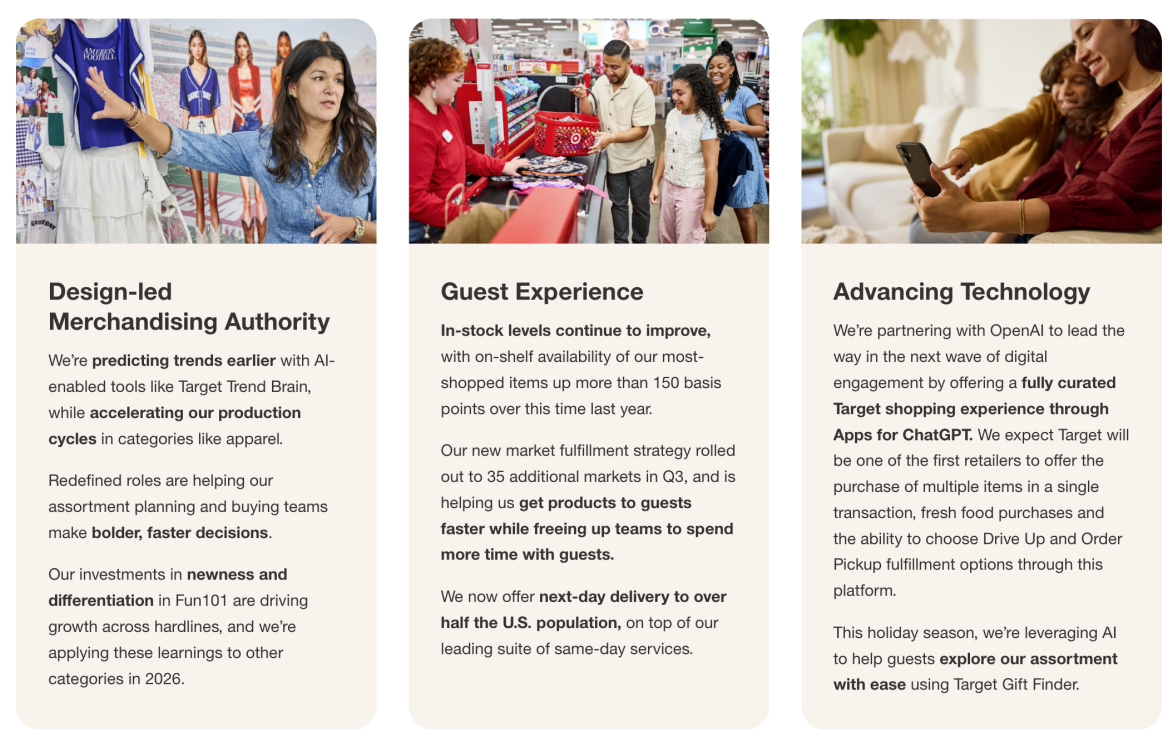
Improving experiences. "Both in stores and digital, a great guest experience means a lot of things, but it starts with a warm, friendly and helpful team. In stores, we're making changes to give our team members more time to focus on what matters most, spending time helping our guests," said Fiddelke. "Through enhanced digital tools, we're reducing time devoted to backroom tasks through more efficient truck unloading and stocking. Every hour we save is being reinvested to allow more guest interaction with a focus on friendliness and service."
Target has also launched a new genAI powered gift finder on the web site and app. The goal is to use technology to ask questions to help guests narrow down choices.
Inventory. Fiddelke said Target is investing in machine learning to optimize inventory processes to improve in-stocks. In the third quarter, Target improved the on-shelf availability of its top 5,000 items by more than 150 basis points compared to a year ago.
The OpenAI partnership. Fiddelke said Target will build ChatGPT in its apps to curate conversational shopping experiences. Customers will tell the app what they're trying to do and OpenAI will make personalized recommendations. "Through this partnership, we expect to be one of the first retailers on OpenAI platforms to offer the purchase of multiple items in a single transaction, offer fresh food products on the platform and the ability to choose drive up and pickup fulfillment options in addition to the conventional shipping options offered by others," said Fiddelke.
Target's customer experience turnaround is a work in progress. The company said an investor day March 3 will lay out the broader strategy.
Larry Dignan is Editor in Chief of Constellation Insights at Constellation Research, where he leads editorial coverage focused on enterprise technology, digital transformation, and emerging trends shaping the future of business. He oversees research-driven news, analysis, interviews, and event coverage designed to help technology buyers and vendors navigate complex markets with clarity and context. ...
Read morePublished
Author
