


Nvidia GTC 2026: 8 takeaways from Huang's analyst meetings
Nvidia CEO Jensen Huang held court with financial and industry analysts this week at Nvidia GTC 2026 and riffed on tokenomics, why he wished OpenAI and Anthropic were public companies to prove out the tokens to revenue equation and why OpenClaw will become part of the enterprise mix.
Huang's follow-up with analysts fleshed out a barrage of news headlines from Nvidia GTC 2026. Here's a look at the takeaways:
Agentic AI is at an inflection point and engineers will have token budgets just like they do laptops. Huang said:
"What used to be a thing for engineers is when you come to work, they give you a laptop.
Now when you come to work, they give you laptop and tokens. And token budget is now a real thing. Every engineer is going to have a token budget. And the idea that you would hire a $300,000 engineer and they spend no tokens in doing their job, you got to ask the question, what are they doing? And so, it is very, very clear now that every engineer will have a lot of tokens that they would have to consume, and those tokens are going to be produced. Now I just said something a second ago, if you just connected the dots, we used to be when an engineer comes to work, software programmer, somebody comes to work, we give them a laptop. That's a tool. To get -- today, we give them a laptop and tokens. Those tokens have to be manufactured. And so, a computer used to be just a tool, a computer of the future is a manufacturing equipment."
- Nvidia GTC 2026: AI inference fueling demand boom, $1 trillion of order flow
- Nvidia GTC 2026: Nvidia’s hardware strategy goes beyond GPU in AI inference pivot
- Nvidia GTC 2026: Nvidia launches NemoClaw, eyes to pair with DGX Spark, DGX Station
- Nvidia GTC 2026: We're a software company too
OpenClaw is a revolution. It's a toy today and enterprise software tomorrow. Huang said:
"Many of these things when they first drop are open source and they seem like toys. You take a step back and just analyze what is OpenClaw on first principles and it is really a computer, the operating system of an AI computer, a personal AI computer. It has all of the properties of a computing system.
Every company in the world will now need to know what your OpenClaw strategy is. Every single software company, every single company needs to have an OpenClaw strategy. Just as we all had our Linux strategy, just as we all had to have an Internet strategy, just what is your mobile cloud strategy."
Top-tier open source models. At an industry analyst meeting, Huang said the open model strategy is to provide strong LLM performance that can be fine-tuned. "Our goal is to be near the frontier,said Huang. "We don't have to be absolutely the world's best, but we have to be near it. Nemotron 3 is near the world's best. Nemotron 4 will be near the world's best." Nvidia Nemotron: Much needed open-source model champion in US
The $1 trillion in orders figure. At Huang's keynote, he said Nvidia has line of site to $1 trillion in orders, up from the $500 billion outlined at GTC DC. However, Huang extended the timeline through 2027. Wall Street took that projection as weaker-than-expected growth. Huang elaborated:
"We have strong confidence and visibility of $1 trillion. It's not a floating point. It is also not 94 digits of accuracy, okay? We have strong visibility of $1 trillion plus of Blackwell plus Rubin. And the reason why it's only Blackwell plus Rubin and not all of the other things that we sell is because I referenced it from the last year. So last year, we didn't have Groq. Last year, we weren't selling stand-alone CPUs. Last year, we didn't have many of the things that we have to sell now."
"It's only Blackwell and Rubin. It's not Feynman, it's not Rubin Ultra. It's not any of those things. It's not Vera stand-alone. It's not Groq. Blackwell plus Rubin, we have high confidence, strong visibility, demand forecast, purchase orders of $1 trillion plus."
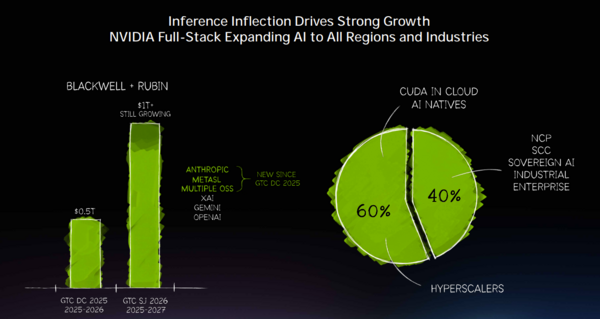
Demand is insatiable and broadening. Huang said:
"We love our hyperscale partners, and we work very, very closely with them. But it's important to understand that our relationship with hyperscalers is we're not selling -- we're not just selling to them. We attract customers for them. Having CUDA in their cloud brings all of the CUDA developers, all the AI natives, all the large companies that we work with. Whenever we accelerate those large companies or small companies, we bring them, we terminate, we have them hosted in the world's CSPs. We are one of the best sales forces of the world's CSPs."
"We are also seeing tremendous customer diversity outside of the CSPs including regional clouds, industrial, enterprise on-prem, OEMs and all the ODMs."
Why Huang wished OpenAI and Anthropic were public.
"I wish those companies were public. And the reason for that is because then you'll see what I see. No company in history has ever grown as a start-up company -- nonpublic company, as a start-up company, increase revenues by $1 billion or $2 billion a week. That's what they're experiencing right now. Now remember, I just said a week, the entire IT software industry is, call it, $2 trillion. That $2 trillion industry, I don't believe it's going to be disrupted. I think it's going to be transformed. I believe that every one of the -- that $2 trillion IT industry is going to integrate a combination of OpenAI, Anthropic and open models.
This IT industry has $2 trillion in software licenses today. It's probably going to be -- let me just pick a random number, $8 trillion that also resells an enormous amount of tokens. 100% of the world's IT industry will become resellers of OpenAI and Anthropic."
AI is just software. Huang said:
"Just think of that AI as just software. (OpenAI and Anthropic) software is going to be offered directly to enterprises, but it's also going to be integrated and become domain-specific and specialized, governed, secured, easily provisioned, connected to their system of records, and so forth. There's going to be a whole and that agentic system will be rented to customers, but they still would have to consume tokens through factories."
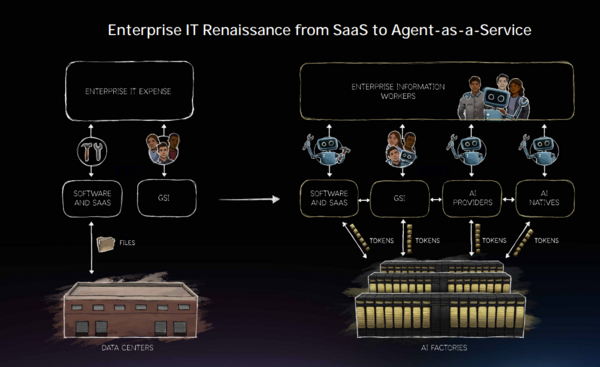
Physical AI inflection point "in a few years." Huang said the physical AI and industrial growth will come in a few years and that'll drive on-premises and edge deployments. Huang said:
"The industrial side has to be done on-prem. It has to be done at the edge. It has to be done in location. It has to be done in the factory. Then all of a sudden, that 40% is likely to grow. And I think ultimately, that 40% becomes larger. And the reason for that is because the world's industries that are related to physical AI is much, much larger than the industries related to digital AI. Something like $70 trillion of the world's industries, $50 trillion, $60 trillion, $70 trillion requires physical AI because the world is happening not in our laptop, the world happens out where the world is. And so, there's a lot of atom-related businesses that simply can't be taken care of without physical AI."
Nvidia GTC 2026: My thoughts
I spent the week at Nvidia GTC 2026 and at a high-level here’s what I’m thinking.
- If I built an AI factory a year ago, I’m already having buyer’s remorse, The architecture, complement of seven chips on the platform, AI inference improvements and advances add up to a better AI factory. Yes, we were told repeatedly that older Nvidia infrastructure performs well, but there’s some serious depreciation with AI advancing this quickly.
- With the addition of Vera CPUs and everything else that goes into the Nvidia stack, it’s clear that customers are going to have to decide whether they just buy everything from Nvidia or choose a heterogeneous AI path. For cloud hyperscalers and LLM giants, the decision has been made. Nvidia is part of the mix, but so is custom silicon and other options. Enterprises will need to decide.
- Nvidia’s ecosystem and software heft is the moat that’ll ensure dominance into the foreseeable future.
- The company’s open-source model strategy is interesting. On the one hand, Nvidia is competing with the big proprietary LLM providers that happen to spend a lot on Blackwell and Vera Rubin systems. Then again, the US needs open-source models and Nemotron is the only game in town.
- Is Nvidia the next Cisco or next Apple?
Here’s our stack of GTC coverage:
- Nvidia GTC 2026: AI inference fueling demand boom, $1 trillion of order flow
- Nvidia GTC 2026: Nvidia’s hardware strategy goes beyond GPU in AI inference pivot
- Nvidia GTC 2026: Nvidia launches NemoClaw, eyes to pair with DGX Spark, DGX Station
- Nvidia GTC 2026: We're a software company too
- Where’s tokenomics for the rest of us?
- Event Report: Nvidia GTC Kicks Off - All Eyes on AI Future
- Nvidia Nemotron: Much needed open-source model champion in US
- Nvidia's Huang: All software will be agentic
- Constellation ShortList™ AI Factory Providers
- CoreWeave launches latest Nvidia instances, adds Weights & Biases tools
- Akamai Inference Cloud deploys Nvidia AI Grid
Larry Dignan is Editor in Chief of Constellation Insights at Constellation Research, where he leads editorial coverage focused on enterprise technology, digital transformation, and emerging trends shaping the future of business. He oversees research-driven news, analysis, interviews, and event coverage designed to help technology buyers and vendors navigate complex markets with clarity and context. ...
Read morePublished
Author
