


Workday Q1 strong, touts Sana, AI agent plans
Workday reported better-than-expected first quarter results, raised its margin outlook and said its AI strategy is working well. The company made the case that Sana integration, consumption models and AI agent returns are going well.
The company reported first quarter earnings of 87 cents a share on revenue of $2.54 billion, up 13.5% from a year ago. Non-GAAP earnings were $2.66 a share.
Wall Street was looking for non-GAAP first quarter earnings of $2.52 a share on revenue $2.52 billion.
CEO Aneel Bhusri said the first quarter highlighted how Workday's "core business is strong, our AI strategy is working, and we're moving with the speed and focus."
The company said its 12-month subscription revenue backlog was $8.81 billion, up 15.5% from a year ago. Total subscription backlog was $27.3 billion, up nearly 11%.
Workday maintained its subscription revenue outlook for fiscal 2027 of $9.925 billion to $9.95 billion and increased its guidance for non-GAAP operating margins to 30.5%. CFO Zane Rowe said the company remains focused on "executing on our agentic AI roadmap while driving operational efficiencies as we scale."
By the numbers:
- Workday said it had more than 4,000 customers using at least one of its organically developed agents, double from last quarter.
- Workday Recruiting Agent supported 14 million hiring processes in the first quarter.
- The company has more than 80 million users under contract.
- Second quarter subscription revenue growth is expected to be 13% with non-GAAP operating margins of 30%.
On a conference call, Bhusri said:
"It was the best first quarter of new ACV growth in five years anchored by the strength of our core business and the traction we're seeing with AI following slower ACV growth in fiscal year '26 we're seeing momentum once again building in the business."
"We've also streamlined ownership across your organization, so every workmate knows exactly how their work connects. Fewer things are done with greater focus. Workday has a dedicated AI agent factory, building agents across all of our application areas, clear ownership and accelerated development of our AI APIs.”
"I've met with dozens of customers since I've been back, and I keep hearing the same thing. Not one of them is looking to replace Workday with something they're building internally or from a startup. Instead, they were looking to us first for AI solutions for the HR and finance world, and hopefully in the future. It's really our opportunity for the taking, but we need to execute flawlessly and with speed."
On the monetization front, Workday President, Chief Commercial Officer Rob Enslin said the company's consumption model is gaining momentum. He also highlighted a deployment agent that has sped up customer adoption.
- Workday CEO Bhusri on two-sided coin of agentic AI
- Disruption coming for ERP and not from where you'd think
"A Flex Credit pricing model is quickly gaining traction with Flex Credit with Unified AI Monetization across Workday, one model for agents, AI APIs, and data cloud. It makes AI adoption simpler for our customers. While still early in the journey, we're seeing a growing mix of AI monetization coming through Flex Credit," said Enslin.
However, Workday's consumption model will be a journey. We've heard multiple gripes from customers about consumption models at SaaS vendors.
Sana focus
Bhusri said this quarter was the first with Sana and Paradox fully integrated. Sana received a lot of attention on the conference call since it's designed to be the front door to Workday.
The company named Joel Hellermark, the founder of Sana Chief AI Officer.
- Workday spends $1.1 billion on Sana, aims to be front door to work
- Workday buys Paradox to build out its recruiting suite, delivers strong Q2
"The integration has gone further and faster than I anticipated. We've already proven that customers trust Workday deliver AI to agents we acquired. This is the year we proved that they also buy the agents we're building organically, agents that only Workday can build," said Bhusri.
Gerrit Kazmaier, president, product & technology, Workday, said "all HCM and finance customers on our AI terms of service will get Sana for Workday and our self service agent as a part of their existing contract."
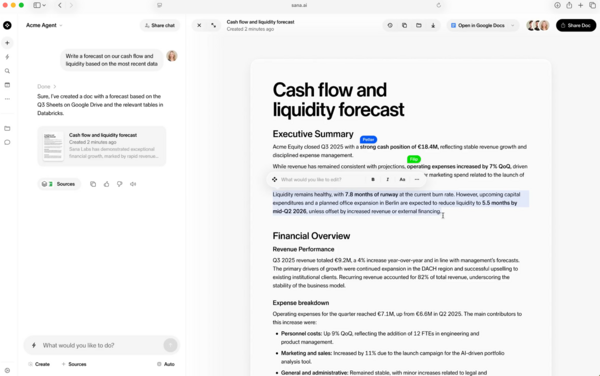
At the Sana AI Summit in New York, Workday outlined Sana for IT Service Management to handle common service tasks from HR, finance and IT and Sana Travel Agent, an offering that brings travel and expenses together.
Both of the new Sana agents were built directly on Workday.
The Sana for ITSM effort highlights how multiple SaaS vendors, notably ServiceNow, Workday and Salesforce are often encroaching on each other's turf.
Sana for ITSM and Travel Agent were demoed at the Sana AI Summit and will be available for early adopter customers in the second half of 2026.
Workday's AI agent differentiation
Bhusri was asked on the conference call about Workday's approach to AI agents and competition. He said Workday's edge is in deterministic workflows and contextual data. He said:
"When I look at the world of agentic AI in the enterprise we have this concept of lawful and lawless agents. Lawful being done the right way. Lawless going directly against the data and getting results that bypass security or bypass a business process framework.
I have yet to meet a single customer that wants to do things in a lawless way. If they follow lawful, there are three paths for us to be successful. One, the best path is for us to sell our own agents, and there's a clear TCO on those agents. We're seeing the success of those agents. Second, is they can use Extend Pro to build their own AI applications, again leveraging our platform, and the third is as we roll out these AI APIs on a consumption basis, that's the way that third parties could build agentic applications but they still have to use the rails, the security, the governance, and the business process framework. There's not a single customer that wants to do things in a lawless way now in the world of HR and finances."
Kazmaier said Workday's agents are deeply embedded in the flow of business.
"Our differentiated AI solutions drive real value, which are not just augmentations, but actually redefining how HR and finance operates by taking big labor spends and making them smaller software spends," he said.
What’s next?
Bhusri said Workday has a priority list for its transformation. These priorities include:
- “We're focused on building organic agents, and that's going extremely well with the self-service agent and deployment agent. The acquired agents continue to be strong, and as we roll out more of those agents we're going to see continued momentum.”
- “We're also doing some really great work on the APIs, which is going to be the way we monetize the headless transaction.”
- “You've got to put that technology transition front and center. The 150th feature in HR finance is not going to move the needle for our business. The next agentic application will.”
Bhusri said Workday’s plan is to grow like it did in the first quarter and keep head count as close to flat as possible since the company is “getting the benefits of using our own products and other AI tools.”
And Workday is going to take a few shots. Bhusri said:
“AI resets competitive boundaries, and we can make bets in a bunch of new markets. All the bets don't need to work, but if we make three or four bets and two of them work, that's a huge success. You’re going to see doubling down on what we're doing an AI within our HR and finance world, but also taking some bets that expand our TAM, because they're there for the taking. Our data model with HR and finance happens to be a very robust data model that really captures every business object under the sun for to build other applications.”
Constellation Research's take
Holger Mueller, an analyst at Constellation Research, said:
"Workday is picking up speed, and that is even before the main portfolio of its new AI platform and offerings are making it into the books. All AI related traction in the results comes from the previous generation of packaged agents - so it's remarkable the vendor can leverage that traction already. Now all eyes are on the release of the new Sana based platform for agents and how that traction in agentic AI translates into revenue in Q2 and even more Q3 and Q4. The AI vision starts with the general work to embed ERP related agents and automation is compelling and unique in the current enterprise system landscape and should fuel growth later this year."
My take:
- What was the most striking about Workday's call was how Wall Street sentiment materially improved. Yes, Workday's AI strategy seems to be working but it is still early. The nuance here is that Wall Street analysts seemed to be giving a SaaS company some benefit of the doubt. Perhaps it's Workday specific, but investors typically shot SaaS first and asked questions later. The tone won't turn up in the transcript, but this quarter was different for Workday, which put up growth of 13.5%.
- Is the worst over for SaaS and the idea that Anthropic will vibe code away enterprise software?
- Workday's take on the consumption pricing for AI agents was positive, but we've heard dozens of customers gripe about those models. It's a journey and time will tell.
- Bhusri does have Workday rowing in the same direction and it was notable hearing him riff on expanding beyond HR and finance, starting with an ITSM and travel agent from Sana.
Larry Dignan is Editor in Chief of Constellation Insights at Constellation Research, where he leads editorial coverage focused on enterprise technology, digital transformation, and emerging trends shaping the future of business. He oversees research-driven news, analysis, interviews, and event coverage designed to help technology buyers and vendors navigate complex markets with clarity and context. ...
Read morePublished
Author
