


SpaceX's worth $2 trillion: Do you believe in space data centers, xAI's potential?
SpaceX’s initial public offering has lifted off. Shares priced at $135, good for a valuation of $1.77 trillion, and topped $2 trillion in market cap once trading started. The IPO is the largest ever.
In a statement, SpaceX confirmed the price. Shares traded under the ticker symbol “SPCX.” Shares opened at $150 and hit about $175 in early trading to top a $2 trillion market cap. CEO Elon Musk is now the first trillionaire.
SpaceX's financial results are driven by SpaceX and Starlink with the AI unit, including X and xAI being a drag.
In its latest update, SpaceX said it is offering 555,555,555 of its Class A common. Elon Musk will hold 84.2% of SpaceX after the IPO.
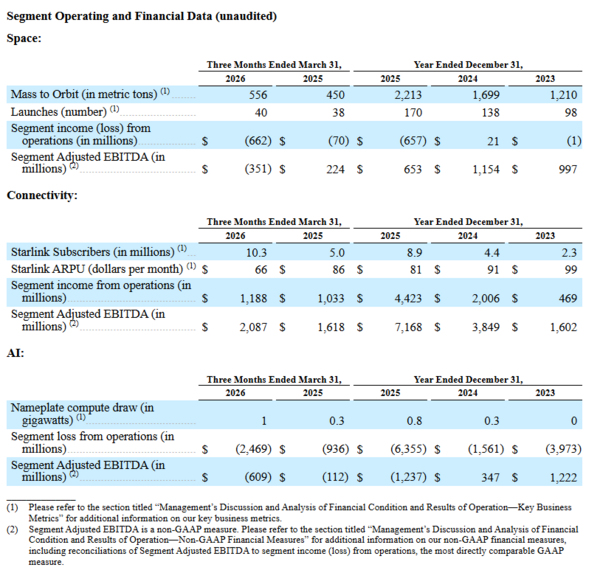
The company's prospectus and shows what a drag xAI is. For the three months ending March 31, SpaceX reported a loss from operations of $1.94 billion on revenue of $4.69 billion. For 2025, SpaceX reported a loss from operations of $2.59 billion on revenue of $18.67 billion with most of that revenue coming from space operations and Starlink.
What emerges from a SpaceX's filing is that Starlink is the money maker. For the three months ended March 31, Starlink, formally known as the connectivity unit in SpaceX, delivered income from operations of $1.19 billion on revenue of $3.26 billion while the space division had a loss from operations of $662 million on revenue of $619 million.
The 2025 results tell the tale: Starlink delivered revenue of $11.39 billion with an operating profit of $4.42 billion. SpaceX's 2025 included a loss from operations of $657 million on revenue of $4.09 billion.
Simply put, Starlink carries team SpaceX and xAI doesn't. For the three months ending March 31, xAI had a loss from operations of $2.47 billion in revenue of $818 million. For 2025, xAI had a loss from operations of $6.35 billion on revenue of $3.2 billion.
The good news for xAI is that it appears to be a neocloud as it has rented its GPU capacity to Google and Anthropic.
Capital expenditures also are driven by xAI. Consider:
- xAI's capex for the first three months of the year was $7.723 billion.
- The space unit capex was $1.05 billion in the same time frame.
- Starlink accounted for $1.33 billion in the same time frame.
- Capital spending for 2025 was also driven by xAI with capex of $12.73 billion compared to $3.83 billion and $4.18 billion, respectively.
Sure, SpaceX said it is investing for growth with xAI, but the division is an albatross. The big picture for Elon Musk is SpaceX is a vertically integrated space meets AI juggernaut. According to the IPO filing:
"We own and operate what we believe to be the largest AI training data center clusters on Earth, including COLOSSUS and COLOSSUS II. The addition of Terafab, a chip manufacturing initiative with Tesla and Intel, aims to further extend our vertical integration to chip design and manufacturing to alleviate potential future chip shortages at SpaceX, optimize compute performance, and potentially reduce overall compute costs."
"Our business model is built on a repeatable, engineering-driven framework that combines our unparalleled launch capabilities, extreme vertical integration, rapid iteration, and disciplined capital investment to create durable, large-scale businesses."
The big theme from SpaceX is space-based AI factories.
"The Sun contains approximately 99.8% of the solar system’s energy and offers what we believe is the only truly scalable solution to the challenge of accelerating demand for compute relative to terrestrial energy constraints. The logical path forward is to move power-intensive AI workloads into orbit, where solar energy is near-constant and uninterrupted. With such accessibility to energy, we believe that our launch business will enable us to consistently activate the highest performing hardware before our competitors without such access, shrinking the timeline to useful tokens on bleeding-edge hardware and sustaining our token cost advantage. We believe SpaceX is uniquely positioned to deploy and operate data centers in orbit that can eventually achieve a lower cost than terrestrial data centers over time."
Other notable space data center tidbits:
- SpaceX has launch capabilities.
- Starlink provides connectivity.
- Starlink in-orbit technology will optimize orbital AI compute.
- The company is building out its chip manufacturing efforts with Tesla.
The SpaceX bet boils down to your belief in space data centers and vertical integration.
By the numbers:
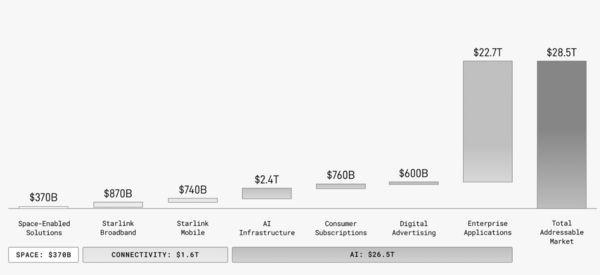
- $28.5 trillion: The amount SpaceX said is its total addressable market.
- $60 billion: What SpaceX will pay for Cursor after the IPO.
- 23: Number of underwriters and book runners listed on the prospectus. Goldman Sachs and Morgan Stanley are the lead dogs.
- $1.25 billion: What Anthropic is paying xAI per month for compute capacity through 2029. The agreements may be terminated by either party upon 90 days’ notice.
- 650: Number of total launches to date.
- 10.3 million: Number of Starlink subscribers.
- 9,600: Number of Starlink broadband and mobile satellites.
- 1.3 billion: Number of supported active accounts over the last 12 months for Grok and xAI.
The risk factors are usually a fun read, but in SpaceX's case they're a bit obvious. A delay in SpaceX's Starship is a risk as our communications licenses for spectrum. And xAI has to deliver. Musk is also a risk factor since he has control.
Other risk factors revolve around space data centers:
"Our ability to achieve orbital AI at scale depends on our ability to access a sufficient number of AI chips, significantly more than are currently available to us. While we expect to construct Terafab to address such supply constraints, Terafab may not be successful, in which case we may not have other sources of sufficient AI chips to meet our orbital AI compute demands. While Terafab is intended to expand our internal chip manufacturing capabilities and alleviate potential future AI chip shortages at SpaceX, particularly as we pursue orbital AI at scale, we expect to continue sourcing a significant portion of our compute hardware from third-party suppliers, and there can be no assurance that we will be able to achieve our objectives with respect to Terafab within the expected timeframes, or at all. While we have a framework agreement with Tesla, neither Tesla nor Intel are obligated to remain a part of the project, and we may not enter into any such definitive agreements."
- The space race and what it means for enterprises
- Anthropic buys all of SpaceX's Colossus 1 data center capacity
- Amazon doubles down on Leo, acquires Globalstar for $11.6 billion
- Cisco's Patel on space data centers, AI infrastructure and hiring young workers
- Data centers in space: Feasible, sustainable and could drive returns
- AWS CEO Garman said space data centers likely to take longer
Larry Dignan is Editor in Chief of Constellation Insights at Constellation Research, where he leads editorial coverage focused on enterprise technology, digital transformation, and emerging trends shaping the future of business. He oversees research-driven news, analysis, interviews, and event coverage designed to help technology buyers and vendors navigate complex markets with clarity and context. ...
Read morePublished
Author
