Results

Box's Q1, outlook highlight potential in AI agent ecosystem

Box's Q1, outlook highlight potential in AI agent ecosystem

Box reported better-than-expected first quarter results and raised its outlook as its content and unstructured data platform carves out a key role as enterprises move to AI agents.

Speaking on an earnings conference call, Box CEO Aaron Levie said customers are upgrading to the company’s Enterprise Advanced plan to leverage Box AI. Box also released a State of AI in the Enterprise Survey, which found more than half of the 1,300 IT leaders surveyed expect transformation from AI in the next two years. Ninety percent of respondents are using AI agents in some capacity with unstructured data and documents a primary use case.

"Box AI Agents will enable enterprises to streamline a due diligence process on hundreds or thousands of documents in an M&A transaction, correlate customer trends amongst customer surveys and product research data, or analyze life sciences and medical research documents to generate reports on new drug discovery and development," said Levie. "None of this would have been possible even a year ago."

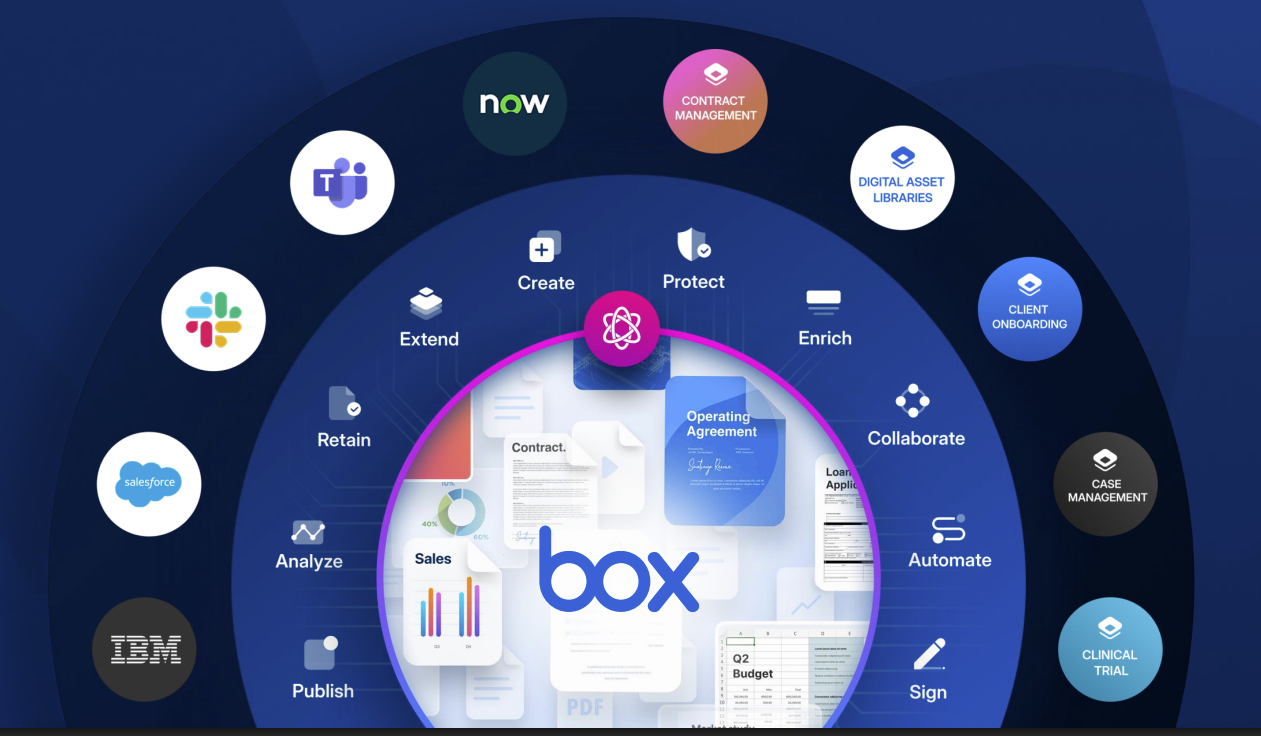
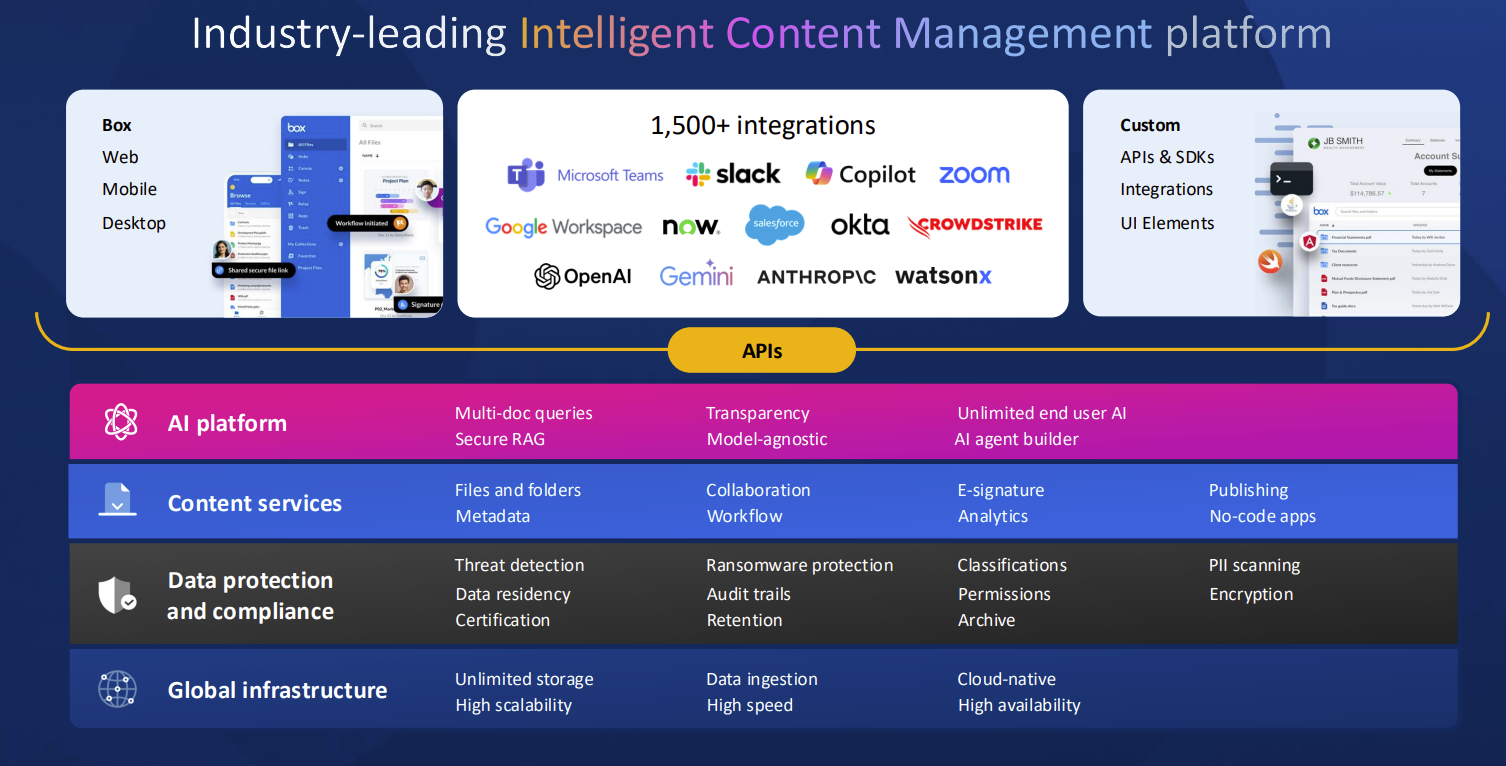
The Box earnings follow the company's rollout of Box AI Agent integration for Microsoft 365 Copilot, IBM watsonx Orchestrate, Google Agentspace, Slack AI, ServiceNow AI Agent Fabric and Zoom AI Companion as well as the Box Model Context Protocol (MCP) server. Box is also officially integrated with OpenAI's ChatGPT's deep research agent. If there's a foundational model such as Meta's Llama or Grok, Box plans to integrate.

Levie added that Box is also benefiting from lower compute costs for AI inference and model improvements.

"On the AI inference side, we've just been very happy about the rate of like-for-like AI model improvements that we're seeing from a cost standpoint. And that can show up in 2 ways. The first is that you can take an existing use case and it might just on a one-to-one basis, be cheaper on a kind of pretty regular basis every kind of 6 to 12 months at a minimum," said Levie. "The alternative is that you get a new capability unlock because you can -- you either get the base model just is getting much better or you can use an existing model and do multiple passes through the model for better accuracy or more complex use cases."

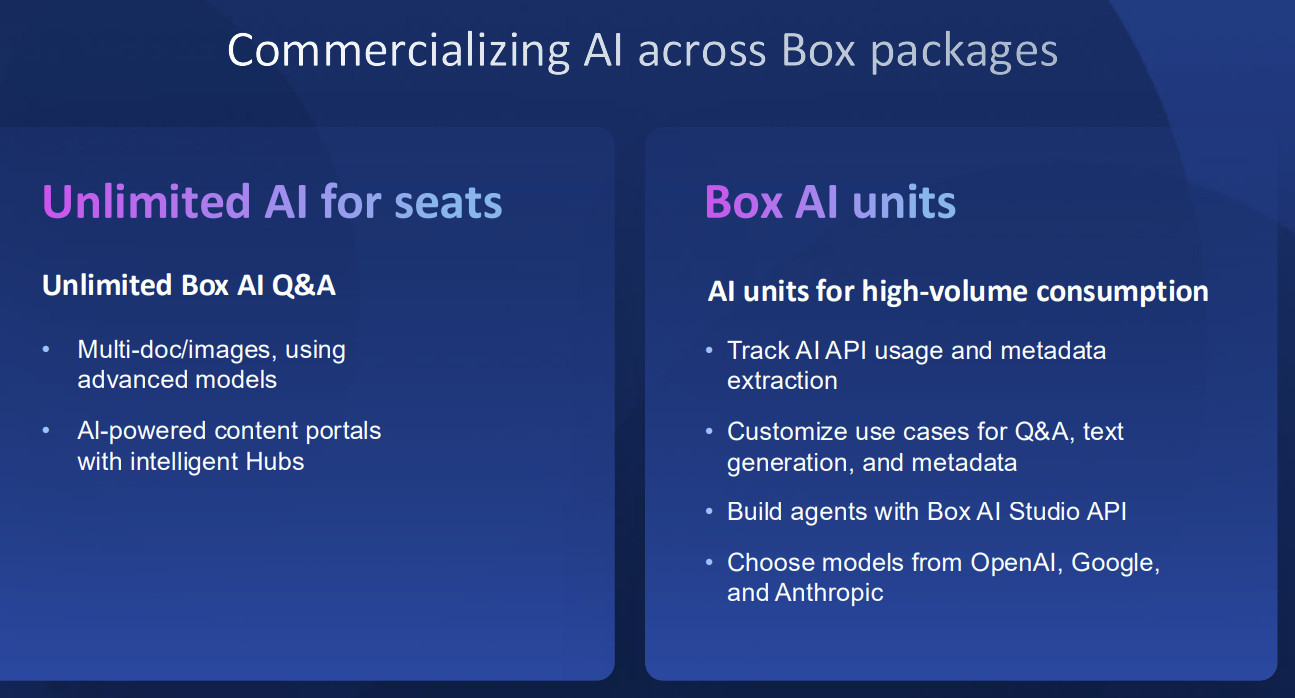
AI use cases will ultimately be margin-neutral, said Levie, who added that Box's pricing is based on seats and credits instead of use case based pricing.
The numbers

Box reported first quarter earnings of $3.51 million, or 2 cents a share, on revenue of $276.27 million, up 4% from a year ago. Non-GAAP earnings were 30 cents a share.

Wall Street was expecting Box to report first quarter adjusted earnings of 26 cents a share on revenue of $274.77 million.

Billings in the first quarter were $242.3 million, up 27% from a year ago. Remaining performance obligations (RPO) of $1.47 billion, up 21%, or 17% on a constant currency basis.
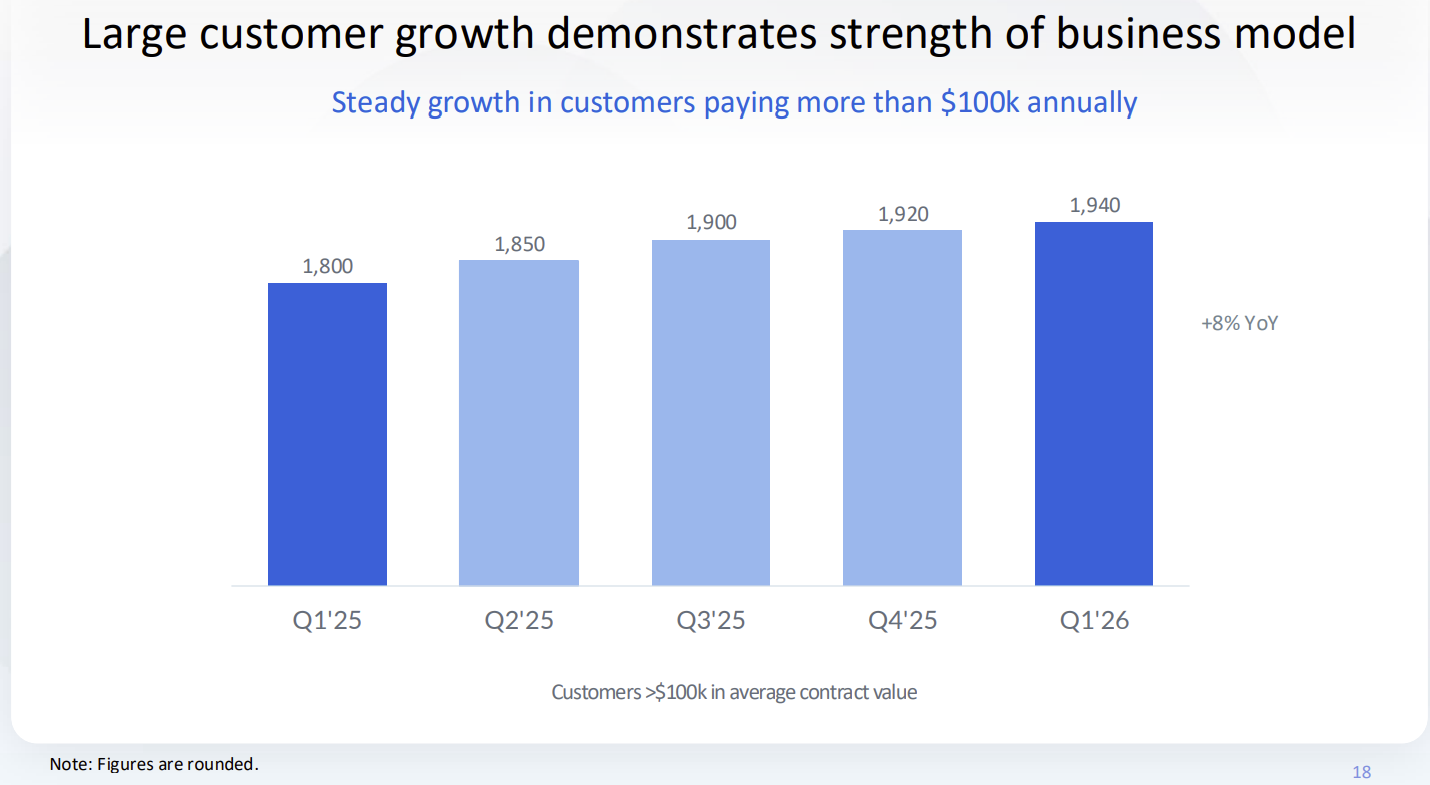
As for the outlook, Box projected second quarter revenue of $290 million to $291 million, up 8% from a year ago. Non-GAAP earnings will be between 30 cents a share and 31 cents a share. Wall Street was looking for second quarter earnings of 28 cents a share on $284.1 million.

CFO Dylan Smith said economic uncertainty hasn't had an impact on Box's business, but it wanted to "remain prudent" with its outlook for fiscal 2026. Box is also navigating currency fluctuations given a big chunk of its business is in Japan.

Box projected annual revenue to be in the range of $1.165 billion to $1.7 billion, up $10 million from its previous guidance, with adjusted earnings of $1.22 a share to $1.26 a share. Wall Street was looking for adjusted earnings of $1.19 a share for fiscal 2026.

Where Box sits in the AI agent ecosystem

Given Box's content platform is a repository and management system for valuable unstructured data, Levie said the company is "sitting very naturally at the center of so much of the innovation happening in AI right now."

Levie added that Box is not competing with any of the AI model providers. Instead, Box is a meeting place where models can add value to customer data. Box also serves as a secure place for content that adds a layer of governance.

"We act as a very natural kind of convening point for these AI models when customers want to be able to use data with any of these leading platforms," said Levie. "You want to ensure that data access controls are actually maintaining the security of your information. And so you don't want to be in a position where you're trying to pack too much of that intelligence into the model layer, you want to pack that into the data plane and the architecture around that, which is what Box provides customers."
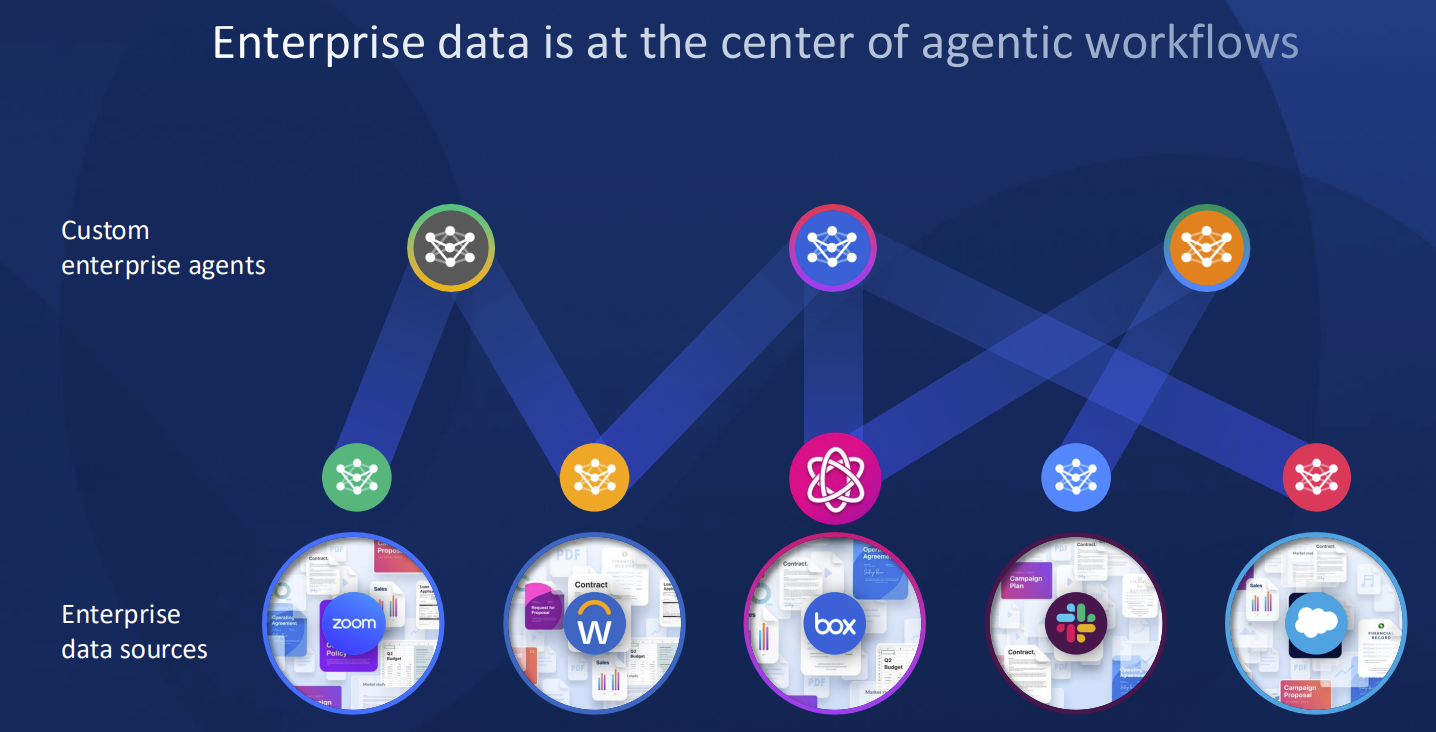
By sitting in the data plane, Box has more appeal to regulated customers as well as mission critical AI use cases, he added. Levie said Box will occupy two layers of the AI stack including the software plane for end user interaction and platform via APIs. Monetization will be based on seats and usage for agent queries going into Box.

"We want to execute on both of those as fast as possible and in tandem because no single company is going to decide where all of the user does their work. It's just not possible," said Levie. "We want to make sure that you can manage your content one place and ensure that it works everywhere."

Constellation Research analyst Holger Mueller said:

"Box keeps innovating, doing the right for customers, but cannot lift its revenue back into the teenage growth numbers, which is the least investors expect from an innovative AI company. The current quarter flirted with the inflation rate, meaning that Box was treading water…  The promise of AI changing how people will upgrade their future of work with documents is becoming clearer and clearer – and if Box can unleash the acceleration potential in the best practices shift, it may well grow again as it should. On the downside are the commoditization pressures that Box has been fighting since the pandemic."

Bottom line: It's early in AI agent use cases, but Box is seeing billings growth, interest for Enterprise Advanced and high-level CxO conversations. Based on those leading indicators, it's just a matter of time until Box sees accelerating revenue growth.
 

Data to Decisions Future of Work Tech Optimization Marketing Transformation Innovation & Product-led Growth Next-Generation Customer Experience Digital Safety, Privacy & Cybersecurity box Marketing B2B B2C CX Customer Experience EX Employee Experience AI ML Generative AI Analytics Automation Cloud Digital Transformation Disruptive Technology Growth eCommerce Enterprise Software Next Gen Apps Social Customer Service Content Management Collaboration Machine Learning LLMs Agentic AI Robotics Quantum Computing Enterprise IT Enterprise Acceleration IoT Blockchain Leadership VR Chief Information Officer Chief Marketing Officer Chief Executive Officer Chief Technology Officer Chief AI Officer Chief Data Officer Chief Analytics Officer Chief Information Security Officer Chief Product Officer
Salesforce acquires Informatica for $8 billion to bolster Agentforce

Salesforce acquires Informatica for $8 billion to bolster Agentforce

Salesforce said it will acquire Informatica for $8 billion, or $25 a share, in a deal that will give it a neutral data integration and management platform to connect Agentforce across systems.

The two companies were in talks a year ago, but couldn't agree on a price. Salesforce will fund the Informatica purchase with cash and new debt.

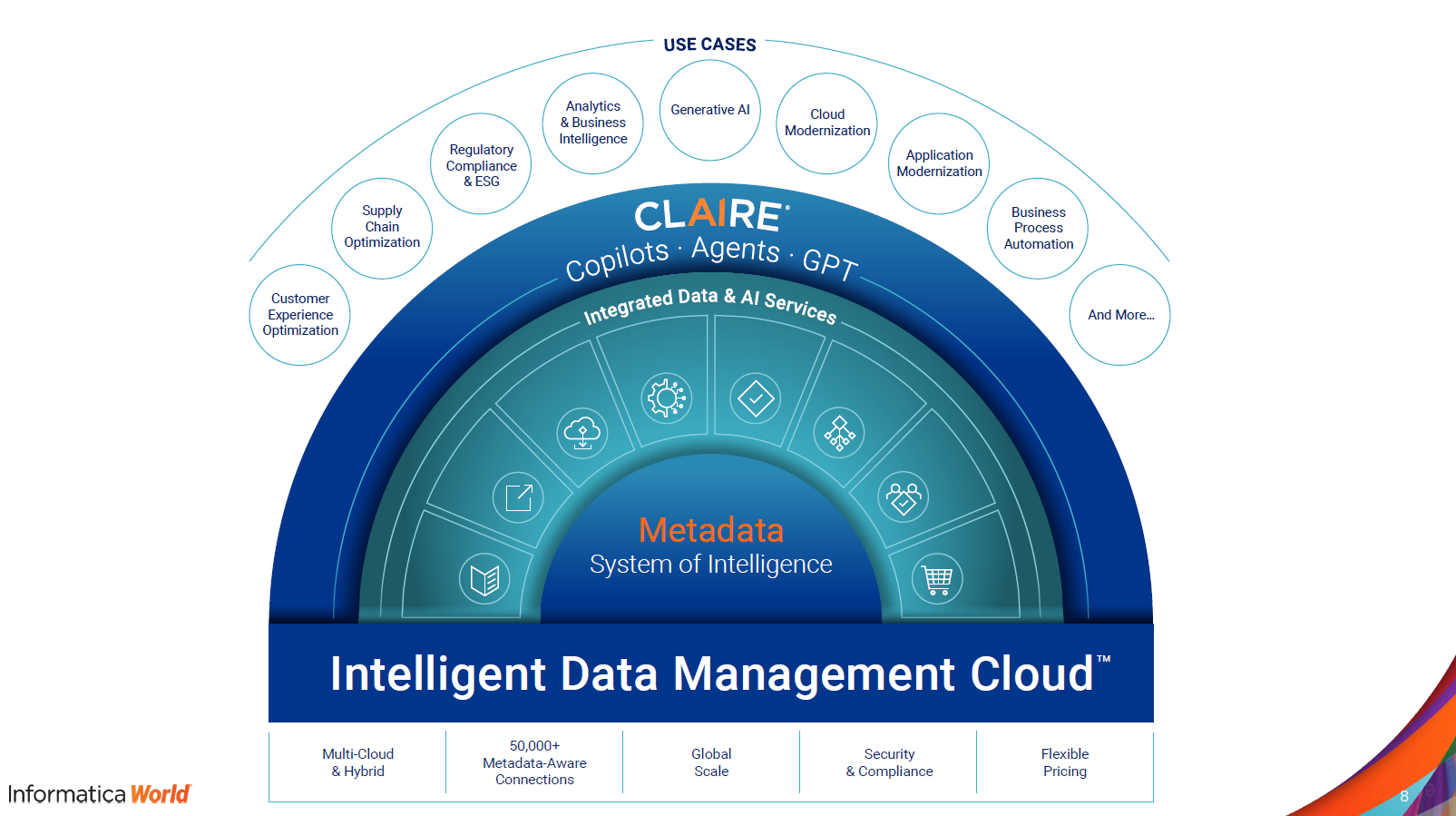
Salesforce said Informatica, which recently announced tighter integration with Microsoft Fabric, Databricks, Snowflake and others, will power its agentic AI vision across enterprises. Informatica brings a data catalog, integration, governance and metadata management.

What Informatica also brings to Salesforce is a neutral platform. CxOs have said that Agentforce is viewed as more of a Salesforce-specific AI agent play instead of a horizontal solution across third-party systems.

Informatica will also bring revenue to Salesforce. Informatica recently projected 2025 revenue of $1.67 billion to $1.72 billion, or growth of 4.6% at the midpoint. Salesforce said Informatica will boost non-GAAP earnings and free cash flow in the second year after the deal closes.

Salesforce revamps Agentforce pricing with Flex Credits: What you need to know | Salesforce expands ecosystem, courts developers and partners to Agentforce | Salesforce landing Agentforce deals, but Q4 and outlook mixed

Salesforce CEO Marc Benioff said the combination of Data Cloud, MuleSoft and Tableau with Informatica will "enable autonomous agents to deliver smarter, safer, and more scalable outcomes for every company."

Here's what Salesforce bought:

According to Salesforce, Informatica will do the following:

  • Strengthen Data Cloud as a customer data platform (CDP).
  • Given Agentforce the ability to interpret and act on a wide range of enterprise data.
  • Augment Customer 360.
  • Bring data quality, integration and governance for the data used by MuleSoft APIs.
  • Provide context for Tableau insights.
  • Bolster Salesforce's industry offerings.

Once the deal closes, Salesforce said it will "rapidly integrate Informatica’s technology stack — including data integration, quality, governance, and unified metadata for Agentforce, and a single data pipeline with MDM on Data Cloud." When integrated, Informatica will be embedded into Salesforce's system of understanding.

Behind the Scenes: The Force Behind Agentforce

In addition, Salesforce said it will support Informatica's ecosystem and data management products.

Salesforce will talk about the deal more on its first quarter earnings call on Wednesday. In the meantime, here are some questions to ponder.

  • How will Data Cloud and Informatica be sold individually? Will there be a conflict?
  • Will Informatica's mojo as a neutral party in data management erode as part of Salesforce? A neutral vendor in your stack is great, but also a pipe dream
  • How quickly can Informatica be integrated into Salesforce's platform?
  • And customers will look for alternatives to Informatica as they are already digesting Agentforce and pricing changes?
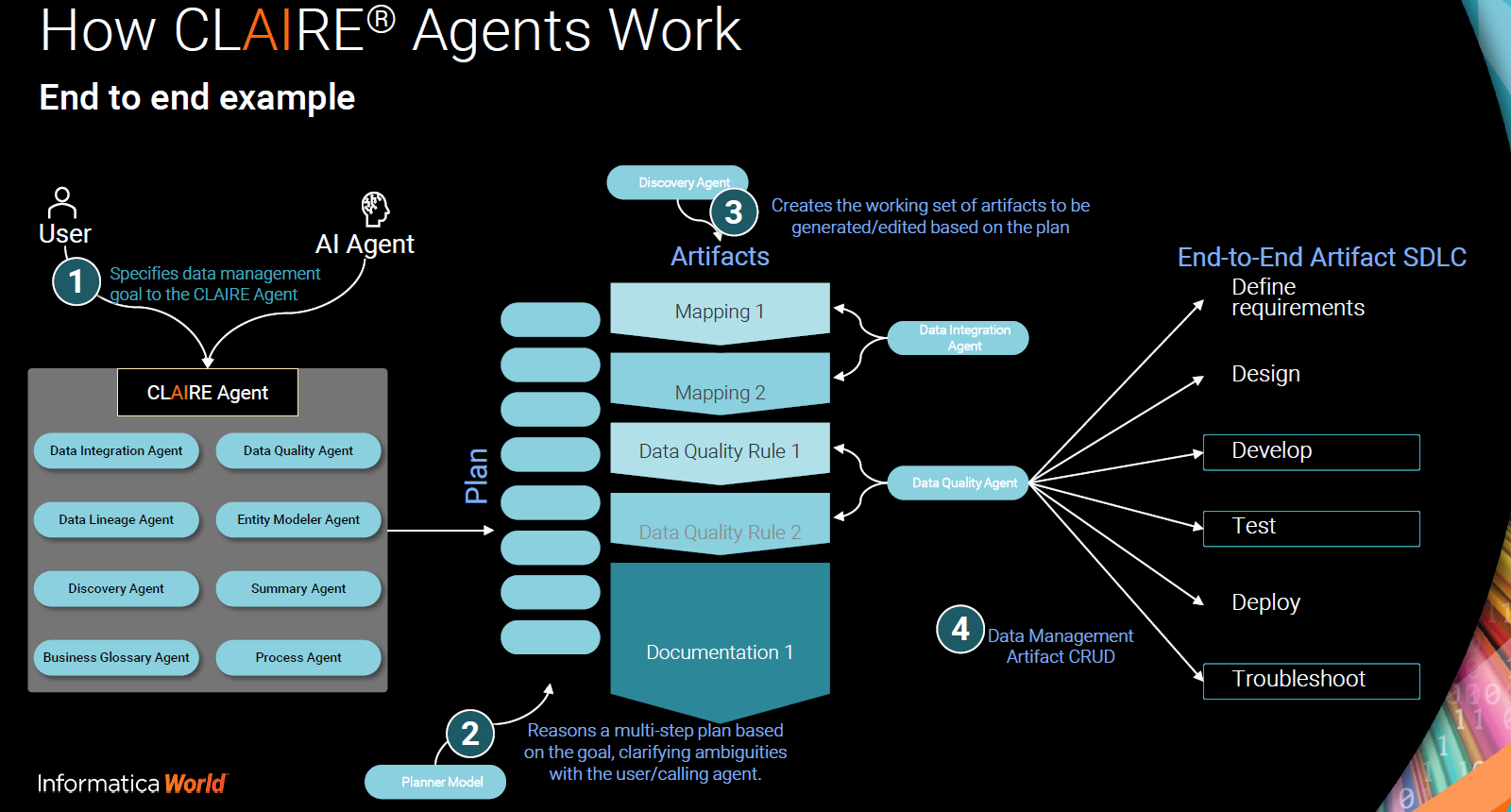
  • How will Informatica's CLAIRE AI agent efforts be affected in the deal?

Constellation Research’s take

Constellation Research CEO R “Ray” Wang said:

“The bottom line is that MuleSoft was not enough. Salesforce showed why Data Cloud was important for AI. But how do you get the data into Data Cloud? A data integration company and iPaaS vendor would have to do the trick. But which one? Informatica has been on the block before and it’s old, legacy, but it has a ton of customers and some great data management tools. But it’s not the future and this what makes the difference between at $10B acquisition vs a $8B acquisition. However, Boomi would have been the smarter buy - brand new tech, an agentic framework ready to go, fast growing company, and a rock star CEO.”

The bigger question in the long run is whether the Informatica deal positions Salesforce to manage and orchestrate agents beyond its platform. 

Liz Miller, an analyst at Constellation Research, said:

"Top of mind for everyone will be the question: "Is this the $8 billion missing piece to shift Agentforce from a dominant promise to a dominant reality for Salesforce customers?" What Informatica brings to the table is data integration capacity, metadata integration and serious data provenance, lineage and governance to stitch all of Salesforce's recent data innovations together.

For Salesforce customers the question will always come down to what additional value will Informatica bring to my current business goals? Does this seismically change the trajectory that my data and my processes and my outcomes are on? 

The moves to watch will revolve, as they often do with Salesforce, around price. In recent weeks Salesforce has worked to simplify and streamline Agentforce pricing and there has been a long history of fine-tuning Data Cloud's consumption pricing. Time will tell if Salesforce's customers can shoulder another layer of data related costs." 

Data to Decisions Future of Work salesforce Chief Information Officer

Accenture's Karthik Narain on human, AI collaboration, trust

Accenture's Karthik Narain on human, AI collaboration, trust

Karthik Narain, Group Chief Executive, Technology and CTO at Accenture, said enterprises should think about trust as the primary gatekeeper to AI adoption, eye collaboration between AI agents and humans, and architect companies to take advantage of a time where there's a "a personalized digital brain for every employee."

Narain, who appeared on DisrupTV Episode 399 and is an author of Accenture's Tech Vision, riffed on the future.

AI as the New Digital Foundation: Narain emphasized that artificial intelligence (AI) is not just another tech trend, but a foundational shift similar to what we saw with the rise of digital technologies in the 2000s. "The theme we believe is going to be very foundational for years to come, and that is all about the role of AI and how it's going to impact societies," said Narain. "All of that is going to be taken to the next level with AI."

Cognitive Digital Brain: Accenture envisions every enterprise creating a "cognitive digital brain," an intelligent system that continuously learns, makes decisions, and collaborates. "We call that concept that an enterprise will create as a cognitive digital brain," said Narain. "Over time, you will have a personalized digital brain for every employee, a digital brain for an enterprise, and at an industry level."

Trust is the Gatekeeper to AI Autonomy: Trust will be the defining factor in determining how much autonomy AI systems are granted. "We believe that the only thing that's going to be a limiting or an accelerant is going to be trust. And it's trust and autonomy that go hand in hand," said Narain. "Organizations need to inject trust in the system for AI to be able to be used. It's a combination of confidence, our own intuition, explainability."

The Binary Big Bang – Architectural Disruption: The "Binary Big Bang" describes how large language models are fundamentally changing how technology is developed and deployed. "This explosion is going to append all technologies and create a new architecture that can come together to drive new experiences and increase the digitization index of enterprises," said Narain.

AI Refinery and Trusted Agent Huddle: Accenture is operationalizing these concepts through platforms like the AI Refinery and Trusted Agent Huddle, focusing on collaborative agentic AI and responsible deployment. "The whole idea of this Trusted Agent Huddle platform that we created is the fact that there needs to be collaboration… and the humans play a very, very important role," said Narain. "Trusted Agent Huddle is not just a communication protocol, it is basically a trust protocol."

Investing in People: Cognitive Upgrade vs. Transfer: Accenture is focusing not on replacing humans but enhancing them—what Narain calls a "cognitive upgrade."

“We are upgrading our talent 80,000 to 100,000 of our employees to become data and AI proficient," said Narain. "There is all this conversation of gloom and doom, but when you reimagine a workflow or a process using AI agents, the human comes first."


Data to Decisions Future of Work Next-Generation Customer Experience accenture Chief Information Officer Chief Technology Officer

Agentic AI: Is it really just about UX disruption for now?

Agentic AI: Is it really just about UX disruption for now?

Are AI agents going to reinvent workflows, processes, the future of work and enterprise efficiency? Or are AI agents just a better user experience and another excuse to sell you a different flavor of the "suite always wins?" Your answer depends on time frame.

We've detailed how it's early in the agentic AI journey and there are a few requirements needed to scale. It appears 2025 is about standards, protocols, improving AI models and orchestrating agents within the same silo-ed platforms you're currently stuck in. If AI agents go production and drive ROI, it's a 2025 story.

The disruption of the minute with AI agents is likely to be about the user experience. When you purchase from your friendly neighborhood SaaS vendor you're buying a data store and often a UI. The enterprise software vendors see this oncoming AI trainwreck and are quickly positioning themselves as platforms with consumption models.

Boomi CEO Steve Lucas said: “I think SAP will always exist. Workday will always exist; Oracle will always exist. Here's the real question. The real question is, how much of that exists in the future? I believe is their UI will go away entirely.”

How would SaaS vendors be valued if they were actually headless systems where enterprises used AI agents to create the user experience? Consider the following developments:

A screenshot of a cell phone

AI-generated content may be incorrect.

  • Microsoft CEO Satya Nadella has repeated referred to Copilot as a user interface to AI-based applications that are delivered via agents. Nadella said at Build that Microsoft "is bringing together agents, notebooks, search and create into a new scaffolding for work." "Beyond horizontal knowledge work, we are introducing agents for every role and business process," he added.
  • SAP executives argued that Joule will be an always-on AI assistant to optimize processes and drive returns. Via Liz Miller, Muhammad Alam, member of the SAP Executive Board, said enterprises should standardize on Joule as their agent of choice. "You can either further complicate your landscape by adding yet another layer of tech, whether from workflow providers or from platform providers, where you knowingly or unknowingly, shift more towards the iceberg," said Alam, who leads the SAP Product & Engineering Board area and has global responsibility for all business software applications. Alam noted that the idea of best of breed AI agent systems doesn't work (as if he'd say anything else). He acknowledged that the enterprise suites didn't innovate fast enough even as he through a few jabs at ServiceNow.

A screenshot of a computer

AI-generated content may be incorrect.

  • ServiceNow also is a big AI agent play and is all about platform. As a result, it doesn't seem hamstrung by UI issues.

Add it up and you have a bunch of vendors talking AI agents that may merely be defending their cross-selling models and interfaces that put a face on their software.

Data to Decisions Future of Work Next-Generation Customer Experience Innovation & Product-led Growth Tech Optimization Digital Safety, Privacy & Cybersecurity ML Machine Learning LLMs Agentic AI Generative AI Robotics AI Analytics Automation Quantum Computing Cloud Digital Transformation Disruptive Technology Enterprise IT Enterprise Acceleration Enterprise Software Next Gen Apps IoT Blockchain Leadership VR B2C CX Chief Information Officer Chief Executive Officer Chief Technology Officer Chief AI Officer Chief Data Officer Chief Analytics Officer Chief Information Security Officer Chief Product Officer Chief Customer Officer Chief People Officer Chief Human Resources Officer

Anthropic advances with Claude 4, APIs, MCP highlight a move upstack

Anthropic advances with Claude 4, APIs, MCP highlight a move upstack

Anthropic launched a set of developer tools that make it easier to build AI agents and launched new Claude 4 models. The news, outlined at Anthropic's first developer conference, highlights how large language model companies are branching out.

For enterprises, the most interesting item from Anthropic's conference is new API capabilities. Anthropic launched a code execution tool, a Model Context Protocol (MCP) connector, Files API and the ability to cache prompts for up to one hour.

These API tools ride along with the launch of Claude 4 Opus and Sonnet 4. The combination means that an AI agent can use the MCP connector to an application like Asana to reference tasks and work, upload relevant reports via Files API and analyze progress with the code execution tool.

Speaking during a chat with Chief Product Officer Mike Krieger, Anthropic CEO Dario Amodei said he has been surprised by the MCP support. "I was surprised at the pace at which everyone seems to have standardized around MCP," said Amodei. "It was very strange. We released it in November. I wouldn't say there was a huge reaction immediately, but within three or four months it became the standard. There's this feeling of being on the spaceship."

This workflow, outlined in an Anthropic blog, highlights how the company is building out a toolbox for AI agents.

Anthropic's developer conference kicked off in the same week as Microsoft Build and Google I/O. Both of those conferences were also AI agent heavy.

Here's the news in a nutshell:

  • Anthropic API has a code execution tool that will give Claude the ability to run Python code in a sandbox to produce insights and visualizations. Claude then becomes more of a data analyst that can handle use cases such as financial modeling, scientific computing, business intelligence and statistical analysis.
  • The MCP connector on Anthropic's API will connect Claude to any remote MCP server without code. Claude will now connect, retrieve tools, reason, execute tool calls, manage authentication and return a response with integrated data. MCP has garnered wide support in a short amount of time.
  • Files API simplifies storage and access of documents for Claude applications. Instead of managing file uploads in each request, you can upload documents once.
  • The extended prompt catching will improve agent workflows without more expense.
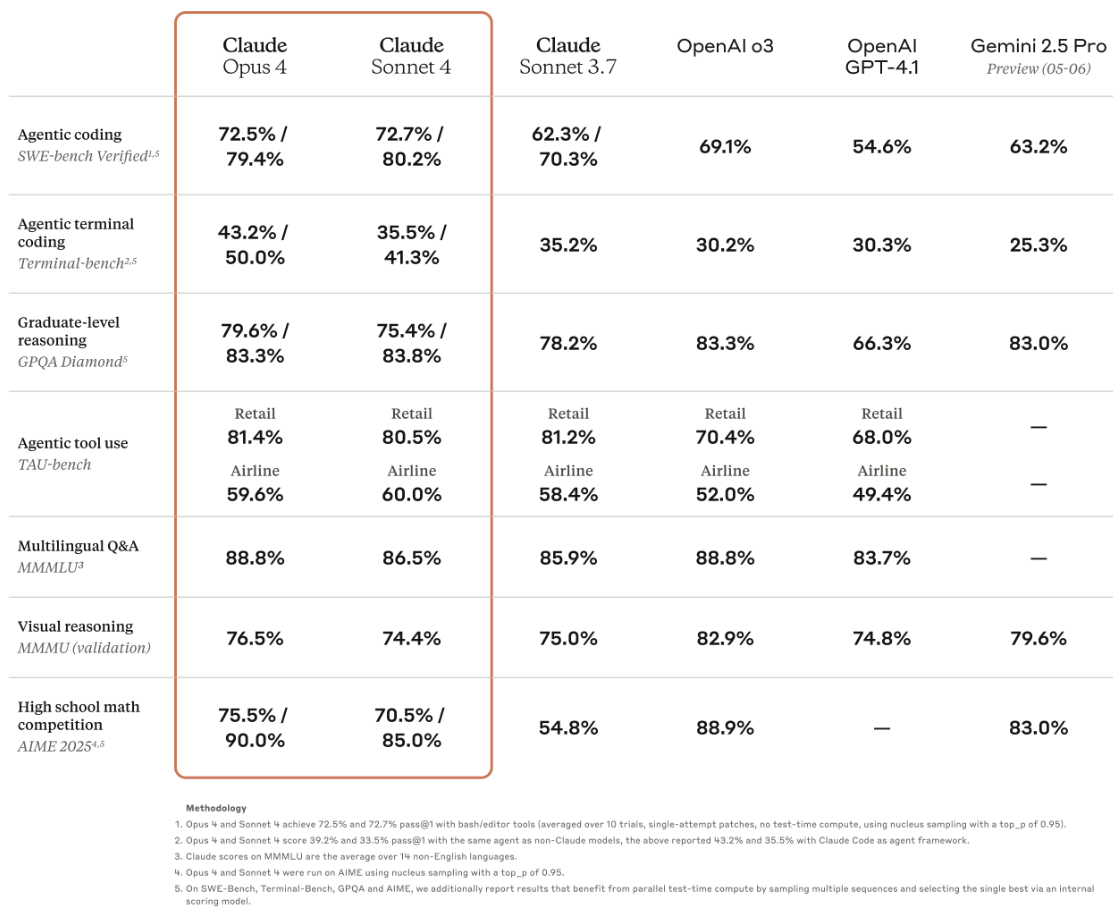
  • Claude Opus 4 and Claude Sonnet are advances in coding and reasoning, respectively. The models can alternate between reasoning and tool use, use tools in parallel, and work well with GitHub Actions.

In addition, Claude Opus 4 and Sonnet 4 are hybrid models with two modes: Near instant responses and extended thinking for deep reasoning. Both models will be available on Anthropic's API, Amazon Bedrock and Google Cloud Vertex API. Pricing is on par with previous Opus and Sonnet models.

Amodei said the industry is headed to a world where you can dispatch agents to do things and models overall will become more autonomous. "We're heading to a world where a human developer can manage a fleet of agents, but I think continued human involvement is going to be important for the quality control and make sure agents do the right things and get the details right."

The Anthropic CEO noted that use cases for these autonomous models and agents would be for software development, cybersecurity, scientific research and biomedical. Amodei also said that it's possible that MCP will hook up to real world data and equipment.

Constellation Research's take

Holger Mueller, an analyst at Constellation Research, said Anthropic's moves are an example of foundational model players moving upstream and branching out. For instance, OpenAI is moving into hardware and Cohere is focused on collaboration as is Anthropic.

Mueller said:

“The LLM vendors are working up the stack into the PaaS layer. Anthropic is a great example of this move with its latest release. Not only is it providing more MCP support, but also giving developers the ability to upload files easier, leverage analytic libraries, and provide a longer context window.

Anthropic's moves will give developers the ability to build agents in a more efficient way. It is good news for CxOs, as they have more choice as LLM vendors move up stack and bump into the traditional PaaS players. Ironically, some of these new competitors will be partners and even investors in Anthropic. It will be interesting to see how these relationships will develop further since Anthropic is on a collision course with ancient software offerings."

Data to Decisions Future of Work Innovation & Product-led Growth Tech Optimization Next-Generation Customer Experience Digital Safety, Privacy & Cybersecurity ML Machine Learning LLMs Agentic AI Generative AI Robotics AI Analytics Automation Quantum Computing Cloud Digital Transformation Disruptive Technology Enterprise IT Enterprise Acceleration Enterprise Software Next Gen Apps IoT Blockchain Leadership VR Chief Information Officer Chief Data Officer Chief Product Officer Chief Executive Officer Chief Technology Officer Chief AI Officer Chief Analytics Officer Chief Information Security Officer

Microsoft Build 2025: Agentic AI Meets Enterprise Data Decisioning

Microsoft Build 2025: Agentic AI Meets Enterprise Data Decisioning

Rise of Microsoft’s Open Agentic Web and why it matters to CDAOs and AI leaders

Microsoft is tackling data silos, disconnected agents, and contextless AI head-on.

Among a stack of announcements, including Copilot Studio, Microsoft Fabric, Entra, and the Model Context Protocol (MCP), Microsoft is building an operating system for intelligent, agentic decision-making. This is Microsoft aiming to do for enterprise AI what Windows did for personal computing: orchestrate it all.

At Build 2025, CEO Satya Nadella framed the moment clearly: “We are in the mid-innings of a major platform shift.” His message?  Expect architectural transformation from the market to defining how data, logic, and action converge. And Microsoft is not alone this month in announcements where AI is not an app, but an embedded behavior in every enterprise decision.

If you’re a CDAO or analytics leader trying to decode what this means, here’s your guided tour through the most meaningful announcements—and what to ask next.

Multi-Agent Systems Are the New Platform Battleground

Microsoft is laying the foundation for a new paradigm: AI agents that coordinate, collaborate, and drive enterprise workflows autonomously.

What’s New:

  • Multi-agent orchestration in Copilot Studio: agents can delegate, coordinate, and execute together.
  • MCP + NLWeb: Microsoft is laying the foundation for an "agentic web" with standardized context and delegation, as well as interfaces for discovery and use.
  • Entra Agent ID: Governance and identity management for agents, just like users.

Why it Matters:

  • This is about composable agents, not monolithic AI apps. Microsoft wants enterprises to build ecosystems of AI that interoperate. This month saw similar announcements from hyperscalers, application platform vendors, and integration and orchestration vendors.
  • MCP could become the TCP/IP of agentic systems-controlling context, state, and trust across your enterprise AI stack, including across Microsoft’s solutions. Interfaces set the boundaries of vendor solutions, so expect some wrestling for control.
  • Agent identity, traceability, and lifecycle governance become core responsibilities of the CDAO. Note: While governance is both critical and a new moat for agentic platforms, it’s a complex enough subject that I’ll cover it in a separate blog.
  • Raises new questions for data and analytics leaders: Who governs your data and analytics agents? Who secures them? If Microsoft owns identity, delegation, and context, is it the new Active Directory for AI.
Fabric Expanding BI to Decision-Making

Microsoft isn’t stopping at Power BI dashboards. Fabric is evolving into an execution platform that unifies your view of data, integrating operations, analytics, and AI-driven decision-making.

What’s New:

  • Cosmos DB is now mirrored into Fabric (OneLake) for real-time, semi-structured data, opening up operational capabilities on top of analytic workloads.
  • Digital Twin Builder brings physical-world data into AI loops.
  • Power BI gets full-screen "Chat with Your Data" and data agents.

Why it Matters:

  • Fabric simplifies the incorporation of real-time operational data on top of traditional analytic data, extending dashboards to decision-making platforms. Examples include Digital Twin monitoring to track manufacturing flow and e-commerce personalization that can search for unstructured concepts like “comfortable.”
  • Fabric is absorbing ETL, MDM, and governance, all as SaaS. Expect data platform players to subsume and simplify the unification of simple data, even as they extend their catalog capabilities to encompass business meaning.
  • Forces the question: What decisions could your ops teams automate if they had simplified, real-time access to both analytics and agents?
Agent Development is Now a Developer Discipline

What is Microsoft Build without a flurry of announcements for the developer-centric audience? Of course, Microsoft had announcements on equipping developers for a future of agent-driven logic and automation.

What’s New:

  • New CLI tools, Terraform support, User Data Functions, and Windows AI Foundry, a unified platform for local AI development.
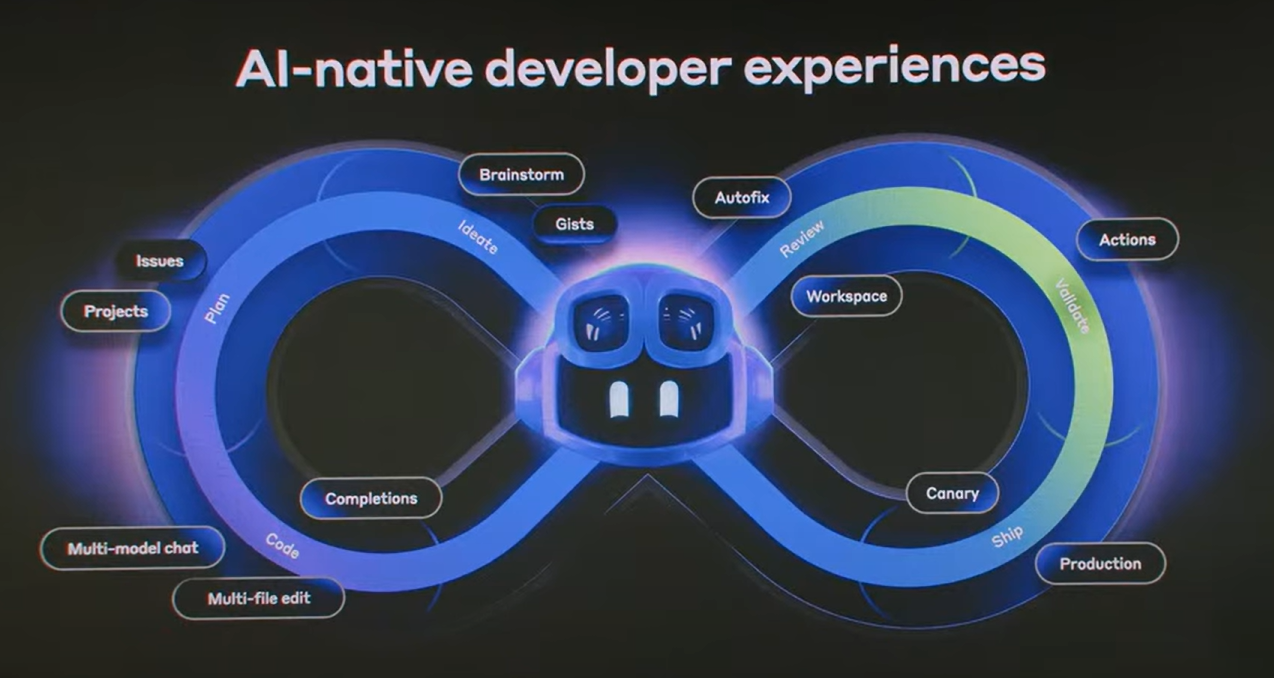
  • Copilot APIs + GitHub Copilot enable agentic DevOps.

Why it Matters:

  • Microsoft is reshaping its substantial developer stack for an open agent ecosystem.
  • Think app store + automation layer: Enterprises need SDKs, deployment tools, and agent lifecycle management, including testing, usage metering, and trust scoring.
  • GitHub Copilot becomes an entry point for agent-based engineering. Consider the “7 tickets in 7 minutes’ example given on stage.  Think of a GitHub ticket flow: a new ticket is automatically picked up by an agent. Multiple agents were tasked with evaluating and developing work plans to diagnose and resolve the issue. Developers can then review, approve, or create new GitHub tickets that they can assign to an “agent peer.”
Data-to-Decision Loop Embedded in the Flow of Work

This is where AI moves from being a project to becoming a standard template for workflow design.

What’s New:

  • Power BI and Copilot Studio integration.
  • Enhanced semantic modeling with natural language response tuning to make data AI-ready.
  • Analytics + Transactional flows (what Microsoft has named “Translytical task flows): enabling write back, trigger workflows, and act from a report.

Why it Matters:

  • Microsoft leverages its ownership of the tools people use by making it easy to publish agents to multiple channels, including embedding decision-making capabilities into Excel, Teams, and PowerPoint.
  • Analysts become answer engineers, providing guides for common questions and answers alongside semantic business context. Power users become low-code AI builders. Every employee gets closer to acting on insight.
  • The wave of BI becoming conversational, contextual to what each user, and executable continues. This will require enabling report and dashboard builders to start acquiring new skills in semantic modeling, tuning, and trust engineering.
  • The coming question for data and analytics leaders is how to architect for domains of data ownership.
Build 2025 Wrap Up

This Build wasn’t about new products—it was about a new architecture for enterprise decisioning. One where data, context, and AI agents converge in a shared, governed substrate that Satya has named the “open agentic web.

With the announcements across the industry, data and analytics leaders have a lot to parse as AI-driven decisioning redefines the enterprise stack, focusing on decision automation and intelligent execution.

I’d love to hear your take. Are these announcements aligned with where your data and AI strategy is heading? What questions do you have about how Microsoft’s analytics and agentic architecture will impact your teams, stack choices, and decisioning workflows?

🗣? Drop a comment, challenge an assumption, or share how you're planning to engage with Fabric—I'm listening

Data to Decisions Tech Optimization Chief Information Officer Chief Digital Officer Chief Analytics Officer Chief Data Officer Chief Technology Officer

Workday delivers strong Q1, says 60% of customers using its AI

Workday delivers strong Q1, says 60% of customers using its AI

Workday reported better-than-expected first quarter earnings as the company benefited from "continued efficiencies." Workday said that more than 60% of its customers are now using Workday Illuminate AI.

The HCM and financial software company reported first quarter earnings of 25 cents a share on revenue of $2.24 billion, up 12.6% from a year ago. Non-GAAP first quarter earnings were $2.23 a share.

Wall Street was looking for non-GAAP earnings of $2.01 a share on revenue of $2.22 billion.

Carl Eschenbach, CEO of Workday, said the quarter was solid and "a testament to the durability of our business and the relevance of our platform."

CFO Zane Rowe added that the company is focused on "executing in this uncertain environment and are reiterating our fiscal 2026 subscription revenue guidance of $8.8 billion while increasing our fiscal 2026 non-GAAP operating margin guidance to approximately 28.5%."

During the quarter Workday launched new Illuminate Agents, added new customers including United Airlines and Mutual of Omaha Insurance Company and saw traction in the technology and media vertical.

As for the outlook, Workday projected second quarter subscription revenue of $2.16 billion, up 13.5% from a year ago. Subscription revenue for fiscal 2026 will be $8.8 billion, up 14%. Non-GAAP margins for fiscal 2026 will be 28.5% up from the 28% projected for the second quarter.

Constellation Research analyst Holger Mueller said:

"Workday had a good quarter, breaking $2 billion in subscription services in a quarter for the first time. Despite restructuring and reducing headcount by about 7.5%, all its key costs in R&D, sales and marketing and G&A were still up. The impairment charge for restructuring  practically halved its operating income from 3.2% to 1.8% of revenues. Eschenbach and team are managing Workday on a razor thin margin, and evidently do not want the vendor to slip back in to the red."

Data to Decisions Future of Work Tech Optimization workday AI Analytics Automation CX EX Employee Experience HCM Machine Learning ML SaaS PaaS Cloud Digital Transformation Enterprise Software Enterprise IT Leadership HR Chief People Officer Chief Information Officer Chief Customer Officer Chief Human Resources Officer

AI infrastructure matures, GPU supply and demand may even out

AI infrastructure matures, GPU supply and demand may even out

Since the start of the generative AI boom, demand for Nvidia GPUs has been insatiable. Nvidia is still raking in cash from its AI infrastructure, but there are few recent developments indicating that the industry is maturing a bit.

In an announcement largely overlooked amid Nvidia CEO Jensen Huang's keynote at Computex, the company launched Nvidia DGX Cloud Lepton, an AI platform and marketplace that will connect developers to available GPUs.

Nvidia isn't providing the service, but has lined up a set of cloud partners including CoreWeave, Crusoe, Firmus, Foxconn, GMI Cloud, Lambda, Nebius, Nscale, Softbank Corp. and Yotta Data Services. These providers are offering Nvidia Blackwell and the rest of Nvidia's stack. GPU marketplaces including Fluidstack, Foundry and Hydra are also participating.

The marketplace "connects our network of global GPU cloud providers with AI developers," said Huang, who added the Nvidia and partners are "building a planetary-scale AI factory." Huang said leading cloud providers and other GPU marketplaces are expected to participate in DGX Cloud Lepton.

Developers would purchase GPU capacity directly from cloud providers or bring their own compute clusters. GPU capacity can also be deployed across multi-cloud and hybrid environments.

With the marketplace, Nvidia is trying to democratize GPU access a bit. After all, Microsoft, Meta, OpenAI, AWS and Google Cloud are likely gobbling up the capacity.

The other Nvidia move that made me go hmm was NVLink Fusion, which enables other CPUs to plug into the Nvidia stack. Speaking at his Computex 2025 keynote, Nvidia CEO Jensen Huang unveiled NVLink Fusion. NVLink Fusion allows cloud providers and presumably sovereign AI efforts and ultimately private infrastructure to use any ASIC or CPU to scale out Nvidia GPUs.

A person standing on a stage

AI-generated content may be incorrect.

MediaTek, Marvell, Alchip Technologies, Astera Labs, Synopsys and Cadence are the early adopters of NVLink Fusion for its custom silicon. Qualcomm also announced its data center efforts and moves to integrate its CPUs into Nvidia infrastructure. Fujitsu and Qualcomm CPUs can also be integrated into Nvidia GPUs via NVLink Fusion.

Constellation Research analyst Holger Mueller said: "Nvidia once again acknowledges the importance of the network for AI. The speed and efficiency how data is served to the precious and inexpensive CPUs is what matters."

The other development in AI infrastructure this week was revealed at Dell Technologies World. Dell outlined a plan to disaggregate data centers and use AI and automation to create a stack that can better mix and match layers, vendors and AI workload architectures.

Dell's disaggregated approach to the data center will apply to private cloud and on-premises deployments.

A screenshot of a computer

AI-generated content may be incorrect.

And finally, Dell is diversifying its AI factory approach. Yes, Nvidia's full stack is the headliner for Dell AI factories, but the company added an AMD version and early-stage Intel offerings.

Add it up and there seems to be some acknowledgement that there will be Nvidia diversification whether it's with custom processors from AWS, Microsoft and Google Cloud or custom ASICs and rival efforts. Even Nvidia's NVLink Fusion acknowledges the broader ecosystem at least for CPUs. Nvidia is playing the long-game, which revolves around the ecosystem and connecting AI infrastructure with its platform.

Data to Decisions Tech Optimization dell nvidia Big Data Chief Information Officer Chief Technology Officer Chief Information Security Officer Chief Data Officer

Zoom reports strong Q1 earnings, shows enterprise strength

Zoom reports strong Q1 earnings, shows enterprise strength

Zoom Communications delivered better-than-expected first quarter earnings as the company is seeing strong demand for Zoom Customer Experience, Zoom Revenue Accelerator and Workivo.

The company reported first quarter earnings of 81 cents a share on revenue of $1.17 billion, up 2.9% from a year ago. Non-GAAP earnings in the first quarter were $1.43 a share. Wall Street was looking for non-GAAP earnings of $1.31 a share on revenue of $1.17 billion.

Eric Yuan, Zoom CEO, said "we saw continued momentum in Zoom Customer Experience, Zoom Revenue Accelerator, and Workvivo as customers look to elevate CX, reinvigorate sales, and strengthen culture." He added that the company appeared to be landing accounts in an uncertain economy. Enterprise revenue in the first quarter was $704.7 million, up 5.9% from a year ago. Online revenue, which is small business accounts, had revenue of $470 million, down 1.2%.

Zoom evolves AI Companion with agentic AI features

Zoom said it had 4,192 customers contributing more than $100,000 in trailing 12 months revenue, up 8% from a year ago. Online average monthly churn was 2.8%.

As for the outlook, Zoom projected second quarter revenue between $1.19 billion and $1.2 billion with non-GAAP earnings of $1.36 a share to $1.37 a share. For fiscal 2026, Zoom projected revenue between $4.8 billion to $4.81 billion with non-GAAP revenue of $5.56 a share to $5.59 a share.

A screenshot of a computer

AI-generated content may be incorrect.

Yuan in prepared remarks said:

  • "Adoption of Zoom AI Companion continues to grow, with monthly active users up nearly 40% quarter over quarter."
  • "While we continue providing tremendous AI value at no additional cost to users with a paid license, we're now monetizing through Custom AI Companion. Though only weeks in market, we're seeing strong enthusiasm from several Global 2000 trial customers, who are especially excited about features like Bring Your Own Dictionary and Index, meeting summary templates, and our Jira integration."
  • "Zoom Phone continues to perform strongly, with revenue growing in the mid-teens. It is also opening new markets for Zoom by integrating seamlessly with other productivity suites and delivering a best-in-class, AI-first voice experience. The adoption of Zoom phone integration with Microsoft Teams has grown significantly, showing how we can meet customers where they are and add value within their existing tech stack."
  • "In Q1, the number of Zoom Contact Center customers grew 65% year over year and Zoom Virtual Agent landed its largest deal to date as an upsell to Contact Center - altogether Zoom Customer Experience is a triple digit million ARR business, growing in high double digits."
  • "Zoom Revenue Accelerator, our AI-first sales enablement and conversational intelligence solution, continues to deliver strong results for revenue teams. In Q1, licenses grew 72% year over year, reflecting growing traction."
Data to Decisions Future of Work Innovation & Product-led Growth New C-Suite Marketing Transformation Next-Generation Customer Experience Digital Safety, Privacy & Cybersecurity zoom Chief Information Officer

Snowflake delivers strong Q1, Q2 outlook

Snowflake delivers strong Q1, Q2 outlook

Snowflake delivered first quarter revenue growth of 26%. The company's data platform continues to see strong demand due to AI workloads.

The company reported first quarter non-GAAP earnings of 24 cents a share on revenue of $1.04 billion. Including stock compensation and other items, Snowflake reported a net loss of $430.1 million, or $1.29 a share.

Wall Street was expecting Snowflake to report non-GAAP earnings of 21 cents a share on revenue of $1.01 billion.

As for the outlook, Snowflake projected second quarter product revenue of $1.035 billion to $1.04 billion, up 25% from a year ago. "We see an enormous opportunity ahead as we extend this value throughout the full data lifecycle," said Snowflake CEO Sridhar Ramaswamy.

By the for numbers for the first quarter:

  • Snowflake had 606 customers with trailing 12-month product revenue of more than $1 million.
  • Remaining performance obligations of $6.7 billion, up 34% from a year ago.
  • Research and development spending in the first quarter was $472.4 million, up from $410.8 million a year ago.
  • The company has been hiring as expenses have crept higher.

A graph of numbers and a number of people

AI-generated content may be incorrect.

Snowflake cited customers such as JPMorgan Chase, AstraZeneca, Dentsu, Kraft Heinz and Siemens. He noted that the company is focused on innovative use cases.

Here's what Snowflake CEO Sridhar Ramaswamy had to say on the earnings call:

  • "Our core business is very strong, our product delivery remains on overdrive, and our go-to-market engine continues to get stronger and stronger. We are in the zone and there's still an enormous opportunity ahead."
  • "We've made important progress in delivering an extensible and flexible connectivity platform, both unstructured as well as structured data. Snowflake connectors, which leverages the technology from our acquisition of Datavolo enables customers with seamless connectivity and data integration with key platforms like Google Drive, Workday, Slack, SharePoint and more to tap into critical data across the business."
  • "This quarter alone, we have brought over 125 product capabilities to market, a 100% increase over what we delivered in Q1 of last year. We continue to see strong adoption of open data formats, especially truly open modern table formats like Apache Iceberg."
  • On hyperscale cloud competition, the Snowflake CEO said: "The hyperscalers are formidable. They are amazing both from an engineering execution and business perspective, but they also work with Anthropic and OpenAI because they are the best -- among the best model makers in the world. Similarly, we are very uniquely positioned in terms of being the excellent data platform that is. And we've also learned how cooperating really leads to a better outcome, whether it is with AWS, which is our biggest partner, or more and more with Azure. There are many customers that Azure not play is just a better outcome for everybody that is involved."

Constellation Research analyst Holger Mueller said:

"Snowflake had a other great quarter, missing the $1 billion in product revenue by a hair. The question going forward is how will its customers adapt to AI. Snowflake has an ambitious agendas here, including its LLM, but the verdict is still out where enterprise data will live. The balance is slowly shifting from analytics vendors to AI automation vendors, and there the transactional vendors that are gaining momentum in product. The second half of 2025 will not only be different for Snowflake, but all analytics centric vendors." 

Data to Decisions snowflake Big Data Chief Information Officer Chief Data Officer Chief Technology Officer Chief Information Security Officer