Results

How Do We Do More? CityTalks Inspires Questions

How Do We Do More? CityTalks Inspires Questions

1
 

Sitting in the audience of the City of Sydney’s #SydCityTalk event featuring human rights advocate and former President of Ireland, Mary Robinson, it was clear that she was preaching to the choir. The message of “people first” deeply resonated with the audience and spread out like a shock wave from the stalls back. It wasn’t that we haven’t heard discussions about the importance of human-centred policy and action before – it’s just apparent that this style of conversation has been missing from our public discourse for some time.

After all, we live in an age where our sense of humanity has taken a backseat on our roadtrip to the future, and we’ve packed off the difficult issues like climate change, asylum seekers and refugees to live with the relatives.

So hearing a discussion of how governments, business and citizens can work together seems strangely foreign and wildly exciting.

Mary Robinson packed plenty into a short presentation – sustainable development goals, global focus, Nelson Mandela, Richard Branson and Bill Gates and global recognition for the programs and actions of the City of Sydney. Be sure to watch her speech in the video below.

Debunking Trickle Down Economics

One of the most interesting talks of the evening was Richard Denniss, Chief Economist from The Australia Institute. Not only was he able to make economics sound interesting and entertaining, he was able to do so in a way that illustrated his main point – that trickle down economics does not work. While we have seen this for ourselves in the widening gap between rich and poor – and the accelerating distance between the poor and the poorest – the raw numbers from the IMF tell an altogether more compelling story.

The research from five IMF economists, drew attention to the issue of global inequality, dismissed “trickle-down” economics and urged governments to target policies toward the bottom 20 percent of their citizens.

The problem with inequality is that it actually cripples growth. If we invest in the top 20% of our population, then GDP declines over the medium term. While a 1% increase in the income share of the poorest 20% of the population results in a 0.38% increase in GDP.

Where to from here?

Each of the speakers told a compelling and vital story. But the facts and figures from Richard Denniss’ speech coupled with Mary Robinson’s urgent insistence on change made me wonder. In fact, it made many of us in the audience wonder – where do we go from here? The levers of change are being applied to the UN’s sustainable development goals – and Australia is a willing signatory. But there is a yawning gulf between intention and policy, signature and action. Where do we go from here? How do we take these good intentions and make change happen? And precisely who is this WE?

I would dearly love to hear an update on progress at the next City Talks event.

Perhaps it is too soon to expect change to take place – or maybe – just maybe, we need more impatience in the mix of government, business and citizen policy making.

You can watch the full replay of the event below.

Marketing Transformation Chief Marketing Officer

The last thing privacy needs is new laws

The last thing privacy needs is new laws

World Wide Web inventor Sir Tim Berners-Lee has given a speech in London, re-affirming the importance of privacy, but unfortunately he has muddied the waters by casting aspersions on privacy law. Berners-Lee makes a technologist's error, calling for unworkable new privacy mechanisms where none in fact are warranted.

The Telegraph reports Berners-Lee as saying "Some people say privacy is dead – get over it. I don't agree with that. The idea that privacy is dead is hopeless and sad." He highlighted that peoples' participation in potentially beneficial programs like e-health is hampered by a lack of trust, and a sense that spying online is constant.

Of course he's right about that. Yet he seems to underestimate the data privacy protections we already have. Instead he envisions "a world in which I have control of my data... I can sell it to you and we can negotiate a price, but more importantly I will have legal ownership of all the data about me" he said according to The Telegraph.

It's a classic case of being careful what you ask for, in case you get it. What would control over "all data about you" look like? These days, most of the data about us - that is, personal data aka Personally Identifiable Information or PII - is collected or created behind our backs, by increasingly sophisticated algorithms. On the one hand, I agree wholeheartedly that people deserve to know more about these opaque processes, and we need better notice and consent mechanisms, but on the other hand, I don't see that data ownership can possible fix the privacy problem.

What could "ownership" of data even mean? If personal information has been gathered by a business process, or created by clever proprietary algorithms, we get into obvious debates over intellectual property. Look at medical records: in Australia and I suspect elsewhere, it is understood that doctors legally own the medical records about a patient, but that patients have rights to access the contents. The interpretation of medical tests is regarded as the intellectual property of the healthcare professional.

The philosophical and legal quandries are many. With data that is only potentially identifiable, at what point would ownership flip from the creator of the data to the individual to whom it applies? What if data applies to more than one person, as in household electricity records, or, more seriously, DNA?  Who owns that? 

The outcome we probably all seek is less exploitation of people through data about them. Privacy (or, strictly speaking, data protection) is fundamentally about restraint. When an organisation knows you, they should be restrained in what they can do with that knowledge, and not use it against your interests. Organisations should show self-restraint, and where that fails, there should be legal limits to what can be done with personal data. And thus, over 130 countries now have legislation which require that organisations only collect the personal data they really need for stated purposes, that personal data collected for one reason not be re-purposed for others, that people are made reasonably aware of what's going on with their personal data, and so on.

Berners-Lee alluded to the privacy threats of Big Data, and he's absolutely right. But I point out that existing privacy law can substantially deal with Big Data. It's not necessary to make new and novel laws about data ownership. When an algorithm works out something about you, such as your risk of developing diabetes, without you having to fill out a questionnaire, then that process has collected personal data, albeit indirectly. Technology-neutral privacy laws don't care about the method of collection or creation of personal data. Synthetic personal data, collected as it were algorithmically, is treated by the law in the same way as data gathered overtly. An example of this principle is found in the successful European legal action against Facebook for automatic tag suggestions, in which biometric facial recognition algorithms identify people in photos without consent.

Technologists often under-estimate the powers of existing broadly framed privacy laws, doubtless because technology neutrality is not their regular stance. It is perhaps surprising, yet gratifying, that conventional privacy laws treat new technologies like Big Data and the Internet of Things simply as potential new sources of personal data. If brand new algorithms give businesses the power to read the minds of shoppers or social network users, then those businesses are restrained in law as to what they can do with that information, just as if they had collected it in person. Which is surely what regular people expect of privacy laws. 

Data to Decisions Digital Safety, Privacy & Cybersecurity Matrix Commerce Tech Optimization Distillation Aftershots Security Zero Trust Chief Executive Officer Chief Financial Officer Chief People Officer Chief Information Officer Chief Marketing Officer Chief Digital Officer Chief Information Security Officer Chief Privacy Officer

The Industrial Internet, Accelerator in a Box and Retail Disruption on #DisrupTV

The Industrial Internet, Accelerator in a Box and Retail Disruption on #DisrupTV

1
Each week, Vala Afshar and R “Ray” Wang host a web series DisrupTV. It’s a 30 minute deep dive into the world of digital transformation featuring the people and organizations that are leading that change.

This week’s episode featured GE’s Chief Digital Officer, Ganesh Bell, Constellation Research Principal Analyst, Guy Courtin and myself.

Setting a cracking pace, GE have become the poster child for the world of digital transformation, coining the term “industrial internet”, establishing startups in Silicon Valley and setting a vision to be a top 10 software company by 2020. In the episode, Ganesh talks about the challenges of transformation – of moving from an industrial company to a digital company and what it takes. It’s well worth watching the replay to learn more about the tangible impact of digital transformation that GE is making not just within their business but well beyond it.

Joining Ray and Vala, about 25 minutes in, I shared some insight into the world of enterprise innovation in Australia:

Guy Courtin joined around 45 minutes in and brought amazing insight into the changing world of retail. From showrooming to the internet of things, he covered a vast terrain of disruption and opportunity, suggesting that bricks and mortar stores still have plenty of advantages over their digital only counterparts, and explaining that to be truly transformative, we need to stop thinking about “e” commerce and connect the dots around the customer’s commercial experience.

While the show ran for just over an hour, it’s jam packed with insight and energy. And DisrupTV is fast becoming an authoritative, must watch series for all those who are serious about the business of disruption and transformation in business. Check out recordings of past episodes here. And watch this week’s episode replay from Blab below.

Marketing Transformation Chief Marketing Officer

SAP Ariba Live - Making Procurement Cool Again

SAP Ariba Live - Making Procurement Cool Again

We had the chance to attend SAP Ariba's user conference Ariba Live in Las Vegas, together with colleagues Chris Kanaracus, Guy Courtin and Ray Wang. The conference was well attended with over 2500 people in attendance. 
 
Guy and I recorded a short video - take a look:
 
 
No chance to watch? Read on:
 
You can find Guy's Supply Chain and Procurement's takeaways here. My next generation Applications takeaways are as as follows:
 
Open APIs - As common these days, SAP Ariba will publish APIs, starting with five areas, hierarchies and approvals the most prominent ones. Kudos to the vendor for working from a roamap going forward so customers and prospects can plan their uptake of these APIs.
 
End User Enablement - We have been writing about end user enablement since a while and it is a key strategy for vendors, as it achieves a number of benefits: First it enables users with reasonable technology savviness to build their own applications. Secondly that helps enterprises to become more agile and to accelerate, critical for their future success. And lastly it protects the vendors from being disrupted from new market entrants, just using their APIs with an attractive user interface. Good to see Ariba enabling a lightweight end user PaaS, allowing to create forms and deploy them not only to the web, but also to tablets and mobile devices. 
 
Platform Innovation - Ariba had one of the earliest internet scale, some may say cloud platforms and as such it shows its age. While there was not much happening two and more years ago on the platform side, its good to see that this has changed. SAP Ariba is actively using Hadoop, exploiting microservices and using popular frameworks like AngularJS. And of course HANA is more and getting though the product. The use case should also be interesting for the recently gone into GA HANA Vora (see below for news analysis when announced). 
 

MyPOV

Good to see traction on the platform side at SAP Ariba. It looks like the division has found new speed and dynamics, that attending customers noticed. Procurement is a huge opportunity for SAP and its customers and it looks like there is a better grasp at getting into a very good position in the next years to come.
 
On the concern side SAP Ariba needs to execute on the new vision and roadmap. Networked applications of the scale that SAP Ariba needs to build are not trivial, even with today's advances on the cloud side. Operating this on internal data centers is a valid strategy, but can / could become also of concern as capability and TCO of the popular cloud based IaaS platforms will become more and more competitive. 
 
But overall good to see the progress at SAP Ariba - we will be watching, stay tuned. 
 
Matrix Commerce Revenue & Growth Effectiveness New C-Suite Data to Decisions Digital Safety, Privacy & Cybersecurity Innovation & Product-led Growth Tech Optimization Future of Work Next-Generation Customer Experience SAP Chief Procurement Officer Chief Supply Chain Officer Chief Product Officer Chief Information Officer Chief Technology Officer Chief Information Security Officer Chief Data Officer

Marketers as Innovators – Join the #DisrupTV Live Stream

Marketers as Innovators – Join the #DisrupTV Live Stream

1
This weekend – at 5am Australian daylight time – I will be joining the hosts of DisrupTV, R “Ray” Wang and Valar Afshar to talk marketing-led innovation, and provide a snapshot of the Australian innovation landscape. This weekly web series is streamed live on Blab.im and is focused on leadership, innovation and disruption in the enterprise and brings together A-list guests, the latest enterprise news, hot startups, insight from influencers, and much more. And when I say “A-list guests”, I’m not talking about celebrities. I’m talking about business and technology leaders who are changing the way that we do, think about and create value in business.

The show has featured:

The discussion with Alex Osterwalder is eye opening and full of insight for those seeking to change the way businesses organise themselves, create value and operate in the world. It’s well worth tuning in (embedded below).

This week’s interview features GE’s Chief Digital Officer, Ganesh Bell. He leads digital innovation and transformation, and is responsible for the digital solutions business and digital engagement to drive business growth. I will be discussing the nature of corporate innovation, how a market-product fit wins over a product-market fit in the enterprise, and will touch on some of the initiatives arising from the Australian Government’s #IdeasBoom. We’ll also be joined in the “Influencer’s Corner” by Guy Courtin, VP and Principal Analyst at Constellation Research.

Be sure to tune in at 11 a.m. PT/ 2 p.m. ET and remember to tweet your questions using the #DisrupTV hashtag.

Marketing Transformation Chief Marketing Officer

ADP MOTM - ADP delivers: New UI, Benchmarks, Market Place & More

ADP MOTM - ADP delivers: New UI, Benchmarks, Market Place & More

We had the opportunity to attend ADP’s yearly user conference ‘Meeting of the Minds’ in Fort Washington, at the beautiful Gaylord National. The conference was equally well attended as last year in Nashville with over 1000 attendees.


Always tough to pick the top 3 at an event – but here you go – take a look at the video:


No time to watch – read on:

New UI for Enterprise and Vantage – Last year at MOTM ADP promised to bring both Enterprise and Vantage products to the new UI the vendor had already used for a number of new applications. Especially the talent management product UI, Vantage looked like ‘vintage’ (pun intended). ADP had to move to a declarative way to build its UIs, encapsulate functionality in APIs and revisit workflows and information model, so taking a year is not a bad timeline for the effort. Attendees were looking forward to use the new versions when talking to them around the conference. Almost all is done, except for the practitioner UI in Enterprise and the recruiter role in Vantage. All should be done later this year. This moves the needle from product development to sales and services, with the question how fast customers can be in a position to use the new UI. It also removes the well reported ‘frown effect’ when demoing ‘vintage Vantage’ – which shortchanged a serious look at a pretty functional rich Talent Management product due to UI concerns.

Data Cloud powers Benchmarking – One of the more exciting products that ADP has created in the last years is the ADP Data Cloud, which is the platform not only to new reporting and visualization, but also the base for its predictive analytics and benchmarking products. And Benchmarking was the new capability showed at MOTM. As ADP pays over 30 Million people in North America it has a better data exposure to salary and more information than probably any vendor. ADP’s labor forecasts routinely beats the government’s labor forecasts. Now – as one of the first benchmarks – users can see salary and more information for a job role across the USA. Participation is very high, well in the 90ies of the customer base, as even the reluctant customers see immediate value. This puts ADP in a very good position to tap into future DaaS (Data as a Service) revenues. On the predictive analytics side things have slowed down a bit (like with other vendors), as HR practitioners remain skeptical towards analytics. All vendors (not only ADP) have to work hard to overcome this, and the path to predictive analytics success in HCM does not lead through the HR department but the business user, who needs any level of automation that works, and can right away see if a prediction / automation ‘works’ (or not).

Market Place – Since its launch a few quarters back the ADP marketplace has been growing fast to almost 100 signed up partners and close to half of them being live. ADP’s approach of allowing competitors on the market place (e.g. Cornerstone) and to compete on merit is a healthy approach that enterprises value. The cloud allows for ‘zapping’ the sales cycle to an afternoon, the provision of free (or cheap) sand boxes to enable ‘try & buy’ sales mechanisms and a fast way of implementation. The future of enterprise software consumption and it is good to see that ADP has enabled the platform and marketplace early.


Analyst Tidbits

  • New Onboarding – ADP has also released new Onboarding capability, a solution the vendor had the courage to onboard analysts with at the last analyst meeting in fall. The product has been delivered in a pretty functional version 1 that will be highly welcome (and is anticipated highly) be ADP customers.

  • Global Offerings – ADP keeps offering global solutions and related services like BPO. The offering has also been moved to the new UI starting with the portal, that most (international) employees see first. Partnerships are progressing, the most recent prominent one being the one with Workday (see below for News Analysis). We see ADP and NGA HR as the ‘last men standing’ to offer comprehensive BPO, whenever that market will find its prince, wakening it from now almost 10 years hibernation.
     
  • ACA keeps giving and giving – With new regulation and compliance burdens hitting enterprises and ADP’s record on compliance it is no surprise this is a well working offering for ADP. Enterprises need help with ACA, as every formal and informal poll shows, and ADP is ready to help, at a staggering scale, e.g. the vendor shared that it is providing more than an 8 digit number of 1095s this month. 

  • Development best practices – ADP has transformed the way it builds product, how it goes to market and large parts of is culture. I think this is the first time a keynote speaker wore jeans (!) on stage, ok it was a developer, but still a milestone. It is good to see ADP is not resting on its laurels and looking at more innovative ways of building products. The session was under NDA, but it was exciting to learn about very short review and product deliver cycles. Some of the products can already be found on the ADP marketplace – I encourage you to find and try them. 

    MyPOV

    A very good MOTM for ADP, the vendor has delivered what it promised a year ago and now has a competitive product, for the first time I can think of. Good to see ADP is not resting on its product laurels and has more interesting offerings and products coming. Naturally, focus now turns to sales and services, customers need to understand and adopt the new offerings. Too early to tell how well ADP will do here.

    On the concern side ADP now needs to show its sales and services muscle. With over 800 sales reps in North America that’s not a question of presence but of mentality. It’s a different sales cycle to ‘grab land’ with an aging product but market leader position vs. winning and converting customers towards newly competitive products. E.g. the ADP sales force will have to show it can sell / upsell Talent Management now. And customers will have to be converted / upgraded to the new user interface (and platform in the case of e.g. Data Cloud) – a new challenge for the services organization. ADP customers need to understand well what it takes to move to the new offerings and chart the course to the upgrade / updated. But at the end of the day a good problem to have.

    Overall good progress as ADP morphs into more of an overall global HCM software player from a North American payroll giant, a good trend for customers. We will be watching, stay tuned.


    More on ADP
    • News Analysis - Workday and ADP partner to Deliver a Seamless Customer Experience for Global Payroll - read here
    • Progress Report - ADP Analyst Day - ADP executes, kills (most) ghosts from the past - read here
    • Event Report - ADP Meeting of the Minds - It’s all coming together for ADP in 2015 - product wise - read here
    • First Take - ADP Meeting of the Minds - Day #1 Keynote - read here
    • Progress Report - ADP shows great vision, delivers product innovation - now it needs adoption - read here
    • Site Visit - ADP's new innovation lab in Chelsea - read here
    • News Analysis - ADP announces Spin-Off plans for Dealer Services, sharpens ADP's focus on HCM - read here.
    • Event Report - ADP's Meeting of the Minds - ADP has made up its mind (almost) - customers not yet - read here.
    • First take - 3 Key Takeaways from ADP's Meeting of the Minds Conference Day 1 Keynote - read here.
    • ADP innovates with with verve and good timing – read here.
    Find more coverage on the Constellation Research website here and checkout my magazine on Flipboard and my YouTube channel here

    And here are my notes - on Twitter - of ADP MOTM 2016:

     
      Future of Work Matrix Commerce Innovation & Product-led Growth New C-Suite Next-Generation Customer Experience Tech Optimization Revenue & Growth Effectiveness ADP AI Analytics Automation CX EX Employee Experience HCM Machine Learning ML SaaS PaaS Cloud Digital Transformation Enterprise Software Enterprise IT Leadership HR Chief People Officer Chief Customer Officer Chief Human Resources Officer

      Announcements from #JiveWorld 2016

      Announcements from #JiveWorld 2016

      As part of the product keynote sessions Jive is unveiled the next generation of interactive intranet and customer communities. In addition, Jive unveiled how the WorkHub and new Jive Identity Service will unite all aspects of a person’s business ecosystem – from colleagues across a company to individual teams, to external stakeholders such as customers and partners – all in one, seamless collaboration experience.

      Jive announced enhancements to Jive’s Employee Engagement solution, Customer Engagement solution and Jive Chime.

      For the Employee Engagement solution, Jive is announced the following enhancements:

      • Corporate communications bundle: Jive’s new, out-of-the-box solution for internal communications teams includes simplified content publishing capabilities for rich, beautiful blogs, images and videos, auto-subscribed targeted news streams, a configurable news page and personalized email digests to draw users into the community, as well as impact metrics for message reach and sentiment.
      • Mobile intranet enhancements: The latest update to Jive Daily encourages visual storytelling by allowing users to take or add a photo from their mobile devices and share it directly into their community. Other features added in today’s Jive Daily release include the ability to mention places and create documents. Near-term feature enhancements include localization, enhanced metrics, additional enterprise security requirements and image collections.

      For the Customer Engagement solution, Jive is announced:

      • New events center: In the coming months, Jive will help make employee and customer community events even more useful and engaging through the ability to directly manage an event lifecycle from before to during and after the event. Additionally, a new event performance dashboard will show the number of attendees and their engagement at-a-glance, as well as post-event success metrics, sessions grading and much more.
      • New social listening integration with Sysomos: Brands soon will be able to route relevant conversations on social media directly in Jive-x community, increasing brand affinity. This integration delivers the ability to listen and respond to over a billion conversations online, in real-time, by enhancing social interactions and dialogue with community members, and improving customer satisfaction along with lowering call center costs.

      Enhancements Jive is making to the Jive for Healthcare Collaboration include:

      • Secure, HIPAA-compliant team messaging: Last year marked the launch of Jive’s real-time team messaging app solution, Jive Chime. Since then, Jive has developed a new hub set to connect clinicians in real-time. With Jive Chime for team collaboration, conversations are now actionable, items are easily tracked and users can set quiet hours and even connect via video.
      • Private support center for peer insights: With Jive’s healthcare collaboration solution, clinicians can search for, ask and answer questions from their peers, and interact with knowledge base documents. With these capabilities, healthcare providers have a simple, easy way to access pertinent information and opportunities to collaborate with leaders in their fields.

      The competition is heating up. Collaboration with employees and customers is key. Will be interesting to see where this industry goes! If you want more information about the ROI of online communities – both the ROI of internal communities and externally facing communities – here’s my latest report with updates for many categories of ROI.

      @DrNatalie, VP and Principal Analyst, Constellation Research

      Covering Software that makes the world a better place to work and live

      Share

      Next-Generation Customer Experience Innovation & Product-led Growth Event Report Executive Events Chief Customer Officer

      For Many B2B Marketers, It’s Time to Set the Foundations

      For Many B2B Marketers, It’s Time to Set the Foundations

      1
       

      For all the how-to guides, blog posts on best practices, tips and tricks, there is a simple reality to modern marketing that we often overlook. In our rush to use the technology, spend our budget and brief our agencies, we forget that good marketing is established on firm foundations.

      A recent study by B2B International found that the top business challenges relate to growth:

      • 62% of marketers are focusing on growth
      • 59% of marketers are driving / needing innovation.

      But in the area of out performing the competition, there are two significant weaknesses:

      • Sophisticated segmentation
      • Unique selling proposition.

      In the research, on 43% of respondents indicated that they were using a sophisticated approach to segmentation. This means that almost 60% are leaving the door open to their competitors who double down on segmentation, audience analysis and journey mapping.

      Furthermore, B2B marketers are rating their USP as a weak 6.3 out of 10.

      Yet on the surface, all these things are under the immediate control of the B2B marketer.  Growth and innovation have tactical and strategic elements and can be tackled through short and medium term activities (yes, this is where those blog posts and tips and tricks can come in handy). Segmentation and analytics is a burgeoning field, and while skilled practitioners may be hard to find, they do exist. And there are great sources of training, conferences and even courses available in convenient online formats.

      Messaging and the strengthening of your value proposition can be hard work – but again – there are agencies who can help, freelancers and brilliant techniques that can help you land on a compelling and differentiated messaging architecture.

      But the data in this report makes me wonder whether we are looking at the right things. Are we valuing the right things. And are we looking for answers everywhere that we should not? I am convinced that the best marketing investment we can make is in our own skills. And that we should seek out a deep appreciation and understanding of the foundations of modern marketing, get back to basics and make our customers delightfully happy.

      b2bmarketingsurvey-smaller

      Marketing Transformation Chief Marketing Officer

      Dos and Don’ts in Hybrid Cloud Data Warehouse Deployment

      Dos and Don’ts in Hybrid Cloud Data Warehouse Deployment

      Disaster recovery and development and testing are obvious starting points, but there are many other hybrid-cloud DW use cases as well as pitfalls to avoid.

      We’ve already witnessed a seismic shift of mainstream corporate workloads into the cloud, but the movement has been slower to take off where data and analytics are concerned, and with good reason.

      Most companies view data as their most valuable asset, so they’ve been more conservative about the digital treasure chest otherwise known as the data warehouse. You can argue all you want about cloud vs. on-premises security, but some businesses and, broadly speaking, some industries just aren’t going to move the bulk of their data into public clouds. In some cases regulatory or data-residency requirements make public-cloud deployment challenging. There’s also the issue of control, with some businesses facing tight service level agreements that demand performance levels that public cloud service providers won’t guarantee.

      @Teradata, #cloud, #datawarehousing

      Capacity planning and software version consistency are among the key concerns in hybrid
      cloud data warehouse deployments.

      All of the above are among the reasons some companies choose private-cloud or Hybrid deployment options combining on-premises deployments with private-cloud services. One example is Core Digital Media, a marketing services firm I recently interviewed for this case study report.  Core Digital handles lots of customer data, so it chose a hybrid approach combining its on-premises production system with disaster recovery (DR) running on private-cloud Teradata Database-as-a-Service.

      A second Teradata customer I interviewed for the research is currently running DR and development and testing (dev-test) on Teradata DBaaS. But this company does not deal in customer data, so it’s also investigating the public-cloud Teradata Database on AWS set to debut later this month.

      As I’ll detail in an in-depth Webinar set for this Thursday, DR and dev-test are typically among the first data warehousing workloads that companies move into the cloud. Other common use cases include unpredictable workloads where you’re not sure of the road ahead and you want to avoid disruption or performance impacts on your production environment. It might be new applications that have emerged from testing and development, but that have yet to prove their business value. It could be fast-growing or compute-intensive workloads that you didn’t foresee in long-range capacity planning. Or it could be spikey workloads that occasionally impact production performance.

      Another hybrid use case is using cloud services to handle unique analysis requirements. One of the Teradata customers I spoke to, for example, periodically does data-discovery querying against high-scale, historical data. This querying can impact the performance of their production system, so they’re considering copying data from their Teradata Cloud DR instance into Teradata Cloud for Hadoop for discovery analysis.

      No matter what database management system you’re using and whether you’re considering public- or private-cloud database services, register for this week’s Webinar (Thursday at 1 pm ET/10 am PT, but also available on demand) to hear about hybrid deployment use cases in more detail. I’ll also share advice on pitfalls to avoid, such as lack of familiarity with cloud capacities and performance characteristics and the related mistake of over- or under-provisioning. Joining me will be Dominique Jean of Core Digital Media, who will offer a first-hand account of hybrid-deployment dos and don’ts.


      Data to Decisions Chief Information Officer

      IoT where two, or even three, possibly four, Worlds collide Or Operational Technology meets Information Technology

      IoT where two, or even three, possibly four, Worlds collide Or Operational Technology meets Information Technology

      The title originates from a chapter heading entitled ‘IoT; Two Worlds collide’ in a recent Telefonica report on IoT Security drawing attention to the technology vendors, as well as enterprise staff, coming from two different backgrounds with very little in common. In reality it’s perhaps slightly worse as there are three distinctively different functional zones in a mature IoT architecture, together with connectivity split between mobility versus more conventional wired, or wireless, networking.

      The technology market, and in-house enterprise expertise is spilt between Information Technology operating the business administration, and Industrial Automation, long time users of sensing technology, supporting Operational Technology. Each further subdivides skills as an example, there are separate IT groups for Web/Services, Cloud, and Mobility technology specializations.

      The recent Mobile World Congress in Europe devoted considerable amounts of session time, and exhibition space to IoT in contrast to its traditional focus on Mobile telephony. Of course in reality a Smart Phone is an IoT device as many exhibition features were keen to demonstrate, along with Wearable technology and other more specialized 4G IoT sensors and devices. One of the most compelling IoT fully integrated business value demonstrations showed automation of IoT Tagged cows farm management.

      Many are surprised to learn that Precision farming as it is called, (see Constellation Blog IoT Market in 2016), continues to be a showcase for business, and sector, transformation through the adoption of IoT. Why doesn’t this register? Almost certainly it is due to the lack of anything in common that would bring it to the attention of IT, and OT, practitioners. Farms are neither office, nor factory based, and by having moving machinery and animals at the center of operations. Accordingly Precision Farming has been driven by Telecom venders providing a Mobility connected Architecture.

      Equally, those engaged with Precision Farming would find the Industrial vendors approach to Machine-to-Machine IoT on the factory floor, or in Buildings, equally incomprehensible. However the real problem is the extent to which it is also incomprehensible to IT practitioners. The converse charge can be made in respect of OT practitioners grasping the principles of IT architecture.

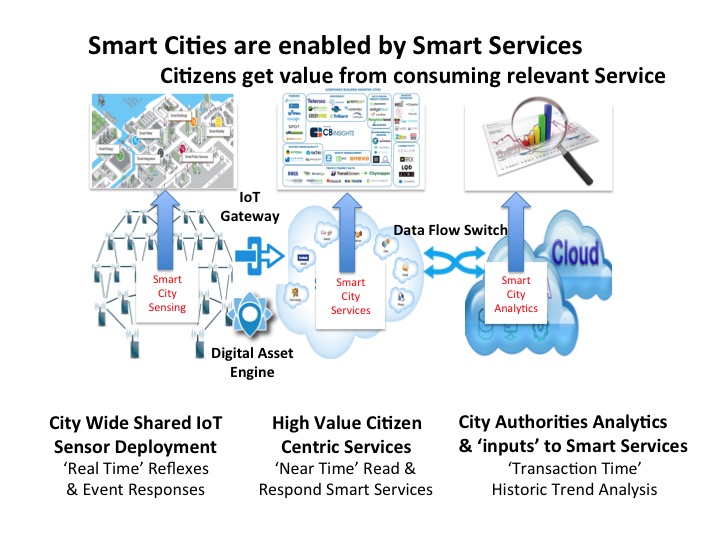
      The diagram below is at the heart of understanding the title and opening comment concerning multiple worlds colliding. The left and right hand sides are pretty clearly delineated by current technology vendors positioning and products, but it’s the center that is the new zone where much of the new business value around Smart Services will be created.

      Its not the possession of IoT data that creates value, its what business valuable action, or outcome that data produces that matters. In each of the three zones in the diagram the type of action and its value is different. An enterprise can benefit  from specific Business value delivered in each of the three zones, but a real ‘transformation’ requires integration across all three.

      Industrial Automation companies, focussed on the left hand side of the diagram, include the suppliers of the heating, cooling, lighting, and a mass of utility equipment that is built into a modern multi-story office building. The numbers of sensors that are already being deployed currently number in the hundreds, but its rising fast as cheap battery powered wireless sensors are being added in increasing numbers.

      In an example of a new build ‘smart’ forty-floor office in London, the planning expects in excess of 20,000 building sensors producing more than 3 petabytes of data annually. The IT community will see this as the ultimate requirement for Big Data analytical tools, but can they really handle 20,000 individual inputs of a few Kbits each when more than 75% of the traffic will merely confirm the status quo is maintained?

      The Industrial Automation vendors working with OT community see a very different picture, with those data flows being used to trigger ‘reflex actions’ such as increasing a selected heating output in reaction to a developing ‘cold spot’. Even more important would be a reaction to a fire alarm releasing fire doors, setting off sprinklers and shutting off power.

      This mass of low value building sensors will be interconnected by low capacity, and power, Grid Networks, such as ZigBee, using a master node to distribute the processing tasks. In short there is little, maybe nothing that relates in the Network, Processing, or even data model of IT systems. This is a pure Machine-to-Machine, or M2M, environment. However as machines can’t repair themselves, (though ‘smart’ automation can limit the impact by bypassing failed equipment), there is a need to connect events with ‘Services’ that can initiative Engineers and repairs.

      Cloud based Services that support, empower and improve the efficiency of people are the prime functionality and business value delivered by the middle of the three zones. These should not be confused with the current Building Management and Service Engineering applications already provided by IT.

      Building Management is a very ‘hot’ market for IoT currently; immediately recognizable is the interest around energy consumption with increasingly expensive and regulatory ‘green’ energy. Energy is typically only 2 to 3% of the overall building management costs, against machinery maintenance running at around 8 to 10%. The biggest reward lies in shifting to preventative maintenance by using IoT sensing to track individual equipment’s operating efficiency to decide when, and what type of optimized action is required, rather than recording planned time based processes in the traditional manner.

      Salesforce is recognized for its longtime focus on cloud based ‘Services’ to make customer-facing people more responsive to real time activities and that includes Service Engineers. Over the last year Salesforce have supported IoT sensor event data inputs to their Services, and in the last month SAP has introduced a Preventative Engineering capability linked to their SAP IoT Initiative. Exactly how the integration that links these capabilities, and those of the final zone of traditional IT, with IoT sensors and grid networks has been examined in detail in previous blogs, most recently in the importance of ‘Final Mile’ architecture in pilots.

      Both the Industrial Automation and Service Management zones share the common trait that the time to read and respond with a successful outcome is as near ‘real-time’ as possible. Indeed ‘timely optimization’ is the critical element in creating the business value. This is in contrast to traditional IT that is largely based on recording what has happening, and analyzing historic data to find value from identifying trends that have already happened.

      The integration with the third zone shown on the right hand side of the diagram, that of traditional IT, is made by methods familiar to IT practitioners around data. As the Data formats and protocols are often different API engines are frequently required. An important point is that this is consolidated data, collected and collated, from the action outcomes made in the first and second zones. Analyzing over a period events that led ‘outcomes’, and ignoring null reports, produces management reporting. Similarly Service contract actions can be captured and recorded with in existing applications.

      Though OT is equally failing to appreciate the implications of how to apply analytics at scale to operational Industrial Automation systems the issues facing IT, who are expected to be at the center of an Enterprises use of technology are are more concerning.

      Few IT practitioners appreciate the massive numbers of small sensing devices currently being deployed, nor the use of new types of networks and protocols, rather than the IP based networks that IT understands. Add to this the overwhelming volume of extremely small data packets containing no contextual information such as location, or type of sensor, etc. that depart from the expected ‘Big Data’ models.

      Unimagined numbers of IoT devices flooding miniscule data packets with no contextual data simply do not suit current big data analytical tools, nor will the traffic be welcomed on critical enterprise networks. Neither can processing be carried out in time frames to s address the key IoT sensing business benefit of optimized real time events and outcomes. Whilst none of these challenges are any more insurmountable than those of past generations of technology innovation waves, but they do require more recognition and understanding of adding and integrating IoT and IoT Smart Services within the enterprise. 

      IT should be leading the path towards a new enterprise architecture that will again unite new business and technology capabilities. Just as in the past, when the advent of Client-Server, Web and Mobility technologies all imposed similar changes.

      Its time to get beyond the current myopic views of the different elements, or zones, of IoT and start to form enterprise wide working parties to pilot around proven Business beneficial requirements an integrated manner! 

      New C-Suite Data to Decisions Future of Work Innovation & Product-led Growth Tech Optimization