Results

Congrats to the 2019 SuperNova Award Winners

Congrats to the 2019 SuperNova Award Winners

Last night at the ninth annual awards Gala at CCE, our team unveiled the winners of the 2019 SuperNova Awards. This was one of our toughest years to choose just one winner in each category; the competition was top-notch.

As digital change continues to dominate the agenda of the global C-Suite, organizations across all industries and geographies must make deeper investments to create true impact. These case studies embody the necessary leadership and teaming talents needed as we move from the post-digital divide into winner-take-all networks.

If you missed the gorgeous gala last night, I’m happy to share the results with you. Congrats to the 2019 winners in each category.

2019 SuperNova Award Winners

AI & Augmented Humanity
Singapore Management University

Data to Decisions
GE Aviation

Data-Driven Digital Networks & Business Models
IBM Food Trust

Digital Marketing & Sales Effectiveness
Sportable Scoreboards

Digital Safety, Governance & Privacy
Sovrin Foundation

Future of Work: Employee Experience
Walgreens

Future of Work: Human Capital Management
Special Olympics
SiteOne Landscape Supply

Next-Generation Customer Experience
Posadas

Tech Optimization & Modernization
University of Pisa

The SuperNova Award winners were selected by a combination of industry judging and public polling. If you are interested in submitting a case study for our tenth anniversary, be sure to look at this year’s winners and prep your nomination for next year. The nominations open in Spring 2020.

For more information, visit https://www.constellationr.com/events/supernova/2019.


Data to Decisions Digital Safety, Privacy & Cybersecurity Future of Work Marketing Transformation Matrix Commerce New C-Suite Next-Generation Customer Experience Tech Optimization Chief Customer Officer Chief Digital Officer Chief Executive Officer Chief Financial Officer Chief Information Officer Chief Marketing Officer Chief People Officer Chief Procurement Officer Chief Revenue Officer Chief Supply Chain Officer

Are you prepared for the HHS fines?

Are you prepared for the HHS fines?

The University of Rochester Medical Center (URMC) has agreed to pay $3 million to the Office for Civil Rights (OCR) at the U.S. Department of Health and Human Services (HHS), and take substantial corrective action to settle potential violations of the Health Insurance Portability and Accountability Act (HIPAA) Privacy and Security Rules.

#Chousangle - This is an area where, on the surface, it looks like an easy fix where every device such as a thumb drive and laptop should be encrypted. Encryption of the device is the easier part. The challenge comes down to setting up a security program, as stated in the correction action agreement.  

A third party consulting entity will conduct the risk analysis to identify the gaps. Once you have the gaps identified, the technical debt on the network infrastructure will be identified.  

  • Will budgeted be allocated to support the next generation secured infrastructure or will the health system take 3-5 years on the infrastructure redesign and implementation, creating a constant state of hardware refresh? 
  • Enterprise risk needs an organizational owner. Who is accountable for enterprise risk? This has to be the COO or someone leading operations and not the CIO.
  • An important key area is to design a security program, including the right governance structure vs. checking off the box on the audit. 
  • Will research institutions comply with the organization's security protocol?
  • How will we hold employees accountable for failing to comply with the security guidelines?

These are just a few notes off the top of my head. What are your thoughts?

Tech Optimization Data to Decisions Future of Work Innovation & Product-led Growth Next-Generation Customer Experience AR Chief Information Officer

DisrupTV Live: Niche Down — How Differentiation Becomes Legendary

DisrupTV Live: Niche Down — How Differentiation Becomes Legendary

DisrupTV Live: Niche Down — How Differentiation Becomes Legendary

In this live DisrupTV segment, hosts R “Ray” Wang and Vala Afshar facilitate a dynamic discussion with Christopher Lochhead—renowned CMO-turned-category designer and coauthor of Niche Down—and Heather Clancy, award-winning journalist and coauthor. Together, they unpack the power of carving a radical niche, explaining how differentiation fuels category design, legendary brands, and meaningful impact.

Featured Guests

  • Christopher Lochhead – Veteran CMO, entrepreneur, and bestselling author (with Niche Down and Play Bigger) whose career-defining philosophy is category design and owning a niche. lochhead.com+1
  • Heather Clancy – Editorial Director at GreenBiz Group, acclaimed journalist and coauthor, exploring how "being different" can be a business superpower.

Key Takeaways

  1. The power of being different: Lochhead argues that "being different is the best way to become legendary", urging audiences to niche down instead of competing in crowded spaces. 
  2. Create your own category: Differentiation means designing a new market where you define the rules rather than competing in existing ones. The category makes the brand, not the other way around.
  3. Niche brings clarity: Heather emphasizes how focusing on the intersection of your skills and vision empowers authentic expression and purposeful positioning. 
  4. Category design is strategic storytelling: Lochhead frames category design as teaching customers what to believe—reframing problems and shaping categories through narrative.

Notable Quotes

  • “Being different is the best way to become legendary.” — Christopher Lochhead
  • “Category makes the brand.” — Christopher Lochhead
  • “What makes you different? What did you choose to do that others didn’t?” — Heather Clancy

Final Thoughts

This session clarifies that niching down isn’t limiting—it’s elevating. By owning a specific category and crafting a compelling narrative, individuals and organizations can move beyond competition and shape markets. Lochhead and Clancy remind us that true impact comes by leaning into what sets us apart—and turning difference into distinction.

Related Episodes


Future of Work Marketing Transformation New C-Suite Tech Optimization Chief Customer Officer Chief Marketing Officer Chief Digital Officer On DisrupTV <iframe src="https://player.vimeo.com/video/371539345?badge=0&amp;autopause=0&amp;player_id=0&amp;app_id=75194" width="1280" height="720" frameborder="0" allow="autoplay; fullscreen" allowfullscreen title="DisrupTV Live: Niche Down with Christopher Lochead and Heather Clancy"></iframe>

The Future of Finance: Automation, Strategy & Transformation | DisrupTV Ep. 169

The Future of Finance: Automation, Strategy & Transformation | DisrupTV Ep. 169

The Future of Finance: Automation, Strategy & Transformation | DisrupTV Ep. 169

In DisrupTV Episode 169, hosts R “Ray” Wang and Vala Afshar engage with three thought leaders to explore how automation, strategic alignment, and digital transformation are reshaping the finance function.

Featured Guests

  • Aaron Harris – CTO at Sage, focusing on technological advancements in financial operations.
  • Grant Halloran – CEO at Host Analytics, emphasizing the alignment of financial strategies with business objectives.
  • Nicole France – VP & Principal Analyst at Constellation Research, analyzing the evolving role of finance in digital transformation.

Key Takeaways

  1. Automation in Financial Operations: Aaron Harris discusses how automation is transforming financial processes, enabling organizations to achieve greater efficiency and accuracy.
  2. Strategic Alignment of Finance: Grant Halloran highlights the necessity of aligning financial strategies with overarching business goals to drive value and growth.
  3. The Evolving Role of Finance: Nicole France explores how the finance function is evolving from a traditional support role to a strategic partner in business transformation.

Notable Quotes

  • “Automation is not just about efficiency; it's about enabling better decision-making.” — Aaron Harris
  • “Finance must be aligned with business strategy to drive true value.” — Grant Halloran
  • “The future of finance is about being a strategic partner, not just a number cruncher.” — Nicole France

Final Thoughts

This episode underscores the critical role of automation, strategic alignment, and digital transformation in the future of finance. Organizations that embrace these elements are better positioned to drive value and navigate the complexities of the modern business landscape.

Related Episodes


New C-Suite Future of Work Digital Safety, Privacy & Cybersecurity On DisrupTV <iframe width="560" height="315" src="https://www.youtube.com/embed/aRAkB-E8Y5Y?si=XyKJ5FHp6KIqEvzC" title="YouTube video player" frameborder="0" allow="accelerometer; autoplay; clipboard-write; encrypted-media; gyroscope; picture-in-picture; web-share" referrerpolicy="strict-origin-when-cross-origin" allowfullscreen></iframe>

Why I'm a CDP Skeptic...And What We Need Instead

Why I'm a CDP Skeptic...And What We Need Instead

If you’ve read any of my other posts, you know how passionately I believe that customer experience should be the organizing principle and top priority of every business. Focus on customers is, to say the least, highly correlated with success. Customer understanding—knowing your customers and anticipating their needs even before they might themselves—makes it possible to design consistently good customer experiences that build successful businesses.

One of the most crucial resources for customer understanding is data. You might be forgiven, then, for thinking that I’d be a fan of customer data platforms (CDPs). After all, they promise to pull together all of a company’s customer data from any number of sources to help analyze, predict, and respond to customer behaviors in ways that improve marketing results.

But I’m not. Here’s why:

  • We live in the real world, where customer data is imperfect, and continuously imperfect at that. The pace of change means that no customer data source can ever be perfectly up to date and consistent. And besides, although we’re getting better at prediction all the time, customers will still do things we don’t expect them to, or when we don’t expect them to. Implementing a CDP to fix that is believing in a fairy tale. Only a company in stasis is going to have a totally consistent view of customers…and a company in stasis is not likely to be a going concern for very long.
  • There’s never been one consistent source of enterprise data for any length of time. Just as customer data is continuously imperfect, so is the structure of most companies. Mergers and acquisitions, expansion into new lines of business or geographies, new strategies, experimentation with new processes or technology approaches—all of these things mean that having only one source of data and insight is, and will likely forever be, an elusive goal.
  • Marketing isn’t the only part of the business that needs a holistic view of customers. Analyzing and taking action on customer data only from a marketing perspective completely misses the bigger objective. Customer experience spans all aspects of a business. Anyone who interacts with customers needs to have access to a consistent view of those customers and insights that make each interaction better. Creating yet another data silo, especially when it purports to be a single source of customer information, is a short-sighted, ill-advised investment.
  • Different departments and teams need different views of the same customer data. What’s most useful to customer service may be very different to what’s top priority for sales teams. What we need to know about customers varies with context. Insights that drive planning, strategy, or product development, for example, have a totally different scale and cadence to what informs effective real-time marketing efforts. Each part of the organization has its own lens or filters to get to the most valuable customer insights for them, but all need to work from a holistic, shared view. And while we’ll never achieve perfection, customer data should be highly consistent no matter who’s using it.

While the promise of CDPs falls short of the mark, these are fundamental challenges that need resolution. So what does getting it right look like?

Here’s my view on the key characteristics of enterprise-grade customer data management systems:

  • Their design is driven by both a solid foundation of good data management practices and a clear set of use cases across different parts of the organization. In other words, they’re not just repositories, they’re also tools that flow seamlessly into all of the enterprise systems that require customer insight to operate effectively.
  • They can adapt to support a wide range of needs and uses, beyond those that we have already identified today.
  • They can accommodate both deterministic customer data (from systems of record) and probabilistic customer data (predictions based on observed behavior)
  • They support different cadences, from real- or near-real-time to periodic, depending on the use case.
  • They provide the ability to identify customer segments that meaningfully inform the most effective ways to interact and engage with individuals—regardless of the type of interaction (e.g., marketing, sales, service). That’s based on more than just analyzing behaviors from a marketing perspective.
  • They ensure that personally identifiable information (PII) is only used where it needs to be and where it’s permitted, whether it’s a question of regulatory requirements or customer preferences.
  • They draw from, coexist with, and feed into the tools that different teams use to get their work done.
  • They help to establish the metadata structures that will improve effective data analysis and use over time.
  • They’re straightforward to use across departments and functions.

This may all sound as much like a fairy tale as the promise of CDPs. The good news is that many companies and a whole lot of sharp minds are working on the problem. Those attempting to tackle it range from startups to established players (some of whom are already in the, ahem, CDP category) to large enterprise technology providers.

Part of the challenge is semantic. The term CDP has become muddied by undelivered promises and limited understanding of the need. Many of the more recently announced offerings in the area of customer data management have been unofficially described as “CDPs that aren’t just CDPs.” These are much more than just data management systems, however. They aim to provide intuitive tools for deriving and applying customer insights, not just consolidating customer data.

The pace with which players in this fast-evolving space are tackling the dual challenges of data management and applied use gives me hope that we’ll soon have some much more effective solutions to putting customer understanding at the heart of business operations. While I suspect we’ll never get to one single system for all customer data, there’s every reason to believe in practical solutions to this large-scale problem in the near future.

In the meantime, do some serious tire-kicking before you invest. Define the use cases that are most crucial for your organization to address immediately. Push hard to understand what a vendor's offering includes today, out of the box, and what's on the near-term roadmap.

Data to Decisions Marketing Transformation Next-Generation Customer Experience Tech Optimization Chief Customer Officer Chief Executive Officer Chief Information Officer Chief Marketing Officer Chief Digital Officer Chief Revenue Officer

Analytics For Applications: Three Next-Generation Options

Analytics For Applications: Three Next-Generation Options

Application-integrated cloud analytics offerings were announced by Oracle, SAP and Workday this fall. Here’s a closer look at when they’re a good fit. 

Applications and analytics have complemented each other for decades, but this fall we’ve seen a fresh wave of announcements about offerings built for the cloud.

The announcements, by Oracle, SAP and Workday, build on larger analytics initiatives they’ve each had in the works for years. At Oracle it’s the company’s next-generation Oracle Analytics (OA) platform, anchored by the Oracle Analytics Cloud. The SAP Analytics Cloud has evolved since its 2015 introduction to become the company’s next-generation product for BI, augmented analytics and planning. Now it’s complemented by the broader SAP Cloud Services platform and a new data warehouse service. At Workday, data and analytics investments have steadily increased from a partnership with Datameer to the 2016 acquisition of Platfora to Workday Rising announcements around its Prism Analytics platform.

Here’s a deeper dive into the announcements along with my take on how to size up the fit you’re your organization.

Analytics for Applications

Reporting capabilities have been tied to applications since the earliest days of the mainframe. Today’s demands for insight are far more sophisticated and, in the latest wrinkle, they must be built for the cloud. Tight integration with applications and cloud deployment are what these three announcements have in common:

Oracle introduces Analytics for Applications. Announced at Oracle Open World 2019 in September, Oracle Analytics for Applications are SaaS apps designed to complement Oracle Fusion cloud applications. First up is Oracle Analytics for Fusion ERP, which is now generally available. Oracle Analytics for Fusion HCM is expected in Q1 2020 and Fusion SCM and CX and NetSuite are on the roadmap. Under the hood, the the SaaS apps will combine Oracle Analytics Cloud with a bundled instance of the two-year-old Oracle Autonomous Data Warehouse service as well as supporting data models, dashboards and key performance indicators. The data pipeline from Oracle Cloud apps to the Autonomous Data Warehouse is managed by Oracle, and Oracle’s Integration Platform as a Service is also available to move data from third-party apps.

Oracle Analytics for Applications offerings will include instances of the Autonomous Data Warehouse and supporting data integration services.

The minimum per-user, per-month licensing level of OA for Fusion ERP required to get the bundled Autonomous Data Warehouse instance is 20 users. At this entry level the data warehouse instance includes 2 OCPUs (Oracle Cloud Processing Units) and 1 Terabyte of storage. Oracle says this is more than enough capacity for Oracle Cloud ERP deployments of that size. Oracle would, of course, be only too happy to add more users, storage and compute capacity as required, and data-integration services are available to bring in data from third-party sources batch ETL style.

SAP extends its analytics cloud. SAP and Oracle seem to be squaring off with similar offerings and even similar names: SAP Analytics Cloud (SAC) and Oracle Analytics Cloud (OAC). SAP embedded SAC into the user interface and user experience of S4/HANA ERP last year, and it’s currently working on embedding SAC into SuccessFactors. Oracle answered with its OA for Fusion ERP release in September and expects its OA for Fusion HCM release early next year. (One notable difference between SAC and OAC is that planning is an integrated aspect of SAC whereas Oracle offers planning through separate cloud services.)

SAP touts the elastic scalability and hybrid- and multi-cloud-friendly virtual data access of its new SAP Data Warehouse Cloud.

At the October 8-10 TechEd event in Barcelona, SAP announced the general availability of SAP Data Warehouse Cloud, a part of its broader SAP HANA Cloud Services platform, which also includes SAP Analytics Cloud and SAP HANA Cloud. The data warehouse service, which is based on HANA, of course, parallels Oracle’s “for Analytics” combinations with its Autonomous Data Warehouse service. Departing from traditional ETL, SAP Data Warehouse Cloud uses data virtualization and a customer-managed semantic layer approach touted as improving reporting flexibility and virtualized querying across hybrid and multi-cloud deployments without always requiring data movement.

Workday bundles dashboards, adds apps. Workday is taking a different approach, bundling a drag-and-drop, analytic Discovery Board tool with its Human Capital Management and Financial Management applications at no extra charge. The optional, extra-cost offering, announced in October at Workday Rising, will be augmented analytic applications, starting with Workday People Analytics. Part of the appeal is keeping potentially sensitive HR data and (once a finance app is available) financial data within the confines of the security and access-control framework of the related applications.

Workday People Analytics is an augmented analytic app that complements Workday HCM.

Workday’s included Discovery Boards and optional applications are all built on Workday’s Prism Analytics platform, which is a cloud-based data hub. This hub is built on Workday application data, but you can also load third-party data. Prism has big data (non-relational) roots (by way of the 2016 Platfora acquisition), but Workday is adding fast relational querying capabilities by way of columnar Parquet data storage.

My Take on Analytics for Apps

Should your application choices determine your analytics strategy, or are these choices best made independently? In my view it all depends the recency of your investments in analytical tools and platforms and the diversity of your applications and data management infrastructure.

Oracle and SAP both have long histories in data management and business intelligence, and with their respective announcements they’re clearly looking to expand from their beachheads in the cloud. The challenge is that many Oracle Business Intelligence Enterprise Edition and SAP Business Objects customers have already moved on to third-party alternatives. If a customer made the switch some time ago (as in, four or five years ago or more), those deployments may now be aging and vulnerable to replacement. Companies that have invested in rival analytics platforms more recently are far less likely to change course and start fresh on a new platform or split investments on two or more platforms.

The two other factors that might sway analytic investments are commitments to apps and investments in data management infrastructure. All-Oracle and all-SAP shops are less common than they used to be, but the more committed the organization is to Oracle or SAP apps and Oracle or SAP data management options, the more open they will be to OAC or SAC and related application content and warehouse services. If it’s an organization that went cloud years ago and is deep into using RedShift, Snowflake or other cloud-based data management options, I don’t see them going back.

This brings us to Workday, which, in contrast to Oracle and SAP, has a modest heritage in data management and analytics. Thus, it’s taking the sensible approach of giving away its app-integrated Discovery Board capabilities. That will give Workday customers – and particularly their analytics and data management teams — a start on using Prism Analytics. The hope is that these folks will gain familiarity and a comfort level with using Prism and will use it more broadly, perhaps even adding data from external sources. Meanwhile, Workday will be selling CHROs and CFOs on the integrated analytic applications it’s developing, starting with Workday People Analytics. These ancillary applications are designed around business questions and processes (reminding me of Siebel Analytic Apps, for those who remember those).

The Oracle and SAP offerings also have business appeal, too, with the inclusion of application-specific schema, key metrics and dashboards and the availability of industry content. But it’s a stack commitment verses an ancillary app offering. I see the Oracle and SAP offerings as a best fit for companies that are heavily invested in these vendors, and that will use these analytical platforms to meet most if not all of their analytical needs, not just those tied to ERP or HCM. Workday’s is a co-existence strategy with existing data management and analytics investments. What’s available and coming will complement HCM and financials, and it’s not built or intended to serve as broad BI, analytics and data management foundation.

Related Reading:
Oracle Reasserts Itself in BI and Analytics
Workday Unifies Its Approach to Machine Learning, Analytics and Planning
Augmented Analytics: How Smart Features are Changing Business Intelligence


Data to Decisions Tech Optimization Digital Safety, Privacy & Cybersecurity Innovation & Product-led Growth Future of Work workday SAP Oracle ML Machine Learning LLMs Agentic AI Generative AI AI Analytics Automation business Marketing SaaS PaaS IaaS Digital Transformation Disruptive Technology Enterprise IT Enterprise Acceleration Enterprise Software Next Gen Apps IoT Blockchain CRM ERP finance Healthcare Customer Service Content Management Collaboration Chief People Officer Chief Information Officer Chief Procurement Officer Chief Supply Chain Officer Chief Analytics Officer Chief Data Officer Chief Technology Officer Chief Information Security Officer

How should we treat facial recognition?

How should we treat facial recognition?

Various law makers -- such as the state of Illinois and the city of San Francisco -- are moving to restrain or prohibit facial recognition through specific legislation.  Evan Selinger and Woody Hartzog writing in the New York Times have called for a ban.  And now, the French privacy regulator CNIL appears to have found facial recognition trials in schools to be in breach of general data protection law. 

How should we look at face recognition and biometrics technology?  Does it need special policy & legal treatment, or is it already covered by general privacy law?  
In my view, most of the world already has an established legal and analytical framework for dealing with automated facial recognition.  We can see face matching as an automated collection of fresh Personal Data, synthesised and thence collected by algorithms, and along the way subject to conventional privacy principles.  Most global data protection laws are technology neutral: they don’t care how Personal Data ends up in a database, but concern themselves with the transparency, proportionality and necessity of the collection. 

Technology-neutral privacy legislation does not specifically define the term ‘collection’.   So while collection might usually be associated with forms and questionnaires, we can interpret the regulations more broadly.  

‘Collect’ is not necessarily a directive verb, so collection can be said to have occurred passively, whenever and however Personal Data appears in an information.  Therefore, the creation or synthesis of new Personal Data counts as a form of collection.  Indeed, the Australian federal privacy regulator is now explicit about “Collection by Creation”. 

So if Big Data can deliver brand new insights about identifiable people, like the fact that a supermarket customer may be pregnant, then those insights get much the same protection under information privacy law as they would had the shopper filled out a form expressly declaring herself to be pregnant. 
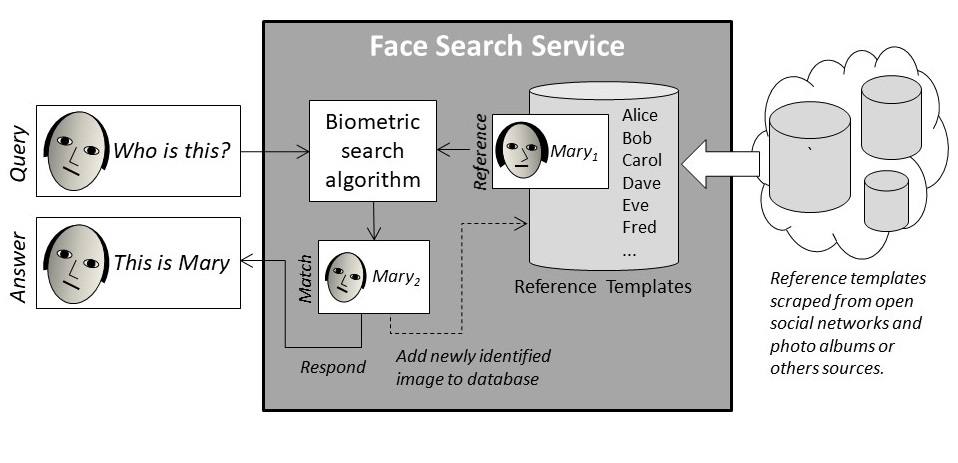
Likewise, if automatic facial recognition leads to names being entered in a database alongside erstwhile anonymous images, then new Personal Data can be said to have been collected.  In turn, the data collector is required to obey applicable privacy principles.  

Which is to say simply: if an organisation holds Personal Data, then unless it has the specific consent of individuals concerned, the organisation should hold as little Personal Data as possible, it should confine itself to just the data needed for an express purpose, refrain from re-purposing that data, and let individuals know what data is held about them.  

Data privacy principles should apply regardless of how the organisation came to have the Personal Data; that is, whether the collection was direct and explicit, or automated by face recognition.  If Personal Data has come to be held by the organisation thanks to opaque (often proprietary) algorithms, then the public expectation of privacy protection is surely all the more acute. 

Across cyberspace now, facial recognition processes are running 24X7, sight unseen, poring over billions of images -- most of which were innocently uploaded to the cloud for fun -- and creating new Personal Data in the form of identifications.  Some of this activity is for law enforcement, and some is to train biometric algorithms; I think it likely that other facial matching is being used to feed signals into people-you-may-know algorithms. But almost all facial recognition is occurring behind our backs, exploiting personal photos for secondary purposes without consent, and in stark breach of commonplace Data Protection rules. 
 

New C-Suite Data to Decisions Digital Safety, Privacy & Cybersecurity Distillation Aftershots Security Zero Trust AI ML Machine Learning LLMs Agentic AI Generative AI Robotics Analytics Automation Cloud SaaS PaaS IaaS Quantum Computing Digital Transformation Disruptive Technology Enterprise IT Enterprise Acceleration Enterprise Software Next Gen Apps IoT Blockchain CRM ERP CCaaS UCaaS Collaboration Enterprise Service developer Metaverse VR Healthcare Supply Chain Leadership Chief Information Officer Chief Marketing Officer Chief Digital Officer Chief Information Security Officer Chief Privacy Officer Chief Technology Officer Chief Data Officer

Data at the Edge: Human Insight, Experience Risk & Strategic Analytics | DisrupTV Ep.168

Data at the Edge: Human Insight, Experience Risk & Strategic Analytics | DisrupTV Ep.168

Data at the Edge: Human Insight, Experience Risk & Strategic Analytics | DisrupTV Ep.168

In DisrupTV Episode 168, hosts R “Ray” Wang and Vala Afshar bring together three experts to explore critical shifts in how organizations approach data and insight:

  • Tricia Wang, Co-founder at Sudden Compass, renowned for championing the concept of “thick data”—human insight that contextualizes numbers.
  • Esteban Kolsky, Principal & Founder at ThinkJar, advising how analytics and customer data intersect to drive experience risk management.
  • Steve Wilson, VP & Principal Analyst at Constellation Research, offering strategic frameworks that tie data initiatives to business outcomes.

Featured Guests

  • Tricia Wang — Evangelist for integrating ethnographic insights with data analytics to guide human-centric strategies.
  • Esteban Kolsky — Authority on experience risk and designing systems that anticipate customer behavior and safeguard brand trust.
  • Steve Wilson — Expert in translating technical analytics capabilities into understandable, actionable narratives for leadership.

Key Takeaways

  1. Humanize Data with “Thick Data” — Tricia Wang argues that qualitative, human-centered insights—what she calls "thick data"—are essential to making data meaningful and avoiding misinterpretation.
  2. Understand Experience Risk — Esteban Kolsky stresses that customer experience can be a source of risk. Organizations must use data to proactively assess customer behavior and mitigate trust erosion.
  3. Link Analytics to Strategy — Steve Wilson emphasizes that the true value of analytics lies in its connection to business value. Leaders must align data workflows with strategic goals rather than chasing favor metrics.
  4. Marrying Insight and Visualization — All guests underscored that analytics should go beyond dashboards—insight needs to be narrative-led and decision-ready.

Notable Quotes

  • “Numbers without context don’t tell the full story—thick data does.” — Tricia Wang
  • “Experience is the new frontier of risk; understanding it is the difference between loyalty and loss.” — Esteban Kolsky
  • “Analytics should illuminate what leadership already priorities, not distract them with noise.” — Steve Wilson

Final Thoughts

Episode 168 drives home this conviction: data becomes transformative when it embraces the human experience and aligns to real-world business challenges. Thick data, experience-risk framing, and strategic analytics help organizations move from reactive measurement toward proactive insight—and stronger outcomes.

Related Episodes


New C-Suite Future of Work Digital Safety, Privacy & Cybersecurity Chief Executive Officer Chief Information Officer Chief Digital Officer Chief Information Security Officer Chief Privacy Officer Chief Technology Officer On DisrupTV <iframe width="560" height="315" src="https://www.youtube.com/embed/5QWD-6lN8gY?si=rXZYXJ69CS5slYZJ" title="YouTube video player" frameborder="0" allow="accelerometer; autoplay; clipboard-write; encrypted-media; gyroscope; picture-in-picture; web-share" referrerpolicy="strict-origin-when-cross-origin" allowfullscreen></iframe>

Cloud ERP is dominating the discussions with healthcare providers.

Cloud ERP is dominating the discussions with healthcare providers.

Workday had their #wdayrising event that brought together their customers, prospective customers, partners, and industry analysts.  In recent years, the healthcare provider industry has spent the majority of its technology budget on the electronic medical records. This has led to a neglect of back-office enterprise resource planning (ERP) software, and, as a result, almost every healthcare provider organization now is evaluating a cloud ERP solution.  Healthcare providers are evaluating ERP platforms based on new sets of criteria in search of a solution to drive digital transformation. These criteria could be described as "postmodern ERP requirements."

I am impressive by growth in workday's healthcare position and the workday healthcare summit event attendance has grown every year showing a lot of new customers in the community.


The primary concern among healthcare providers with workday during the last few years was that it had a robust HCM and accounting component, but it lacked a supply chain module.  Now the supply chain module is ready, and we have seen many new live clients along with the list of potential healthcare full cloud ERP clients growing.  Here is a view of the live and upcoming live clients on the workday supply chain.

Top of mind for healthcare CxOs

  • Driving transformation and eliminating unnecessary expenses – The Workday supply chain module is designed for healthcare providers with inputs from many large healthcare provider organizations. Healthcare executives must utilize their ERP solutions as the platform to drive efficiency in supply chain. Areas of focus will be on optimizing their pricing structure with the manufactures, enhancing their charge capture capabilities, and creating a mobile-first experience for the front-line supply chain staff to streamline the stocking, par counting, and other areas of the operation.
  • Organization talent and insight – The cost of external recruitment in a tight labor market that currently has a talent shortage is very tough and expensive. HR leaders want insights into their employees to increase staff retention while promoting growth internally. Analytics and insight into the workforce will be key to driving an engaged organization workforce culture.
  • Grants management – One area that has always been tough for healthcare provider institutions with an extensive research operation is managing grants. The grants management feature in the financial management module will help capture the accurate information on tracking grants before it is awarded and post-grant for budgeting, staff utilization that is working clinically and on the research side, and reporting.
  • Data-Driven – Healthcare organizations strive to be a data-driven organization, and they are focusing on providing the highest quality of care at the lowest cost. Enhanced ERP analytics will help CxO and department manager gain insight with better tools.

#chousangle

  • Cloud ERP adoption will be just as hot as the electronic medical record (EMR) implementation wave as organizations focusing on their transformation journey.
  • Early adopters of the cloud ERP have workday HCM while utilizing another system for finance and supply chain.  Will these organizations have the optimal data integration set up for driving operational efficiency, or will there be another wave of implementation to move towards an integrated platform?
  • Healthcare providers have a choice to make in selecting their enterprise analytics platform since they have many different analytics systems in the portfolio.  Will they trust the cloud ERP analytics platform at the enterprise level or look at another solution?
  • Workday credentials using blockchain technology can be a game-changer not for just HR on validating skills and credentials, but also for the clinical staff.  Workday credentials can be the source of truth for identity access management.   Healthcare organizations traditionally rely on their HCM system as the source of truth for employee information.  Now with the workday credentials, it is a prime opportunity to tie in roles and system access management, which is an immature area for healthcare providers.
New C-Suite Tech Optimization workday Chief Financial Officer Chief People Officer Chief Information Officer Chief Procurement Officer Chief Supply Chain Officer Chief Revenue Officer

Reimagining Education, Blockchain & Public Engagement | DisrupTV Ep. 167

Reimagining Education, Blockchain & Public Engagement | DisrupTV Ep. 167

Reimagining Education, Blockchain & Public Engagement | DisrupTV Ep. 167

In DisrupTV Episode 167, hosts R “Ray” Wang and Vala Afshar lead a thought-provoking conversation with three visionary leaders. Together, they examine how education, technology, and civic institutions are transforming to meet the needs of a rapidly evolving world.

Featured Guests

  • Hunt Lambert — Dean of Continuing Education and University Extension at Harvard University, spearheading programs that empower adult learners and professionals to adapt to new career landscapes.
  • Sheila Warren — Head of Blockchain and Distributed Ledger Technology at the World Economic Forum, leading conversations on ethical adoption, governance, and global impact of blockchain.
  • Phillip Long — Special Advisor at Arizona State University, innovating at the intersection of technology, education, and public sector transformation.

Key Takeaways

  1. Lifelong Learning is the Future of Education. Hunt Lambert highlights how continuing education programs provide flexibility, accessibility, and relevance for professionals seeking career adaptability.
  2. Blockchain Offers New Governance Models. Sheila Warren emphasizes blockchain’s potential to redefine trust and accountability, but insists that adoption must be accompanied by robust ethical frameworks.
  3. Public Sector Innovation is Essential. Phillip Long explores how educational and civic institutions can embrace technology to deliver services more inclusively and efficiently.
  4. Bridging Innovation with Society. All guests underscore the importance of aligning technology and education with the public good, ensuring equitable access and long-term impact.

Notable Quotes

  • “Education doesn’t end at graduation—it’s a lifelong journey.” — Hunt Lambert
  • “Blockchain is only as powerful as the governance systems built around it.” — Sheila Warren
  • “The future of public service depends on designing for adaptability and inclusion.” — Phillip Long

Final Thoughts

Episode 167 makes it clear: innovation only matters when it serves society at large. Whether it’s reimagining education, building ethical frameworks for blockchain, or redesigning public institutions, leadership in these areas requires a blend of vision, empathy, and accountability.

Related Episodes


Data to Decisions Future of Work Marketing Transformation New C-Suite Next-Generation Customer Experience Tech Optimization Chief Executive Officer Chief Financial Officer Chief Information Officer Chief Marketing Officer Chief Digital Officer On DisrupTV <iframe width="560" height="315" src="https://www.youtube.com/embed/wrCfasIkuRI?si=HYzA9Mx6YB2DTRVK" title="YouTube video player" frameborder="0" allow="accelerometer; autoplay; clipboard-write; encrypted-media; gyroscope; picture-in-picture; web-share" referrerpolicy="strict-origin-when-cross-origin" allowfullscreen></iframe>