News Analysis: Why 2025 Became The Age of AI
Executive Summary
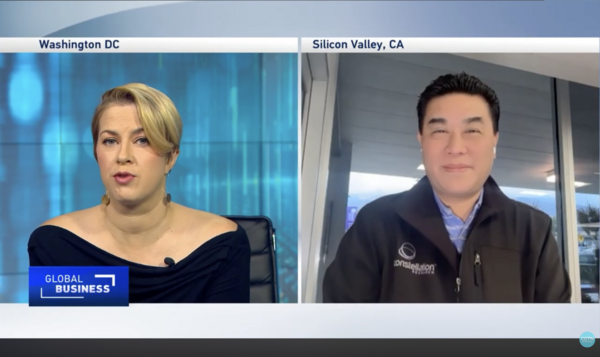
From AI breakthroughs to infrastructure investments, 2025 reshaped the tech landscape. CGTN's Sally Ayhan spoke to Ray Wang, Principal Analyst at Constellation Research, about the year's biggest tech milestones and what's driving competition heading into 2026.
Source: CGTN America
The Biggest AI Breakthroughs In 2025 Came Fast and Furious
AI dominated and permeated every aspect of our lives in 2025. Generative AI moved to the mainstream and models improved ability to process text, images, audio and video. This multi modal ability to analyze and create content improved. The shift from generative to Agentic AI showed enterprises that they could automate work processes and start to accelerate decision velocity. Humanoid robots made progress and raised hopes in the west that Physical AI would be ready in time as aging populations faced lower birth rates. Cybersecurity had breakthroughs in offense and defense for AI driven attacks.
Billions In Infrastructure Changed The Competitive Landscape
Big tech poured billions into infrastructure - chips, power and data centers. The impact on the venture capital, private equity, and startup funding changed forever. In fact, the battle for data center dominance took the market by surprise. Data centers outstripped commercial real estate as the largest category for investment. Data centers drove over $61B in deals and investment for 2025. The Amazons, Googles, Microsofts, Meta, and others dominated investments while NeoClouds such as CoreWeave, Oracle, and others added to the frenzy.
China’s major players Alibaba, Tencent, ByteDance, DeepSeek, Zhipu AI, Baichuan And others pledged investments of up to $70B in data center expansion for 2026. What we learned in 2025 was that natural resources and real assets have more value than ever as power, water, real estate, and critical minerals are the linchpins to any AI project.
Market Sentiments Towards AI Fluctuated From Short Term Gain to Long Term Pain
Investor pushback questioning AI's return of investment picked up in the Fall of 2025, after nine months of giddiness. There were some reports that showed AI burnout or overload but those were short lived. Companies with real AI success showed 10X to 100X gains and outpaced those who waited too long. Those dabbling are following behind A class of AI exponentials who have emerged to outclass competitors who do not have AI capabilities. Ultimately, AI is a game of long term investment for a winner takes all market.
China Shows Strong AI Development
Constellation Research estimates $150B in AI industry value as AI is being embedded In smart cities, llogistics, healthcare, pharma Agriculture, robotics, and consumer chatbots into China. China's growth in embedding AI into real economic sectors was quite significant by all counts. From AI models, semiconductors, robotics, over $125B in state funding went to companies such as DeepSeek, Huawei, Alibaba, Tencent, and Zhipu AI. Alibaba Tongyi and Qianwen took off as Open Source LLMs had their moment.
AI robots like Agibot took hold as the race for humanoid robots showcased not only how far they have come but also their major limitations. Huawei launched the Ascend 910 chip. Meanwhile, DeepSeek R1 and Wudao 3.0 plowed ahead with open Source LLMs. Overall the race between China and the US was quite competitive with the US slightly ahead.
The Forecast For 2026 Looks Brighter and Bolder
Heading into 2026, AI agents and autonomous workflows are expected to grow rapidly. Expect leadership to focus on a few areas such as chip dominance. Expect faster chips, more power efficiency, and expansion of TPU's for inference. getting faster chips, TPU advancements. On the model adoption front, the battle for Chinese Open Source vs Western Models and their ecosystems will be decided by the developers.
In the area of data dominance, the battle for data sets will increase as companies scramble for data sources to feed the voracious appetites of models and the constant updating of signals. The emergence of Data Inc companies and their business models will come to fruition in late 20206.
Real world ROI will be prevalent in every outcome based conversation. The winners will achieve exponential efficiency and infinite possibilities.
Expect Fierce Rivalry In The China vs US AI War
The race continues on. This battle is about mass adoption and investment. China has the lead on power efficiency and open source LLMs The US has the models, the chips, and market ecosystems The real question is who will have the better business models and which system will be bankrupt first from AI investments and which countries will have the greatest returns. This will be what we will be watching for in 2026.
Your POV
What were your top highlights for 2025? What are your wishes for 2026?
Add your comments to the blog or reach me via email: R (at) ConstellationR (dot) com or R (at) SoftwareInsider (dot) org. Please let us know if you need help with your strategy efforts. Here’s how we can assist:
- Working with your boards to keep them up to date on technology and governance.
- Connecting with other innovation minded leaders
- Sharing best practices
- Vendor selection
- Implementation partner selection
- Providing contract negotiations and software licensing support
- Demystifying software licensing
Reprints can be purchased through Constellation Research, Inc. To request official reprints in PDF format, please contact Sales.
Disclosures
Although we work closely with many mega software vendors, we want you to trust us. For the full disclosure policy,stay tuned for the full client list on the Constellation Research website. * Not responsible for any factual errors or omissions. However, happy to correct any errors upon email receipt.
Constellation Research recommends that readers consult a stock professional for their investment guidance. Investors should understand the potential conflicts of interest analysts might face. Constellation does not underwrite or own the securities of the companies the analysts cover. Analysts themselves sometimes own stocks in the companies they cover—either directly or indirectly, such as through employee stock-purchase pools in which they and their colleagues participate. As a general matter, investors should not rely solely on an analyst’s recommendation when deciding whether to buy, hold, or sell a stock. Instead, they should also do their own research—such as reading the prospectus for new companies or for public companies, the quarterly and annual reports filed with the SEC—to confirm whether a particular investment is appropriate for them in light of their individual financial circumstances.
Copyright © 2001 – 2025 R Wang and Insider Associates, LLC All rights reserved.
Contact the Sales team to purchase this report on a a la carte basis or join the Constellation Executive Network
R “Ray” Wang is the CEO of Silicon Valley-based Constellation Research Inc. He co-hosts DisrupTV, a weekly enterprise tech and leadership webcast that averages 50,000 views per episode and blogs at www.raywang.org. His ground-breaking best-selling book on digital transformation, Disrupting Digital Business, was published by Harvard Business Review Press in 2015. Ray's new book about Digital Giants and the future of business, titled, Everybody Wants to Rule The World was released in July 2021. Wang is well-quoted and frequently interviewed by media outlets such as the Wall Street Journal, Fox Business, CNBC, Yahoo Finance, Cheddar, and Bloomberg. Short Bio R “Ray” Wang (pronounced WAHNG) is the Founder, Chairman, and Principal Analyst of Silicon Valley-based Constellation Research Inc. He…...
Read morePublished
Author