


Zoho revamps Zoho Analytics, could extend its reach
Zoho revamped Zoho Analytics with business context, including ontology and semantics, AI agents that specialize in analytics, governance and a unified platform that operate headless and extend into other applications.
Pricing wasn't disclosed, but given Zoho's history and current pricing Zoho Analytics will make a strong case for value. If successful, the revamped Zoho Analytics could extend its reach beyond its own platform.
Zoho Analytics, which has more than 100,000 businesses using the platform daily, will add the following in its major update.
- An intelligence layer that grounds AI agents in trusted data and business context across Zoho apps.
- Native ontology and semantic layers so AI agents understand business data, relationships, metrics and context.
- Ask Zia becomes a broad agent that orchestrates specialized agents for data analysis and preparation, modeling, visualization and coding in one interface.
- Governance and security controls for raw data as well as agent answers.
With the update, Zoho Analytics is serving the company's current ecosystem and connecting to a broader market. Zoho USA CEO Tony Thomas said the Zoho Analytics updates gives every AI tool in your business the context, metrics, and governance to deliver answers users can rely on."
Zoho Analytics models its structure on an enterprise's data with a semantic layer designed to give AI agents actionable and practical recommendations. Governance is at every step of the process, according to Zoho.
- Constellation ShortList™ Embedded Analytics and Intelligence Platforms for Cloud Applications
- Zoho Day 2026 themes to watch: ERP, SaaS, customer value, AI, sovereignty
- Zoho previews AppOS ahead of enterprise app avalanche
- Zoho just delivered the best SaaS defense vs. AI
The intelligence layer in Zoho Analytics enables Ask Zia to create agentic AI plans to take a user query and turn it into an analysis.
Customers can create specialized Zoho Analytics agents and work with multiple systems with model context protocol. Zoho Analytics is available on AWS, Microsoft Azure and Google Cloud as well as on-premises and hybrid cloud.
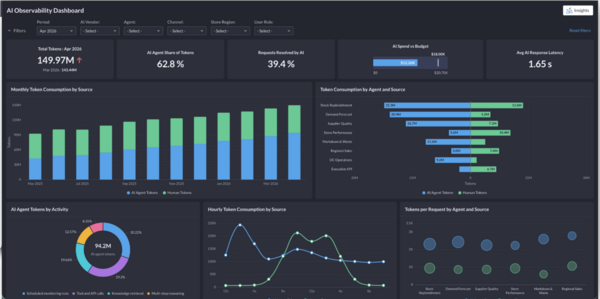
Key points about Zoho Analytics include:
- More than 30 new data connectors and more than 500 connectors already available.
- Expanded Zoho integrations with Zoho ERP, Zoho Spend, Zoho Shifts and other applications.
- Connectors to SAP, PayPal, Adobe Commerce, Twilio, Amazon Document DB, Google Cloud's AlloyDB and others.
- A semantic layer that supports multiple semantic models.
- Ask Zia becomes a super-agent that works across Zoho's ecosystem and an enterprise's ontology.
- Tools to create custom agents with governance and controls.
- AI agents that trigger actions and workflows directly via a workflow builder.
- The ability to go headless as well as a new command line interface. users can use Zoho Analytics from inside Anthropic's Claude via a plug-in.
- Governance tools including a data catalog, AI observability that track agents across workflows, a sandbox to develop analytics artifacts and agents before pushing them into production.
- New visualizations, reports, scenario analysis, forecasting models and data science studio.
As for the roadmap, Zoho said this iteration of Zoho Analytics is a foundation that will lead to dynamic business context, decision tracking, more integrations and a plan to become a unified data lakehouse that supports structured and unstructured data.
In a walkthrough of Zoho Analytics with analysts, Clarence Rozario, Zoho's head of data and analytics product suite, highlighted the following:
- The goal of Zoho Analytics is to move data to decisions to actions leveraging AI agents.
- Ask Zia now operates on a multi-agent architecture and orchestrate multiple sub-agents.
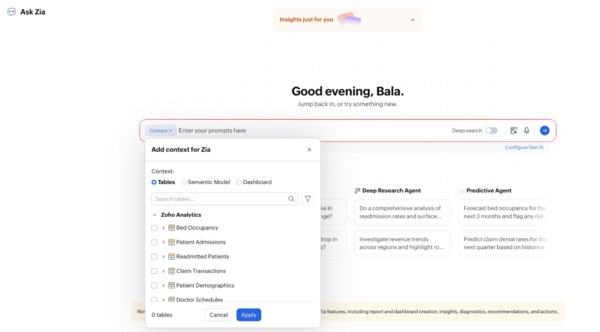
- In a retail demo, the agent went from what happened, to why, to what to do, "all in a single conversation happening in a data analysis agent."
- Custom agents will be critical to Zoho Analytics. "It is not sufficient to only offer your pre-packaged AI agents," said Rozario.
- Each step taken by a data pipeline agent needs confirmation. "If you don't like it, you can always take control and do the design yourself," said Rozario.
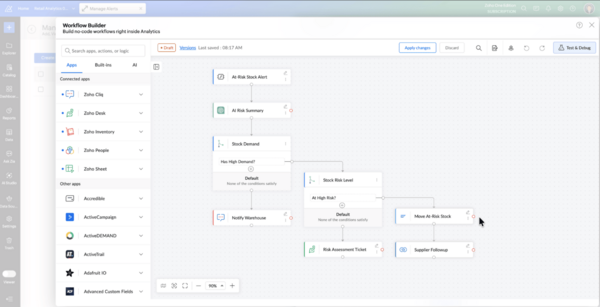
- In a demo, a Zoho agent was able to create a purchase order in SAP.
- Zoho Analytics was able to show the data lineage and the impact of any changes. If a prompt from an admin asks for AI agent usage and costs, a sandbox comes with a detailed versioning count and rollback controls.
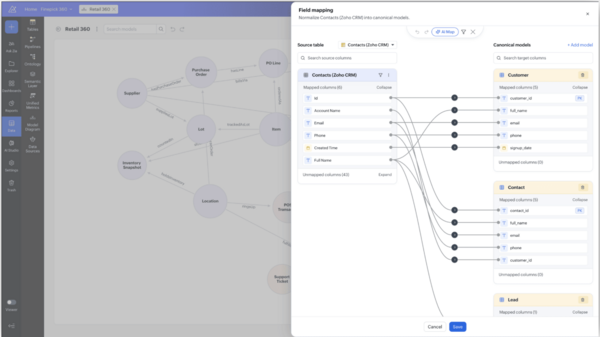
With the Zoho Analytics launch, Zoho is clearly aiming to be more of a platform that can appeal to manufacturing, retail and IT services as well as SMBs.
Constellation Research’s point of view
Mike Ni, an analyst at Constellation Research, said:
“The addition is the business-context layer is an important one for Zoho users. Zoho is bringing ontology and semantic modeling together with its analytical agents, so users can work from consistent definitions of customers, revenue, and other business measures. That matters as analytics moves beyond dashboards to support AI-driven applications and automated workflows. The question is how well Zoho supports maintaining those definitions as data and business requirements change.
With this release, Zoho is catching up on some individual AI features, but for customers and prospects, that is not the whole competitive story. Analytics, data management, business context, and automation are converging, and vendors are competing to deliver more of that full stack. Zoho's advantage is its integrated approach and its established business application ecosystem. My question is whether it can turn that into simpler deployment and better economics for customers.
The business-context layer is an important addition for Zoho, but semantics and business modeling are well established in analytics leaders. The competitive opportunity is in packaging. Zoho is bringing these capabilities together, along with data preparation, agents, and analytics, in one product. That can make advanced AI analytics easier for customers to adopt without assembling a larger technology stack.
The industry has spent years integrating data. Now, organizations need to keep data meaning consistent across systems, people, and AI agents. As more applications rely on that shared business context, every change can impact a slew of reports, decisions, and workflows. Zoho has added the foundations for sharing that context. The next opportunity is to automate monitoring of data changes, then maintain, test, and update those data pipelines and usage as systems and/or the business change.”
Larry Dignan is Editor in Chief of Constellation Insights at Constellation Research, where he leads editorial coverage focused on enterprise technology, digital transformation, and emerging trends shaping the future of business. He oversees research-driven news, analysis, interviews, and event coverage designed to help technology buyers and vendors navigate complex markets with clarity and context. ...
Read morePublished
Author
