


Salesforce still has pricing work to do
Salesforce's Dreamforce conference kicks off this week in San Francisco and rest assured there will be plenty of innovations ranging from Agentforce, Slack and Headless 360 and a broad platform narrative. What Salesforce should really rally around is having every customer leave Dreamforce with an understanding of how its pricing models work.
During our monthly BT150 call, one CxO was headed to Dreamforce. The main mission was to understand the pricing and how things can change when the company takes an internally built Agentforce agent external in about six months. So far, this company is using gifted credits from Salesforce to develop the Agentforce-build efforts.
This CxO is trying to model the usage when this Agentforce effort scales. And now Salesforce launched Claudeforce with Anthropic there's even more pricing confusion. The CxO's company is also an Anthropic customer. "I don't know if I'll get all the answers next week or not, but from what I read you can go in multiple directions," said the CxO.
Now Salesforce isn't the only enterprise SaaS customer trying to figure out the agentic AI pricing game. Vendors are pricing by license, seats, consumption and now outcomes. Salesforce has been ahead of many vendors with its willingness to experiment with pricing and the intersection of value, but customers have a lot to digest.
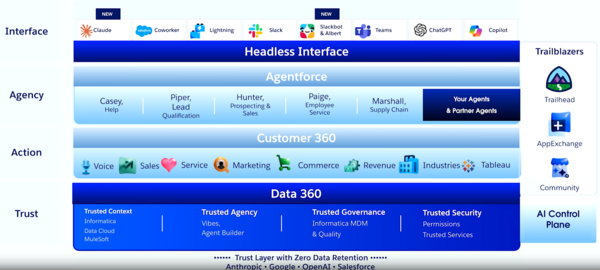
Salesforce recently held an AI monetization call for Wall Street analysts to talk monetization. Every Salesforce customer is likely to work through their budgets and how it'll align with Agentforce pricing as well as their CFO's financial models.
- Salesforce aims to be your enterprise AI harness, touts AIforce
- Salesforce Q2 shines amid AI demand
- Salesforce takes a run at outcome-based Help Agent pricing
Here's a primer of what Salesforce has been saying about pricing leading into Dreamforce.
The challenge. Bill Patterson, President and Chief Commercial Officer, laid out the challenge. He outlined Agentforce advances, the importance of the data layer and how context, models and applications all go together. Patterson, however, said the pricing has to make sense. Referring to Salesforce customers, he said:
"I can guarantee you if you have the wrong pricing model and the wrong monetization model, they're not going to transform. In fact, they're going to be really confused. And so, one of the things my team has been deeply focused on is really simplifying and streamlining a lot of our pricing and packaging opportunities really to give customers benefit at this time. Enterprise software has always been complicated. It's always been challenging to sort of price by feature or priced by size of an offering or how much scale do you want to put into your solutions."
The ingredients of agentic AI pricing. The trick is the blend of predictability, value realization for customers and ultimately outcome-based pricing. Salesforce has bucketed predictability, value and flexibility in its pricing plans.
Salesforce's high-level view goes like this:
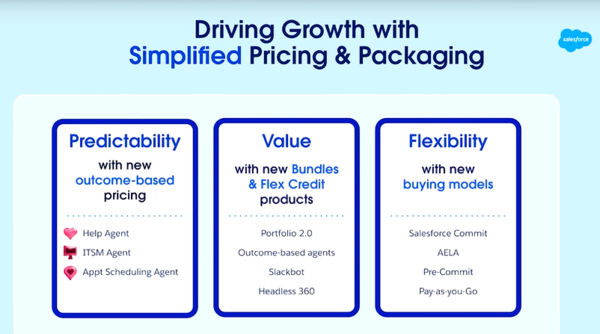
Headless 360 pricing. The various pricing plans from Salesforce also ride along with Headless 360 pricing. Salesforce is setting itself up to be a broad platform that can be access from multiple endpoints such as Anthropic's Claude. This headless access now has an add-on. After all, SaaS vendors have never seen an add-on they didn't want.
Patterson said:
"We've created what we call this Headless Add-on, which packages a lot of work capacity for every user, make it easy. So maybe you and I use the software a little bit differently. You're probably a lot more intense on the software with how much consumption you're driving. But essentially, that Headless Add-on monetizes just in a simple way for every user to access the platform, and it gives you enough capacity that you need to get your job done. We take this Headless Add-on, put a lot of more capacity. This is all the AWUs (Agentic Work Units) you need to be productive. And now that becomes a simple way for every organization to start accessing new technologies like Claudeforce, the partnership we just announced with Anthropic."
The headless add-on will also be packaged into Agentforce's premium editions.
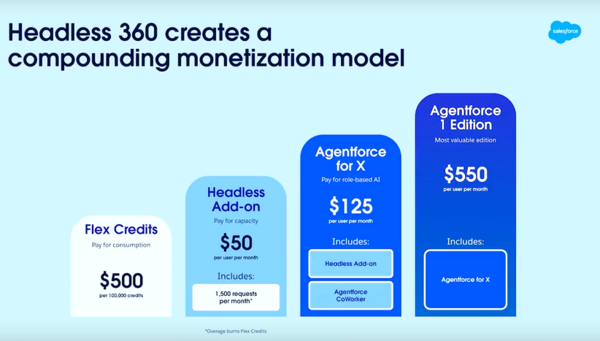
"All of that AI centralized and organized by role, optimized for every user makes our users very productive with the amount of capacity they need and it's really that focused productivity they require to get their job done. And so that Agentforce service or sales add-on also nests in our premium edition," explained Patterson.
Salesforce will work with you, but it may make your brain hurt. Connor Marsden, President of Sales at Salesforce, acknowledged that "there's a lot of concern over the cost of AI."
"We have the flexibility to provide a limited agreement so we can take that -- we can provide a predictable model on what the cost can be. If customers are using multiple solutions from Salesforce, you don't need to precisely predict what the consumption or anything is because you have flex credits that are fungible that can be plugged into your data solution if you end up using more of our data products or across your various agents," said Marsden. "We can meet the moment for wherever our customer is on the journey to provide them the right contracting and pricing to meet their requirements."
You'll need your CFO, procurement and a few math wonks. Patterson acknowledged that customers are struggling with value. He seemed to indicate outcomes were the way to go.
"I was with a customer just recently, and they said their spending is up 30%. And when they actually did the math, their productivity was up by about 3%. And so, there's just a fundamental mismatch today between what is going on in the spending environment and then the value realization environment," said Patterson. "Our mission is to change that. It's to be easier, to be simpler, to be more valuable for every customer. So, you're not counting how many tokens, you're counting how many leads that you process or how many new orders that you sort of manage or how many cases you resolved on our platform."
Patterson noted that Salesforce wanted to make it easier to talk to your CFO and value and outcomes will make that dream happen.
Value and outcome pricing assumes you have your business instrumented. Patterson said the proper way to view Salesforce pricing is to forget about AWUs and focus on labor, workflow, software and integration costs.
"What I want customers and the industry to be thinking about is the labor and the economic offset of it used to cost me maybe $5 to do a phone call. Now I can actually do it for $1, $2 per resolution here on the Salesforce platform. So, this is where we want to just think about offsetting kind of expenses for our customers and making it much more economical, much easier to scale using the benefit of our platform that can now serve that unit of work," said Patterson.
- Oracle: Takeaways on AI value, outcome pricing, managing AI spend
- HubSpot sees turbulence ahead due to outcome-based pricing shift, AI budget scrutiny
- Oracle eyes outcome-based pricing: Does it stand a chance?
- Pegasystems sees opportunity in runaway token costs, pitches outcome-based pricing
There's always the bundle. Marsden said Salesforce is "seeing an explosion of upgrades to the Agentforce 1 Edition" and "we think it's going to accelerate because we're adding Headless into the model as well."
Agentforce 1 Edition includes the entire platform with unlimited usage. Headless will move the edition beyond Salesforce's platform.
Will our BT150 CxO get the answers needed to scale the Agentforce effort? We'll loop back after Dreamforce to find out. My hunch is there will be a few more models to ponder.
Constellation Research’s point of view
Esteban Kolsky, Constellation Research’s Chief Distiller, said pricing an ecosystem isn’t easy and that’s Salesforce’s transformation challenge. He said:
“What Salesforce is not addressing, and the CxO said perfectly, is the price of building and selling an ecosystem. Salesforce is still going at it like it’s the only one the client needs to deal with and figure out. Customers are doing two things: 1) building an ecosystem where Salesforce is a small to medium (maybe) player, and 2) finding the best way to budget for that without incurring extra Salesforce money (since value decreases in a hybrid ecosystem).”
I’d argue that finding the right pricing model may be Salesforce’s most important innovation task. Pricing an ecosystem is difficult and software vendors usually rely on just a few primary business models. Fortunately for Salesforce, the company isn’t alone with its pricing challenges. Except for cloud hyperscalers and Nvidia, most enterprise technology pricing models are more complicated than clean.
Bottom line: The SaaS industry needs to figure out pricing for agentic AI or disruption is ahead. Salesforce’s mission is to create a pricing model that you can explain to your mother. Otherwise, it’ll be less relevant in five to 10 years.
Larry Dignan is Editor in Chief of Constellation Insights at Constellation Research, where he leads editorial coverage focused on enterprise technology, digital transformation, and emerging trends shaping the future of business. He oversees research-driven news, analysis, interviews, and event coverage designed to help technology buyers and vendors navigate complex markets with clarity and context. ...
Read morePublished
Author
