


Accenture's Q4 results indicate enterprise AI broadening
Accenture's fourth quarter results indicate that enterprise demand for AI transformation is surging.
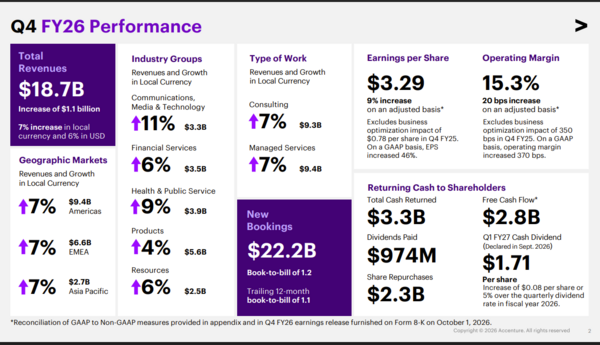
The consulting giant reported fourth quarter earnings that were well ahead of expectations. Accenture reported fourth quarter earnings of $3.29 a share on revenue of $18.7 billion, up 6% from a year ago. New bookings in the quarter were $22.2 billion, up 4% and the company improved its operating margins.
For fiscal 2026, Accenture reported $74.2 billion in revenue with earnings of $13.56 a share. Accenture is a key partner for the AI enterprise vendors and have even rode along with the forward deployed engineering wave Palantir and others are trying to ride.
The one nit for Accenture was a fiscal 2027 outlook that was below estimates. Accenture is projecting revenue growth of 3% to 6%.
Accenture's results were well received, but the between the lines reading of the earnings call were what sent shares surging. Here's a look at the takeaways for enterprise AI.
Growth was solid across industries and Accenture is a big cog in AI implementations. Accenture CEO Julie Sweet said she was "particularly pleased with our 37 clients with bookings greater than $100 million." She added that discretionary spending was stable but anemic.
Simply put, demand is broadening.
AI projects are driving demand. "Large-scale reinventions, including many driven by AI, drove strong demand. These spanned transforming functions and building out digital cores. Our clients are also focused on AI and believe AI will help them achieve more than previously possible across the enterprise, but clients remain at very different stages of readiness," said Sweet. "Much of our growth today comes from continuing to build their digital core, data foundations and the enterprise AI stack that they need to use AI at scale, and many are just starting their AI journey."
Accenture is trying to be a platform. Sweet often referred to acquisitions as a way to grow and fill in platform gaps with commercial models that didn't require a lot of headcount.
Platform improvements mean Accenture can embed advanced AI earlier in large transformation projects. "Because we are investing in our platforms and new solutions, we are able to embed advanced AI earlier into large-scale reinventions. Our proprietary assets and platforms, ecosystem relationships and our ability to deliver the work through consulting, managed services or a combination of both allows us to meet clients where they are and help them move at pace," said Sweet, who cited FedEx and BP as companies using Accenture for AI reinvention.
Accenture is looking to leverage AI in its own delivery operations. "AI is making both our own delivery and the technologies we implement more efficient. Consistent with prior technology waves, we see this in two areas: the additional productivity we achieve in delivering our services, which creates greater value for our clients and faster, more efficient implementations as our ecosystem partners embed more AI capabilities into their platforms," said Sweet. "Our strategy is to lean into these efficiencies precisely because they create value for our clients, while continuing to invest and rotate our capabilities to capture the larger growth opportunities AI creates."
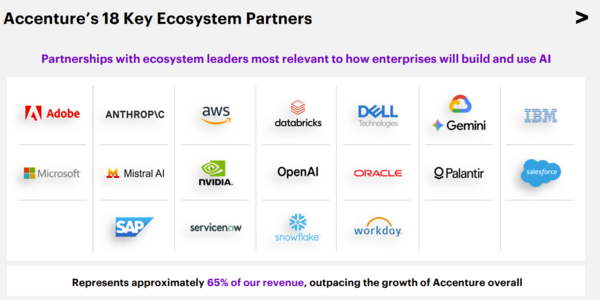
The AI budget is decoupled from the IT budget. Sweet said she is expecting more of the same from IT budgets, but argued that AI "is a net new category." She added that the more token costs fall, the more AI will be used in more places at scale.
AI hasn't led to headcount reductions at Accenture. Sweet said the company is both upskilling and hiring in data and AI. The company also increased revenue per person in 2026. "We expect to hire in every market, but it'll be below what we've been hiring this year. We still expect to hire more entry level, which is because we are focused on changing what our entry-level workers do."
Larry Dignan is Editor in Chief of Constellation Insights at Constellation Research, where he leads editorial coverage focused on enterprise technology, digital transformation, and emerging trends shaping the future of business. He oversees research-driven news, analysis, interviews, and event coverage designed to help technology buyers and vendors navigate complex markets with clarity and context. ...
Read morePublished
Author
