


McDonald’s strategy bets on AI, digital capabilities
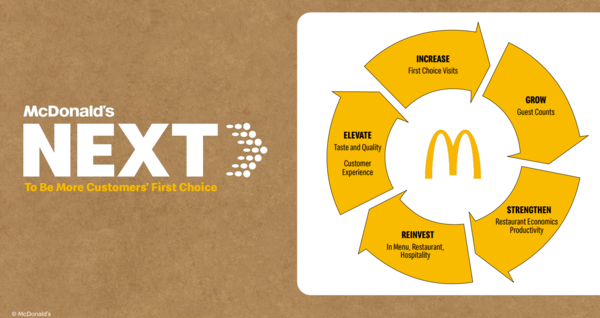
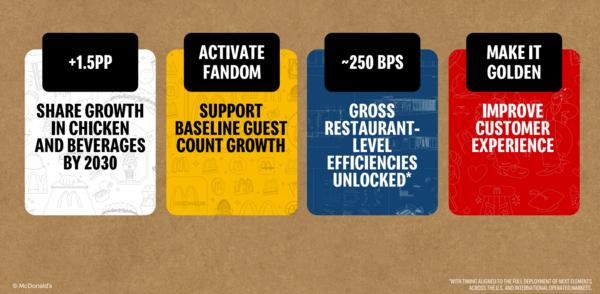
McDonald's laid out its three year roadmap with a plan called McDonald's Next that includes a heavy dose of AI, an $8.5 billion investment in improvements and 250 basis points of restaurant efficiencies.
Those improvements and gains will partly be driven by a data flywheel, a new AI-driven restaurant operating system, a strategic partnership with Google and inventory and supply chain efficiencies. At the center of Next sits a few key AI related initiatives.
- A data lake that now can bring together data from across the restaurants to train AI models. McDonald's CEO Christopher Kempczinski said: "Every day, we serve more than 70 million customers. Our menu is iconic, reflected by our 17 billion-dollar brands. Nearly 220 million customers regularly use our app and participate in our loyalty program, making it one of the largest in the world. This provides us with more data and better insights than anyone else, an asset particularly valuable for training new AI capabilities. We have unrivaled buying power across our supply chain."
- Edge compute at restaurants to provide real-time data needed to run operations via Google Distributed Compute.
- A restaurant operating system called ArchIQ.
- Digital experiences to navigate the reality McDonald's traffic growth in owned markets will be flat as inflation surges.
These initiatives were enabled by some unglamorous heavy lifting by McDonald's to transform and prepare to be digital first since 2020. The Covid-19 pandemic accelerated the urgency of the McDonald's transformation.
Kempczinski cited figures that are alarming yet commonplace at large enterprises. McDonald's had hundreds of finance and HR systems, separate apps in every company and "data puddles instead of data lakes." Business functions were decentralized across the company.
Today, McDonald's runs on a common technology platform, one enterprise data foundation and systems that can run across more than 46,000 restaurants. McDonald's has also honed a strategy where it pilots new technologies and approaches in international markets before scaling them to the US.
Of course, McDonald's said it will improve its menu with items like hand-breaded chicken, accelerate its efforts on drinks and refurbish stores to complement the digital efforts to drive more frequent visits from customers. McDonald's primarily competes in three areas: Beef, which is a $50 billion category where the company has a 40% market share, chicken, a $130 billion category, and beverages, which is a $230 billion market.
Fun facts: McDonald's is the second largest coffee player globally, drives nearly $15 billion in annual system sales from Chicken McNuggets and 84% of US McDonald's customers are on GLP-1 drugs so the company will be leaning into protein franchises including four $1 billion or more burger brands.
Skye Anderson, President of McDonald's USA, said GLP-1 users "want more protein, greater portion flexibility and food that leaves them satisfied without feeling like too much." Think Chicken McNuggets, Filet-O-Fish and Happy Meals.
The Next plan includes four pillars where technology intersects:
- Menu: Taste and quality improvements with more consistent execution.
- Consumer: Better understanding of customers to drive loyalty and personalization.
- Restaurant: Simplified operations, modernized designs and AI tools at scale to drive efficiency.
- People: Better training and well-equipped teams. The company is looking to leverage AI-based training to keep employees longer and teams well-trained. The cost of replacing a McDonald's employee is about $1,600 and a shift manager replacement runs $5,800 before productivity or guest experience losses.
"AI serves as an accelerator, helps us understand customer behavior, innovate faster, simplify operations and make better decisions at scale," said Kempczinski.
Here's a look at the technology and AI initiatives outlined during McDonald's investor and analyst day.
ArchIQ, a restaurant operating system
Jill McDonald, executive vice president and global chief restaurant experience officer at McDonald's, said the company has to drive efficiencies to expand markets.
McDonald's plans to deliver 250 basis points of gross restaurant level efficiency over time due to productivity in its owned restaurants. The company is focusing on new kitchen layouts, service stations, drive-thru operations and delivery lockers to serve digital customers with better processes.
The designs also have fewer variations and more shared components to boost procurement savings.
ArchIQ will play a big role in those savings. "We're deploying ArchIQ, our new AI-powered restaurant operating system. It reduces complexity and frees up labor hours so our crew can work more efficiently and focus on improving customer experience with hospitality and great-tasting food and drinks," said McDonald.
McDonald's CIO Brian Rice said ArchIQ "is a game changer." ArchIQ is visible across four areas:
- Voice AI and drive-thru via Arches, a model that can take live orders in English and Spanish with 90% accuracy. Rice said Arches will free up at least 50 labor hours per week.
- Automated inventory. ArchIQ can track stock in real-time via low-energy Bluetooth tags. That real-time tracking saves about 5 hours per week and cuts food waste by 15%.
- Connected equipment and computer vision to improve food quality and consistency. Rice said the predictive operations for equipment management drives about a 50% improvement in equipment and menu availability in each restaurants.
- Intelligent accuracy scales verifies millions of orders daily. The company has accuracy scales in 10,000 restaurants and the plan is to double that sum by 2028.
McDonald said ArchIQ is built on the learnings from 8,000 restaurants in China where a tool called Restaurant General Manager Boss, which "already provides a single source of insight and data for restaurant managers through real-time visibility into operations, scheduling and automated inventory management."
According to McDonald's the accuracy scales were created in France with other parts of ArchIQ being piloted in the UK.
Edge compute and data lake
CIO Rice said ArchIQ and efforts to make managing a restaurant easier are powered by local compute.
McDonald's announced a multi-year partnership with Google in 2025 to scale AI and compute. Rice said:
"Put yourself in the shoes of a restaurant manager today. They're balancing food quality, staffing, equipment maintenance, inventory and customer demand across more ordering channels than ever. That's a lot. Over the last few years, we've made significant progress in building the digital foundation to make running our restaurants easier than ever. First, since announcing our partnership with Google, we've deployed Google Edge technology to thousands of restaurants across 7 major markets, and we have plans to complete the rollout in the U.S. in 2027. This brings high-performance AI compute power directly into our restaurants."
He added that McDonald's has unified point of sale systems across its market.
Rice added that AI is only as good as the data feeding it.
"We've also built a standard restaurant data lake that is connected directly to restaurant-level operations. This allows our AI models to make accurate split-second decisions. By interconnecting the operational heartbeat of over 46,000 restaurants worldwide, our data lake captures billions of data points daily," said Rice, who added that the common data architecture creates a "continuous learning loop."
Digital engagement and marketing
Morgan Flatley, global chief marketing officer and new business ventures head at McDonald's, said the launch of the company's loyalty program five years ago provides a data set of 220 million 90-day active loyalty customers. The company has grown its loyalty member base 45% over the last three years.
"Loyalty allows us to know our customers better to deliver more meaningful value and promotions to them. But we haven't met our full potential yet. Now we can with personalization," said Flatley.
McDonald's plans to launch a tiered loyalty program, partner bundles with Uber and Disney+ and deals.
Dario Baroni, McDonald's president of international developmental licensed markets, said the company is using its international markets as a "learning lab." For instance, China is McDonald's most digitized market with 98% of sales coming through a digital channel including social commerce.
"Digital experiences at most companies are built market by market, each country with different technology, separate code bases, fragmented road maps and inconsistent capabilities. It is slow, it's expensive and it's inefficient," said Baroni. "Over the last 3 years, we rearchitected our digital foundation from the ground up, unifying ordering, marketing, loyalty and data into one single global backbone. -- that shared foundation makes the next leap possible, GMA1. Also known as Global Mobile A1, this our first true global mobile platform, turning everyday digital interactions into dynamic, highly personalized journeys at McDonald's scale."
GMA1 is focused on lighting fast reordering, intuitive reward redemption, meal building and checkout. Once the data shows that a new experience drives a business outcome it can be deployed anywhere globally in weeks not years, said Baroni.
Baroni added that GMA1 can plug into conversational commerce channels without reengineering. McDonald's will pilot conversational commerce in France and scale across its top 10 home markets by the end of 2028.
Flatley said the loyalty program is also leading to new businesses including the McDonald's Media Network. "he more our fans engage with us, the more we learn about them as individuals and the more personal and relevant we make each interaction, the more demand we create," said Flatley.
People training and experience management
McDonald's is looking to leverage ArchIQ data to lessen the administrative burden on restaurant crews.
Tiffanie Boyd, Global Chief People Officer at McDonald's, said ArchIQ will provide the data to upskill, fill gaps and measure restaurant performance. From there, managers can give employees more consistent coaching.
Boyd said that McDonald's is using Qualtrics as an experience management platform to combine guest and employee feedback with operational performance data.
"Earlier this year, we launched our first global employee listening platform, generating more than 300,000 employee responses across 7 markets in just a few weeks. Today, these insights sit in separate systems," said Boyd. "Going forward, we can connect them, leveraging one common data lake. This will give us a clearer view of how employee and guest experience impact business performance. In Q1 of 2027, we will deploy this system across the U.S. and international markets."
Boyd said the company is looking to also change what it measures and look to evaluate employees on whether they can create a "feel good moment."
The stack
McDonald's CFO Ian Borden acknowledged that the company's overhaul won't be cheap. The upgrades including AI and remodels will run $8.5 billion and McDonald's has to wrangle potentially hesitant franchise owners.
However, Borden said AI will enable savings beyond the restaurant and make McDonald's more efficient in corporate offices too. "All the work we've been doing on technology to modernize, generate scalable tools and capabilities will be more efficient. We had 600 finance systems and several hundred HR systems," said Borden. "We can leverage that capability at scale and drive efficiency across the organization. AI can help further enable end-to-end processes."
Based on announcements and job listings, McDonald's has multiple vendors and its data lake provider is unclear. There appear to be multiple vendors in the mix.
Here's a look at some of the key players in McDonald's data and AI stack.
- Google Cloud. McDonald's has announced partnerships to cover Google Distributed Cloud and job listings mention BigQuery and VertexAI. Google Cloud has become more strategic across the McDonald’s stack.
- AWS is also in the mix for cloud infrastructure and analytics. AWS features a case study on McDonald's that's dated, but a job role for a platform engineer that's current mentions AWS and Google Cloud. That role focuses on Amazon MSK as well as Confluent Cloud.
- MParticle is mentioned as a customer data platform in a job listing that includes Google Cloud.
- Qualtrics was highlighted throughout the investor day to blend customer and employee experience data.
- Oracle appears to be the ERP platform based on a job listing, SAP is used for HR via SuccessFactors and ServiceNow and McDonald's held a joint security and operations AI agent session in May.
- Cognizant is also being used for ongoing transformation and AI work. McDonald's and Cognizant announced that they renewed a deal that started in 2017.
- Although McDonald's confirmed data lake stack remains a bit of a mystery, it's clear from job listings that Google Cloud plays a big role as does AWS on some layer. Collibra appears to be a governance and catalog platform.
Larry Dignan is Editor in Chief of Constellation Insights at Constellation Research, where he leads editorial coverage focused on enterprise technology, digital transformation, and emerging trends shaping the future of business. He oversees research-driven news, analysis, interviews, and event coverage designed to help technology buyers and vendors navigate complex markets with clarity and context. ...
Read morePublished
Author
