


OpenAI's Dev Day features dots, Ultrafast, GPT-6 Sol, but can it woo the enterprise?
OpenAI CEO Sam Altman highlighted more than 20 new features and products including its answer to personal AI agents with the introduction of dots.
Embedded in the barrage of announcements is OpenAI's response to Meta's Muse AI agent efforts and tools for developers and by extension enterprises. The announcements were notable on multiple fronts, but the backdrop of multiple AI agent incidents means that Altman will need to stretch to win over corporations.
Here’s OpenAI’s challenge in one word: Trust.
OpenAI has had its issues with what it calls model alignment. To enterprises, these issues are more about security and lax engineering. OpenAI CEO Sam Altman has to speak to developers but also corporations. The burden of proof that OpenAI is enterprise grade is clearly on the AI lab. The other discussion point here is Nvidia's take that wayward AI agents are an engineering problem and it has launched its Open Agent Safety Platform. Should Nvidia win this commonsense debate then it's clear OpenAI has engineering issues.
Dozens of new features and products aren’t going to overcome those concerns.
Nevertheless, OpenAI’s announcements were interesting even if they won’t be enabled by an enterprise admin anytime soon.
Here's a sample of the most interesting announcements from OpenAI.
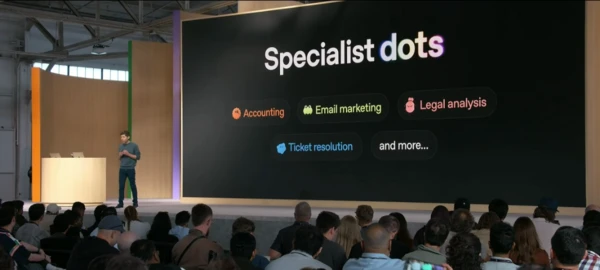
Dots. OpenAI announced dots, which are always-on agents that will work on your behalf. In a nutshell, dots are the answer to Meta's Muse AI agent push. Dots will be available on Pro and Business Premium subscriptions. In enterprises and industries like education and healthcare dots will be in beta and turned off by default until an admin turns them on.
Personal AI assistants to proliferate and so will the governance headaches | Agentic AI deployments: What you should, and shouldn't do | Meta launches Meta Enterprise Platform led by CJ Desai
Like Meta's Muse, OpenAI dots will work on their own cloud computer and sandbox. Anyone who has enabled an agent and connected it to your various accounts knows the balance between helpful and creepy. Dots can also be specialized. OpenAI noted:
"When you aren’t actively working with it, your dot looks for ways to help in the background. We call this “proactive research”. It does this by using the apps you’ve already connected with tools that are restricted to be read-only, which means that they can’t send messages, change app content, or control your browser or computer.
Security safeguards built into dots help defend against malicious instructions and monitor for potentially harmful behavior. If our monitoring system detects a safety concern, it can pause or stop the dot’s work. You choose which apps dots can access and can manage their permissions through your existing ChatGPT app controls."
GPT-6.1 Sol. OpenAI upgraded GPT-6 Sol with a spin on efficiency, performance and the ability to lower token costs. OpenAI touted "near Astra" performance with efficiency gains in GPT-6.1 Sol. "Cached input costs just $0.10 per million tokens—95% less than standard input pricing and 50% less than GPT‑6 Sol’s cached input pricing—giving developers more room to build and run capable agents that reuse context across requests," noted OpenAI.
Ultrafast, which is a premium speed tier. Ultrafast can deliver an 8x boost in token generation in Codex and 6x in the API. GPT-6 Astra Ultrafast is available in API, ChatGPT Work and Codex on Pro 500 and Enterprise plans. OpenAI said GPT-6.1 Sol Ultrafast is on deck.
OpenAI Private Intelligence includes Zero Data Retention with Private Safety Processing. The idea is that users can run automated safety reviews without giving OpenAI personnel access to underlying content.
Codex gets broad refresh that includes a refreshed Codex CLI, availability in the cloud for use across multiple environments, a new code review interface and new tools in Codex Security Cloud.
The rest. OpenAI also announced more tools to customize ChatGPT with plugins, multiple collaboration offerings such as ChatGPT Space, Pages and collaborative slides.
Larry Dignan is Editor in Chief of Constellation Insights at Constellation Research, where he leads editorial coverage focused on enterprise technology, digital transformation, and emerging trends shaping the future of business. He oversees research-driven news, analysis, interviews, and event coverage designed to help technology buyers and vendors navigate complex markets with clarity and context. ...
Read morePublished
Author
