


Why Oracle's Fusion Claw is worth a look as OCI dominates the headlines
Oracle Cloud Infrastructure dominated the headlines and attention at Oracle AI World, but you could argue that its applications business and Fusion Claw, a governed agentic AI system that can take on specialist-grade work, deserves another look.
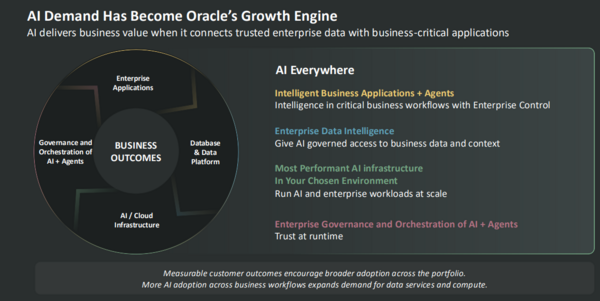
At AI World, Oracle moved to make AI the user experience across its Fusion Cloud Applications for HR, finance, supply chain, sales and service. The big idea is that Fusion Claw will be different from other autonomous agents since it will be governed, leverage structured data housed within Oracle's database and combine the best of probabilistic planning and deterministic execution.
Oracle launched 25 Fusion Claw-powered apps across its Fusion ERP, HCM, SCM and CX offerings. These Fusion Claw apps cover general ledger, workforce orchestration, payroll, procurement, service and supply chain allocation among others.
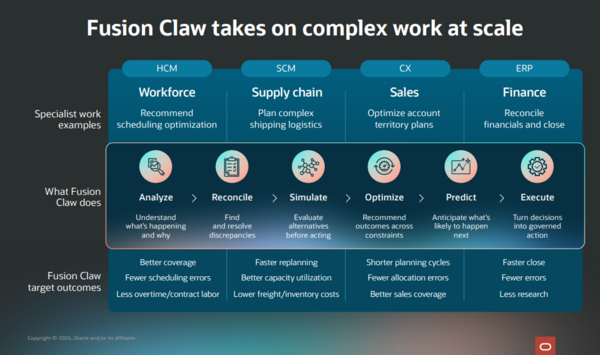
Diginomica's Jon Reed noted that Fusion Claw may be the most interesting enterprise software development you'll never hear about because the focus is all on Oracle Cloud (OCI) and the AI infrastructure buildout. He isn't wrong: OCI headlines included partnerships with Snowflake, Google TPUs, Nvidia, Cerebras, Intel and OpenAI as well as cloud networking updates. Fusion apps got its own day with press releases, but the sheer volume was all about OCI.
Nevertheless, Oracle's Investor Day at AI World did give Fusion Claw a bit of the spotlight.
Oracle CEO Mike Sicilia riffed on AI becoming the new UI. That refrain is common to most enterprise software vendors, but Fusion Claw was pitched as the differentiator. Fusion Claw is a set of AI agents that carry out work on Oracle's apps and integrated AI stack.
Sicilia said on Oracle's Investor Day at AI World:
"Fusion Claw makes AI the UI not just for a single app, but across many applications. Be they Oracle apps or be they somebody else's app, doesn't matter. AI is the UI. Fusion Claw is the orchestration layer and AI UI to enable these outcomes. So this means that AI can become the UI for our customers, for business outcomes regardless of the underlying systems. It doesn't matter. And AI becomes the trusted interface and the partner for getting work done faster and more efficiently."
Chris Leone, Executive Vice President of Oracle Applications Development, said Oracle has been working on agentic AI within its applications for a while. Leone said Fusion Claw is focused on specialist work such as a financial analyst, supply chain analyst and inventory specialist.
With Fusion Claw, Leone said, "we can do different types of work that was traditionally done outside of Fusion Applications now inside Fusion Applications."
"Fusion Claw allows us to take on long-running work, allows us to do multistep computational intensive work, allows us to do reconciliation against millions of records, allows us to do simulations, allows us to do optimizations, allows us to do sophisticated high-value work within the enterprise," said Leone. "It's a huge leap from an architecture perspective. We have cracked the economic side of handling extremely large workloads. When you're doing enterprise AI within Fusion Applications, you're talking about extremely large operational and transactional data sets that you need to do work against."
A ledger of 1 million or 2 million records might require 1,000 calculations or 100 scenarios. If those records were connected to an LLM or an agent it wouldn't be efficient, accurate and economical enough. "Just the way an agent works, or an LLM reasons, it looks at a record, it makes a decision and then it goes back and does the exact same thing and looks at record after record," said Leone.
That approach won't scale because it will fill up the context window and lead to wrong decisions.
"Architecturally, we separated reasoning and planning, which AI does fantastically well. We leverage it to do all the planning. And then we use deterministic compute to do the execution side. We use AI to understand the problem, to assemble the tools and capabilities and skills and the execution logic, and then we hand that execution logic over to compute, and then we can run it against a million transactions, a thousand scenarios and do it without touching the token side of the LLM," said Leone.
Leone said Fusion Claw is built on one execution runtime engine that can solve thousands of use cases across the enterprise.
The big theme from Fusion Claw is that Oracle is looking to continually own an outcome for a use case and then execute and continually optimize, said Leone. In a demo, Leone walked through a shipment load planner that balances service, capacity of costs and identifies what needs attention and moves forward.
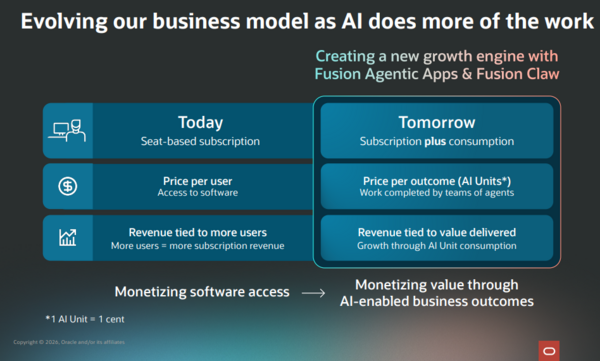
What remains to be seen is whether Fusion Claw enables Oracle to charge more by the outcome.
Sicilia said:
"The catch with outcomes-based business is you want to be sure that you can generate the outcome. And since we've been an operator and a custodian for so long, our confidence is quite high. Our customers have shown us what good looks like and in many cases, what great looks like. And if we can replicate those heuristics across all of our customers by industry, we think that becomes a terrific business for us."
More on outcome-based pricing:
- Outcome based pricing: Pros, cons and nuances
- Outcome-Based Pricing, AI and the Future of Experience Management | CRTV Episode 141
- Oracle: Takeaways on AI value, outcome pricing, managing AI spend
- HubSpot sees turbulence ahead due to outcome-based pricing shift, AI budget scrutiny
- Salesforce takes a run at outcome-based Help Agent pricing
- Pegasystem's Ken Stillwell on Tokenomics and Outcome-Based AI
- Oracle eyes outcome-based pricing: Does it stand a chance?
- Pegasystems sees opportunity in runaway token costs, pitches outcome-based pricing
Larry Dignan is Editor in Chief of Constellation Insights at Constellation Research, where he leads editorial coverage focused on enterprise technology, digital transformation, and emerging trends shaping the future of business. He oversees research-driven news, analysis, interviews, and event coverage designed to help technology buyers and vendors navigate complex markets with clarity and context. ...
Read morePublished
Author
