


Does Airbnb have the blueprint for the AI enterprise rewrite?
Airbnb may have cracked the great AI enterprise rewrite.
With Airbnb's third quarter earnings, CEO Brian Chesky made the case that the company is back into growth mode. The company put up revenue growth of 19% in the third quarter and that's the fastest clip in more than three years.
Chesky touted a transformation into an AI native company that had growth as its North Star. The effort took years including thankless tech chores to retire tech debt. "The momentum has been building for several quarters, driven by years of work to rebuild Airbnb."
That rebuild was focused on changing how Airbnb operates so it innovates faster and operates efficiently. Chesky said now the company is growing. Airbnb delivered third quarter net income of $1.9 billion on revenue of $4.9 billion.
"Our growth isn’t being driven by any single product or feature. It’s the result of hundreds of improvements we’ve made across Airbnb over the last several years," said Chesky, who noted that the company shipped more than 50 products and features in the third quarter, up 70% from a year ago.
2026: Airbnb graduates to AI native: A look at the metrics, ROI approach
2025: Airbnb: A look at its AI strategy
2025: Airbnb: With tech stack in place, expansion plans accelerate
2024: Airbnb CEO: GenAI's impact on app experiences minimal so far
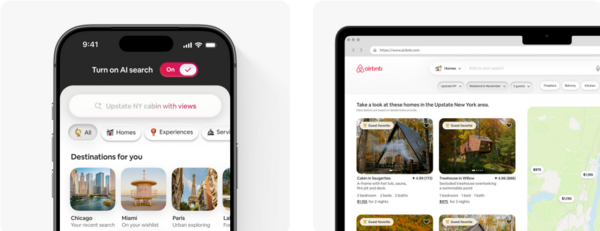
Most of those features have an AI hook. Airbnb is developing its own AI agent, improved its customer support with AI and launched tools for hosts, search, dynamic pricing and home comparisons. Chesky said Airbnb is resonating with Gen Z as well as empty nesters.
The biggest theme from Airbnb is AI adoption is about growth more than cost cutting. Its own AI agent is an example. Chesky said:
"We don’t believe people will use one AI agent for everything. We believe the best agents will be specialized, built by companies that deeply understand the people they serve, have earned their trust, and can help them take action—not just answer questions in a chatbot.
We’re building our own AI agent to help guests plan and book trips. Today’s AI agents are good at simple, routine tasks, like making a restaurant reservation or scheduling an appointment. But planning a trip on Airbnb is different. Travel is aspirational, and discovering where to go and where to stay is part of the experience. In fact, 80% of travelers enjoy spending time researching trips. People don’t want to delegate the choice of where to stay. They want to browse unique homes, compare options and decide for themselves, often with the people they’re traveling with."
Airbnb is projecting fourth quarter revenue growth of 16% to 18% and annual revenue growth in the high-teens. Here's a look at Airbnb's enterprise rewrite playbook.
The enterprise rewrite has a lot of steps that aren't just about the technology. Fix the foundation first. Chesky said Airbnb had to rewrite its technology stack shortly after its IPO. "We spent years rebuilding our technology platform. We redesigned the app. We improved our core experience, and a lot of this was you know pretty thankless at the time because we had to trade in some near term growth to make these very important investments," said Chesky.
In other words, those never-ending transformation efforts do pay off.
Organize for small teams. "We also had to fundamentally changed how the company operates. So we organized Airbnb around a single roadmap. We brought all these teams together. We focused small teams on very specific problems. Then we developed an entirely new way to build products, and it was inspired by the original early days of Airbnb," said Chesky.
Focus. Chesky said the core small team focused on one job, which was to make finding and booking a home easier. That approach moved to other features and businesses. But Airbnb was always focused on travel.
Use AI as an accelerator not a magic wand. "We spent years laying the groundwork, but now AI is helping us build, test, improve products faster than we've ever done before," said Chesky.
Growth and context matter. "We don't think the traditional chatbot is the right way to plan travel. It's the wrong interface. So what we are doing is developing a custom-designed AI-native experience that responds to what guests are looking for. Instead of relying on traditional chat alone, which is very text-heavy, which again is definitely not the way you should plan travel, our agent draws from a library of hundreds of travel-specific interface components, maps, photos, comparisons, calendars, itineraries, and compose them in real time to match what they're looking for," said Chesky.
Drill down on what makes you unique. Chesky on the earnings call said there's an intersection between travel social networking and discovery. That social connection can be an untapped market since social media isn't social or media anymore.
He said:
"I no longer have a social graph. I no longer know whose birthdays my friends are, unless they're close friends. I no longer know when somebody like something happens in someone's life. I no longer know how to keep in touch with people except when I've got to message them in WhatsApp or my messaging platform. So there really aren't social graphs anymore.
What if we brought back the social graph, but instead of being an online social graph, it was a social graph in the real world of the people you travel with and the people you meet along the way of your travels? We thought this could be really interesting. So we started building these social travel features this year. We launched them in May. We launched the travel map, and we started realizing this might be the beginning of something massive. And we are going to be launching a lot more social features and social connection features next year. I think this is maybe one of the single most underestimated parts of our business."
Larry Dignan is Editor in Chief of Constellation Insights at Constellation Research, where he leads editorial coverage focused on enterprise technology, digital transformation, and emerging trends shaping the future of business. He oversees research-driven news, analysis, interviews, and event coverage designed to help technology buyers and vendors navigate complex markets with clarity and context. ...
Read morePublished
Author
