


Quantinuum sets Nexus quantum software roadmap through 2029, reports Q3
Quantinuum outlined its Nexus software development roadmap and deployment plans for each generation of its hardware through Apollo, which is a fault-tolerant quantum computer expected in 2029.
The software roadmap comes as quantum computer players such as IBM are building their software ecosystems to go with the hardware. Meanwhile, Intel recently bought Classiq, a key quantum computing software player, to build a complete quantum stack.
Constellation ShortList™ Quantum Full Stack Vendors | Constellation ShortList™ Quantum Computing Platforms | Quantum computing: Where we stand in 2026
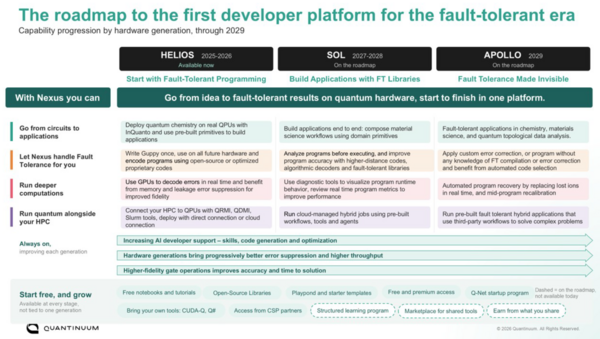
According to Quantinuum, Nexus will handle the complexity behind fault-tolerant quantum application development. The idea is that Nexus will enable developers to run more powerful apps as quantum systems improve. Nexus will do the following:
- Integrate automated error-correction encoding so developers can focus on logical operations.
- Enable execution on Quantinuum hardware as it evolves.
- Offer hybrid workflow orchestration so customers can develop, deploy and operate applications as hardware advances. The hybrid orchestration will allow developers to coordinate quantum and classical computation across QPUs, cloud systems, GPUs and CPUs.
- Provide a set of modular libraries, workflows and algorithmic building blocks.
Quantinuum launched Nexus in 2024 and now can manage cloud-based quantum workflows, develop apps and combine programming, validation and compilation in one environment. The company said it will automate and simplify error correction, resource management, orchestration and deployment through multiple releases through 2029.
- Quantinuum inks Oracle Cloud partnership, reports Q2
- Quantinuum, Rolls-Royce, Riverlane, EPCC eye industrial quantum use cases
- Quantinuum’s IPO prices at $60: What you need to know
- Quantinuum launches Helios quantum computer, touts fidelity, enterprise customers
Ultimately, Quantinuum is making its pitch that an integrated quantum stack of hardware and software makes it a stronger platform for enterprises. So far, Nexus has more than 200 active organizations using it.
Dr. Rajeeb Hazra, Quantinuum CEO, said:
"Our full-stack approach means each advance in hardware can become a capability customers can build on through Nexus. As our systems become more capable, our aim is for the applications, workflows, and expertise customers develop in Nexus to become more valuable, giving them a compelling reason to build with Quantinuum and making Nexus an enduring part of their computing environment."
Here's a look at the roadmap.

Separately, Quantinuum reported better-than-expected third quarter results. The company reported a net loss of $118 million, or 46 cents a share, on revenue of $9.1 million, up 223% from a year ago. The non-GAAP net loss was 29 cents a share.
Wall Street was expecting Quantinuum to report a third quarter non-GAAP loss of 37 cents a share on revenue of $8.07 million.
Hazra said in a statement that the company is making strong progress. "In the third-quarter, we extended our technology leadership in the critical area of fault-tolerance, added to our customer base, and expanded our routes to market," said Hazra.
As for the outlook, Quantinuum said its fiscal 2026 revenue will be between $31 million to $34 million, up from the $28 million to $32 million range previously.
Larry Dignan is Editor in Chief of Constellation Insights at Constellation Research, where he leads editorial coverage focused on enterprise technology, digital transformation, and emerging trends shaping the future of business. He oversees research-driven news, analysis, interviews, and event coverage designed to help technology buyers and vendors navigate complex markets with clarity and context. ...
Read morePublished
Author
