


How three hotel giants are playing agentic commerce, AI
Agentic commerce is in its infancy and enterprises need to think through ownership of the customer experience, architecture and playing the co-opetition game with AI giants. For hotels, agentic commerce has the promise of demand and distribution and efficiency. The key for hotel operators will be preserving their first-party data flywheels.
Here’s a look at how three hotel giants are playing the agentic commerce game while also leveraging AI to become more efficient.
Marriott
Marriott has a portfolio of nearly 1.78 million rooms across 9,800 properties in 145 countries. Marriott Bonvoy, the hotel's loyalty program, has 271 million members as of Dec. 31.
For Marriott, the data, technology and AI flywheel, is about productivity and customer experience. The company has had a multi-year digital transformation underway of its three primary systems: Property management, reservations and loyalty.
Speaking on Marriott's fourth quarter earnings call, President and CEO Anthony Capuano said AI is an enabler to experiences, but the hotel giant expects to keep the customer relationship. And that means working with multiple leaders including Google and OpenAI.
"We see AI as an opportunity to potentially redefine the customer acquisition paradigm that has governed our industry for the past several decades," said Capuano. "While AI search and commerce models are still emerging, we're excited about AI's ability to further personalize and simplify the travel search and the booking process, and we're optimistic about the potential for AI to bring more consumers into the Marriott Bonvoy ecosystem and help strengthen our direct booking channels in a very efficient manner."
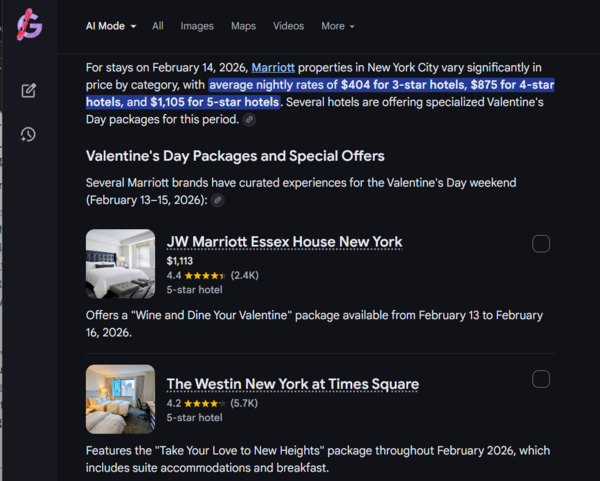
Specifically, Marriott will deploy natural language search on its site and app. The company is also optimizing its content for AI so Marriott properties are positioned for wherever consumers search.
"We are actively collaborating with numerous tech companies across the space. For example, we are one of the initial companies working with Google on their forthcoming Google AI Mode Travel product and with OpenAI on their AdPilot program," said Capuano.
Marriott plans to spend about $1 billion on investments in 2026 and 35% to 40% will be spent on the company's digital transformation.
Not surprisingly, Capuano was asked about the Google and OpenAI partnerships and whether they went beyond distribution. The CEO noted that "people talk about various facets of the business through the lens of what inning we're in, but agentic AI is an area where "we're pulling into the players' parking lot. We're not even in uniform or on the field."
Marriott began designing a property search experience in November to facilitate bookings through Google AI mode. OpenAI is about being in early on ChatGPT advertising. Google is betting that AI will blur the boundaries between sales channels for travelers.
Marriott CFO Kathleen Oberg said at a December conference these big technology partnerships are a bit frenemy. "I think they want to be able to do actual bookings," said Oberg. "Exactly how all those economic models work out it is too soon to say. We are very involved and talking to all of them."
Hilton
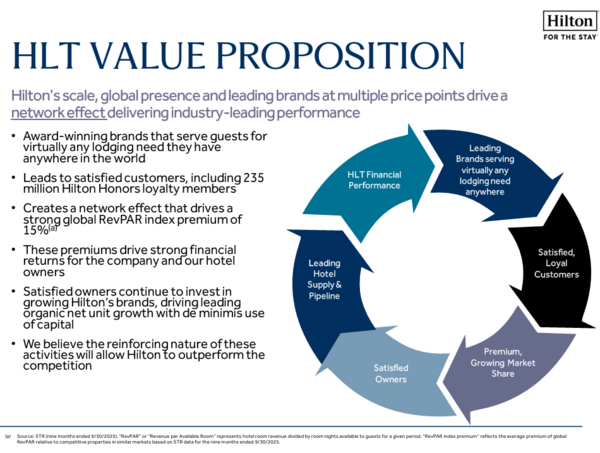
Hilton has 250 million members in its loyalty program and has 9,000 hotels around the world. The company is also expanding into apartment-style lodging with the Apartment Collection by Hilton.
The company said it has a modern tech stack and is poised to take advantage of AI internally and externally. CEO Christopher Nassetta said: "We're spending a huge amount of time on AI throughout our whole organization. And one of the things that I believe gives us a meaningful competitive advantage is that we have a modern tech stack. And relative to our competitive environment, I don't think anybody can claim what we can claim. It just affords us much greater flexibility and agility to adopt AI in a bunch of really interesting ways."
Nassetta bucketed Hilton's AI initiatives:
- Efficiencies. Expenses are lower than they were six or seven years ago and Nassetta credited process reimagination and technology. "AI is just another amazing tool that allows us to speed that up," he said. Nassetta said Hilton is making the process of opening a hotel more efficient.
- Distribution. Nassetta said Hilton is working with the big AI players to figure out distribution through AI interfaces. "We tend not to make big announcements until we've done things. And so, we're working with many of big players out there like OpenAI and Google. We're involved in all of their tests, and we're developing the connectivity with those platforms," he said.
- Customer experience. Nassetta said Hilton is working on connecting natural language search to booking and the experience within its own platform. "With a fully modern tech stack, we can really revolutionize how customers interact with us," he said.
- Asset management. "We have the ability to create tools that enable our teams to have so much more information for people to plan their stay on property, problem resolution, et cetera. I'm not going to get into everything we're doing. Obviously, it's competitively sensitive, but we're doing a whole bunch of stuff. We have more than 40 use cases and growing in all of those buckets around AI, working with a bunch of great partners, many of the names that you read about in the news every single day and have super close engagement," said Nassetta.
Hyatt
In terms of loyalty programs, Hyatt is the smaller player with 63 million members. Hyatt has 1,500 open hotels and resorts globally. Mark Hoplamazian, President and CEO of Hyatt, spent his prepared remarks focused on hotels, expansion and revenue trends. Nevertheless, Hoplamazian, like every CEO, was asked about AI disruption.
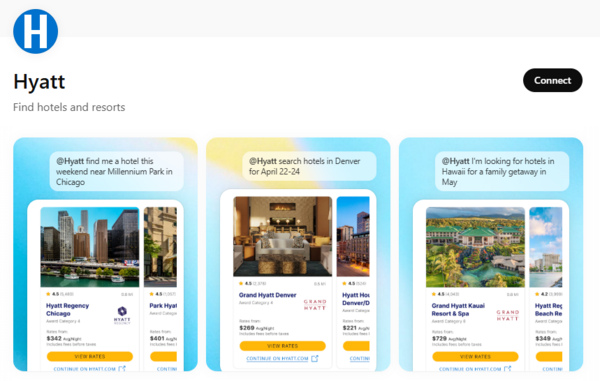
Hoplamazian said the balance of traditional search advertising and generative AI remains to be seen. Hyatt’s approach is to keep its distribution options open. Hoplamazian did note that Hyatt was one of the few hotel companies that have already launched an app live on ChatGPT. “We're learning a lot, just watching and learning from how people are actually using that app in relation to search. And we're studying it,” said Hoplamazian. “We've been working with OpenAI for months, which is why we've advanced to getting an app up and running so quickly. And of course, everybody in the world is at the table with Google and everything else. You can assume that all suppliers are engaged with all providers of platforms, LLM-based platforms.”
Hyatt has been working on AI internally since January 2024. Hoplamazian said Hyatt set up infrastructure, governance and identified use cases early. Today, Hoplamazian said Hyatt has four large-scale agentic AI efforts to improve efficiency internally.
According to Hoplamazian, Hyatt’s natural language search has provided data on booking conversion rates and revenue generated. Hyatt’s ChatGPT app ultimately points to Hyatt.com because OpenAI and ChatGPT are prepared to be a merchant of record or complete a reservation.
Hoplamazian made the following points about agentic commerce:
- There will be several agentic interfaces including agent-to-agent booking.
- Hyatt isn’t agnostic about the LLMs it uses. Hoplamazian said the company is deliberate about its LLM choices but will work with multiple vendors.
- The agentic commerce and AI advances will develop more. Hoplamazian noted that Hyatt is closely watching what Google does with Gemini.
Internally, Hyatt is automating operations. The existing plan for Hyatt revolves around using multiple models from Microsoft, Google, Anthropic and OpenAI. All are in production at Hyatt. “The reason why you use different LLMs is because different LLMs have different attributes, both in terms of how they've been trained, but also their trainability. We have an agentic platform for our group sales force. And it has allowed them to value every piece of business. We responded to over 1.5 million RFPs and we wanted to automate a lot of what we're doing,” said Hoplamazian.
The models rank and value every piece of business for Hyatt and accounts for the overall relationship with the customer. A top-five customer requesting space for a small meeting will be prioritized for the relationship even if the immediate revenue from the meeting is small, said Hoplamazian.
The agentic commerce scrum
Although it's early in the agentic commerce game, it's going to be interesting to see how enterprises play agentic AI distribution with controlling the customer experience.
Salesforce said it will acquire Cimulate, a company that specializes in product discovery for commerce. Salesforce said the acquisition will bolster its agentic commerce efforts as well as Agentforce Commerce. Cimulate provides "an intent-aware context engine purpose-built for retail."
Meanwhile, Google laid out its commerce ad strategy. "In 2026, agentic commerce is no longer just a concept, it’s reality. It will transform how we shop, from discovery to decision, while helping brands differentiate themselves. Our goal is twofold: One, remove the grunt work of shopping so consumers can focus on the fun parts. Two, work hand-in-hand with the industry on the building blocks needed to make agentic commerce seamless and secure," said Vidhya Srinivasan, Vice President/General Manager, Ads & Commerce, in a blog post.
OpenAI is launching its ad tests with ChatGPT and there will ultimately be hooks into closing purchases.
Agentic commerce was also a talking point on PayPal, Alphabet, Visa, Mastercard and Reddit earnings calls.
We're clearly in the never-ending agentic commerce announcement phase. Shopify President Harvey Finklestein said his company plans to be the back end of agentic commerce and sometimes the front end. Shopify has partnered with Google on Universal Commerce Protocol, or UCP.
"We are literally setting the standard on how the world will shop with AI. We've also added more integrations, so our merchants will be able to sell on every major AI platform. And we've launched a product to power AI shopping for brands that aren't even on Shopify yet," said Finkelstein on Shopify's fourth quarter conference call. "Shopify Agentic Storefronts syndicates billions of products through our catalog to all major AI platforms, Google AI Mode and Gemini, ChatGPT, Microsoft Copilot. Obakne click and our merchants get instant access to millions of potential buyers who are actively looking for their products."
Finkelstein said agentic commerce "is the new surface where merchants can sell to customers." "LLMs do not bypass Shopify's checkout. The complex back end will always flow through Shopify," said Finkelstein.
He did note that the interface may change with agentic commerce. "AI transforms interfaces and accelerates the pace of change, but it doesn't alter the underlying architecture of commerce," said Finkelstein.
Shopify isn’t the only commerce and retail player thinking of agents.
- What's Agentic Commerce Without Infrastructure? (Distillation Aftershots)
- Agentic AI experiences will determine enterprise winners
- Walmart's agentic commerce vision: Practical, personalized, immersive and less scrolling
- Google launches agentic commerce tools, Universal Commerce Protocol, Gemini Enterprise for Customer Experience
- NRF 2026: Agentic AI commerce, frontline workers, customer experiences
- Anthropic, Microsoft, OpenAI build out AI agent use cases
Larry Dignan is Editor in Chief of Constellation Insights at Constellation Research, where he leads editorial coverage focused on enterprise technology, digital transformation, and emerging trends shaping the future of business. He oversees research-driven news, analysis, interviews, and event coverage designed to help technology buyers and vendors navigate complex markets with clarity and context. ...
Read morePublished
Author
