


The art and science of blending human and AI labor
Have we overshot on the idea that AI agents are going to replace humans? Perhaps. Maybe the dystopian view of AI agents is a misplaced theme that's championed by a handful of companies that benefit from you blowing your token budget.
At Cornerstone Connect 2026 in New York City, you had a vendor transforming from learning management to workforce intelligence. You had human resources and learning management folks rattled by AI agents and a pace of change that borders on ridiculous.
Sleep habits were mentioned repeatedly during keynotes at Cornerstone's conference. We're running faster due to AI but not necessarily getting anywhere--especially on the business outcome front.
This immature AI age requires a certain bit of thrashing about because best practices aren't exactly solidified. Some companies overshoot and cut every human they can find for an AI agent. Some companies will inevitably realize they need more humans. US enterprises are like rest of America: We go from one extreme to the other without much middle ground or common sense. During the COVID pandemic, companies pursued FOMO hiring. Today, we have the opposite, but it's a bit fuzzy on how many enterprises are simply using AI as an excuse to make their operations more efficient.
It stands to reason that executives need to think about that middle ground blending of humans and AI.
"AI is transforming business, but people transform business. AI brings incredible intelligence, but lacks the wisdom that's human. Agents deliver unprecedented coordination, but they don't replace connection. We believe the future doesn't belong to organizations with the most AI. It belongs to the ones that know how to use AI to make people better," said Cornerstone CMO Mini Peiris. "AI shouldn't shrink human potential, but should grow it."
Cornerstone CEO Himanshu Palsule said learning and development will matter, but there will be new playbooks. "AI is going to disrupt technology. It's going to disrupt skills, and it's disrupting business models. Roles that companies are going to change. HR is impacted a level of AI fluency is essential. Your roles are not going away, your tasks may change, but your role today is as important as ever."
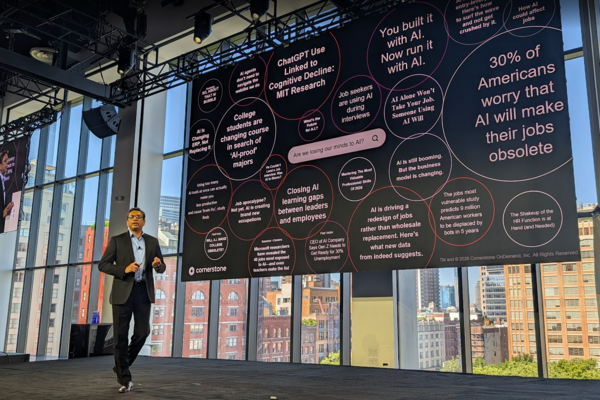
The pace
It's notable that one of the key features of Cornerstone's Workforce AI is the ability to track signals on attrition and burnout. In the AI age, burnout is a big risk for the human workforce.
"When I see successful CXOs adopting AI, they're not just bolting on AI solutions into old, fragmented workflows, they're being really intentional about what is the workflow, what's the productivity you're trying to get out of it, and what are the outcomes ultimately that you want to drive. And so, I think intentionality really stands out to me," said Lenore Lang, Executive Vice President at Salesforce. "We're also watching the trends and behaviors and making sure that people don't burn out."
All you have to do is talk to a developer trying to orchestrate AI agents and keep up. These agentic AI tools can be wildly productive. They can also be like managing a bunch of cats.
Is it superintelligent to being this frenetic? Probably not. At least your vendors like the inefficient token spend.
- AI inference costs are going to be a big concern: What's the fix?
- Where’s tokenomics for the rest of us?
What's missing in this human-AI equation is balance and a healthy dose of forethought.
The art blending AI and humans
Constellation Research CEO Ray Wang said the talent market is changing, but it's not doom and gloom. The trick will be figuring out where the AI augments the human and where the human augments the AI.

Speaking at Cornerstone Connect 2026, Wang touched on what human AI is and can be. We'll let Wang do the talking with a few choice quotes from his keynote.
- "Don't be afraid of the technology, in fact, put it to use, because these are the companies that are going to be successful. That shift from learning to performance management was a big shift, but to workforce readiness, it's going to be even different. Our ability to collect and capture data put it to use towards an outcome is what creates those opportunities for everybody.
- "We have everybody on AI now. What we're trying to do is figure out how to actually work together with AI to create new opportunities, and it's one of those things that you aren't expecting, because when you think about AI, maybe jobs get away, but in their case, it's company that they're actually adding more jobs, because work is happening much more quickly, and the human decision making became important. The humans become the critical path."
- "AI seems scary now, but we're going to go back and look at this 12 to 24 months later and realize this was a tool that helped us get to point from point A to point B."
- "We're in a world of infinite possibilities, which means we can create things at the speed of thought. We can code at the speed of thought. What is the essence of strategy? Where to play, how to win, or maybe what not to do. Knowing what not to do is just as important as what your strategy is. In fact, it may be more important. "
- "We have places where we augment the machine with a human, we augment the human with the machine. Some things are just designed for human touch. So, the question here isn't about where we automate. The question in the future is more about when and where do we insert a human. When we collapse decision trees, you insert a human because you're only 33% accurate. You insert a human because of regulatory compliance. You insert a human because you want to provide that different kind of experience in human touch."
- "AI is about giving you more at-bats, more chances to do something. But one of the most important things we have to think about is how do you achieve machine scale with humans. Humanity is at stake, and your job to ensure that we actually build it the right way."
Larry Dignan is Editor in Chief of Constellation Insights at Constellation Research, where he leads editorial coverage focused on enterprise technology, digital transformation, and emerging trends shaping the future of business. He oversees research-driven news, analysis, interviews, and event coverage designed to help technology buyers and vendors navigate complex markets with clarity and context. ...
Read morePublished
Author
