


AWS CEO Garman said space data centers likely to take longer
AWS CEO Matt Garman said data centers in space will happen, but timelines are likely to be a lot longer than expected.
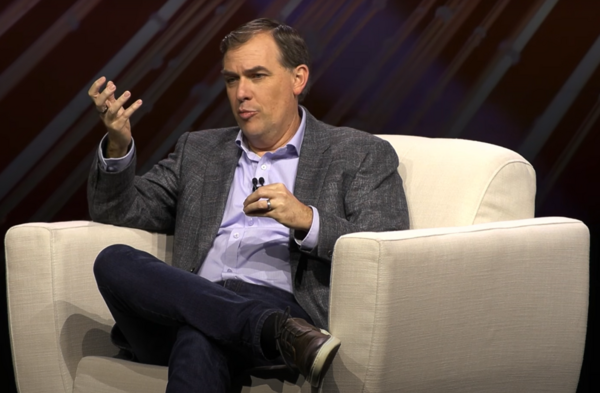
Garman was asked at the Cisco AI Summit whether space data centers was in the plans. Elon Musk's SpaceX, which announced a merger with xAI, touted data centers in space due to efficiency, unlimited power and cooling.
"It all depends on your timeline. Going and building some of these things is quite difficult. I think there are a lot of compelling ideas about a data center that's in space, but I don't know if you've seen a rack of servers recently, but they're heavy," said Garman. "Humanity has yet to ever build a structure, a permanent structure in space, on the moon or anywhere like that. I know Elon says a million satellites or whatever, like, there are not enough rockets to launch a million satellites yet."
- AWS European Sovereign Cloud available with EU AWS Local Zones on deck
- AWS launches AI factory service, Trainium 3 with Trainium 4 on deck
- Live from AWS re:Invent: Partner Award Interviews
- AWS re:Invent 2025: This one was different
- From "Legos" to Solutions: AWS re:Invent 2025 Takeaways with Constellation Research Analysts
Garman also noted that there will also have to be improvements in efficiency and costs with getting payloads in space. "A huge number of people are investing in making space transport much more economical, but that is one bottleneck. There are latency concerns as well," he said.
On other topics, Garman said:
Returns on investment. Garman said one of the big challenges with AI is that companies are doing proof of concepts when they didn't have success criteria at the beginning. "I'm sure many of you went on this where you asked your teams to do hundreds of different experiments and roll them out, and you didn't really have a goal of what you were going to accomplish," said Garman. Knowing those success factors upfront is key to moving AI to production.
Metrics also depend on function. AI for customer service has solid benchmarks. Coding is another example. "For the rest of the workforce AI has kind of a general productivity fuzzy metric," he said.
Security and AI agents. Garman said security and governance is a hangup for AI agent deployments. "As you get into agentic workflows, people are super worried about security. They're worried that the agents are going to go off and do things that they're not supposed to. They're worried about the sprawl of agents. They're worried about agent identity and a bunch of those things. And frankly, they're worried about how you scale," said Garman.
Inference. Garman said inference will be a critical part of all applications. "There's not going to be AI applications and non AI applications, there's going to be applications, and they all are going to have inference integrated into those capabilities," said Garman.
Garman was asked about the need to drive inference efficiency and said Trainium is one of those efforts. Custom silicon enables AWS to pass along price savings and have some diversification against supply bottlenecks.
Semiconductor cycles. Garman said the chip cycle time has compressed, but there is still strong demand for old chips. AWS has never sold out of A100 servers and has never retired one that wasn't due to a breakdown or end of life scenario.
Sovereign AI. Garman said every conversation he has had recently with a European company has revolved around sovereign infrastructure. "The conversation starts with look we trust you. I don't know if I can trust your country," said Garman. "These companies are realistic and don't want to compete with the world's best technology but wonder what if the US government turns me off. We assure them that it's unlikely to happen, but it's a concern they have." He added that the AWS EU Sovereign Cloud was built to help them address those concerns.
More from Cisco AI Summit:
Larry Dignan is Editor in Chief of Constellation Insights at Constellation Research, where he leads editorial coverage focused on enterprise technology, digital transformation, and emerging trends shaping the future of business. He oversees research-driven news, analysis, interviews, and event coverage designed to help technology buyers and vendors navigate complex markets with clarity and context. ...
Read morePublished
Author
