


Thoughtworks data, AI chief Mohanty on how agentic AI will change leadership
Agentic AI will transform enterprise business processes as much as technology and require new architectures and leadership approaches. Simply put, everyone is going to move up the abstraction layer.
Those were a few of the takeaways from Shayan Mohanty, Chief Data and AI Officer at Thoughtworks. Speaking at Constellation Research's AI Forum in Silicon Valley, Mohanty laid out a series of considerations to ponder as enterprises adopt agentic AI. Today, that AI adoption revolves around the software development life cycle but will quickly expand to other functions of an enterprise and transform how businesses are run.
Thoughtworks formed a joint venture with Teneo to focus on AI transformation holistically from boardroom strategy to corporate advisory as well as AI and software engineering services.
Here's a look at what Mohanty had to say about AI, business and data transformation.
The backdrop. Mohanty said Thoughtworks clients are solving problems that fall into two buckets. The first is the complexity of the business problem and the second is technical.
On the technical side, enterprises are trying to build personas for different use cases. The idea here is that you essentially clone a role. "That persona cloning is a difficult problem at a technical level," said Mohanty. "You have to steer the models and find the direction that best represents the persona."
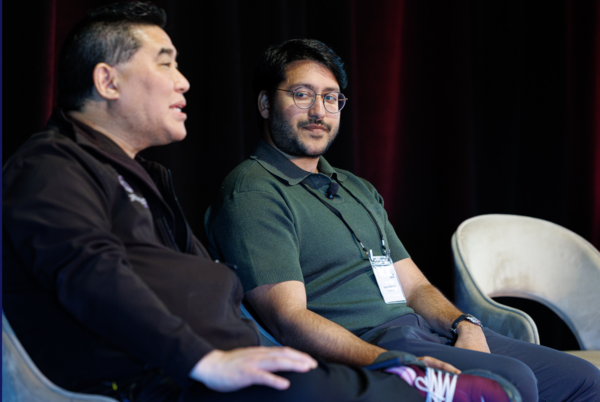
The business side is about the process and domain knowledge. Every company deploying AI has to rebalance the human vs. agentic AI labor split. "How do you think about the human labor and the costs associated with all of that? It all needs to be reengineered. Often, we start touching one part of the business, and very quickly our clients direct us to other things, and eventually we're running a full-on AI transformation program. These are the types of things that are happening organically across every single industry," said Mohanty.
- Holger Mueller: Thoughtworks Jolts Enterprise AppDev Into the AI Era
Managing human-AI systems and delegating will require new approaches. Mohanty said companies will need to develop new leadership skills that revolve around directing fleets of agents and delegating. He said:
"Humans are really good at directing, but not broadly. I would say that's a learned skill. Most people, just off the street, are quite bad at delegation and designing compartmentalized pieces of work that can then be distributed across the workforce. It is helpful to have folks who have expertise in a space that also has that directive ability."
Mohanty added that the future leaders will need to manage human and AI interactions. Companies will need to determine what the steady state of splitting work will look like and what requires handheld direction vs. delegation.
More from Constellation Research’s AI Forum:
- AI Forum 2026: "There are claws everywhere now"
- Scenes from two AI-native services firms
- CX strategies for agentic AI
- Actian CEO Potter: AI driving a data governance renaissance
Curiosity is a missing but critical leadership trait. "You'd expect curiosity is a primitive of leadership, but not always," said Mohanty. "Curiosity is critical at this stage."
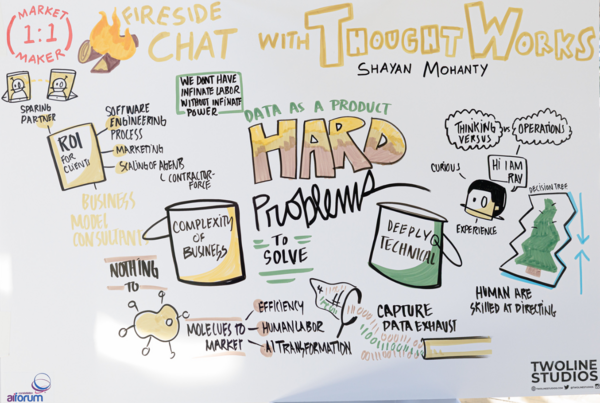
Everyone (not just engineers) is moving up the abstraction layer. Constellation Research CEO R "Ray" Wang noted that we're in an age where expertise is a commodity, but experience isn't.
Mohanty said:
"It doesn't matter if you're talking about software engineering or talking about business folks like strategists because everyone is just going up the abstraction chain. We went from a period of craftsmanship and how fast can I hammer a nail to now being how well do I understand framing of a house. This is a different way of thinking."
Strategic executive agents could be leadership amplifiers. Mohanty said AI agents are going to play a role in strategy and leadership. On "executive sparring partner" agents, Mohanty said:
"Just imagine an agent that sees all your meeting transcripts, which sees all your emails, which sees all your internal chat, you know, Slack, G chat, whatever you use, has 100% of the context that you do, has access to the internet, etc., right? So, as you're thinking about things, as you're mulling things over, you have a sparring partner you know holds the same exact context and understands how to apply pressure in the right ways to your system, your organization, to make things happen."
Data as a product is a mindset and operating model. Thoughtworks' approach revolves around seeing data as a product. "Don't just create data, throw it over a wall and leave it in a big pile to figure out later," said Mohanty. "Think intentionally about what data is being created, why it's being created, who the consumers are and what they expect out of it."
Mohanty added that this data as product isn't about technology or stack, but a philosophy that means being a good caretaker of data and using it as a competitive advantage.
The operating model for the data as a product will also evolve. First, enterprises will need to design for AI as the primary consumer for data. "We're shifting to a world where the primary consumers of data are no longer humans or dashboards, but they're agents and AI functions," said Mohanty.
He added that this AI transformation shouldn't revolve around a massive data transformation project but focusing on end-to-end slices based on the highest value use cases. "It's not necessary to do a full-on data transformation, like all at once and then get to AI, we actually recommend doing both at the same time in slices," said Mohanty.
Data exhaust matters for agentic reasoning. Mohanty said enterprises need to think through just the first phase of data and AI optimization and that means focusing on data exhaust. He explained:
"Data exhaust is a real thing. I would also say capture all your data exhaust, especially right now. We're in the state where you create these data products, you drive downstream data and business functions, but oftentimes you just let all of that agentic reasoning, all of the spinning it's doing, go out. There's tons of optimization opportunity if you're able to capture that and then reuse it back into its own function."
Develop an architecture for elastic work. Mohanty said enterprises will create new architecture for agent-based work that is elastic. He said:
"You can almost think of agents as FTEs (full-time employees) right there. They're just constantly kind of doing something in the organization to fit into a business process that is well defined. And then every so often, you're going to need to spin up another 50 agents to swarm on a task and then they go away. Two days later, you're going to spin up another 60 agents to do a different task. They're like contractors in a lot of ways as you elastically scale capacity."
More:
Larry Dignan is Editor in Chief of Constellation Insights at Constellation Research, where he leads editorial coverage focused on enterprise technology, digital transformation, and emerging trends shaping the future of business. He oversees research-driven news, analysis, interviews, and event coverage designed to help technology buyers and vendors navigate complex markets with clarity and context. ...
Read morePublished
Author
