


Scenes from two AI-native services firms
AI has revamped services companies and given smaller firms that ability to compete with giants. Here is a look at the moving parts, scaling and the new models emerging.
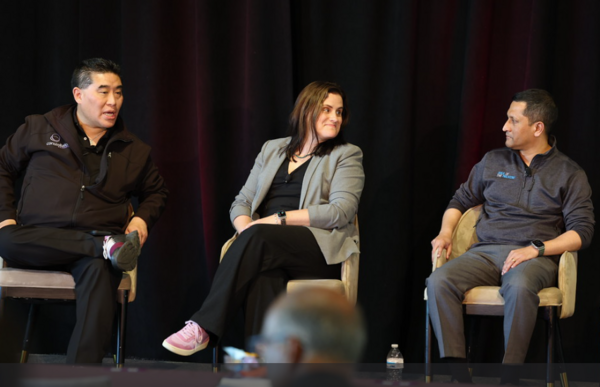
At Constellation Research's AI Forum in Silicon Valley, Forever Human.ai and Soul of the Machine, which launched at AI Forum 2025, walked through AI-driven services. Here are the takeaways from Tracey Cesen, Founder & CEO Forever Human.ai, and Sunil Karkera, Founder of Soul of the Machine.
Use of AI. Cesen's firm is focused on ServiceNow deployments and was one of the early customers of Moveworks, which was acquired by ServiceNow. AI has been used for back-office operations and the returns have been due to the "number of people I didn't have to hire."
Karkera said AI, specifically agentic AI, has enabled Soul of the Machine to scale its expertise quickly. "We have built a tool chain that's end to end from ideation to actually designing, shipping and running an application in one package," said Karkera.
The pace of AI. Cesen said her clients are "under tremendous pressure to actually get stuff done. "Clients are saying 'can we get this AI in, rolled out and with the right governance quickly," she said. "We see a lot of execution and innovation that's going right into the core business. There's so much pressure from boards. I say our competition is not another provider, but it's people doing nothing."
- CX strategies for agentic AI
- Actian CEO Potter: AI driving a data governance renaissance
- AI Forum 2026: "There are claws everywhere now"
Cesen said projects that used to take three to six months and a lot of money now take two to four weeks.
For Soul of the Machine, use of agentic AI is enabling it to ship SaaS applications instead of just changing existing ones. "Business model change is important and what we're seeing in terms of speed is real," said Karkera. "We replaced an ERP system that was written 4 years ago within six months. We shipped a SaaS application with millions of lines of code in four months. A website rebuild used to be six months to a year. Now it's four to six weeks."
Karkera said he prices by milestone reached so the shorter time means more volume.
Executive sponsorship. Cesen said it's critical to have an executive sponsor who actually wants to change thing. "If they're just looking to check a box that's not going to be a win for us," said Cesen, who said she has bi-weekly check-ins with executives. If C-level sponsors aren't joining regular calls, they're not the right customer.
Outcome-based pricing. Karkera prices based on output. "We are not doing outcome-based pricing. We're still doing milestone-based pricing. We don't want to take on the outcome risk yet," said Karkera.
"Outcome sounds really good on paper, but they're hard to execute. If you do a good job the customer is like 'we'll just pay you the traditional way," said Cesen. "I think we'll see a move toward more of a long-term contract and retainer type model with success fees and maybe some risk."
Hiring at an AI native company. Karkera said Soul of Machine simply needs less people. However, Karkera said he's looking for people with high context and engagement managers who understand the customer's domain and business processes. "It's not about how many years of experience, it's about how much impactful experience they had, and how much they have retained, and how much they have thought through on their own," said Karkera.
- Soul of the Machine: AI proof of concepts a waste of time
- AI is your new co-founder, core and creative and engineering muse
Cesen said her first hires were senior and focused on full stacks and platforms. The second set of hires can be less senior. She said:
"You need a lot of openness with hires. We're all getting disrupted all the time, and we have to disrupt ourselves first. We need to be in front of the client's disruption so we can guide them both through that. You're looking for openness and also discipline and structure to do the work."
Future of services. Karkera said Soul of the Machine doesn't see itself as a service company. "We see ourselves as high-speed learning company and expertise distribution. So, we have to learn faster than others and be extremely paranoid," he said.
Cesen said the human touch matters as does human judgement. Experience also matters. "There are 20 perfectly good ways to do things. How do you pick the right one? You can't substitute human judgment. This is about productizing knowledge.
Larry Dignan is Editor in Chief of Constellation Insights at Constellation Research, where he leads editorial coverage focused on enterprise technology, digital transformation, and emerging trends shaping the future of business. He oversees research-driven news, analysis, interviews, and event coverage designed to help technology buyers and vendors navigate complex markets with clarity and context. ...
Read morePublished
Author
