Digital Business; Transforming Procurement; Shifting to Purchasing Services
Digital Business; Transforming Procurement; Shifting to Purchasing Services

Andy Mulholland is Vice President and Principal Analyst focusing on cloud business models. Formerly the Global Chief Technology Officer for the Capgemini Group from 2001 to 2011, Mulholland successfully led the organization through a period of mass disruption. Mulholland brings this experience to Constellation’s clients seeking to understand how Digital Business models will be built and deployed in conjunction with existing IT systems. Coverage Areas Consumerization of IT & The New C-Suite: BYOD, Internet of Things, IoT, technology and business use Previous experience: Mulholland co authored four major books that chronicled the change and its impact on Enterprises starting in 2006 with the well-recognised book ‘Mashup Corporations’ with Chris Thomas of Intel. This was followed in…...
Read moreIf Digital Business is a transformation of the ‘sell’ side of an Enterprise then it stands to reason that a similar transformation must take place in the ‘buy’ side. After all, your Enterprises buy is another Enterprise’s sell. Yet there is relative little focus on Procurement amongst the great deal of content on Enterprise transformation in terms of addressing markets and products. There are two distinctive sides to the transformation of Procurement; the alignment of procuring ‘Services’ to match the selling of ‘Services; and the ability to simply buy better with Digital techniques to save money.
Simple logic suggests that the lessons learnt in successful Digital Business procurement techniques should feed a Digital Business sales strategy, and vice versa. Learning to excel at one should lead to excelling at both!
How has procurement become the Cinderella of Digital Business? The probable cause is the structure of the traditional business model around the separation of various Enterprise activities to better focus on functionality excellence. ERP in many ways served to preserve this by offering the necessary data flow between departments to provide an Enterprise wide cohesion. As stage one of any procurement transformation is almost going to be based on the existing department it makes sense to start with using Digital Business capabilities to cut the cost of the overall Enterprise procurement budget. The winner of Constellation Research Connected Enterprise annual award for Technology Optimization and Innovation made the scope for this kind of transformational improvement of procurement very clear.
William Cooper, Associate VP and Chief Procurement Officer, University of California managed to reduce the annual procurement spend by $128million in one year by a real Digital Business transformation of the Universities procurement function and activities.
The achievement was made all the more remarkable by this being achieved in the first year after agreement to proceed with a strategic procurement transformation. The expected ongoing target from year two onward moves this up to an annual $200million of savings. The University of California transformation had a clear well constructed vision, driving a strong organizational and operational transformation program, with equally clearly focused metrics. The full details will be available as a Constellation case study shortly. The focus was rightly on the business model transformation necessary to bring this about, not on the adoption of a single element, or technology product/service. The case study therefore focuses on the operational elements of the transformation, which for this blog are reduced to the following key elements;
Collaboration; transforming ten physically separate campus procurement teams into a single virtual centralized operation organized around virtual teams for particular procurement specialties comprised from those with the most experience to support best practice…everywhere, even if working in different physical locations.
Online Digital Procurement; reduced the cost, time and other factors involved in running individual procurement exercises/bids, which in turn allowed Procurement to address more purchasing requirements. The actual the number of items subjected to continuous competitive procurement rose dramatically from $2bn to $5bn introducing not only cost improvements, but in many cases service level improvements to users as well.
Auctioning; real time competitive online auctioning including the introduction of Reverse Auctioning introduced a game change in time and cost of competitive bidding. The capability to ask Suppliers to bid against your enterprise’s terms and conditions offers important changes in terms of the time, knowledge, and skill required in assessing competitive bids and different commercial terms. This is becoming a key aspect for the ongoing procurement of Services, as detailed in the next paragraphs.
Services; the single most important ongoing change for any procurement department to understand what exactly this will mean to operating managed procurement in an Enterprise that is moving to become a Digital Business on the sales and marketing side.
The procurement of Services is fast becoming a very necessary new skill for an Enterprise to acquire in adopting Digital Business for its go to market operations. What would be the outcome if you could find out how many contracts your Digital Business users have ‘agreed’ online …… without reading the terms and conditions?
There are a variety of Industry estimates on this, if you include personal use of Apps then the number is usually said to be 15 to 20; restricting the count to genuine business process usage suggests around 5 to 10 at a conservative estimate. Whichever one of these estimates is true represents a currently unknown business risk in terms of security, wrongful use, commercial terms, or any other possibility. The need for a Risk Register’ for an Enterprise to recorded, and address, the extent of it’s exposure was defined in a previous blog. The IT department is right to be very worried about the extent of ‘Shadow IT’, but at the same time it has to accept who buys, what, why and on whose budget is a huge game change factor in Digital Business.
Digital Business requires operational managers to consciously make choices using their ongoing operational budgets (OpEx) to acquire capabilities as ‘Services’. The contrast to a yearly centrally administered Enterprise budget (CapEx) supported by Procurement is a genuine Game Change. The traditional IT and Procurement process simply is not going to work on grounds of time, cost, skills in new aspects that have to be mastered, let alone its unsuitability for OpEx versus CapEx business models.
Perhaps this is the moment to refer again to the University of California Procurement transformation that started this blog. Here the first three building blocks listed provided the basis for establishing a new set of methods that are suited to procuring “Services’. Perhaps also rereading a previous blog that introduced the need in Digital Business for Mastering new Financial Controls may also help as well. Fast online procurement by reverse auctioning allows your Enterprise to set its own terms, and if the handfuls of large players don’t want to accept them, then there are an ever-increasing number of competitors in the second tier that probably will. Taking this approach means you know exactly what terms apply to any contract!
But, what if its not IT, or even technology as we understand the term, at all? Most Building Management projects wouldn’t be described as being part of IT, but are equally shifting to ‘services’. As an example the University of California added $3billion to what it described as its ‘addressable procurement’ spend by rethinking all items. In the case of building projects it was not only about buying material better, but to adopt shift ‘services’ such as the power tools required being supplied as a ‘Service’. Extend this line of thinking to include the impact of the Internet of Things on Building Management Outsourcing. Consider who owns the sensors and the data versus who processes and supplies the management of key capabilities ‘as a service’ and the longer-term procurement management of ‘services’ in a Digital Business starts to emerge.
If the pundits are right, and it already looks that way, then the transformation of Procurement and its operations to match/align with Enterprise Digital Business goals, and the market opportunities, is as much a strategic initiative as the transformation of the go to market operations that today receive all of the focus.
Innovation & Product-led Growth Tech Optimization Future of Work AI ML Machine Learning LLMs Agentic AI Generative AI Analytics Automation B2B B2C CX EX Employee Experience HR HCM business Marketing SaaS PaaS IaaS Supply Chain Growth Cloud Digital Transformation Disruptive Technology eCommerce Enterprise IT Enterprise Acceleration Enterprise Software Next Gen Apps IoT Blockchain CRM ERP Leadership finance Customer Service Content Management Collaboration M&A Enterprise Service Chief Information Officer Chief Technology Officer Chief Digital Officer Chief Data Officer Chief Analytics Officer Chief Information Security Officer Chief Executive Officer Chief Operating Officer




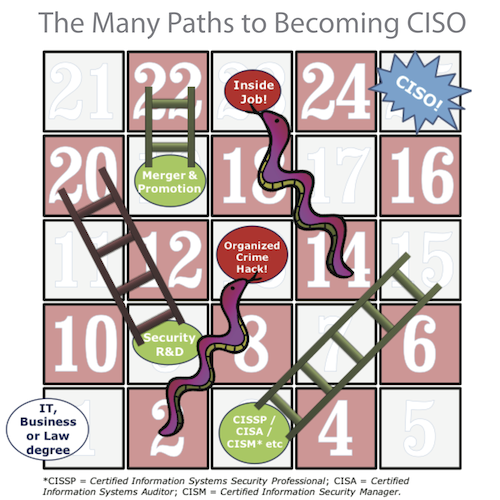 Over the years, we security professionals have tried all sorts of things to make better connections with other parts of the business. We have broadened our qualifications, developed new