Results

Lesson 5 From Disrupting Digital Business - Build For Insight Streams

Lesson 5 From Disrupting Digital Business - Build For Insight Streams

Sometimes when you are in the thick of it, it’s hard to describe what’s happening.  In the case of digital business, these models have progressed over the past 20 years.  However, non-traditional competitors have each exploited a few patterns with massive success. However, as the models evolved, winners realize there are more than a handful of patterns.

Get All 10 Lessons Learned From Disrupting Digital Business

As with the beginning of every revolution, those in the midst of it can feel it, sense it, and realize that something big is happening. Yet it’s hard to quantify the shift. The data isn’t clear. It’s hard to measure. Pace of change is accelerating. Old rules seem not to apply.

Lesson 1 – Transform Business Models And Engagement

Lesson 2 – Keep The Brand Promise

Lesson 3 – Sell The Smallest Unit You Can

Lesson 4 – Know That Data Is The Foundation Of Digital Business

Lesson 5 – Build For Insight Streams

In fact, the impact is significant and now quantifiable with 52% of the Fortune 500 gone since 2000 and the average age of the S&P 500 company in 1960 is down from 60 years to a little more than 12 projected in 2020.  That is a 500% compression that has changed the market landscape forever in almost every industry.

Over the course of the next 10 weeks, I’ll be sharing one lesson per week.  For traditional businesses to succeed, they will have to apply all 10 lessons from Disrupting Digital Business in order to not only survive, but also relearn how to thrive.

Build For Insight Streams

Screen Shot 2015-05-31 at 8.19.46 AM

One of the biggest opportunities for monetizing digital business will come from insight streams.   These insights will come from both least likely sources and the most obvious.   For example, least likely sources include the amount of power consumer, water used, visitors into the building, foot traffic on the sidewalk, and density of the parking lot.   These sources may seem mundane and useless information to most of us, but large insight brokers will take that data to drive contextually relevant information.  Obvious sources include internal systems such as work force performance data, customer satisfaction, product quality stats, and other areas.   The goal here is to use this information to differentiate.   There are three models to build big data/insight business models.  I’m going to pull from my December 6th, 2012 post on Harvard Business Review here and share with you these models (Figure 1).

Figure 1. Digital Organizations Build Business Models Based On Insight

Big Data Business Models

  1. Differentiation of insight creates new experiences. For a decade or so now, we’ve seen technology and data bring new levels of personalization and relevance. Google’s AdSense delivers advertising that’s actually related to what users are looking for. Online retailers are able to offer — via FedEx, UPS, and even the U.S. Postal Service — up to the minute tracking of where your packages are. Map services from Google, Microsoft, Yahoo!, and now Apple provide information linked to where you are.  Big data offers opportunities for many more service offerings that will improve customer satisfaction and provide contextual relevance. Imagine package tracking that allows you to change the delivery address as you head from home to office. Or map-based services that link your fuel supply to availability of fueling stations. If you were low on fuel and your car spoke to your maps app, you could not only find the nearest open gas stations within a 10-mile radius, but also receive the price per gallon. I’d personally pay a few dollars a month for a contextual service that delivers the peace of mind of never running out of fuel on the road.
  2. Brokering augments the value of insight. Companies such as Bloomberg, Experian, Dun & Bradstreet already sell raw information, provide benchmarking services, and deliver analysis and insights with structured data sources. In a big data world, though, these propriety systems may struggle to keep up. Opportunities will arise for new forms of information brokering and new types of brokers that address new unstructured, often open data sources such as social media, chat streams, and video. Organizations will mash up data to create new revenue streams. The permutations of available data will explode, leading to sub-sub specialized streams that can tell you the number of left-handed Toyota drivers who drink four cups of coffee every day but are vegan and seek a car wash during their lunch break. New players will emerge to bring these insights together and repackage them to provide relevancy and context.  For example, retailers like Amazon could sell raw information on the hottest purchase categories. Additional data on weather patterns and payment volumes from other partners could help suppliers pinpoint demand signals even more closely. These new analysis and insight streams could be created and maintained by information brokers who could sort by age, location, interest, and other categories. With endless permutations, brokers’ business models would align by industries, geographies, and user roles.
  3. Delivery networks enable the monetization of insight. To be truly valuable, all this information has to be delivered into the hands of those who can use it, when they can use it. Content creators — the information providers and brokers — will seek placement and distribution in as many ways as possible.  This means, first, ample opportunities for the arms dealers — the suppliers of the technologies that make all this gathering and exchange of data possible. It also suggests a role for new marketplaces that facilitate the spot trading of insight, and deal room services that allow for private information brokering. The most intriguing opportunities, though, may be in the creation of delivery networks where information is aggregated, exchanged, and reconstituted into newer and cleaner insight streams. Similar to the cable TV model for content delivery, these delivery networks will be the essential funnel through which information-based offerings will find their markets and be monetized.  Few organizations will have the capital to create end-to-end content delivery networks that can go from cloud to devices. Today, Amazon, Apple, Bloomberg, Google, and Microsoft show such potential, as they own the distribution chain from cloud to device and some starter content. Telecom giants such as AT&T, Verizon, Comcast, and BT have an opportunity to also provide infrastructure, however, we haven’t seen significant movement to move beyond voice and data services. Big data could be their opportunity. Meanwhile, content creators — the information providers and brokers — will likely seek placement and distribution in as many delivery networks as possible. Content relevancy will emerge as a strategic competency in delivering offers in ad networks based on the context by role, relationship, product ownership, location, time, sentiment, and even intent. For example, large wireless carriers can map traffic flows down to the cell tower. Using this data, carriers could work with display advertisers to optimize advertising rates for the most popular routes on football game days based on digital foot traffic.

Homework

Start by thinking of the obvious and non-obvious data sources.   Put on your privacy hat and make sure you aren’t brokering any PII.  Armed with these data sources, start thinking about potential business models from these insights:

1.  Where you can create new brand promises with insight?  Take a look at the March 2015 article in Wired on the Disney Magic Band.  Note how they are using this device to create differentiated experiences.

2. What insights can you broker and trade?  Start with the questions you’d like to ask of your systems. Find out what insight sources are missing for you to make that decision.  Identify partners to trade with.

3. Find out if there are industry associations or consumer marketplaces where this data could be exchanged.  Determine what contextual services you may want to launch.

The result of this exercise is a list of potential projects to pilot.  Makes sure you rank them based on brand promise delivered, value created, return on investment, and level of strategic differentiation.

The Complete 10 Lessons Learned From Disrupting Digital Business

For those attending the full keynotes and book tours, you’ll get the complete session and in many cases a copied of a signed booked.   For those following virtually, I’ve provided the slimmed down slide share deck for your use.

You now have the 10 lessons learned to disrupt digital business in your hands. You can take this information and change the world in front of you or choose to sit on the knowledge as the world passes you by and digital darwinism consumes your organization.

I trust you will do the right thing. And when you want some company, come join us as a client at Constellation Research where we’re not afraid of the future and the art of the possible.

Get The Book Now Before Digital Darwinism Impacts You

Purchase on Amazon
Bulk Orders: contact [email protected]
About Disrupting Digital Business

Join the Digital Disruption Tour. Events in San Francisco, Atlanta, London, and Amsterdam!

Your POV.

Are you ready to disrupt digital business?  Have you ordered the book?

Add your comments to the blog or reach me via email: R (at) ConstellationR (dot) com or R (at) SoftwareInsider (dot) org.

Please let us know if you need help with your Digital Business transformation efforts. Here’s how we can assist:

  • Developing your digital business strategy
  • Connecting with other pioneers
  • Sharing best practices
  • Vendor selection
  • Implementation partner selection
  • Providing contract negotiations and software licensing support
  • Demystifying software licensing


Data to Decisions Matrix Commerce Next-Generation Customer Experience Innovation & Product-led Growth Tech Optimization Future of Work AI ML Machine Learning LLMs Agentic AI Generative AI Robotics Analytics Automation Cloud SaaS PaaS IaaS Quantum Computing Digital Transformation Disruptive Technology Enterprise IT Enterprise Acceleration Enterprise Software Next Gen Apps IoT Blockchain CRM ERP CCaaS UCaaS Collaboration Enterprise Service developer Metaverse VR Healthcare Supply Chain Leadership B2B B2C CX EX Employee Experience HR HCM business Marketing Growth eCommerce finance Customer Service Content Management M&A Chief Customer Officer Chief Information Officer Chief Marketing Officer Chief Technology Officer Chief Digital Officer Chief Data Officer Chief Analytics Officer Chief Information Security Officer Chief Executive Officer Chief Operating Officer Chief Experience Officer

Continuity of Customer Experiences Drives the Future of Commerce

Continuity of Customer Experiences Drives the Future of Commerce

Continuity of Customer Experiences Drives the Future of Commerce - Constellation ResearchContinuity of Customer Experience Drives the Future of Commerce. I just finished some new research on how improving online customer experiences boosts customer loyalty and revenue in matrix commerce. This survey report provides online businesses with insights into e-commerce challenges, tools used for success, and plans for e-commerce usage in 2015-2020.  The goal is to ensure better experiences and understand what experience-driven continuity means to online business leaders, learn how organizations rate their own brand’s online experiences today, discover what they do to engage with customers across devices, and find out how organizations would rate the emotional connection that customers have with their brand online.

An excerpt of the report is available to download. 

DOWNLOAD EXCERPT

How End Users Should Use This Information: Clients should use this document as a best practices guide in developing online customer experiences that will positively drive revenue in matrix commerce initiatives. A successful customer experience on ecommerce consists of six elements I call the 6 Pillars of Customer Experience.

6 Pillars of Ecommerce Customer Experience Constellation Research

Start in one channel, finish in another.

  • Stat: Only 29 percent of U.S. and 22 percent of U.K. brands reported that it was extremely easy for their customers to start the buying journey in one channel (e-mail, chat, video chat, mobile chat, co-browsing, etc.) and complete the purchase in another channel
  • Customers expect to start the buying process in one channel and finish in another of their choosing.
  • It is paramount to reach out to consumers at the moments that most influence their decisions.
  • If a customer cannot easily transition from one channel to another in the buying process, a company will not be able to reach out to the customer at the moment the customer has questions, wants advice or needs help in making a decision.
  • The customer journey must involve continuous interactivity and a two-way conversation with the brand at the right time, with continuity at its core.

Start on one device, finish on another.

  • Stat: Only 35 percent of U.S. and 23 percent of U.K. brands reported that it was extremely easy for their customers to start the buying journey on one device and complete the purchase on another device and keep all the information for the order correct and complete.
  • Customers expect to start the buying process on one device (desktop computer, tablet, smartphone) and finish on another.
  • Leaders should make the business case for not only the technology to make it possible to start the buying process on one device and finish it on another, but also the staff and the training for them to help customers when they transition from one device to another.

Proactively deliver contextual agent assistance during the purchase process.

  • Stat: Only 46 percent of U.S..and 48 percent of U.K..brands could provide excellent agent or human-assisted service through voice and chat while keeping intact the context about the customer’s search, previous purchases and likely purchases.
  • Stat: In addition, only 49 percent of U.S. and 41 percent of U.K. brands could anticipate when a customer may need human assistance while on an e-commerce site.
  • What this means is that brands are not able to provide the human touch often required to close a purchase or understand the context of customers’ potential purchases and help them make the best choice.

Create performance reports viewed as a dashboard or downloadable for reporting and analysis.

  • Stat: Only 51 percent of U.S. and 34 percent of U.K. brands had technology that could provide a variety of e-commerce/website performance information as a dashboard.
  • Without an easy way to look at analytics, the numbers can be lost on many people.
  • Actionable insights must be provided in a dashboard fashion, with trends and easy-to-interpret “next best actions” in order to optimize e-commerce conversions.
  • Stat: In addition, only 50 percent of U.S. and 34 percent of U.K. brands had technology that provided them with site performance reports that were downloadable for reporting and analysis.
  • Without this capability, it is difficult to communicate to senior leadership about the trends, the progress or what is needed to convert more sales and drive higher profits.

Detect if customers need pre-purchase assistance and then support them and send help.

  • Stat: Only 27 percent of U.S. brands and 19 percent of U.K. brands reported that it was extremely easy to send the customer help.
  • When respondents were asked if they were able to detect when customers need pre-sales or pre-purchase support, the survey also asked them how they were able to determine the customer’s need.
  • The breakdown of how respondents currently can determine (or not) whether customers need help indicate a very rudimentary approach.
  • The way brands currently are able to determine if a customer needs pre-sales help is if there is general movement throughout the e-commerce site pages because they are toggling between products or because they are on a page for a long time.
  • Brands need to be smarter than this and the right technology can help here.
  • However, if the brand is not able to reach out to customers with the right information at the right time, it is unable to convert these in-need customers in time into purchasers.
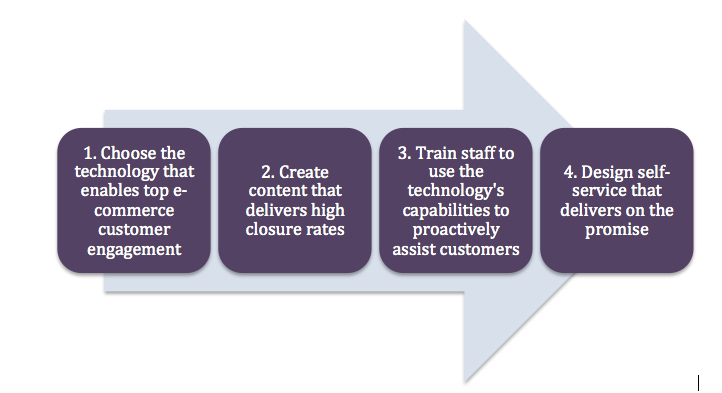
  • The various forms of assistance included being able to send a knowledge base article or offer a proactive, pre-sales chat designed to stop the customer from abandoning the site or the shopping cart.

 Get high lead conversion rates from demand generation content.

  • Stat: In order to secure the resources for content marketing to generate demand for products, brands need to be able to have a high lead rate for the content they create.
  • This means that brands do not understand what type of content customers need to make up their minds and purchase the product. Content generation can be expensive and require additional staff.[2]
  • Content is not something to be taken for granted. It takes budget, people, and process to deliver relevant content to engage customers and drive commerce.

Next Steps?  Have you gotten your customer experience in shape so you can ultimately drive revenue and commerce? If so, what did you did you do? What do you think most brands are missing on this topic?

Download an excerpt of the report

DOWNLOAD EXCERPT 

References

[1] Harris Poll Survey and Constellation Primary Research.

[2] How to Staff the Team for Effective Content Marketing: From Ad Hoc to Professional, Learn What It Takes to Staff for Success, Constellation Research, Dr. Natalie Petouhoff and R “Ray” Wang, April 10. 2015

Matrix Commerce Next-Generation Customer Experience Chief Customer Officer Chief Information Officer

The Inaugural Qantas Hackathon

The Inaugural Qantas Hackathon

1

Held over the weekend of 30-31 May, we’ve been working with Qantas to host a hackathon that brings together teams of developers from across the country. How will these innovations play out? What will the teams deliver? Only time – 24 hours to be exact – will tell. Here’s the wrap of the first day.

Marketing Transformation X Chief Marketing Officer

Salesforce Acquires Tempo Smart Calendar

Salesforce Acquires Tempo Smart Calendar

Congratulations to Raj Singh and the rest of the Tempo.ai team on being acquired by Salesforce. Tempo has been one of my favourite vendors as I research intelligent collaboration and personal digital assistants. I will be watching closely to see where they end up in the Salesforce platform.

Here is the message on their website: 

Today, we’re excited to announce that Salesforce has acquired Tempo. Joining the Salesforce family will give us the opportunity to continue our mission at a much larger scale. Unfortunately, this means the Tempo app will be discontinued on June 30, 2015, and we are no longer accepting new users. Although we are sad to be closing this chapter, we are thrilled to join the world’s #1 CRM platform!

For those of you unfamiliar with Tempo, they first came to my attention almost two years ago with a $10M funding round.


Since then they have been one of my go to examples for the next generation of productivity tools, bridging the worlds of collaboration and recommendation to help people work more effectively. Tempo looks at your calendar and shows the social media posts from attendees, relevant emails and documents, estimates driving times and a lot more. 


After Salesforce shutdown their social task management tool Do in Oct 2013, I was concerned about where the company was going with respect to organizing the growing choas people face during their workday. They did create a "Today" app as part of their Salesforce1 mobile application, but it is not as advanced as Tempo. I look forward to seeing how Salesforce integrates Tempo, hopefully in time for Dreamforce.

I have to admit, I was pretty sure Microsoft or Google was going to acquire Tempo, so I would have lost a bet on this one! Hats off to Salesforce for scooping up one of the best products in this space.


Future of Work

Speed matters for HR - how to accelerate - Part I

Speed matters for HR - how to accelerate - Part I

We know business is running faster than ever before, with little to no chance of slowing down. We often talk about the fact that 52% of the Fortune 500 are no longer part of the index, a development that has happened in the last dozen or so years. We also use another statistic from the Fortune 500 Index, where the average age of the company joining the index is now 10 years, meaning it has been founded this century. There is no question – things are speeding up.

But speeding up is not easy and as enterprises struggle on how to pick up speed, the people function needs to get ready and help. Ironically the HR function has been more pre-occupied with compliance issues, largely triggered by the ACA in the US and other statutory changes worldwide, than with looking at how to make the HR function leaner and more agile with the ultimate goal to help accelerate the overall business.

The good news is that HR systems vendors have realized this, and there is help on the way, but before these solution ship in the coming quarters – let’s look at what the criteria for a successful next generation HR product should be:


Let’s look at the first three of them in this blog post – more to come later:

Business User

Many generations of HR software have been written with the HR professional in mind. And while that was a valid approach in the 20th century, bowing to Tayloresque organization models and following them in enterprise software, it is not valid for the 21st century anymore. Business users don’t have the time to walk by the HR professional for a chat, weekly 1 to 1s are history and in general business users are not necessarily looking forward to work with HR. And the reason is at hand – business users have to move faster, but HR is not, so intuitively they tend to cater to human nature and start to avoid what is not helping them. No business line user is primarily paid for their job to ensure compliance, but to ensure business results through leadership of the people in their team. In consequence it means that next generation HR software is not designed and built for HR professionals – but for the business users who manage people. Automation for the HR professionals is then the next step. So when looking at the next generation of HR software, look for the support of the business user.
 

BigData enabled

We are witnessing a fundamental change in the computing model that is applied to software problems. In the past the compute model was characterized by sparse resources, which by today is part of the history. Specifically to BigData it means that enterprises can store all their existing data again, in BigData clusters, for a fraction of the cost, with the benefit of more in depth analysis, even not knowing what questions they may ask down the road. So not only can new insights be found, but BigData solutions offer business users for the first time the re-assurance to be able to ask any questions and chase any potential insight that may pop up in the future. That is of tremendous value, especially when considering both acceleration and uncertainty enterprises face. So make sure your next generation of HR software takes advantage of BigData capabilities.
 

‘True’ Analytics

A lot of talk happens on analytics these days, but business users should be aware of very little software that is called ‘analytics’ does true analytics. And with that I refer to either taking an action or make a recommendation (read my blog post here). A chart, visualization, dashboard does not do that, it’s back to the human to make the decision. But confronted with a need to make more decisions in less times, ‘true’ analytics are the solution for business users that have to execute faster. So equally make sure that when you make decisions for next generation HR software – that it enables ‘true’ analytics. Because at the end you don’t want business users start downloading data in spreadsheets and upload them to some (maybe questionable) analytical insight web sites.

Stay tuned for Part II.

Resources

Inside the Future of HCM

DOWNLOAD SNAPSHOT

Ten Trends Chief People Officers Need to Know in a Digital Age

DOWNLOAD SNAPSHOT


Future of Work Next-Generation Customer Experience Digital Safety, Privacy & Cybersecurity Data to Decisions Tech Optimization AI Analytics Automation CX EX Employee Experience HCM Machine Learning ML SaaS PaaS Cloud Digital Transformation Enterprise Software Enterprise IT Leadership HR LLMs Agentic AI Generative AI business Marketing IaaS Disruptive Technology Enterprise Acceleration Next Gen Apps IoT Blockchain CRM ERP finance Healthcare Customer Service Content Management Collaboration Chief People Officer Chief Customer Officer Chief Human Resources Officer Chief Information Officer Chief Technology Officer Chief Information Security Officer Chief Data Officer

Moving Beyond Likes To Business Actions

Moving Beyond Likes To Business Actions

For years I've been saying that the key to adoption of collaboration software is "purpose". Without a real business reason to use a tool, it will just by another thing employees have to worry about. But if a tool is a seamless and natural part of a process, then organizations won't worry about measuring adoption, as everyone (invovled in that process) will be using the tool to do their jobs.

Several enterprise software vendors have latched onto the concept of "purpose" and have developed their collaboration platforms to integrate into the way people work. One such vendor is Collaborne, who recently introduced a feature they are refering to as "Call-To-Action".  Instead of just providing the standard "Comment" and "Like" action on posts, Collaborne enables customers to customize the way people interact with posts using a structured reply form.

In the example below you can see a new record has been created for a job opening in SAP and that record has been posted into the activity stream (newsfeed) in Collaborne.  Instead of standard text box for generic replies, there is a button called "Endorse a candidate". Clicking the button opens a form where people provide a link to a candidate and recomendations on why they suggest them.


While this may seem like a subtle difference, I think the impact can be signifigant.  The ability to openly collaborate (be "social") but at the same time have a level of structure to the content is a powerful mix that I'd like to see more of from enterprise software vendors.


Future of Work

Google Now - Helping You Get Things Done

Google Now - Helping You Get Things Done

Yesterday at Google I/O they previewed the next generation of Google Now, their mobile digital assistant. It's like Siri for those of you familiar with iPhones. The major enhancement was "Google Now on tap" (which I'll refer to with the unfortunate acronym, GNOT)  which will provide information based on the exact context of what you're doing. So instead of just providing information like weather, stocks, news and flight details, GNOT will deliver content based on what is currently on screen.

Currently the examples Google is showing are all based on things you do in your personal life, such as  "if a friend emails you about seeing the new movie Tomorrowland, you can invoke Google Now without leaving your app, to quickly see the ratings, watch a trailer, or even buy tickets"

Google Now on Tap


While providing context specific information around our personal lives is interesting, what I'm the most interested in is the potential way GNOT could be used at work. Imagine if integrated into the Google Apps for Work suite, how GNOT could provide context sensitive information about the people or the content related to what you're doing.

For example:

- From an email, provide information about the people on the email chain, the companies they work for, the history of your relationship, their current social media posts

- From a calendar entry, display travel information (flights, hotel, cars), businesses in the area, people (colleagues or competitors!) that are near by

- From a document, show recent news or other data sources related to the topic

Google's blog post about GNOT says: "Since we launched Google Now, we’ve been expanding the ways it can help and do more of the work for you."  I look forward to seeing how GNOT fits into The Future of Work, not just for Google's products, but how developers can use it to enhance their own applications.

Google Now on Tap is scheduled to ship with Android M in Q3. (currently in developer preview for Nexus 5, Nexus 6, Nexus 9 and Nexus Player)


Future of Work Data to Decisions Innovation & Product-led Growth New C-Suite Marketing Transformation Next-Generation Customer Experience Digital Safety, Privacy & Cybersecurity Google

Real-time, In-Journey Customer Experience Mapping Provides The Right-time, Real-time Engagement

Real-time, In-Journey Customer Experience Mapping Provides The Right-time, Real-time Engagement

In-Journey, Real-time Customer Journey Mapping

Lots of clients ask, “How can I improve my customer experience to gain and retain loyal customers?” Some brands are operating on old legacy systems and are having a difficult time being able to incorporate customer data with the real-time customer experience. If that is possible, it will help the employees (marketing, sales, customer service, customer success management…) to provide the best in-context answers depending on what a customer has already looked at, has already done with a brand and where they seem to be stuck or need more information to choose a product or service. If you want to understand this more, here is a link to a webinar with more detail: Real-time, in-journey customer experience mapping.

We see this “in-journey” customer data and customer analytics capability as key to being able to deliver on engaging customer experiences. Here’s a picture of what an in-journey customer experience brand dashboard can look like:

In journey customer experience supports customer service agents

Source of Diagram: Engage.Cx

What The In-Journey Customer Engagement Dashboard Looks Like

From the in-journey customer experience dashboard, someone trying to help support a customer can follow along the gray line in the middle (with the dots in it and a arrow at the top) and see each of the “events” or interactions the customer has already had with the company. For instance, on Wednesday, March 25th, they had several engagements with the brand. If you look at the bottom and to the left of the diagram, you’ll see on Thursday, March 26th at 1:23 PM – the customer had a chat session with the brand. On Wednesday, April 1, they had another chat session at 5:39 PM.

On April 15th, at 5:42 PM the customer had a 12 min, 2 second chat with the brand. The affinity was rated at a 10 and the readiness to buy was a 9, meaning NOW. As you follow the gray arrow you see on Wednesday April 15th, the customer was in the store. On May 6th, the customer had another chat session with the brand at 2:03 PM. So this what a customer’s Key Brand Engagement and Buying Interactions Timeline can look like. With this information in-front of a sales person, a customer service agent or marketing professional, they can not only see what this particular customer’s brand engagement pattern is (how they go from one channel to another, what time they engage with the brand, whether it is in the store, or online….)

And if online, what channel they use – chat, email, website, etc…) This is all very helpful when an employee is trying to help the customer make a decision. Things that the customer has already asked don’t have to be repeated. New questions can be answered and the brand can really appear and be helpful to a customer. And finally the employee (marketing, sales or customer service) can clearly see what the customer needs next. This helps the employee decide what content to send the customer or the buying objections they may have had and how they the employee can best help that customer to make a good decision.

Aggregation of Customer Engagement Patterns of Customer Journey

What a brand can also do is to look in aggregate, many customers over time, to see how customers generally engage with a brand. This can even start to take the place of “guessing” the customer journey mapping that brands do (often from the company’s point of view and not necessarily what customers actually do.) With that real customer journey mapping in hand, brands can change their processes to make the best possible customer journey, with the least friction, from the customer’s point of view.

Real-time Customer Journey Mapping

With this type of real customer journey mapping, a brand can look at the content they need to provide to marketing, buying, customer service cycle as well as how to take extra steps out of their processes to make it easier for customers to make a commitment to a brand. With this type of customer journey information, a brand can really begin to understand their customers to the point that they make it so easy to do business with that brand, that customers not only become loyal, but they also become customer advocates and refer their friends and family.

How does your company realize it’s customer journey’s? Do they do it on paper, in a large conference room? or do they map it real-time as the customer is on their journey? Which do you think is more effective in getting to building the least friction and the highest lead conversion rates?

@drnatalie, VP and Principal Analyst, Covering Marketing, Sales and Customer Service to Deliver Great Customer Experiences

Next-Generation Customer Experience B2C CX Chief Customer Officer Chief People Officer Chief Human Resources Officer

Salesforce Starts Wave For Big Data

Salesforce Starts Wave For Big Data

Salesforce announced a good starting point for big data analysis Thursday with the introduction of Salesforce Wave For Big Data, but it’s just that: a starting point. Stay tuned for more partners, more big data plumbing and, most importantly for customers, proven and repeatable use cases.

This week’s announcement was all about big data access, with free integrations introduced to the Google Compute Cloud, Cloudera and Hortonworks Hadoop distributions, and application-management vendor New Relic. That’s a pretty impressive list, though the obvious hold outs are Amazon Web Services and Splunk. It’s a good bet they’ll join the list as Salesforce Wave adoption grows.

A fictional Salesforce Wave for Big Data analysis in which weather and sensor data is mashed up with a bike-share firm's CRM data.

A Salesforce Wave for Big Data analysis in which weather and sensor data is mashed up with customer Bay Area BikeShare’s CRM data.

What you didn’t hear much about was ready-to-run analyses, much less anything resembling applications. That’s pretty typical in the big data space where the possibilities are always limitless but not terribly concrete. It’s up to the practitioners to come up with something practical, affordable and differentiating.

There are, at least, very obvious themes Salesforce customers can pursue:

  • Sales: Clickstreams and other high-scale customer-interaction data sets could enhance sales lead scoring efforts.
  • Service: With all the discussion of Internet-of-Things opportunities, we can’t miss the idea of applying log and sensor data to customer service scenarios like predictive maintenance.
  • Marketing: Mobile data gets big, and it could be useful to marketers looking for best customers and hoping for responsive marketing campaigns.

In the absence of lots of real-world customer-use-case examples (for now), the message might be, “if you can dream it, you can do it.” But the data you need won’t magically appear in Salesforce Wave. We’re going to see two personas involved at the back end of Salesforce Wave for Big Data deployments: big data developer types and data wranglers. The developer types will be the people who can spot the right data deep inside these Google/Cloudera/Hortonworks/New Relic data lakes. The data wranglers will then curate that information into slivers of data or aggregates that can be loaded into Wave.

Data curation is where Salesforce Wave for Big Data partners Informatica and Trifacta come in. Informatica is, of course, the biggest cloud-data-integration partner for Salesforce. But this data-munging process doesn’t have to be an IT project. These two vendors also offer self-service style data-blending and transformation tools — Informatica Rev and Trifacta, respectively – that are geared to analysts and data-savvy business users who can prepare data for loading into Wave. Once these data-movement jobs are set up, Salesforce says they can be repeated up to 20 times per day, with near-hourly latency being another pretty good start.

MyPOV: Great Start, Now For The Second Wave

Salesforce will have more to say about big data later this summer, so the story will get richer than extracting data sets and putting them into Wave.  We’ll want to see deeper and more repeatable connective tissue between diverse source systems and Wave. Customers will want to see proven, lighthouse-customer case examples and some form of starting point or blueprint for building big data apps.

The imperative for would-be customers – and indeed for all big data practitioners – is getting business leaders engaged in the blue-sky brainstorming. Without good, free-flowing and on-going collaboration between the business types and those developers and data wranglers, a project might start to feel like an old-school data warehousing project, with requirements-gathering and time-lag disconnects. As my colleague Holger Mueller points out, the very act of picking slivers of data or aggregates out of those big repositories removes the opportunity to “ask all kinds of ‘crazy’ questions in the hunt for insights.”

Holger is alluding to the flexibility of schema-on-read analysis, but it’s just not practical to put everything in a Hadoop cluster into Wave. The database behind Wave is a proprietary NoSQL key-value-store, so we should expect fast and flexible data loading. But from what we’ve seen thus far, it seems the serendipitous big-data-discovery opportunities will remain at the big data platform level.

Salesforce Wave for Big Data is about putting proven insights into production in an end-user-accessible data mart in the cloud. That’s still powerful because Wave is broadly accessible to all those Salesforce business users with, of course, all the mobile and social goodness that comes with Salesforce.

Have a question about your big data/analytics strategy? Let's talk! Contact me here. 


Data to Decisions Next-Generation Customer Experience salesforce AI ML Machine Learning LLMs Agentic AI Generative AI Robotics Analytics Automation Cloud SaaS PaaS IaaS Quantum Computing Digital Transformation Disruptive Technology Enterprise IT Enterprise Acceleration Enterprise Software Next Gen Apps IoT Blockchain CRM ERP CCaaS UCaaS Collaboration Enterprise Service developer Metaverse VR Healthcare Supply Chain Leadership Chief Information Officer Chief Technology Officer Chief Information Security Officer Chief Data Officer

Google I/O Day #1 Keynote - it is all about Android

Google I/O Day #1 Keynote - it is all about Android

We had the opportunity to attend Google I/O in San Francisco today. As usual the conference sold out in a matter of hours and is filling up Moscone West with 6500 attendees. 


So here are the takeaways from the keynote:

Android M  - for More usability – The next release of Android, M, is coming in Q3 2015. Google will focus on usability for the release, a good move as it has been pushing for new functionality in the L release. And usability is the #1 thing not working for Google when combatting Apple for the smartphone market shares. But usability for Google does not mean a new user interface – but a number of improvements. The major one is probably Android Pay, and Google is bringing capabilities back to older Android version. The fast loading will likely delight users, but needs apps and developers to uptake the capability, so the benefits will be out a little from today. Changing app permissions on the fly – not at install – is a good capability that makes users think about what and who they are giving access to. Android Wear has made good progress, too – Google is augmenting the platform with regular updates, which creates value for early users. With over 4k apps for Android watch Google has substantial counter weight vs the omnipresent Apple iWatch.
 
6 New Key Capabilities with Android M 

Brillo and Weave for IoT – Google wants to play (even more post Nest) in the IoT space, and both Brillo and Weave are key steps for that market. Brillo is a shrink down version of Android, as an OS for things, a smart move leveraging Android assets. Weave sets the communication protocol, and its beauty is that is dynamic in the declaration of the payload. Brillo is coming in Q3 of 2015 and Weave in Q4 of 2015, Google will publish updates and specs during the year so developers can start coding. 
 
Polymer 1.0 is coming (sorry super fuzzy)

GoogleNow changes paradigm – It used to be that a smartphone vendor would invoke the virtual assistant – but that action would be context free, maybe augmented by location. Google is changing this with GoogleNow on tap – fetching the context of the user to make better recommendations and take actions. Google has done well of doing this without being invasive to the apps, but making it a platform feature. Content can be fetched by #GoogleNow without apps exposing information. That maybe a security / PII issue – but as with any innovation, let’s look at the insights and gains in productivity first. Getting more data available makes always for better analytics. So a good move by Google that can have the most profound impact on the Future of Work.

 
Deep Neural Networks are GoogleNow's Magic Sauce
 

MyPOV

A good start to Google I/O – which was more Android centric than ever (or I can recall). In previous years we had search, the Chrome vs Android story, moonshot projects etc. – this year it was all about Android, and the Android developer to build more Android apps. That message came across and was well received by the audience, which is mostly… developers.

It’s good to see Google going a little more conservative and deliver ready[HM1] , e.g. all announcements were delivering in 2015. On the concern side I was surprised that Google Cloud Platform and the Google Apps were featured only shortly, they provide significant value to the Android ecosystem and developers.

But it is early from Google I/O 2015 – stay tuned.


More about Google:
  • News Analysis - Google does it again (lower prices for Google Cloud Platform), enterprises take notice - read here
  • News Analyse - Google I/O Takeaways Value Propositions for the enterprise - read here 
  • Google gets serious about the cloud and it is different - read here
  • A tale of two clouds - Google and HP - read here
  • Why Google acquired Talaria - efficiency matters - read here

Find more coverage on the Constellation Research website here and checkout my magazine on FlipboardAnd some 'notes' from Twitter: 


New C-Suite Tech Optimization Innovation & Product-led Growth Next-Generation Customer Experience Data to Decisions Future of Work android Google ML Machine Learning LLMs Agentic AI Generative AI AI Analytics Automation business Marketing SaaS PaaS IaaS Digital Transformation Disruptive Technology Enterprise IT Enterprise Acceleration Enterprise Software Next Gen Apps IoT Blockchain CRM ERP finance Healthcare Customer Service Content Management Collaboration Chief Information Officer Chief Technology Officer Chief Information Security Officer Chief Data Officer