Results

Sleeping Giants Take on Fake News and Brands – Is Your Brand Ready?

Sleeping Giants Take on Fake News and Brands – Is Your Brand Ready?

1
 

We have all heard about the vast network of fake news sites that spread disinformation during the recent US Presidential Campaign. These sites use the same clickbait strategies that propelled sites like Upworthy to the top of the digital media scrapheap – inflammatory headlines, sensationalist stories and catchy hooks that tempt you to click just once more.
What Upworthy’s content strategy revealed was a unique combination of skilled teams, data and insights would help the organisation create content that was “viral ready”. As Joseph Lichterman explained in this Nieman Lab article:

Using the user data it’s collected, Upworthy found that elements like humor and a story structure that built in suspense would draw in readers and keep them on the page and better engaged.

This meant that even to tell a story with real information and verifiable facts, the goal for Upworthy was to grab and own the attention of readers as a priority, delivering news and information as a lower priority. As Amy O’Leary, Upworthy’s Editorial Director explained, “If I were to tell you, ‘Hey, I’ve got a 5,000-word piece on fast-food workers’ wages,’ very few people would be excited about that”. Instead the story would focus on building rapport with the audience, engaging through an imaginative framework of shared experience and emotionally engaging writing and opening up into the ethical challenges that come with enjoying something you eat while knowing the background and facts of its production. As O’Leary suggests, “I think we’re reaching deeper into people, because the approach is one of openness and not judgment”.

It’s worth reading more of the article to learn how Upworthy used data to drive its curation process – but what is fascinating (and concerning) is the way that this model has been co-opted by the fake news movement. By ignoring facts as the basis of news, these fake news sites have effectively defined a whole new genre of content catering to our own sense of digital isolation and disconnectedness. If we have learned anything from the last decade in this Age of Conversation, it is that when we (as consumers) come face-to-face with the vast anonymity of the internet, we rapidly seek our tribe – and we do so through the media at our fingertips – visuals, text, keywords. We seek the connection via keyword and conversation – and naturally enough find ourselves in an echo chamber.

Those of us who work with digital technology and audience strategy have – to be honest – been taking advantage of this approach for years. I often say that both love and hate Facebook and its targeting for I know how useful and powerful it is as a marketer, but equally how invasive and manipulative it is as a consumer. So much so that I consciously manage my engagement and sharing on Facebook and limit what I click on etc. But I also know that even my limited engagement there – and on every other digital channel – leaves enough breadcrumbs to be valuable to the brands and businesses seeking my attention. These days my choice to click comes down to context and location.

Because I know that every click rewards not only the brand but the advertiser too.

With the massive rise in programmatic advertising over the last two or three years, most advertisers and planners are unlikely to even know where their branded advertising will appear. It could appear on alt-right websites (the term used to mask white supremicist oriented websites), pornographic websites or even across the dark web. The powerful retargeting tools now in the hands of marketers and their trained algorithms means that ads that you first see on a mainstream website will follow you wherever you may go online. And while the web has some amazing resources, it also has some deep and nasty crevices.

So what do you do when your brand starts advertising in this murky digital world?
Imagine, for example, that you visited a fake news site with outrageous headlines and you did so out of curiosity. What kind of advertiser, you wonder, would support a platform that knowingly creates fake news and information that demonises your own audiences (the people who are your customers and supporters). This NY Times article explains such a situation:

One day in late November, an earth and environmental science professor named Nathan Phillips visited Breitbart News for the first time. Mr. Phillips had heard about the hateful headlines on the site — like “Birth Control Makes Women Unattractive and Crazy” — and wondered what kind of companies would support such messages with their ad dollars. When he clicked on the site, he was shocked to discover ads for universities, including one for the graduate school where he’d received his own degree — Duke University’s Nicholas School of the Environment. “That was a punch in the stomach,” he said.

Rather than to let this slide, the professor sent a tweet to his Duke questioning its affiliation with a “sexist and racist” site. Eventually this was sorted, as the NY Times revealed.
But in the background, a movement known as “Sleeping Giants” was arising to combat this kind of fake news. This shared Twitter account and network of followers are using a similar approach – naming and shaming the brands that support these fake news networks. The Sleeping Giants publish a list of brands who have discontinued their support for fake news sites – starting with the Breitbart network. But we can expect more of this kind of activity in the coming months and years. The question for brands in all this – do you know where and who your ad dollars go to? And how will you respond when you find your brand in places you don’t expect or want?

Marketing Transformation Chief Marketing Officer

CEN Member Chat: Trends for 2017 - Using the AstroCharts for Strategic Planning

CEN Member Chat: Trends for 2017 - Using the AstroCharts for Strategic Planning

Know the Most Relevant Enterprise Technology Trends for 2017. Gain key support from Constellation Research's recognized industry analyst experts on your strategic planning. 

If you are not a Constellation Executive Network member yet, join our analysts in this private community to talk shop and solve business problems in real time. 

Data to Decisions Future of Work Marketing Transformation Matrix Commerce New C-Suite Next-Generation Customer Experience Chief Customer Officer Chief Digital Officer Chief Executive Officer Chief Financial Officer Chief Information Officer Chief Marketing Officer Chief People Officer Chief Procurement Officer Chief Revenue Officer Chief Supply Chain Officer On <iframe src="https://player.vimeo.com/video/198430160" width="640" height="360" frameborder="0" webkitallowfullscreen mozallowfullscreen allowfullscreen></iframe>

#Socbiz and #GTD News: Atlassian Acquires Trello

#Socbiz and #GTD News: Atlassian Acquires Trello

Media Name: atlassianplustrellostacked.png

As organizations become "more social" and employees create and share information more openly, it's easy for people to get overwhelmed not only with the amount of information, but also the number of sources. To help alleviate some of this chaos, many organizations are using Social Task Management tools which help people organize tasks around projects and events. Recognizing this trend, Atlassian announced on Monday that they are acquiring Trello, a Social Task Management tool currently used by 19M people, for $425M. Both companies blogged about the new on their respective sites: Trello and Atlassian.

I first wrote about this market in 2012 in the Constellation Research report: Getting Work Done With Social Task Management. More recently we've published two Constellation ShortLists™  Social Task Management: Enterprise Suites With Project Features and Social Task Management: Stand-alone vendors that highlight the key vendors in this space.

Atlassian is not the first collaboration vendor to add Social Task Management to their portfolio via acquisition, as Jive Software acquired Producteev in November 2012, and Microsoft aquired Wunderlist in June 2015. Microsoft also developed their a new application called Planner, which they released in June 2016.

I shared my initial thoughts on the acquisition in this video on Twitter:

Dr Natalie Petouhoff looks at the some of the business aspects of the deal in her blog post: Atlassian Acquires Trello for $425M: Will It Remain Free?

So what does this mean for your company?  

Chris Kanaracus and I discuss this in the CRInsights article: Atlassian Buys Trello for Collaboration Tools: What It Means

"As organizations try and shift some of their communication away from email to more social tools, they can quickly find that information overload increases rather than improves," he says. "The abundance of information shared in social networks and chat clients can be overwhelming. Social task management tools can help reduce some of the strain, by providing structure to the content, enabling people to organize, prioritize and act on tasks in a more manageable and repeatable way.  Constellation recommends organizations invest in collaboration platforms that either have native task management capabilities, or support very seamless integration with dedicated task management tools."

Are you using a Social Task Management tool to help you get your work done? If so, which one and how do you like it? If not, let us know how we can help you with your vendor selection process.


News Articles About the Acquisition


Future of Work

Atlassian Acquires Trello for $425M: Will It Remain Free?

Atlassian Acquires Trello for $425M: Will It Remain Free?

As most acquisitions start out with the “ideal” that the product will remain pristine and nothing will change – it will be interesting to see if the acquisition of Trello by Atlassian will be the norm or the exception. From a business point of view Atlassian paid $425M, so they will want their investment to pay off.

What’s interesting in today’s world is that instead of putting a bunch of developers in a room to develop new software, companies like Atlassian, instead buy a company. This is truly an emerging strategy in product development and one that makes sense with respect to acquiring best of breed. We hope that Atlassian will keep its word and Trello will remain free. Proof is always in the pudding.

Often the story during the press release phase is that “The original folks are going to run it, not the new company!” “Things will stay the same.”

WhatsApp and Waze are both pretty good examples of high profile acquisitions. It’s generally unlikely that it will be the executive team from any start-up that ends up sticking around past whatever agreement they signed with buyer. There’s generally some “golden seatbelt” that requires the start-ups executives to stay for a particular period of time. And once that time is up, its not unpredictable that they leave that because they are “start-up” personalities – meaning they like the start-up phase and not so much the growth and maintenance or innovation phase of a company because their jobs will change and hence their interest.

It really takes four types of entrepreneurs/management to make a start-up successful. First the the start-up folks who like the beginning, ideas flowing, do a lot with a little, the adrenal of “can we do this?”

Second, to have a company grow, it takes people who are really good at R&D and growth strategies, which different often greatly from start-up strategies and tactics.

And third, there are the maintenance executives who are really good a making a company run like a well oiled machine; again very different type of personality traits are required for this.

The fourth stage is now required (it had not been as much a part of management theory in the past. But with technology changing so rapidly, innovation to stay relevant and on top requires people to look outside their comfort zone and understand what’s coming next and how can they innovate and transform their company.) Otherwise the company becomes a dinosaur and dies. We’ve seen plenty of that happening to the likes of Tower Records, Circuit City, etc..

screen-shot-2017-01-09-at-2-41-03-pm

We all have our beloved start-ups. And many of us have been part of start-ups. What’s true is that we all hope nothing will change. What is also true is that it takes a lot of effort to go beyond the start-up phase into the growth, maintenance and innovation phases. People get tired; they want their initial investment to pay off; and they truly like doing what they do best. And it may not be the other phases of what a company goes through. It’s not fair to ask people, however idealistic it is, to do things they don’t enjoy or are not good at.

Will Trello stay the same? Or will it change as many other acquisitions have, as they got bought or swollen up, and give into the reality of the phases of what it takes for an initial idea to grow into a company? Only time will tell.

@DrNatalie, VP and Principal Analyst, www.ConstellationResearch.com

Covering customer-facing applications and innovation

Next-Generation Customer Experience Chief Customer Officer

Culture as a Differentiator in Corporate and Employer Branding - Learnings from Salesforce

Culture as a Differentiator in Corporate and Employer Branding - Learnings from Salesforce

I attended Salesforce's Analyst Event in San Francisco last week and beyond learning about their various cloud strategies, I had some takeaways on the broader theme of corporate culture in branding. Salesforce as a company has been known as much for their culture and philanthropic initiatives as their business success. I recently saw this quote from Salesforce CEO Marc Benioff, “The business of business is improving the state of the world.” That’s a bold statement, yet the company has successfully woven the culture of giving back into the fabric of the company beginning over a decade ago with their 1-1-1 model, which is 1% of equity, time, and product donated to charitable causes. The 1-1-1 model has been emulated by over 1,300 other companies. At the analyst event, culture took center stage with the second presentation by Salesforce’s new Chief Equality Officer Tony Prophet. A comment by Prophet that resonated with me was his explanation of the word equality versus diversity in his title and that diversity does not equate to equality (couldn’t agree more). The session with Prophet led me to think about Colin Powell's email hack last year and the subsequent leak of Salesforce's acquisition strategy deck. It provided a glimpse into the highly acquisitive company’s ($4.5b in 2016) merger & acquisition due-diligence process. Besides all the juicy tidbits on the companies listed and code names assigned, there were some great learnings for other C-Suites. Specifically, my takeaway was the prominence Salesforce placed on the target company’s Glassdoor CEO approval rating and whether employees would recommend the company to others. Companies like Salesforce stress the importance of employer brand and understand that employee satisfaction and CEO approval are indicators of a company's culture and values. It leads to the ability to attract and retain talent as well as help predict synergies during the integration process. 
 
 
Beyond M&A evaluations, employee reviews are increasingly used as an evaluation criterion for supplier stability by procurement and Wall Street looks at it as part of a company’s stock analysis. CEOs need to pay close attention to these reviews and not see it as only an HR or marketing metric. Employees represent the company and can be the best brand advocates, which leads me to my point that Marketing is not only an external initiative but an internal one as well. Companies with a mission, vision, and value statements are ubiquitous. Where the disconnect happens is when values are set at the top, but not communicated effectively to the rest of the company or externally. The importance placed on culture and the effective “marketing” of philanthropy and business is where Salesforce excels.
 
So how can other C-Suites learn from Salesforce’s example? From the marketing perspective, I suggest that Chief Marketing Officers (CMO) partner with the Chief Human Resources Officer (CHRO) to market “culture” and to build and promote employee engagement campaigns. A few ideas for CMOs and CHROs to partner on include:
 
  • Start with a great onboarding experience - Create a welcome video or provide a live session focused on corporate values to start the process. Provide a kit with branded gifts as a welcome to new employees and offer a session on the use of social media to improve their personal social presence and brand advocacy.
     
  • Create Employee Journeys - Flip the concept of marketing journeys inward and place new hires and other employees through an employee “journey”. Companies such as Qstream and Worktap can provide branded portals and/or employee onboarding programs complete with gamification to keep them engaged.
     
  • Celebrate Employee Successes - Create an internal communications newsletter or on the company intranet, celebrate and market employee milestones and successes.
     
  • Place Equal Importance on Employee NPS   - NPS (Net Promoter Score) isn’t just for customers anymore. Create an NPS survey for employees on whether they would recommend the company to a friend. This is the same as the recommend score on Glassdoor. HR can work the nuances of the survey and Marketing can assist with promoting the survey through the internal communications process.
Although this blog focused on the partnership between Marketing and HR, corporate culture has to start at the very top with the CEO. The reason the 1-1-1 movement continues to grow and that Salesforce has a Chief Equality Officer is because Marc Benioff makes culture a priority. At the time of this blog, Marc Benioff has a 97% CEO approval rating on Glassdoor and 85% of employees would recommend the company to a friend. 
 
Back at the Analyst Event, Salesforce included a volunteer activity for the charity, Family Giving Tree, to assemble backpacks for K-12 underprivileged children in the San Francisco area. While assembling the backpack I couldn’t help but think about the child about to receive the pack I helped put together. Getting a deeper dive on Salesforce’s go-to-market plans and making a small difference? Time well spent for the first week of 2017.
 
 
For more, click here to view a Storify collection of my tweets from the #SalesforceAR event.
 
Marketing Transformation New C-Suite Data to Decisions Future of Work Innovation & Product-led Growth Next-Generation Customer Experience Digital Safety, Privacy & Cybersecurity Marketing B2B B2C CX Customer Experience EX Employee Experience AI ML Generative AI Analytics Automation Cloud Digital Transformation Disruptive Technology Growth eCommerce Enterprise Software Next Gen Apps Social Customer Service Content Management Collaboration Chief Executive Officer Chief People Officer Chief Marketing Officer

Salesforce Takes Apps-First Approach with Einstein AI

Salesforce Takes Apps-First Approach with Einstein AI

Salesforce promises artificial intelligence applications that ‘just work’ out of the box. It’s a contrast to public cloud AI offerings and a lesson learned from Salesforce Wave.

There aren’t enough data scientists in the world to go around, so Salesforce is counting on automation and an apps-centric approach to bring its Einstein artificial intelligence capabilities to the masses.

At last week’s Salesforce Analyst Summit in San Francisco, company executives shared details of the company’s two-plus-year effort to build a highly automated data management and machine learning pipeline to deliver predictions and recommendations at scale. The work started with Exact Target predictive customer journeys, and many (though not all) Salesforce AI acquisitions are being plugged into the same automated pipeline. The system can scale, said company executives, because all data collection, data prep, feature selection, model building, hyper-parameter tuning and scoring is handled automatically.

Salesforce says it spent more than two years developing an automated data management and
machine learning pipeline to drive customer-specific predictions at scale.

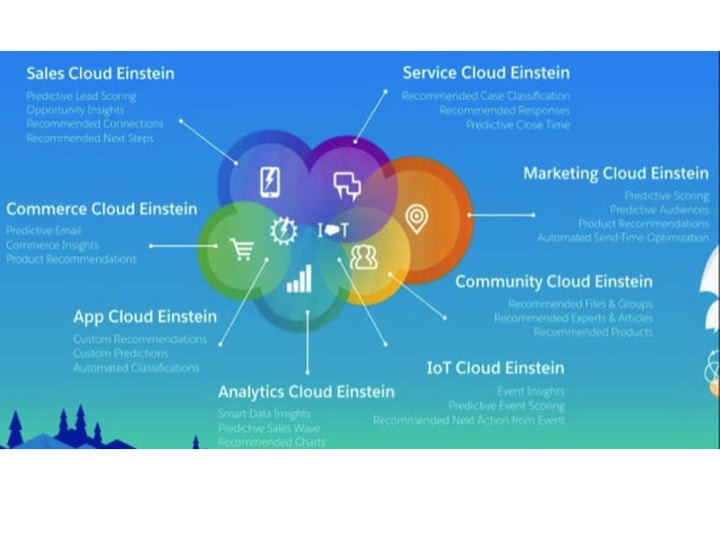
This data management and machine learning pipeline is already delivering as many as 300 million predictions/recommendations/scored leads per day, according to Salesforce. It’s the engine behind Sales Cloud Einstein, Service Cloud Einstein and Marketing Cloud Einstein apps that are either already available or due out this year (see chart below). Next out will be Sales Cloud Einstein apps due out with the Salesforce Spring 2017 release in February.

“One of our pilot customers flipped the switch [on Einstein Predictive Lead Scoring] and got a 25 percent lift in sales,” said John Ball, senior VP and general manager of Einstein and a KXEN veteran that Salesforce hired for his experience with automated analytics.

The goal with Einstein apps is to help people focus on what matters. Predictive Lead Scoring, for example, helps salespeople focus on the most promising leads. Opportunity Insights, another Sales Cloud Einstein App due out in February, helps salespeople set next priorities. For those still short of their quotas, that will mean spotting the next deals most likely to close; those who have made their quotas can turn to nurturing their pipelines.

Einstein apps won’t be a fit for every company. For starters, it takes lots of data to drive automated, machine-learning-based predictions. If you are dealing with fewer than 100 leads per month, humans can handle the load and they probably have a good sense of which leads to prioritize. It’s when data volumes are overwhelming that Einstein apps will make sense, said Ball.

That’s not to say that Einstein is geared only to big companies. Data volumes depend on the application. Many small marketing teams, for example, send out millions of emails per month. So Predictive Scoring & Audiences and Automated Send-Time Optimization, two apps coming to the Marketing Cloud this year, might make sense even for small companies, so long as they are marketing at scale.

For now, Salesforce is picking and choosing straightforward Einstein apps that will “just work out of the box,” said Ball. But over time the company plans to get to more sophisticated apps that might require a bit of consulting and business process change to deploy. There are also plans to support custom Einstein apps, but here, too, Salesforce said the capability will be a point-and-click affair for developer types without need of data science talent.

Until more sophisticated apps or custom app capabilities show up, Salesforce offers the ad hoc analysis and recommendation capabilities of Analytics Cloud Einstein Smart Data Discovery, which is powered by BeyondCore, acquired in September.  This separate machine-learning-based engine lets you load and explore data sets from Salesforce, relational databases or Hadoop and answer four questions: What happened? Why did it happen? What will happen? And how can I improve?

The answers to these four questions, which are descriptive, diagnostic, predictive and prescriptive analytics, respectively, are delivered in the form of text-based “stories” that can be exported as Word documents or PowerPoint presentations. You can also generate supporting data visualizations through the Salesforce Analytics Cloud Wave engine.

Smart Data Discovery was designed to let business analyst explore data and investigate measures such as cost, profitability and customer lifetime value. As with other Einstein apps you’ll need sufficient data. Beyondcore veterans say the engine needs at least 10,000 rows of data to spot correlations and patterns and generate reliable predictive and prescriptive recommendations.

My Take on Einstein’s Progress and Competition

Salesforce is taking an apps-first approach in part due to lessons learned from the failed initial launch of the Analytics Cloud in late 2014. As I wrote last year, the first iteration of Wave was too expensive, too enterprise focused and packaged too much like a traditional BI platform. Last year’s reboot emphasized ready-to-run Sales Wave and Service Wave apps designed to work out of the box.

Rather than introducing an “AI Cloud,” as in the original Wave approach, Einstein is a capability that’s built into the Salesforce platform. Wave analytics capabilities are also built into the platform, but the original Analytics Cloud packaging and pricing approach, with platform fees and expensive builder licenses aimed at developers, just didn’t work. With Einstein, Salesforce is starting with the apps and adding custom capabilities for developers later.

The big and crucial question outstanding about Einstein is just how much are these apps going to cost? Salesforce execs are still vague about that, saying that some capabilities will be free while most apps will involve per-user/per-month or per-prediction fees. In the case of Einstein apps that were acquired, notably those from BeyondCore and Demandware (now the Commerce Cloud), pricing is said to be in line with what existing customers were paying.

Looking at competitors, Oracle is also taking a prebuilt apps approach with its Oracle Adaptive Intelligent Applications. Oracle announced six planned Adaptive Intelligent Applications in September and said they would debut within 12 to 18 months. Constellation expects to see at least a few of these apps in the first half of 2017.

Public cloud vendors Amazon and Microsoft have taken services library approaches to AI, leaving it to developers to bring together machine learning, natural language processing, machine vision, sentiment analysis and other services together in finished applications. Templates, sample scripts and other content is available to guide the way, but they’re not ready-to-run applications. We expect Microsoft will do more to bring customer-experience specific services and, perhaps, something closer to finished AI apps into its Dynamics application portfolio.

IBM deserves credit for putting AI back on the map with its Watson Cognitive Computing push over the last five years. It now has a bifurcated strategy with IBM itself going after more sophisticated opportunities while also building out Watson platform cognitive services for a growing developer community.

IBM itself offers cognitive marketing solutions around campaign automation, marketing insights, real-time personalization, customer experience analytics, and customer journey analysis. Meanwhile, Watson developer partners, such as Influential, SocialFlow and Equals 3, offer Watson-powered cognitive marketing solutions. Whether from IBM or independent developers, these solutions are likely to require integration with systems of record. Salesforce, by contrast (and Oracle, when it releases its apps), is delivering ready-to-run AI applications that are extensions of its software-as-a-service applications. If Salesforce is your CRM system of record, Einstein will be the easiest and obvious first choice for adding AI.

Related Reading:
Oracle Vs. Salesforce on AI: What to Expect When
Inside Oracle Adaptive Intelligent Apps
Salesforce Reboots Wave Analytics, Preps IoT Cloud


Media Name: Salesforce Einstein Table II.jpg
Media Name: Salesforce Einstein.jpg
Data to Decisions Future of Work Tech Optimization salesforce Chief Executive Officer Chief Information Officer Chief Marketing Officer Chief Digital Officer

Blockchain Visionaries and Blockchain Awareness - Critiquing The Critics

Blockchain Visionaries and Blockchain Awareness - Critiquing The Critics

In a Huffington Post blog "Why the Blockchain Still Lacks Mass Understanding" William Mougayar describes the blockchain as "philosophically inclined technology". It's one of his rare instances of understatement. Like most blockchain visionaries, Mougayar massively exaggerates what this thing does, overlooking what it was designed for, and stretching it to irrelevance. If "99% of people still don't understand the blockchain" it's because Mougayar and his kind are part of the problem, not part of the solution.

Let's review. This technology is more than philosophically "inclined". Blockchain was invented by someone who flatly rejected fiat currency, government regulation and financial institutions. Satoshi Nakamoto wanted an electronic cash devoid of central oversight or 'digital reserve banks'. And he/she/they solved what was thought to be an unsolvable problem, with an elaborate and brilliant algorithm that has a network of thousands of computers vote on the order in which transactions appear in a pool. The problem is Double Spend; the solution is have a crowd watch every spend to see that no Bitcoin is spent twice.

But that's all blockchain does. It creates consensus about the order of entries in the ledger. It does not and cannot reach consensus about anything else, not without additional off-chain processes like user registration, permissions management, access control and encryption. Yet these all extras require the sort of central administration that Nakamoto railed against. Nakamoto designed an amazing solution to the Double Spend problem, but nothing else. Nakamoto him/herself said that if you still need third parties in your ledger, then the blockchain loses its benefits.

THAT is what most people misunderstand about blockchain. Appreciate what blockchain was actually for, and you will see that most applications beyond the original anarchic scope for this philosophically single-minded technology simply don't add up.

Digital Safety, Privacy & Cybersecurity Innovation & Product-led Growth Matrix Commerce Distillation Aftershots Data to Decisions AI Blockchain Chief Information Officer Chief Executive Officer Chief Technology Officer Chief AI Officer Chief Data Officer Chief Analytics Officer Chief Information Security Officer Chief Product Officer

Salesforce Has A Platform Vision - Progress Report from Analyst Day

Salesforce Has A Platform Vision - Progress Report from Analyst Day

We had the opportunity to attend the analyst meeting of Salesforce, held January 3rd till 5th nicely located at the Four Seasons in San Francisco. Despite the early time, Salesforce got an impressive range of influencers to the event, even travelling as far as Europe. And it was well worth it, as it was the most comprehensive insight into Salesforce I have experienced in my 3.5+ years covering the vendor.


So, take a look at my musings on the event here (pardon for the bad lighting, but I really liked the skyline and you know my face ...):
(if the video doesn’t show up, check here)


No time to watch – here is the one slide condensation (if the slide doesn’t show up, check here):
 
 
Want to read on? Here you go: Always tough to pick the takeaways – but here are my Top 3:

Platform Focus is CRM – Salesforce has a substantial PaaS business under the Salesforce App Cloud brand name. Like every traditional application vendor, it has the challenge to position itself as apps vs platform overall (this is more platform at the moment per Parker Harris) and add-on / extend PaaS vs all-purpose PaaS. The interesting insight courtesy of Adam Seligman was that now Salesforce sees itself as PaaS around customer, basically for CRM. 

On the IaaS side of the platform (where Salesforce announced its partnership with AWS – read here), Salesforce is on track to run all its products on AWS in Montreal as announced. As Harris shared, the Oracle portion of the stack will also run on AWS (but on Oracle), though not in RAC mode. A very important step for Salesforce to reduce its CAPEX into infrastructure, a key move for data privacy and residency and last but least for performance of the applications. 
 
Salesforce Constellation Research Holger Mueller Enterprise Software Musings
Salesforce co-founder Parker Harris with Bruce Richardson
Meta -Tenancy – A lot of confusion (still) exists around multi-tenancy – but Salesforce was not shy to introduce another tenancy term – Meta-Tenancy. With that Salesforce means the process of de-coupling products, exposing more services and allow an overall more composite (remember mesh?) application architecture. It allows Salesforce to e.g. centralize what the vendor runs under ‘trust’ (Security, Single Sign-On etc.) – all very important given the fact that Salesforce runs on a heterogenous system landscape. And that trend will not slow down, given e.g. that Salesforce acquired vendors at the rate of $4B last year. Moving to a more composite, layered, shared service architecture makes a of sense here. 
 
Salesforce Constellation Research Holger Mueller Enterprise Software Musings
5 Transformers of Enterprise Software per Salesforce
Platform perspective is key for Einstein – The most prominent service of recent time for Salesforce has been and remains Einstein, its AI ambition. So far Salesforce has largely brought together existing offerings, but also shared a roadmap of capabilities coming in the next 12 months related to Einstein. But the vendor understands that there is only a limited number of data scientists, so enabling business users on a platform level will be key. Good to see that understanding, 2017 will be interesting to follow how Salesforce will deliver these capabilities. 
 
Salesforce Constellation Research Holger Mueller Enterprise Software Musings
5 Gentlemen, 6 Clouds
(ltr Blitzer - Sales & Service, Tippets - Marketing, Karkhanis - Analytics, Micucci - Social, Seligman - App)

MyPOV

A good event for Salesforce, good to see the roadmaps for all the different Salesforce products, which were all reasonable, we think attainable and realistic and most importantly deliver value for Salesforce customers. On the differentiation side, we are not so sure if Salesforce has hit the mark, but that would require more detailed product roadmap / plan analysis than a 2 day analyst meeting can deliver. What is clear is that for the first-time Salesforce is offering a strategic path to rid itself of its in-house infrastructure. As founder Parker Harris correctly observed, IaaS was not around when Salesforce was started… but by now it is best practice for a SaaS (and PaaS) provider to be based on an IaaS and leave the heavy lifting (and investing) to the IaaS players. My back of a napkin calculation is that if Salesforce could stop all in-house infrastructure spending immediately, it would be a profitable company… but of course that process will take a few years (if Salesforce really pulls the switch), and I expect Salesforce to invest the infrastructure savings into product capability (as the rest of the industry does). It was also good to see the talent of the Salesforce product bench – we spoke generally with development leaders removed by one or two organization levels from the CEO, many coming from acquired entities and presenting their products in a positive, competent and appealing way. Product talent matter and it is good to see that Salesforce has it.

On the concern side, Salesforce needs to rev up its development speed. As an example, we are seeing Lightning slides and products moving to Lightning now since more than three (?) years. And though Salesforce sits on a massive system, it is probably challenging the record for the lengthiest UX conversion overall, certainly in the CRM industry. But to be fair – these things always take time, and with the competition not delivering superior product either, it is good for Salesforce to focus on platform capabilities, synergies and its internal TCO to operate all of Salesforce applications.

Overall time well spent, the best insight into Salesforce in my analyst career, lots of exciting and value creating capabilities in the bag for 2017. Stay tuned. 
 
Want to learn more? Checkout the Storify collection below (if it doesn’t show up – check here).
Find more coverage on the Constellation Research website here and checkout my magazine on Flipboard and my YouTube channel here.
Next-Generation Customer Experience Tech Optimization Innovation & Product-led Growth Event Report salesforce Executive Events Chief Customer Officer Chief Information Officer Chief Marketing Officer

Facebook Video Ads: What’s the ROI?

Facebook Video Ads: What’s the ROI?

With the variety of common products available, often customers want to learn how a product or service works before purchasing. With more and more buyers using mobile devices to shop, 4 out of 5 shoppers say a video showing how a product or service works is important in their decision to purchase or not purchase a product or service. In fact, shoppers report research on mobile devices with visual content helps inform their product selection. As a result, Marketers who use video grow revenue ~49% faster than non-video users. But if a brand is going to use video, understand that shoppers of shoppers expect a consistent set of visual content across desktop and mobile devices.

Where does Facebook come into this equation? Over 100 million hours of video per day are watched on Facebook. (Techcrunch) It is reported that shoppers who view video are 1.81 times more likely to purchase than non-viewers and more than half of the marketing professionals worldwide name video as the type of content with the best ROI.

With over 1.5 billion users, ~1 billion users visit Facebook on their mobile device, so brands considering must think mobile first. What sets Facebook apart from its competitors is its unique ability to harvest vast amounts of customer information to create custom audiences, generate leads and build brands. The advantage is that it’s all within a platform that is already known for its engagement opportunity.

Facebook also  rewards advertisers for shares with cheaper views, cheaper clicks, and more impressions. This combination leads to an overall better ROI. The net-net is that retailers & brands should be seriously considering video advertising because advertisers cite a 40 percent increase in purchases as a result of video – specifically in the categories of apparel, home goods, and electronics.

While there seem to be many advantages, some businesses are holding back on video advertising because they feel video is too hard to make, or doesn’t produce conversions the way other ads do. But video content does not need to be difficult to create. There are vendors that make it easy, like Animoto. And attribution to video ads is easier often than TV ads because of the digital footprint.

Brands should also use the analytics Facebook provides and make sure to not waste budget by not segmenting your audience. Segmenting audiences can be done by looking at jobs, life events, relationship status, purchasing behaviors and additional segmenting can be done beyond this, for example geo-location targeting. Without segmenting an audience, marketing risk wasting their ad budget on the wrong audience and not generate the conversions expected.

In addition, as in any advertising, it’s important to include a call-to-action. A call-to-action can be as simple as Book Now for travel, Learn More for addition features on a product, Contact us for more information or Shop Now to be taken to the actual online store or landing page or a click-to-call button. But be careful – a call-to-action without engagement can result in consumers feeling “pushed” vs “pulled” into taking action. Include special offers and time sensitive, last minute deal to motivate consumer to come to a store, call or click.

If Marketers use a click to call button, make sure the contact center is ready to take the calls and knows what the special offers are. Consumers seem to prefer to call than fill out a web form and call convert to revenue 10X more than web leads. That is only true if there is someone at the other end of the phone to take the call intelligently. This means Marketers must ensure the ad copy and landing pages are optimized to drive calls and that they can attribute calls and the outcome to the right ad campaign so you can do more of the right thing and optimize the video marketing.

Dr. Natalie Petouhoff, VP and Principal Analyst, Constellation Research

Covering Customer Facing Applications

Marketing Transformation meta Marketing B2B B2C CX Customer Experience EX Employee Experience AI ML Generative AI Analytics Automation Cloud Digital Transformation Disruptive Technology Growth eCommerce Enterprise Software Next Gen Apps Social Customer Service Content Management Collaboration Chief Marketing Officer

The IoT Market in 2017 – Identifying changes in the role of the Buyer and the Implementer resulting in changes in Propositions, Sales and Marketing

The IoT Market in 2017 – Identifying changes in the role of the Buyer and the Implementer resulting in changes in Propositions, Sales and Marketing

When briefing Analysts Microsoft illustrate their potential IoT market with a slide showing four major Industry sectors with up to fifteen different Line of Business Management roles in each. Every role is regarded as an actual, or potential, buyer of IoT solutions. Whilst this is undoubtedly true, for reasons covered later, it does imply having to be able to position and sell fifteen different IoT business solutions in any single Enterprise.

This may sound impossible yet almost identical slides have been shown in the past to illustrate how all roles across the Enterprise could benefit from Enterprise eMail adoption. Then some years later it become Internet /Web connectivity and functionality. In both cases, as with IoT, the initial argument for adoption was difficult due to a lack of individual benefit cases.

Think of it in terms of the difficult to sell early phones when numbers of connections were limited. In time Enterprises could not participate in business markets with out their employees having access to a phone. A similar path was followed with Internet connectivity and web adoption.

Traditional Enterprise business cases require a specific activity to be improved and see no specific Enterprise wide technology based capability adoption, such as email or Web connectivity as an increase in overheads. Recent history shows that adoption time frames are shortening for each technology wave. Though initially slow, the trigger point to Enterprise Business capability transformation is occurring sooner, and then the period to widespread adoption is very short.

The relentless spread in the number of Internet connected Devices capable of providing Business Intelligence renders it inevitably that every Enterprise will ultimately be driven to adopting IoT as a necessity to remain in business.

The current phase of selecting individual business deployments focused on a specific issue are merely commercially justifiable starting point for gaining experience. However at Enterprise Management level there should be involvement to ensure that these early individual Line of Business Managers deployment decisions will not become medium term issues due to a lack of strategic foresight.  

There is strong evidence from numerous sources, ranging from Social Sources to larger scale surveys that the cohesive management of IoT projects across the Enterprise has already become an issue.  A good example of a detailed report comes from the magazine Computing survey in May 2016 whose sample of responses of those who had carried out IoT projects was across multiple Industry sectors, and Enterprise sizes.

The following are two key points abstracted from the published report, but there are many significant direct quotes providing valuable insights that make reading the full report desirable.

To the question of the background of an IoT Project leader being better to be from IT Strategy (linked to Business strategy), or Data Analytics and Development, the split was respectively 53% for IT/Business Strategy versus 39% for the more Technology based skills. The remaining 8% rejected both options, or were undecided.

A similar question relating to a desirable background for the Project Leader being either Business, or Technology management produced a total lack of consensus! The respective split being 36% to Business versus 33% to Technology, but with an astonishing 31% feeling unable to answer the question!

Whilst those delivering an IoT project may not be totally reflective of those who are the initiators, or buyers, a reasonable conclusion is that there is a remarkable diversity in where, and for what, IoT is being deployed. For IoT vendors this is a huge challenge to the traditional sales process built on marketable ‘propositions’ directly aligned to readily identifiable Business Buyers and their requirements.

If the evidence is correct then it would seem that a shift from IT driven issues to IoT Line of Business buyers could turn the accepted IT sales process around case studies and outcomes on its head!

In the traditional Enterprise Application sales process the expectation is that the IT vendor better understands the balance between best business practice and most effective technology implication. This is particularly true in ERP where, over two decades implementation, the purchase moved from heavy customization of the ERP Applications in order to fit an Enterprises current practices; To the Enterprise adopting industry sector best practice as defined in the ERP Application and modifying their own procedures to make the alignment.

A core element in the role of IT has been to assist the Enterprise to centralization and standardize to reduce cost, yet Digital Business models all stress a reversal of this move towards various degrees of de-centralization to access more opportunities in the market. The philosophy to capture more of the Long Tail is to improve revenue creation by the use Digital Technology. Continuous innovation is stressed as a necessity, and emphasis is laid on the ‘Intrapreneurship’ of Line of Business managers.

For those new to the term the shortest definition of an Intrepreneur from Dictionary.com states; ‘an employee of a large corporation who is given freedom and financial support to create new products, services, systems, etc., and does not have to follow the corporation's usual routines or protocols’. There is an increasing amount of discussion on the topic including a useful article in Forbes defining the four essential qualities of an Intrapreneur.

The facts seem to point towards a link between the diversity of IoT buyers and deployments and innovative Digital Business initiatives. Line of Business managers are individually innovating around their deep personal experience to introduce competitively differentiated outcomes. If this is truly the case then the well developed IT sales methodology of packaging and selling complete solutions supported by case studies looks unworkable, as it would require the development of too many small solution offers.

 It will require either the market to mature around a contained number of Business requirements, or a different approach.

So what could be an alternative? Inbuilt into the traditional sales offerings is a reduction in the risk of adoption, both for the buyer and seller, through implementing a known solution. In an IoT deployment the risk factor becomes higher as the new technology is still in the early adopter phase, offerings that reduce risk will always be popular.  The ever-growing move towards using ‘Services’ certainly reduces the buyer’s risk. Conversely it increases the pressure on the vendor to determine flexible enough Service packages to ensure enough sales revenues to cover their commercial investment in building and operating Services.

Both vendor and buyer need common IoT solution frameworks that support standard architecture elements onto which individual unique and innovative requirements can be readily mapped. This is not ‘news’ to the IT vendors who are already introducing ‘templates’; unsurprisingly these are largely based on the IT business solution principle.

Is there a case for a bolder move that will accept that the Digital Economy built on IoT, Clouds, and soon including AI, calls for a different approach? If so what could the basic architecture propositions be based upon?

At the most basic level there are four readily identifiable business activities where IoT can add value by increasing the data available. In no particular order;

                                  People in relationship to their Activities; Service Engineers, Merchandisers, Sales and similar Activities.

Machines monitoring their operations for reliability, operating efficiencies, etc.

Process to gain near real time data to optimize and improve further process steps

Ecosystems for the interconnection of any and all of the above in Smart Services.

Using these four definitions it is noticeable that a high number of IoT market success reports f are grouped around these headings; Salesforce concentrates on People; GE on Machines; SAP on Process but who is the leader in the final category of Ecosystems? Microsoft, AWS and Google could all claim their presence in this sector. But is it really that simple?

Careful analytics of the reported wins suggests that either focus, or volume succeeds; The People, Machines and Process category case studies all show the in depth focus and inherent knowledge of the vendor in the Business activity.

Summary;

There are two distinct different markets with different Buyers, whose projects are different, and whose selection of a supplier and solution is therefore equally distinctly different. Vendors will need to make a substantial effort to identify and verify exact where their products and in house skills will serve them best.

Line of Business Managers require a Vendor with strong sector specialism/experience to act as a partner in developing an innovative idea.  Engagements may be driven by revenue creation activities in respect of the Digital Economy and Smart Services, or internal Operational Improvement, though in Utilities as an example, this is likely to mean external deployments. A strong factor will be the ability to provide ‘the final mile’ sensors/sensing and connectivity element, once again favoring the specialized vendor.

Individual Projects may be small, but the decision making, budgetary approval cycles will be fast, with an expected high business value outcome.

Initial engagements should form the basis for an ongoing team partnership with the development of methods and architecture that could form the basis for becoming an Enterprise level partnership embracing other Line of Business Managers.

IT Managers expect their existing IT Vendors, particular their Cloud Services providers, to be able to demonstrate how IoT will be an extension of the existing Enterprise IT strategy. The IT driven project is likely to be driven from the perspective of ‘Big Data’ and ‘Analytics’ with in-house IT expertise in these areas playing an important role. An existing Cloud Partner offering ‘template’ solutions, and able to introduce preferred partners for ‘the Final Mile’, or for integration, is the ideal.

Projects will have full Enterprise support and will go through the traditional sales/buying cycle required for this level of significant investment using cost justification as the major factor.

Cloud based partnerships are driven by cost and Service levels, but IoT brings a new set of dynamics to the existing IT use, and charging models, of Clouds. Both sellers and buyers will need to carefully their on going commercial relationship.

Enterprise Hybrid Adoption Models combining both types are the most likely outcome as the boundaries between both fluctuate in different sectors and Enterprise cultures. However both sellers and buyers will need to make clear decisions on exactly where, and how, they intend to develop in the 2017 IoT market, or they are likely to end the year with conflicting outcomes and a poor enterprise level success.

New C-Suite Data to Decisions Future of Work Innovation & Product-led Growth Tech Optimization