Results

Microsoft Spiking Docs.com: What It Means for Dynamics

Microsoft Spiking Docs.com: What It Means for Dynamics

Constellation Insights

Many acquisitions lead to product overlap, and Microsoft's $26.2 billion purchase of LinkedIn a year ago is no different. Redmond has announced that Docs.com, the filesharing service it launched in 2010, will be shuttered by December 15. Here's the rationale Microsoft gave for the move:

Following Microsoft’s acquisition of LinkedIn, SlideShare has joined the Microsoft family, and represents the ideal platform for publishing your Word, PowerPoint, and PDF content with its audience of 70 million professionals, and vast content library. For custom sharing, OneDrive offers additional tools, permission settings, and security to help share and protect your data and content. With the retirement of the Docs.com service, we hope to streamline our offerings in this space and provide you with a more cohesive experience.

As of now, it's no longer possible to create a new Docs.com account, although existing users can publish and edit files until August 1. After that it's read-only through December 14. Users can choose to have compatible files automatically backed up to OneDrive or OneDrive for Business, but not to SlideShare.

To put it mildly, Docs.com has not been a runaway success for Microsoft. Initially launched in partnership with Facebook, Docs.com was an attempt to find synergies between Microsoft's online productivity software and the massive audience provided by the social network.

While you can still login to Docs.com with your Facebook account, the relationship between the platforms has long since faded into the deep background, thanks in part to factors such as Facebook's move to create Workplace by Facebook. Moreover, OneDrive has existed under various names and forms since 2007, and today has a much richer feature set than Docs.com. The case for redundancy is solid. 

SlideShare, meanwhile, is no replacement for either Docs.com or OneDrive. Rather, it's a highly popular but uniquely positioned document-sharing service with a large existing audience of business users, both individual and corporate. The site gets 70 million unique visitors a month and 38 million registered users. While it competes with the likes of Scribd, SlideShare's already deep integration with the massive LinkedIn network is something rivals can't say they also have. 

The imminent end of Docs.com is welcome one, as it will free up resources Microsoft can use to focus more attention on SlideShare's roadmap, not to mention integrating LinkedIn, says Constellation Research VP and principal analyst Alan Lepofsky

"While I am sure a lot is going on in the background, not a lot of new features or integrations have manifested yet in their products," and it was disappointing that LinkedIn its related APIs didn't take high priority at last month's Build developer conference, he adds. 

"What we're waiting to see is how LinkedIn and Dynamics come together," Lepofsky says. Indeed, the potential for synergies between LinkedIn and Microsoft's business applications has been a much-discussed topic since the acquisition.

SlideShare's capabilities and audience have a natural alignment with Dynamics, especially for CRM (customer relationship management), marketing, recruiting and employee training. Enterprises have used SlideShare this way for years, albeit mostly in an ad-hoc manner. Now Microsoft has an opportunity to tightly integrate the SlideShare experience with Dynamics, while adding enterprise-friendly features. Constellation expects Microsoft will reveal its intentions along this lines—as well as a broader vision for the LinkedIn-Dynamics combination—at its Envision conference in September. 

24/7 Access to Constellation Insights
Subscribe today for unrestricted access to expert analyst views on breaking news.

Marketing Transformation Future of Work Chief Customer Officer Chief Information Officer Chief Marketing Officer Chief Digital Officer

Ford Centralizes Data Science Expertise to Democratize Data-Driven Decision Making

Ford Centralizes Data Science Expertise to Democratize Data-Driven Decision Making

Ford Global Data Insights and Analytics team spreads data access and analysis capabilities enterprisewide.

With its data growing exponentially and digital transformations including mobility, continuous connectivity and autonomous vehicles quickly emerging, Ford recognized back in 2014 that it need to take a more comprehensive and strategic approach to data-driven decision making. These were key reasons why Ford hired its first Global Chief Data and Analytics Officer, Paul Ballew, and formed the Ford Global Data Insights and Analytics (GDIA) unit in January 2015.

A veteran of Dun & Bradstreet, Nationwide Insurance, General Motors and J.D. Power and Associates, Ballew’s challenge was to “take big data and analytics to the next level inside Ford… establishing an enterprise-wide vision for analytics and integrating all research, analytics, processes, standards, tools and partner engagement,” stated a company press release.

Analytics tools, methods and processes were in use throughout the company, but “it wasn't efficient to have individual pockets of the business going about analytics in inconsistent ways,” Adam Blacke, Lead Data Scientist, recently told me.

GDIA was created to share best practices and drive optimized, data-driven decision-making across the organization. Drawing on a mix of Ford veterans formerly embedded within departments as well as new hires, GDIA has grown to a staff of more than 600. Through consultative engagements, it has supported all aspects of the business, from manufacturing, research and development and supply chain to marketing, customer service and administrative, legal and accounting teams.

As I explain in my latest case study research, “Ford Analytics Team Democratizes Data-Driven Analysis,” GDIA’s centralized coordination promotes consistency and sharing of best practices. “We knew we could learn from each other,” said Blacke. “Previously, we had individual teams learning different things, but they weren't sharing across pockets of analytic exploration.”

Centralization is one way organizations are making the most of available data science expertise, but there’s more than one way to achieve centralized oversight. Facebook, for example, developed a hybrid approach whereby data science experts remained embedded within specific business areas, but as I explained in this 2013 article, they also reported to then chief analytics officer Ken Rudin (who has since joined Google) and they met regularly with their peers from other business units.

In the hybrid approach, experts develop deep expertise in one business domain and are always available to (and are funded by) that group. They also regularly share what they are working on with their analytics peers and trade ideas and lessons learned across business units. The chief analytics officer promotes the development of talent, sets and coordinates analytic priorities, and champions infrastructure and data investments to the benefit of all business units.

Ford’s approach to centralization is equally valid and it does not prevent individual business units from retaining dedicated analytical resources. The centralized team approach is particularly beneficial in spreading data-driven decision making and optimization to departments and business units that are too small or otherwise ill- equipped to support analytics initiatives on their own.

Analytics expert Thomas Dinsmore, author of Disruptive Analytics (one of the best books I’ve read on the topic of analytics), recently told me that data scientists should be handled like commercial airliners: they should always be overbooked. Centralization is one way to ensure that there’s always a steady, prioritized pipeline of analytics projects to tackle. But you can also get into trouble with centralization if the queue for analytics support gets too long or if there’s a lack of entrepreneurial innovation. Dinsmore says he’s seen organizations go back to more decentralized (or, perhaps, hybrid) approaches after giving centralization a try.

My case study report details how Ford GDIA is organized and how it promotes democratized data access with tools from vendors including Alteryx, Qlik and Tableau. Alan Jacobson, Director of Global Analytics, explains how Ford helps users ask the right questions and choose the right tools. The report also details how GDIA tackled three projects where data science expertise made the difference in logistics and purchasing, manufacturing and supply chain management. Click here to download a free excerpt of the 14-page report.

Media Name: Ford.jpg
Data to Decisions Chief Information Officer Chief Procurement Officer Chief Supply Chain Officer Chief Digital Officer

10 Examples of Innovative Influencer Marketing Campaigns

10 Examples of Innovative Influencer Marketing Campaigns

1

Influencer marketing is one of the most useful and efficient ways for businesses to reach potential customers for their products and services.

According to a study by Adweek, 75% of brands engage with influencers as a part of their main marketing strategy.

Businesses know that today’s consumers are knowledgeable and not easily swayed by traditional marketing. Consumers also look to peers to help them make purchase decisions.

Influencer marketing can increase brand awareness, build an audience and help boost sales. Most importantly, it often costs significantly less than conventional advertising.

If you’re looking ideas on how to work with influencers for your digital marketing campaign, you should learn from the best.

So here is a list of some of the best innovative examples of companies that nailed their influencer marketing campaigns and what you can learn from them.

Use “regular” people to spread the word

Manhattan-based beauty startup Glossier has owed their overnight cult status to their ever-growing group of super fans and micro-influencers.

Instead of paying big name celebrities to promote their skincare and cosmetics, the brand relies on “regular women” to spread brand awareness.

90% of Glossier’s revenue doesn’t come from paid or build marketing spend, but comes from their highly engaged fans.

There is an army of Glossier girls that closely follow the brand’s product announcements, social media posts, event invitations, and forwards the brand’s messages to their followers on social media and in real life.

According to Glossier CEO Emily Weiss, “What’s very motivating to us is this idea of every single woman being an influencer. That power of the individual person—just the girl—is infinite.”

Collaborate with other companies 

Nikon formed a strategic partnership with Warner Music Group to become the title sponsor of their SXSW Music Festival using the platform to showcase the quality and capabilities of Nikon cameras.

At the festival, Nikon HD-SLR cameras were used to capture live performances that were live streamed over the three nights. Stations and roaming photographers also gave people the chance to use the cameras and directly share pictures to their Facebook.

In addition, artists performing at SXSW used Nikon cameras to capture and share their experiences leading up to the show to get their fans excited about the event.

Using the hashtag #NikonWarnerSound, it created a widespread buzz during the festival and became one of the top trending topics on Twitter during all three nights of SXSW Music.

Their success was driven by strong fan engagement both online and offline. The campaign made over 46 million media impressions through coverage from popular publications and over 166 million social impressions.

Over 500,000 people watched the live stream shot, 1,100+ photos were captured and shared by the people that attended the event, and over 15,000 social posts featured the hashtag #NikonWarnerSound with positive responses.

Look for fresh perspectives

Buick worked with prominent Pinterest influencers (referred to as Pinfluencers) in the fields of design and style to help create a new brand image for their new Encore luxury model.

The campaign was called “Pinboard to Dashboard” and instead of partnering with influencers in the automobile industry, they chose outsiders who could showcase the brand from a different perspective.

Pinfluencers shared their visions of how the exterior and interior of the new luxury model would look on their Pinterest board, encouraging people to look at the brand with fresh eyes.

The “Pinboard to Dashboard” campaign generated over 17 million unique visitors and followers across Pinterest, Twitter, Facebook, and Instagram.

It was a success as it helped to promote Buick’s Encore to younger car buyers and at the same time maintained Buick’s image as a luxury brand, while also showing a more whimsical side.

Stick with brand values

Boxed Water may sell water, but the company also highly values environmental conservation. They collaborated with the National Forest Foundation to create the “Retree Project” campaign.

For every photo Instagram photo that is posted using the hashtag #Retree, Boxed Water would plant two trees.

The company reached out to famous Instagram influencers to post in support of the campaign and also encouraged their followers to repost.

The campaign is currently ongoing and the brand has planted over 500K trees in Sierra National Forest, Stanislaus National Forest, and Uinta-Wasatch-Cache National Forest.

Leverage authenticity

Sephora a French chain of cosmetics stores built a community of insiders called “Beauty Talk,” who leave honest product reviews and help people to make purchasing decisions based on their needs.

Sephora also sends free cosmetic samples to popular beauty vloggers/bloggers, but the reviews they get in return are always authentic and genuine.

The community is successful because Sephora gives their influencers the freedom to be unbiased, helping to develop a genuineness that their customers appreciate.

Showcase real stories and powerful imagery

On International Women’s Day in 2016, Microsoft used National Geographic’s enormous social media audience to build an Instagram marketing campaign called “Make What’s Next.”

The goal of the campaign was to encourage young girls to work in STEM (Science, Technology, Engineering, Math).

30 photos were posted on five of National Geographic’s Instagram channels and the photos were taken by popular adventure photographers. Each photo featured the story of a prominent female scientist or adventurer. The photo captions also included: @Microsoft – Empowering girls to change the world, stay in STEM, and be the ones to #MakeWhatsNext.

Microsoft created sponsored posts around stories of human experiences, with real faces with real stories. This strategy helped the company connect and engage with audiences on a deeper level and built long term brand awareness.

At the end of the campaign, Microsoft received over 3.5 million likes on the 30 photos with over 1,000 fan posts on Instagram using the hashtag #MakeWhatsNext.

Don’t focus on your brand or product

Four years later, British Airway’s “UnGround Innovation Lab” campaign is still being discussed today.

In 2013, a flight took off from Silicon Valley with 100 thought leaders, influencers and prominent thinkers from Google, RocketSpace and Silicone Valley Bank. They were put together to use their brainstorming skills for the greater good and show how great ideas can be created when people work together.

On the flight, 22 concepts were developed in less than five hours. The ideas were all geared towards helping STEM-driven people to find opportunities to use their skills.

The campaign worked because they were able to get big names to join the experiment, which automatically brought media attention to the campaign. The focus wasn’t on the company, but British Airways still got their name in the news in an authentic and positive way.

Influencers don’t need to be humans

Mercedes joined forces with an Instagram famous dog and VR technology to create their latest marketing campaign #MCPhotoPass. It involved creating cinematic video content for Mercedes’ YouTube Channel and used professional photographers to produce photos for their Instagram.

Mercedes invited Loki the Wolf Dog and his owner Kelly Lund to drive a 2017 Mercedes GLS through the snowy mountains of Crested Butte Colorado. The car had 3D cameras attached to give viewers the experience of Loki the Wolf Dog running through the snowy terrain, while the other cameras give an inside look of the GLS.

The main strategy for the #MBPhotoPass campaign was to create videos that brought together a variety of different influencers to give fresh perspectives on Mercedes-Benz cars. They worked with world class chef Chris Coombs to Loki the Wolf Dog, targeting different customer segments.

The second part of the strategy was letting the best Instagram photographers capture photos of the excitement and glamour associated with the Mercedes brand.

Their Instagram generated 173 million impressions, 2.3 million likes/comments and $4 million worth of earned media. The campaign worked because Mercedes took advantage of the growing popularity of VR technology and of course, people’s love of cute animals.

Give your brand a “human face”

TD Ameritrade’s “Human Finance Project” campaign was created to change the negative perceptions of the finance industry by featuring stories of real registered investment advisors on their website.

The goal was to showcase the work that financial advisors do and put them in a positive light by showing investors, they aren’t in it for the money, but focused on helping people meet their life goals through money management. It gave advisors the opportunity to share their stories, specifically about what inspires them and what drives them to do what they do.

The company gave the financial industry a human face by putting the spotlight on individuals with relatable stories, making it easier for people to feel connected with them.

They used regular people as influencers to connect with the public, reminding us that influencers don’t need to be famous celebrities. They just need to be relevant to your audience and campaign.

Hand over creative control

Clothing retailer Zara worked with top fashion-focused Instagrammers on the design project #iamdenim campaign to highlight their latest products by showcasing them in a way to appeal to their target audience.

By working with Instagram fashion influencers like Teesh Rosa, they were able to give the impression that their products are more accessible compared to high fashion clothing brands. The message behind the #iamdenim campaign was the brand worked with real people to produce clothing for real people.

Zara’s Instagram posts look like photos from the pages of a fashion catalog, where people can look for ideas and tips on what’s trendy in the fashion industry.

In just eight months Zara’s Instagram gained 4.6 million new followers, that’s quite an impressive feat!

The success behind Zara’s influencer marketing campaign was handing over the creative control of the brand to their influencers. Due to the accomplishments of their campaign, many competitors also started to copy their strategies hoping to gain the same success.

Key Takeaways

  • Influencers don’t always need to be celebrities, they can be just regular people or even non-human. As long as they are relevant to your campaign and target audience.
  • Collaborate with non-competitor companies to reach and target potential new customers by leveraging their large social media audience.
  • Work with influencers who aren’t a part of your industry in order to gain new ideas and ways to promote your brand.
  • Give your influencers the freedom to provide honest and unbiased reviews of your products or services to enhance the authenticity of the brand and gain the trust of your customers.
  • Influencer campaigns don’t always need always need to be focused on the brand or product. Think outside of the box and find different ways to promote your business without being too gimmicky and in-your-face.
  • Let your influencers have creative control over the campaign. They know their audience the best and the best ways to engage with them.

Looking for more help with your influencer marketing campaigns? Check out our Influence Marketing Services to learn more and be sure to contact us!

The post 10 Examples of Innovative Influencer Marketing Campaigns appeared first on Sensei Marketing.

Next-Generation Customer Experience Chief Marketing Officer

Hortonworks Rolls Out 'Flex' Support Subscription Model for Its Big Data Platform

Hortonworks Rolls Out 'Flex' Support Subscription Model for Its Big Data Platform

Constellation Insights

Hortonworks has introduced a new support subscription model for its Hadoop-based big data platform, in a bid to appeal more to customers with hybrid deployments as well as intentions on full-scale migration to the cloud. 

The new Flex Support Subscription is transferable between on-premises and cloud deployments, and provides the flexibility the market demands, Hortonworks said in a statement:

Customers gain freedom to meet fluctuating business demands not just in monthly capacity, but also in choice of infrastructure. The single support subscription encompasses HDP on-prem and in the cloud, as well as cloud services providing expert guidance to optimize Apache Spark, ETL and analytics workloads inHortonworks Data Cloud for [Amazon Web Services]. 

Some 25 percent of Hortonworks customers already run their big data platorms on AWS. The move toward Flex makes sense given how cloud is the fastest-growing choice for deployment models.

Flex's structure provides even more flexibility by introducing a "node month" concept, whereby customers can buy credits for support and then draw them down based on how many node months they actually use in the cloud, notes Constellation Research VP and principal analyst Doug Henschen. Overall, Flex is a "no-brainer" for Hortonworks, he adds. 

However, Flex support subscriptions on their own would still require a separate agreement with the underlying cloud vendor. That's why Constellation favors cloud services where the platform and underlying infrastructure are supported by the same vendor, Henschen says.

Hortonworks offers just this through Hortonworks Data Cloud for AWS, a managed service. Microsoft uses Hortonworks' distribution underneath its HDInsight managed service on Azure, but in that case the Flex credit scheme wouldn't apply, Henschen notes. 

24/7 Access to Constellation Insights
Subscribe today for unrestricted access to expert analyst views on breaking news.

Data to Decisions Chief Information Officer

Hortonworks Ships Updates to DataFlow, Its Platform for Streaming Analytics

Hortonworks Ships Updates to DataFlow, Its Platform for Streaming Analytics

Constellation Insights

Hortonworks has announced the general availability of DataFlow 3.0, the newest version of its platform for streaming data analytics. The Hadoop distributor says the growth of IoT (Internet of Things) devices and related data will make streaming a crucial part of future analytic applications:

"To stay competitive in today's interconnected world, businesses must harness the insights from data everywhere," said Scott Gnau, chief technology officer at Hortonworks. "Increasingly, this means from point of creation on connected devices and it's crucial to make decisions as close as possible to the edge device."

The centerpiece of HDF 3.0 is Streaming Analytics manager, a drag-and-drop interface that even non-programmers can use to build streaming applications. 

While HDF 3.0 leverages Apache NiFi under the hood, crucially it also supports other streaming engines, such as Apache Kafka and Apache Storm, a move that's supposed to add flexibility and save time when building streaming applications.

Hortonworks is also announcing that HDF 3.0 will be available on IBM Power Systems servers. The systems are geared for big data workloads through features such as multithreading, multi-level data caching and large amounts of main memory.

Analysis: Can Real-Time Be Manageable This Time?

There are many options but few default choices for handling streaming data processing and streaming analytics scenarios, says Constellation Research VP and principal analyst Doug Henschen. "Most organizations wade in slowly, cobbling together many technology piece parts and struggling with complexity. Some vendors do offer more comprehensive systems for streaming, but the proprietary complex event processing (CEP) systems of the past, for example, tended to be expensive overkill."

HDF provides a more modern, open-source option for streaming analytics and the new features in 3.0 fill gaps where users have struggled with complexity, Henschen adds. 

The industry is still in the early days of streaming demand despite all the hype around IoT, and to date organizations have tended to experiment using one or two scenarios by adding a few piece-part technologies, he says: "Too often it’s only in hindsight, once streaming scenarios have proliferated, that companies recognize that they’re struggling with complexity, long development times and a lack for repeatability. HDF is akin to a factory, more for building out and supporting streaming analytics workflows. The best prospects for it are companies that see the promise of real-time performance but that have been burned by complexity."

24/7 Access to Constellation Insights
Subscribe today for unrestricted access to expert analyst views on breaking news.

Data to Decisions Chief Information Officer

Techno-Illusionist Marco Tempest Performing at Constellation's Connected Enterprise 2017

Techno-Illusionist Marco Tempest Performing at Constellation's Connected Enterprise 2017

Media Name: ted2014dddsc66801920.jpg

Constellation is pleased to announce Marco Tempest is performing at Constellation's Connected Enterprise 2017! Tempest is a performer who uses technology to create illusions, and has delivered thought-provoking performances at TEDGlobal, the World Economic Forum, and LeWeb. 

Below, Tempest performs "Augmented reality, techno magic" at TEDGlobal.  


Constellation's Connected Enterprise is Constellation's annual innovation summit and executive retreat. Held annually at the Ritz-Carlton Half Moon Bay, the conference brings together the brightest minds in disruptive innovation to discuss early adoption strategies, innovation-focused change management, and emerging technologies. Constellation's Connected Enterprise is an all-inclusive three-day, two-night conference, so all meals, conference programming, and golf or spa are included in your ticket. 

Register for Constellation's Connected Enterprise 2017 by July 21 to get the best discount on passes. See you there!

GE Aims Predix IoT Platform at Smart Utilities, Energy Trading

GE Aims Predix IoT Platform at Smart Utilities, Energy Trading

Constellation Insights

GE has expanded its Industrial IoT platform Predix deeper into the electric utilities space, with a new suite of applications aimed at not only optimizing power producers' operations, but also deriving more profits from energy trading. Here's how GE's announcement explains the value proposition:

GE’s ‘Digital Utility’ solutions are designed to help electricity businesses navigate rapidly changing markets. Low demand growth, falling wholesale power prices, excess capacity from the growth of renewable energy sources, and long-term investments in thermal generation are greatly impacting power and utility businesses’ profitability.

For energy businesses ... remaining profitable means responding quickly to short-term trading opportunities, maximizing capacity for peak demand periods, and strategically planning to address long-term supply and demand trends. 

GE’s Digital Utility software suite serves these needs, connecting data from electricity generation, distribution and transmission assets to enable more informed financial decision making.

The software suite uses more than 100,000 "digital twins"—software-based representations of physical assets—"to deliver insights about efficiency, capacity, emissions, flexibility, and availability that traders can use to bid with confidence in long-term, day-ahead, and short-term markets," GE added.

Specifically, the new applications include Business Optimization, for real-time communications between traders and operations; an updated Operations Optimization module for monitoring plant and fleet performance; a single dashboard system for health monitoring across traditional electric grids as well as renewable sources; new capabilities for field service technicians; Baseline Security Center, a new cybersecurity suite; and a new set of digital transformation services. (Full details are available at this link.)

Analysis: Predix Represents the Move Toward Systems of Engagement

Moving away from the gritty details, GE's latest Predix announcements symbolize a broader market trend, one that is important to understand.

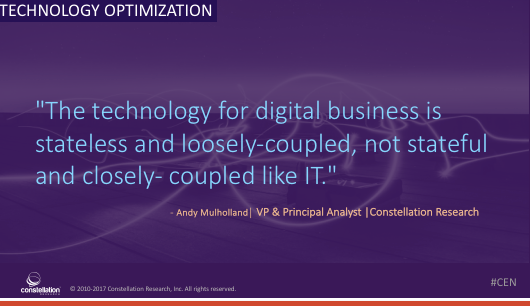
"The market is seeing the leaders fusing IoT with AI to create real digital businesses," says Constellation Research VP and principal analyst Andy Mulholland. "But the question is not the direction that the technology and market is taking, it is who are those leaders? It is no longer possible to use current, or one should say older definitions and market positions, as those vying for a leading place are coming as much from industrial technology as from information technology."

GE clearly is constantly repositioning its capabilities, just as entrenched enterprise IT players such as IBM and SAP are moving to also transform their markets and positions, Mulholland adds. "Is there a recognisably strategy under lying this? Thee answer lies not just in the more nebulous concept of the digital enterprise but in the development of intelligent systems of engagement models to bring competitive advantage and compliment the IT systems of record investments."

(Go here to read Mulholland's in-depth report on GE's most recent Mind and Machines conference, its annual showcase for industrial IoT.)

24/7 Access to Constellation Insights
Subscribe today for unrestricted access to expert analyst views on breaking news.

Data to Decisions Matrix Commerce Tech Optimization Chief Executive Officer Chief Information Officer Chief Supply Chain Officer Chief Digital Officer

6 HCM Future of Work Quotes

6 HCM Future of Work Quotes

Holger Mueller, Constellation Research VP & Principal Analyst, covers both Future of Work for Human Capital Management (HCM) and Next Gen Apps. The latter is part of Constellation's Technology Optimization theme. He's well-travelled, multilingual, and very active on Twitter (@holgermu) with no shortage of sound advice for business leaders like those who are a part of our executive network community.

We provide weekly thought leadership quotes for anyone interested in non-mainstream, disruptive thinking from our seasoned Constellation analysts. The full archive remains accessible for our Constellation Executive Network members.

DOWNLOAD THESE ANALYST QUOTES

FUTURE OF WORK - HOLGER MUELLER |  VP & Principal Analyst | Constellation Research 

Voice is the new UI, perfect for low frequency users – like your employees using a HCM system."

"Globalization remains strong – no matter what happens in the US – better be prepared."

"The irony of economic isolation in the US for non-US enterprises means more globalization, as they need to be present in the US."

"The future of HCM systems is being invisible for enterprise users, other than HR personnel.

"Prediction: In 2017 we will see #MobileFirst getting trumped by #VoiceFirst."

"Fact: Every generation in the workforce has taken up new technology, as all want to do well. Millennials are no different."  


Future of Work Innovation & Product-led Growth New C-Suite Tech Optimization Data to Decisions Digital Safety, Privacy & Cybersecurity Distillation Aftershots Next-Generation Customer Experience Matrix Commerce Leadership AI ML Machine Learning LLMs Agentic AI Generative AI Robotics Analytics Automation Cloud SaaS PaaS IaaS Quantum Computing Digital Transformation Disruptive Technology Enterprise IT Enterprise Acceleration Enterprise Software Next Gen Apps IoT Blockchain CRM ERP CCaaS UCaaS Collaboration Enterprise Service developer Metaverse VR Healthcare Supply Chain CX EX Employee Experience HCM HR Chief Information Officer Chief Experience Officer Chief Technology Officer Chief Data Officer Chief Digital Officer Chief Analytics Officer Chief AI Officer Chief Information Security Officer Chief Product Officer Chief Financial Officer Chief Operating Officer Chief Executive Officer Chief Customer Officer Chief People Officer Chief Human Resources Officer

Rimini Street Expands Database Support, Security Offerings In Bid for Growth

Rimini Street Expands Database Support, Security Offerings In Bid for Growth

Constellation Insights

Rimini Street is expanding its third-party software support portfolio significantly about a month after announcing it will soon become a publicly traded company. It will now offer support services for six additional database platforms, as well as a security service delivered in partnership with McAfee.

The company had already provided support for SAP HANA and Oracle database. Now it will also support IBM DB/2, Microsoft SQL Server, SAP ASE, SAP IQ, SAP SQL Anyhere and SAP Advantage Server. 

As with its Oracle and SAP application support programs, the database support services will be offered at 50 percent lower cost than vendor maintenance. They will provide proactive health checks; technical services for integration and other matters; security services; and database performance tuning.

In its release, Rimini included a quote from existing customer Rodobens, a Brazilian company with divisions focused on banking, real estate, auto sales and more. Rodobens previously selected Rimini Street to support its SAP ECC 6.0 installation, which uses SQL Server as the underlying store. SAP has said it will support ECC 6.0 until 2025, but has been working to move customers to the next-generation S/4HANA suite, which only supports HANA as a database.

The four additional SAP databases Rimini will be supporting were gained through its 2010 acquisition of Sybase. While HANA has received most of SAP's investment and attention, the former Sybase databases have ample installed bases and SAP has made no public indications of sunsetting any of them.

Meanwhile, DB/2 and SQL Server remain widely used by the ECC 6.0 installed base, although Oracle has been the most popular choice for those customers historically. 

Rimini Street is also getting into database security services using technology created by McAfee. It incorporates "virtual patching" to block attacks before they can reach a database instance, along with monitoring for vulnerabilities. Virtual patching provides a gateway that allows for attacks to be spotted and blocked without need to directly apply patches to the core database. This approach is superior to traditional patching methods due to its speed as well as alleviating the need for regession testing, Rimini says.

Rimini had long been expected to file for an IPO, but last month instead announced it was merging with GPIAC, an entity known as a SPAC (special purpose acquisition company). It was not a merger with another operating company but rather a merger "with a big pile of cash," as Rimini CEO Seth Ravin put it in a recent conversation with Constellation Research.

One reason for the move was a $124 million judgment Rimini had to pay to Oracle over an intellectual property lawsuit, which put a lot of debt on its balance sheet, Ravin said. Rimini expects to get some or even most of the $124 million back on appeal but that won't play out until the end of next year, he added.

The company sees a $81 billion total addressable market for on-premises maintenance, and the move into broader database support is an attempt to get a bigger piece of that pie.

Rimini's fastest-growing product line of late has been Oracle database support, Ravin added. The company also sees a growth opportunity in offering premium SaaS maintenance.

The idea is to exploit the trend in which SaaS vendors sometimes require new licenses for additional functionality rather than including key new features in the monthly rent, angering customers, along with offering poor SLAs unless customers pay a hefty premium for higher-level support. Rimini sees an opportunity in offering its traditional level of high-touch support but at a reduced price compared to SaaS vendors, Ravin said.

Going forward, Rimini is going to ramp up user conference appearances, self-produced events and thought leadership speaking opportunities as its key marketing strategy going forward. "We don't want to be just the '50 percent off guys," Ravin said. Rather, Rimini wants to be seen as more of a consultative resource for CIOs jugging on-premises and cloud strategies. 

POV: The ambitions laid out in Ravin's final comments will put Rimini Street in closer competition with the large systems integrators of the world. To date, those players have been loath to enter the third-party maintenance market lest they alienate the likes of Oracle and SAP, whose ecosystems provide ample revenue streams around implementation services, along with the type of strategic consulting Ravin outlines. 

At the same time, for Rimini to gain credibility as a strategic consultant, it must also acquire expertise and offerings for a bigger slice of the IT budget, which makes the move into database support and security a logical step. 

24/7 Access to Constellation Insights
Subscribe today for unrestricted access to expert analyst views on breaking news.

Tech Optimization Chief Information Officer
Cornerstone on Demand Confluence 2017 - Back to Learning Basics

Cornerstone on Demand Confluence 2017 - Back to Learning Basics

We had the opportunity to attend Cornerstone’s yearly user conference Confluence in San Diego, held from June 5th till 7th 2017, at the San Diego Marriott Marquis & Marina. The conference was very well attended with over 1000 attendees, and almost 30 influencers. The show floor saw a wide range of partners – including – as it’s in the time of the marketplace – coopetitors. A good sign for customers. 


So, look at my musings on the event here: (if the video doesn’t show up, check here)


No time to watch – here is the 1-2 slide condensation (if the slide doesn’t show up, check here):


Want to read on? 


Here you go: Always tough to pick the takeaways – but here are my Top 3:


Conerstone on Demand Confluence Holger Mueller Constellation Research
Miller opens keynote

Back to the [Learning] Basics – Cornerstone started in the Learning area of Talent Management and that is where till today the bulk of its customers are. But the focus in the last years has been on adding more Talent Management capabilities, notably in Recruiting and Performance Management, and most recently (last year) even beyond Talent Management with HR Core. In the meantime, software technology has progressed in regards of video capabilities, publishing, machine learning etc. and that requires a re-visit on how Learning best practices are evolving or have changed. So, its timely for Cornerstone to go back to the basics and revisit Learning. Inspiration came from Netflix (see content that’s relevant) to Spotify (serve next relevant content – like the next song), with that Cornerstone is heading in the right direction. But Cornerstone has more than a software direction, the vendor also has a content ambition, starting with the launch of CyberU a year ago – but even more so now, trying to become a content aggregator for all things (enterprise) learning. It’s good to see that the 21st century Learning experience is understood as the combination of functionality and content.
 
Conerstone on Demand Confluence Holger Mueller Constellation Research
The new learner experience

New Products – Engagement and Benchmarking – The demand around engagement remain strong it seems, as Cornerstone was compelled to add its own engagement capabilities. This is a valuable mover for customers, as they don’t have to look for a separate vendor to address the employee survey / engagement needs. It’s too early to tell if Cornerstone can play well enough in the engagement game compared to the best of breed vendors, but it’s the consequential strategy of the suite vendor to add new functionality when demand is there. On the Benchmarking side, Cornerstone follows a general trend. With cloud scale backends, customer want to (finally) see answers on how they are doing compared to peers and other enterprises. So, good to see Cornerstone launching its product in the space. 
 
Conerstone on Demand Confluence Holger Mueller Constellation Research
Cornerstone Engage

Overall on the right track – In previous years I have shared my concerns around Cornerstone’s architecture, technology, user experience and implementation cost. To make it short, Cornerstone has advanced in all four areas. While most of the technology and architecture changes are still under wraps, the direction with smaller services, looking at cloud native deployment - are the right steps. The user experience is much improved when compared to 12 or 24 months ago, something that wasn’t left unnoticed by customers. And Cornerstone has always listened to customers when it came requirements and implantation, the latest push is the new customer advocate Karla. All things moving in the right direction for customers, who want easy to use, easy to deploy and flexible to run HCM offerings. Cornerstone is working hard to get in that direction.

 
Conerstone on Demand Confluence Holger Mueller Constellation Research
Cornerstone Benchmark
 

MyPOV

A good user conference for Cornerstone customers and partners. The vendor is growing and that always generates a good vibe at user events. Customers are expanding their Cornerstone footprint. The new HR Core offering, launched only a year ago, (not surprisingly) is seeing more traction in Europe than North America. Cornerstone is working hard to get a bigger footprint in the Japanese market as well.

On the concern side, Cornerstone is in a transition mode on many fronts. Its architecture and deployment must change successfully in the next 12 months, it is building for new best practices that customers will have to adopt and it is pushing for more growth overall. On the bright side the vendor has turned to profitability, a financial state it now needs to maintain, if not improve. So, a lot of challenges in the next 12 months, no reason or indicators that Cornerstone cannot handle them, nonetheless – there is a lot on the plate for the vendor and a lot of change coming for customers.

Exciting times ahead, stay tuned. 


Want to learn more? Checkout the Storify collection below about the conference and about the analyst event here (if it doesn’t show up – check here).
 
     
    Tech Optimization Future of Work Innovation & Product-led Growth New C-Suite Data to Decisions Marketing Transformation Next-Generation Customer Experience Digital Safety, Privacy & Cybersecurity AI Analytics Automation CX EX Employee Experience HCM Machine Learning ML SaaS PaaS Cloud Digital Transformation Enterprise Software Enterprise IT Leadership HR IaaS Disruptive Technology Enterprise Acceleration Next Gen Apps IoT Blockchain CRM ERP CCaaS UCaaS Collaboration Enterprise Service Chief Information Officer Chief Customer Officer Chief People Officer Chief Human Resources Officer Chief Technology Officer Chief Information Security Officer Chief Data Officer Chief Executive Officer