


Warby Parker's third act revolves around AI
Warby Parker is entering its third act that will be powered by AI on two fronts: Productivity and revenue growth.
Neil Blumenthal, President and Co-CEO, said on the company's third quarter earnings call that the eyeglass retailer's next act will be "defined by innovation through AI."
Blumenthal added:
"We plan to leverage AI to develop new products like AI glasses, to enhance our customer and patient experience like our homegrown first true to scale virtual try-on that now encompasses features like glasses eraser and adviser and to drive productivity and accelerate EBITDA expansion. We previously announced that we'll be working with Google to bring intelligent eyewear to market and are excited to share that we're partnering with Samsung as well."
For Warby Parker's next act to pay off a lot will be riding on the Google partnership, which was announced in May. More news could be outlined in the coming months with CES 2026 or Google I/O as obvious events to showcase a new product.
Google is looking to be a fast-follower to Meta, which has had success with adding technology to Ray Bans. Meta has a long term partnership with Ray Ban parent EssilorLuxottica.
Warby Parker emerged as one of the first Internet lifestyle brands and sold glasses online with frames starting at $95. Warby Parker, through multiple business cycles, has kept that trademark pricing.

As for the second act, Warby Parker scaled its brick-and-mortar footprint and began providing eye exams and contacts. Today, the company's glasses are often covered by insurance and the customer base has diversified enough to show different buying patterns. For instance, Warby Parker's single vision and contacts business lost some momentum since those buyers are younger and struggling amid economic uncertainty. Sales of progressives had more resilience because the customers are older and better off.
The retailer AI strategy is broad and designed to drive productivity, new customer experiences and new products. Here's a look at the plan.
AI productivity efforts
Blumenthal, along with Co-CEO and Principal Financial and Accounting Officer David Gilboa, recently held the company's annual One Vision Summit, which brings retail leaders and optometrists together.
Because it's AI-driven tools on the website and in Warby Parker's app have been so successful, the company has been able to sunset its Home Try-on program.
Under that program, Warby Parker would send prospective customers a set of frames to try on at home and then send back. The program, which was critical to getting consumers used to buying glasses online, also came with shipping costs and a longer sales cycle.
Sunsetting Home Try-on is part of an effort to align with evolving customer preferences and technology while simplifying operations and carrying less inventory.
"We're encouraged by the engagement and conversion we're seeing from AI-powered tools like Advisor, which gives us confidence in our ability to drive the channel long term. Lastly, we continue to expand our holistic vision care offerings as part of our broader strategy to serve all of our customers' needs," said Gilboa.
Blumenthal highlighted a few ways AI was driving Warby Parker metrics.
- "We're using AI in our eyewear design process and even evaluating technical designs as we leverage AI as part of our customer journey flow," said Blumenthal.
- "Our brand and creative tools are leveraging new tools to bring down the cost of content creation as we think about photo shoots and the production costs," he said.
- "Every corporate team member is using often multiple AI tools per day and we're finding increased productivity across our headquarters team," said Blumenthal.
AI will also play a role in Warby Parker's proprietary point-of-sale system and software for optometrists so they don't get bogged down with administrative tasks, said Blumenthal.
AI powered glasses
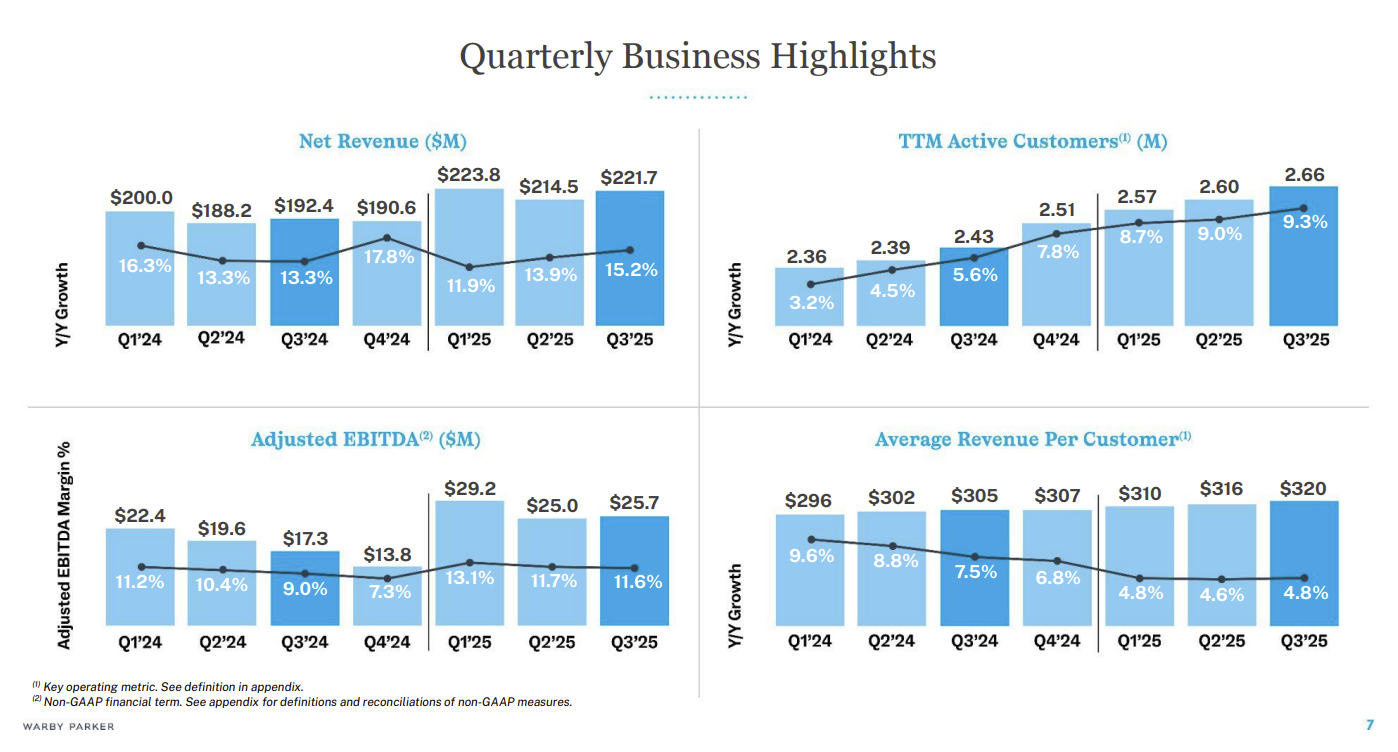
The plan for Warby Parker is to expand its total addressable market beyond eyeglasses. The company ended the third quarter with 2.7 million active customers, up 9.3% from a year ago, with average revenue per customer of $320.
Warby Parker is projecting 2025 revenue of $871 million to $874 million, up about 13%.
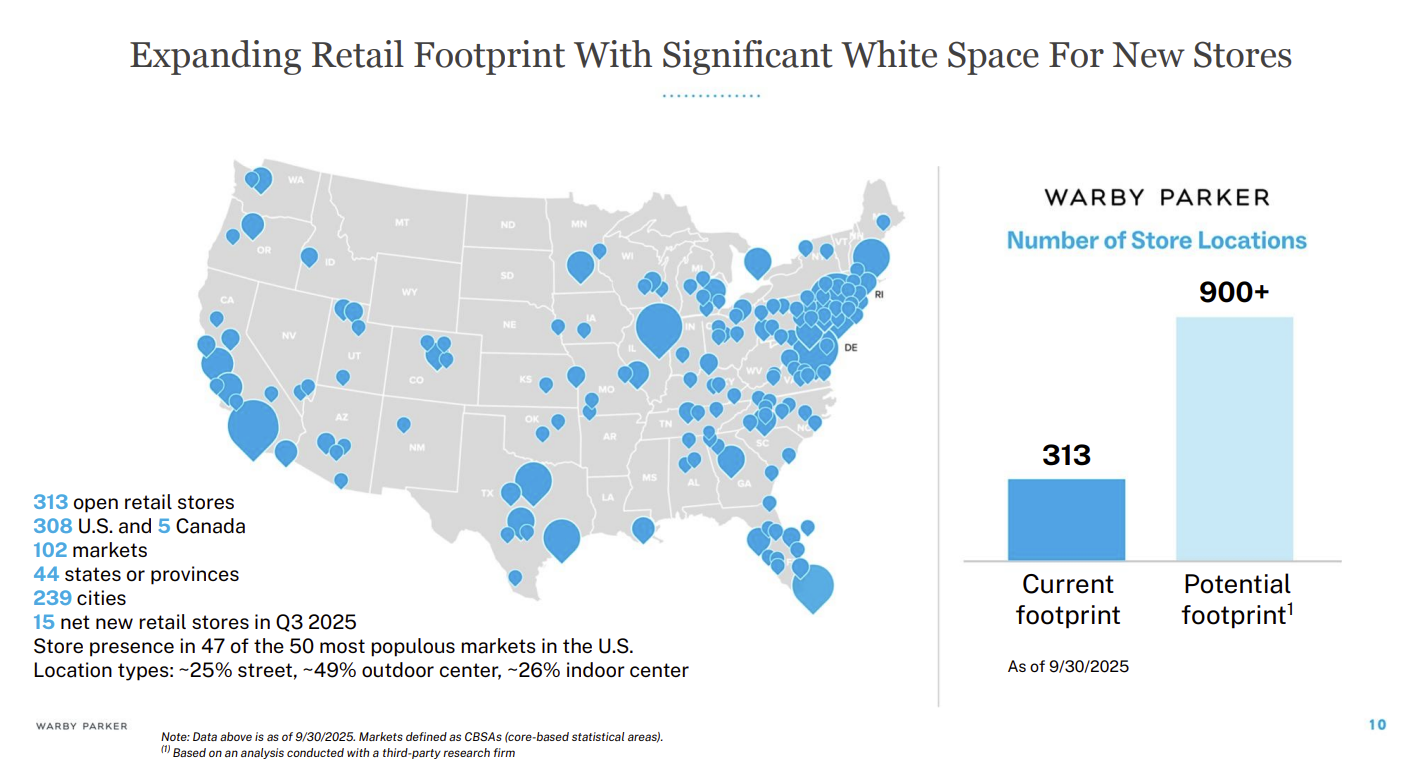
Although Warby Parker primarily sells online, its stores are acquiring customers, said Gilboa. Retail revenue in the third quarter was up 20% from a year ago due the addition of 15 new stores. The retailer also has a partnership with Target to add shops.
Those stores will be critical when Warby Parker shows off its Google-powered AI glasses. Blumenthal said the company upgraded its optical labs to support future growth, faster delivery times and ultimately fulfillment for AI glasses.
Details of the Google-Warby Parker partnership have been coming out in recent months. In many respects, Google is a big brother to Warby Parker. Google will be covering a chunk of the expenses to stand up a product including product development, experiences and the demo environment, which will be delivered in Warby Parker stores.
Google also said it will invest $75 million in Warby Parker subject to hitting collaboration milestones.
Gilboa said in September that Google AI will be embedded into Warby Parker glasses designed for all-day wear for prescription or non-prescription lenses.
"Our understanding is that the primary use cases are really to replace AirPods or take hands-free photos and our products will do that exceptionally well. But the reason that we were really excited to partner with Google is because of their AI capabilities throughout their organization with Gemini and DeepMind," said Gilboa. "Google also has massive capabilities across Android, Gmail, Google Maps and search."
Gilboa added:
"We think that they're going to be really transformative in terms of how people engage with technology and will enable them to stop being tethered to kind of pulling a screen out of their pocket and engage more with the real world."
Larry Dignan is Editor in Chief of Constellation Insights at Constellation Research, where he leads editorial coverage focused on enterprise technology, digital transformation, and emerging trends shaping the future of business. He oversees research-driven news, analysis, interviews, and event coverage designed to help technology buyers and vendors navigate complex markets with clarity and context. ...
Read morePublished
Author
