Is Slack Becoming the iPhone of Enterprise Decision-Making?
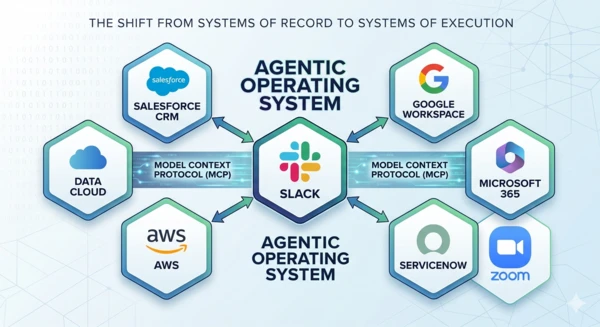
Salesforce didn’t just upgrade Slackbot, it made a strategic move to redefine:
where enterprise decisions get made—and how fast they execute.
What actually changed?
The March 31 launch (30+ new AI features) wasn’t about copilots or summaries. Quick list of what’s new:
- Generate: presentations, dashboards, meeting briefs
- Execute: schedule meetings, update CRM, send contracts (DocuSign), fix bugs (via dev agents)
- Observe: listen to meetings, read screens, summarize in real time
- Coordinate: create channels, bring in humans + agents, manage workflows end-to-end
But, three things matter:
- Slackbot is now a context-aware agent
- It can orchestrate actions across systems
- It turns Slack into a decision + execution layer
From the keynote:
“Slack is our operating system… the front door to the agentic enterprise.”
Slackbot is no longer a passive assistant or just a space to collaborate. It’s becoming the system where work is initiated, coordinated, and completed.
The shift most leaders are underestimating
For the last decade, enterprise architecture focused on:
- systems of record
- systems of integration
The rise of AI and now agents shows us that’s no longer the constraint. The new constraint is: how quickly organizations move from signal → decision → action (and then learning)
Slack is positioning itself as: the decision surface for that loop
Of course, that led to the most memorable quote from Parker Harris, Co-Founder of Salesforce & CTO of Slack, who joked that after driving applications since 1999, given Slack as the front door, he now asks …
“Why log into Salesforce [apps] at all?”
The architectural bet: Thin vs Thick
Marynne Patel, CPO for Agentforce Sales, discussed the different needs between thin, conversation-oriented questions versus “thick applications" like in the call center, where agents face high repetition, process-oriented, and a need for minimized back-and-forth.
Salesforce is enabling/forcing the distinction:
- Thin layer (Slackbot): Always-on, High adoption, Low friction.
- Thick layer (applications): Deep functionality, Structured workflows, Lower engagement.
What’s the implication:
The interface where work happens matters more than the siloed apps and data lives. AI removes the need to navigate to systems for details, and allows users to focus on outcomes.
Slackbot delivers this by positioning itself as your personal agent, orchestrating other agents, and providing a unified experience across what has been a fragmented context across systems and organizations, while sitting above orchestration and agents.
Why this matters
Three forces are converging:
1) We were told, let a 1000 flowers bloom … and we did
Work is already fragmented, and having multiple agents only makes the problem worse. We already had Slack, email, meetings, dashboards, and a plethora of CRM and ERP applications. Organizations now have chatbots, multiple AI-driven tools, and AI-driven processes to improve how their teams work. Then, they complain about not seeing the returns on all their AI investments. Through it all, decisions are happening everywhere, but are rarely tracked or governed.
As raised at last month’s Constellation CEO Future’s Forum, the era of experimentation Is shifting to production. Understanding how we change work and fundamentally enable how their organizations operate is today’s challenge for really getting ROI from the AI investments made over the last 2-3 years.
2) It just works … AI can lower the cost of delivering data-driven decisions and actions
Users don’t want to navigate apps. They want to ask and act with more complete information. Slackbot now reads the conversation, pulls in context, suggests actions, and increasingly executes. The increase in decision velocity is measurable. Some examples from Marc Benioff and the team’s launch event:
- +60% improvement in deal cycles (Anthropic)
- 125,000 hours saved in pipeline updates (2 months of Salesforce time)
Similar to the iPhone, users don’t go to the apps, the app comes to you and adapts to the need.
3) There’s an App for That … Slack already has distribution
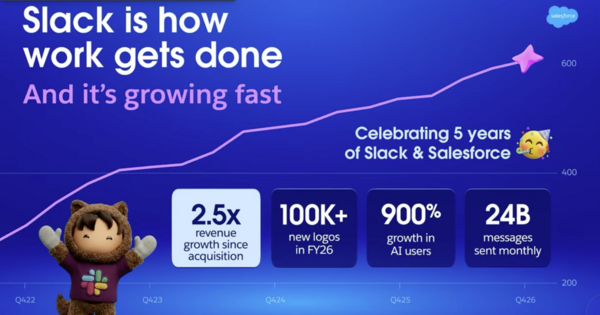
Just a couple of numbers from the Slackbot launch event:
- 300% growth in custom AI agents since February
- 1M+ businesses using Slack
- 2,600+ apps in ecosystem
This is not early-stage, but a healthy ecosystem of users, partners, and workflows already using Slack.
4) … and a consideration ... how many industries did the iPhone kill?
Do you remember when we used to have flashlights? When's the last time you've seen someone carry around a camera? Whatever happened to dedicated navigation devices or my trusty Thomas Guide that navigated me through the many random roads of LA?
Enterprises, and certainly vendors, need to think about where your value shifts when a new interface wraps your capabilities. As a serial CPO/CMO, the exec team and I used to argue how we could "own the glass” to fight being commoditized or disintermediated altogether. What "thin" parts of your app drive unique decisioning in your agents and solutions, or engagement to your "thick" applications, become strategic calls.
My POV
Slackbot isn’t an AI feature. it’s a move to own the decision surface.
Slack is moving to own that moment, building on a growing set of automated workflows and processes, and orchestrating agents. This improves some things:
- Speed of decision-making
- Accessibility of data, insights, and AI-driven acceleration and guidance
- Cross-functional alignment
And that creates a new tension as enterprises rethink process flows that span traditional applications, data, and, importantly, organizational silos (these are industry, not Slackbot specific):
- Speed vs control (unified governance)
- Flexibility vs consistency (semantics, context)
- Interface vs execution
Bottom line? The iPhone didn’t win because it replaced every system.
It won because it owned the interface, the ecosystem, and the moment of action
What to do next
If you’re a CIO/CDO/CAIO, don’t start with the tool.
Start with these questions:
- Where are decisions actually made today? Slack? Dashboards? Meetings? In specific apps?
- Who owns: the interface (Slack/Teams), decision rights/assignments, the execution layer, as well as the context that applies to any decision (data platform)?
- Is your governance in place before scaling agents?
What do you think? What did I miss? Put your comments below.
Michael Ni is Vice President and Principal Analyst at Constellation Research, covering the evolving Data-to-Decisions landscape—where CDOs, CIOs, and CPOs must modernize data infrastructure, integrate AI into decision-making, and scale automation to improve business outcomes. Ni’s research examines how enterprises operationalize AI, automate decision-making, and integrate data management and analytics into core business processes. He focuses on the challenges of scaling AI-driven decision systems, aligning data strategy with business goals, and the growing role of data and decisioning “products” in enterprise ecosystems. With 25+ years as a product and GTM executive across enterprise software, AI platforms, and analytics-driven technologies, Ni brings a practitioner’s perspective to…...
Read morePublished
Author