Infor’s Bet: AI Is Moving to Where Work Gets Done
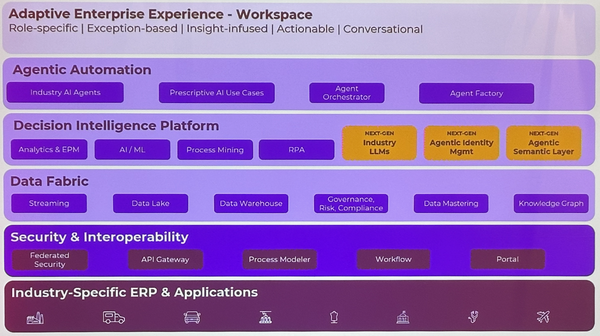
Enterprise AI isn’t being won in the model layer—it’s being won at the point of execution.
That was the clearest signal from the April Infor Analyst Summit. What stood out wasn’t more copilots or incremental AI features layered onto existing systems. It was a more fundamental shift: AI is moving into the processes where decisions are made—and where outcomes are measured.
Infor’s CEO kicked off the summit, summarizing the state of the industry. While enterprises have invested in data platforms, analytics, and AI models for years, utilization remains low, processes are still fragmented and manual, and many AI initiatives stall in pilot operations, using generic AI that lacks the context to operate within real workflows.
CEO, Kevin Samuelson, was joined on stage with President/CTO, Soma Somasundaram (Employee #1), to lay out a view on how the industry is ripe for change with a view on how ERP becomes the backbone of an agentic enterprise … and why their bets over the years on industry-specific, multi-tenant cloud are paying off.
Here are the critical takeaways CxOs should consider as they navigate digital transformation and drive competitive advantage.
1) AI is getting a job
The most important change is not that AI is embedded. It's that AI is being held accountable.
Infor is moving beyond copilots to process-centric AI, where decisions are directly tied to operational outcomes. This approach of AI by design looks like this in practice:
- AI is embedded into workflows like order-to-cash, procurement, and supply chain execution
- AI helps resolve issues inside the process, not just surface them
- Process mining is used to identify where automation will have the most impact
- AI decisions linked to SLAs, KPIs, and business targets (e.g., for a customer, agents were deployed to suggest rebalancing inventory for margin and SLA optimization, starting with human‑in‑the‑loop and then removing humans once trust was established. Over $600K worth of rebalancing, and just ramping to broader control)
This represents a shift from:
AI as advisor → AI as operator
It also explains why many copilots have struggled to deliver ROI. They increase output, but they don’t change how decisions are made or enforced.
Bottom line: AI creates value when it is accountable for outcomes—not when it generates insights.
2) Pre-built Vertical Processes Reduce Complexity and Enable AI
Infor’s micro-vertical strategy is often framed as a form of segmentation. In practice, it functions as an execution context for AI.
By embedding industry-specific data, semantics, process models, and constraints, Infor effectively provides the starting configuration for how automations should reason and where they are allowed to execute.
What defines this execution context:
- Pre-modeled process flows, data models, and KPIs across 60+ micro-verticals
- Domain-level semantics captured in a business context graph
- Alignment of data, process, and metrics at the point of execution
This moves from traditional vertical SaaS to industry value chains built on outcomes-based decision velocity
One of Infor’s customers shared why this mattered -> the speed they went from initiating a bill-to-pay process re-engineering initiative to new automation using AI to review and resolve specific issues within 3 weeks.
While pre-configured SaaS isn't new, Infor delivers pre-built decision logic, libraries of process/ industry semantics, and fine-tuned LLMs that provide the trusted context data AI-driven processes and agents need.
Bottom line: The real moat is not better models, it’s a better-defined context for AI-driven processes, agent decisioning, and industry-specific automations at runtime.
3) Process Intelligence and Operational Signals Enable Precision Decisions
Even with strong starting points, processes don’t stay static. They evolve as conditions change—and increasingly, they are being redefined as AI collapses traditional steps into faster, more automated decision flows.
That makes visibility and feedback critical.
Infor uses process mining and monitoring not as standalone tools, but as the entry point into a broader system of continuously understanding and improving how work actually gets done.
What’s emerging is a shift from analyzing processes after the fact to actively guiding decisions in real time.
What defines this shift:
- Process mining is the starting point for identifying where automation and AI can have the most impact
- A multi-object view of operations, connecting orders, vendors, SLAs, and downstream dependencies
- Movement from observability → situational awareness → precision execution
- Integration across IT systems (ERP, supply chain, finance) and operational systems (manufacturing instrument signals, logistics events, real-world constraints)
- Closed-loop systems that sense, decide, act, and learn over time
This integration across digital and physical systems enables a new level of decision quality.
In many environments, especially in manufacturing and distribution, decisions cannot rely solely on ERP data. They require real-time awareness of what is happening on the ground: delays, capacity constraints, supplier variability, and operational disruptions.
By bringing these signals together, organizations move from:
- Reactive reporting to
- Context-aware, precision decisioning based on current conditions
This aligns with a broader industry shift toward real-time operational awareness, in which decisions are coordinated across IT and operational environments.
For asset-intensive industries, this is not incremental. It is foundational. It enables a transition from reacting to issues after they occur to anticipating and resolving them as they emerge.
Bottom line: Process mining is not the endpoint. Decision velocity is.
Combined with operational signals, it becomes the foundation for continuous, real-time decision optimization.
4) ERP Is Evolving into a System of Action Platform
The above shifts are redefining the role of ERP.
Historically, ERP systems have been systems of record. What’s emerging now is a transition toward systems of action, where signals are captured, decisions are executed, and decisions are refined in real time.
What defines this new role:
- Integration of data signals, analytical, decisioning, and transactional in one environment, creating a decision loop that learns to improve decisions and processes over time
- Embedded AI agents operating directly inside workflows
- Event-driven architecture that supports real-time decisioning
- Unified conversational interfaces across data, insights, decisioning, and actions
This creates a new competitive dynamic.
- Data platforms like Databricks and Snowflake continue to play a critical role in data management and modeling
- Application platforms like Infor and ServiceNow are moving closer to execution and orchestration
For buyers, this simplifies the architecture.
Instead of stitching together multiple systems, more functionality is available within a single platform.
Bottom line: ERP is becoming the place where decisions are executed, and not just recorded. Transactional data and systems of record are the foundation for better decisions.
MyPOV: Infor Is Betting on Execution, Not Experimentation
Infor’s strategy reflects a long-term architectural bet they’ve been building. While much of the market is still retrofitting AI onto legacy ERP and data platforms, Infor has spent the last decade building a multi-tenant, industry-specific foundation. That work now enables AI to be embedded directly into operational workflows.
For most organizations, the path forward is pragmatic: start with the processes already running in your enterprise system (e.g., ERP) and embed AI decisions where they can make traditional, rules-based, more rigid automations more adaptive to a broader range of situations or handle unstructured data. This is where businesses can see a shorter-term, measurable impact.
Infor’s advantage is that it helps customers realize near-term operational gains by leveraging prebuilt processes and embedded decision points, rather than starting from scratch.
From there, the opportunity expands. As these use cases scale, ERP can evolve from a system of record to a platform for AI-driven process execution. This creates a compounding advantage, a domain flywheel, where ownership of data, context, and execution drives better outcomes with each iteration.
In the long term, the market will not converge on a single architecture. Data platforms, application platforms, and orchestration layers, and their specific context layers, will coexist. Standards are already rising to share data, context, and control.
Infor is positioning itself to address the reality of converging architectural approaches by providing context to enable competition at the execution layer, where decisions are made, enforced, and improved over time.
There are still risks. Most organizations are early, and adoption will likely progress from task-level automation to broader process orchestration over time.
Bottom line: start with what delivers value now, but recognize that those gains are building toward a larger shift in where enterprise AI actually operates.
–
For more, listen to the Constellation Infor Analyst Summit takeaways here: AI is finally getting a job: https://www.constellationr.com/video/ai-finally-getting-job-infor-analyst-summit-takeaways
Michael Ni is Vice President and Principal Analyst at Constellation Research, covering the evolving Data-to-Decisions landscape—where CDOs, CIOs, and CPOs must modernize data infrastructure, integrate AI into decision-making, and scale automation to improve business outcomes. Ni’s research examines how enterprises operationalize AI, automate decision-making, and integrate data management and analytics into core business processes. He focuses on the challenges of scaling AI-driven decision systems, aligning data strategy with business goals, and the growing role of data and decisioning “products” in enterprise ecosystems. With 25+ years as a product and GTM executive across enterprise software, AI platforms, and analytics-driven technologies, Ni brings a practitioner’s perspective to…...
Read morePublished
Author