


Your AI playbook and a look at the big themes
Enterprise leaders have gone from concerns that they aren’t moving fast enough to a more mature approach and developing AI playbooks. Constellation Research CEO R “Ray” Wang outlined the AI playbook and the themes that matter.
The economic backdrop driving AI adoption is margin compression, exponential scale and outcomes are growing in importance and companies will organize around them.
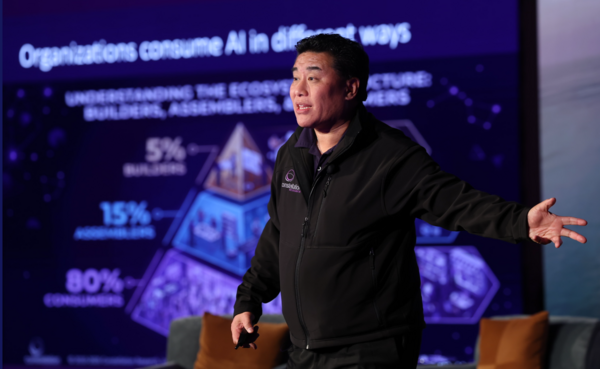
Here's a look at Wang's AI playbook and rules of the road followed by the more nuanced themes at CCE 2026.
- The goal is to make faster decisions. "Machines are making hundreds, 1000s of decisions per second. Your competitors are going to run circles around you," said Wang.
- Your business graph is your most valuable asset. The business graph is the record of your company's interaction and metadata. You need to keep it away from AI labs and competitors.
- Know where to put a human. "You do not look at automation. What you want to think about is when and where do you insert a human in your decision tree," said Wang.
- Handing a customer to a human is a cost decision. "Your customer lifetime value better be high enough before I let you talk to a human, because I'm going to lose money in every interaction," said Wang.
- Processes are learning loops. "In every process, we're going to loop it over and over until we get to higher levels of precision," said Wang.
- Every AI decision needs a human owner. Wang said enterprises need to inventory AI use cases, create clear accountability for each one, audit trails and escalation points. "Who's the decision maker for the outcome," said Wang. "It can't be AI. there has to be a human on the back end."
And now onto those bigger themes.
Managing at machine scale isn’t going to be easy
Managing at the intersection between human and digital workers is chaotic and it's pretty clear most enterprises are winging it. CxOs are managing for the short-term, but need to also think about the long game. The immediate priorities are change management, people and processes as well as burnout.
Operating at machine scale has put humans on a hamster wheel going nowhere. Paul Roehrig, Executive Vice President, Chief Strategy and Marketing Officer at Ascendion, said that feeling may be front and center due to AI, but it's nothing new for humans. "Are people going to get burned out? Yeah, people have always gotten burned out. Ask somebody that was a hunter-gatherer, and they would have said "yeah, I burned out looking for berries."
More CCE 2026:
- 2027: VCs see a time of potentially brutal sorting
- AI strategy is business strategy and boards don't get it
- Outcome based pricing: Pros, cons and nuances
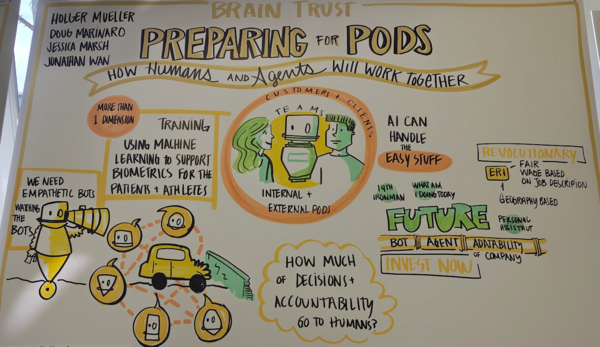
- Teamwork in the AI age: Pods, clusters, flocks
- An early read on your 2027 AI budget
- Management amid AI chaos: Takeaways from the field
- 2027 themes to watch and what you should do now
- Boomi CEO Lucas: Beware your zombie AI agents
Brian Solis, Head of Global Innovation at ServiceNow, said most enterprises are focused on using AI to modernize and optimize, but there should be more thought given to futureproofing. "Does this workflow deserve to exist in 2030?" asked Solis. "If the workflow is just a more optimized version of what you were in 2026 that's past proof."
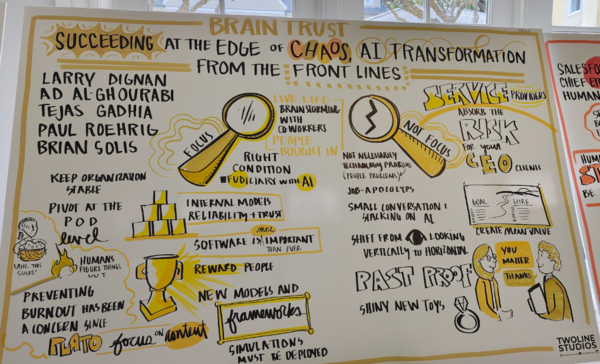
Perhaps the biggest question about AI-driven companies is culture. Chris Deaver, Principal of BraveCore and author, made the case that culture will be a company's biggest differentiator because AI will be a commodity. Deaver, who has seen the impact of culture and co-creating products at Apple and Dell, said: "The main challenge with AI adoption. It's your culture. What is the differentiator? It's people powered AI, so it's converging the best of technologies and humanities. AI can do a lot of things. It can get things done. But the brain trust really helps decide what's worth doing, what matters."
My take: What's unclear as companies scale is how culture is maintained if most of operations is run by AI agents. Can you hard code a company culture? Color me skeptical.
Scaling in the AI exponential age and the human role
Kim Smith, Senior Vice President at Improzo, knows scale from stints at Microsoft, IBM and AWS. In an interview, Smith said the next leg in scale is going to come from machines working with other machines, not training more people.
Smith argued that there needs to be a more holistic approach to scaling. "It's not really about the human connection anymore with AI. This is machine to machine. And I don't think we're thinking about that as holistically as we should be," said Smith.
The approach to scale means building for AI agents and then getting out of the way. Not every AI product and service will need a human-facing interface.
What do humans do? We're guides. "We think AI is guiding us, but it's a tremendous opportunity for us to be guiding AI," said Smith.
However, the humans may be maxed out already. Peter Danenberg, Software Engineer at Google DeepMind, said: "Every single engineer now is effectively babysitting N agents, and I'm trying to figure out what N is. But it seems like people cap out at about six or seven agents, and so everybody that I know is running around with this effectively this induced ADHD where they're basically constantly mode switching. Nobody can achieve anything like flow state anymore. All of these models are good enough to do anything we want, but somehow we have to solve this like human attention problem and this context problem."
Max Brodeur-Urbas, CEO of Gumloop, an enterprise agent platform, said scale happens one use case at a time. "The pattern we've seen that works best is having people explore, see the use cases and then apply AI. If you really let people who deeply understand something build an agent and automate it, there's immense ROI," said Brodeur-Urbas.
The common scaling themes across CCE 2026 were the following:
- Scaling used to mean adding people and infrastructure. Now it means machines working with other machines.
- Speed and scale are happening at "machine scale," faster than humans can follow.
- Ambition and value should drive scale, not bottom-up automation.
- Governance and go-to-market are what hold scale back.
- Ecosystems and shared data make scale possible.
My take: Across panels, there was an assumption that the goal was to get big. I'm not convinced that we're looking at the right goal. Reaching scale and bulking up is always the theme in Silicon Valley. It's go big or go home. Is the win really building the next Anthropic, OpenAI or Google? Or is the real benefit from AI creating thousands of small companies with five people generating $5 million in revenue per head?
I'd take hundreds of thousands of small companies leveraging AI to punch well above their weight over one behemoth.
AI is forcing a conversation about outcomes
Outcome-based pricing sounds good, but it is hard to put into a contract. However, there's enterprise buying interest in sharing risk with vendors and the likely end state is a hybrid model that includes a base fee, upside tied to outcome and milestones.
I moderated a panel on outcome based pricing. Here's a look at the takeaways from Anil Cheriyan, Managing Partner at Phase IV Ventures, Minerva Tantoco, CTO at City Strategies LLC, and Alisha Thompson, CTO at Team Air Distributing.
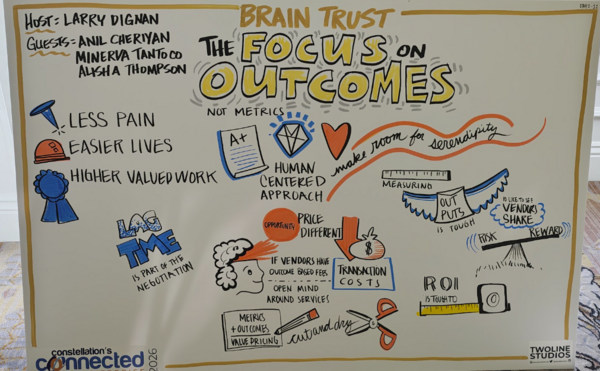
The lessons learned include:
- Don’t confuse metrics for outcomes.
- Leave room for benefits you didn’t plan for.
- Pricing for outcomes is hard.
- Services firms may be best fit for outcome-based pricing
- Keep an open mind.
- Procurement is the biggest barrier.
"I think it all comes down to the deal and how much skin they have in the game, what exactly that we determine as a success metric, how much risk that we both have, and it would have to be in paper. We would both have to be sharing the risk,” said Thompson. “Just because we haven't seen it before doesn't mean that it couldn't be beneficial for us, depending on the type of deal, the type of services."
My take: Outcome-based pricing will happen, but it’ll take time. The industry almost needs an observability layer for AI value.
Get ready to wrangle zombie agents and governance
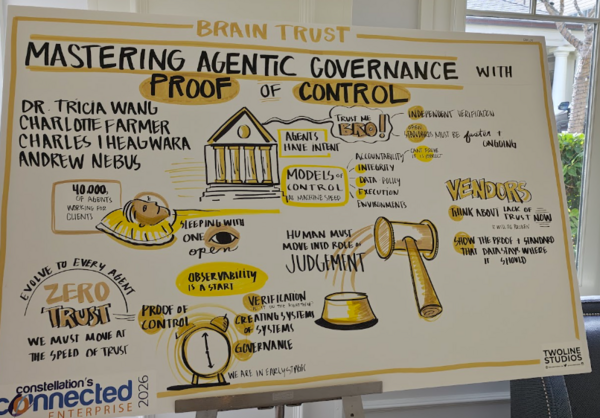
Governance is a big theme in 2027 and your biggest chore is going to be putting zombie agents down.
Boomi CEO Steve Lucas said: "I would be concerned about the zombie agents running in your organization. I'd be very concerned about the AI that shouldn't be accessing a data source."
Brodeur-Urbas of Gumloop said:
"The most common issue we see at all of our customers is they know that agents can do like 90% of the work they want them to do, but IT is saying no at every corner. There are 100 reasons for IT to say no. Like they actually lose their job if something goes wrong. So I don't blame them at all, but they need to make sure that they're like everything is set up so that the data lives in the right place, goes to the right people and is used for the right reasons. There's 1,000 different governance, observability, security features. You need to be able to make agents work in the workplace, but focus on the boring side of AI."
Runtime monitoring, clear accountability, restricted access, and verifiable controls were common themes across CCE 2026.
My take: We're going to spend 2027 playing AI agent Whac-O-Mole.
Talent will be organized in pods
Team structures need to adapt as AI agents and humans increasingly work together in smaller structures, or pods. A pod is a hybrid team of humans and AI that will also include people outside of the company.
At CCE 2026 teamwork was a core theme. How will humans work with AI agents and what structures are needed to produce AI exponential outcomes?
Here's a look at the themes that'll impact the future of teamwork.
- Organizations will have to be reordered into smaller teams.
- The hard design issue will be the handoffs.
- AI adds time but has to be additive.
- Compensation will be an issue.
- Culture between humans and AI agents.
My take: It’s hard to imagine a company maintaining a culture over time when AI agents and automation will represent the majority of an enterprise.
The future of LLMs may leave you out
Lucas had a comment that is worth filing in your back pocket. "I think we've seen the last of these very advanced AI companies giving us their best models," said Lucas. The argument: Why would frontier AI labs sell their competitive advantage when they could use those models for new revenue streams? Think biotech. Keep that mention in mind when you see headlines from Anthropic touting how it is using its models for life sciences and drug discovery.
Models may be hitting their peak. Danenberg said model gains are leveling off. "The difference between an LLM number like 5 and 5.5 is not really a huge step function," he said.
Danenberg reiterated an unpopular view that there may need to be an LLM architecture that goes beyond transformers. "The models are a little bit saturated," said Danenberg. "In order to see the next step function, we have to figure out what's after transformers."
One thought from Lucidity CEO Divya Chander, MD, PhD. is that "wetware" and biology may be the answer. She said the brain's energy efficiency could be a model for future AI. "The brain operates on about 20 watts, which is a dim light bulb. Think of the data centers and all the energy that they take," she said. "Future foundation models originally were based on neurons, integrate and fire, but now they're going to be based on some of the more efficient modes of compute that brains offer us."
Until that time, panelists argued that open models will be critical for the enterprise and possibly win out. Why? Open models enable enterprises to control their data destiny.
My take: The US open model ecosystem needs to be built out beyond Nvidia Nemotron. If I were Google, I'd launch open Gemma models at a much faster clip. Gemini is the focus, but Google should have an open model cadence that rivals what the Chinese labs are doing.
Larry Dignan is Editor in Chief of Constellation Insights at Constellation Research, where he leads editorial coverage focused on enterprise technology, digital transformation, and emerging trends shaping the future of business. He oversees research-driven news, analysis, interviews, and event coverage designed to help technology buyers and vendors navigate complex markets with clarity and context. ...
Read morePublished
Author
