


Management amid AI chaos: Takeaways from the field
AI agents, automation and the breakneck pace of machine scale are creating management playbooks to be rewritten on the fly.
At Constellation Research's Connected Enterprise 2026, a series of panels pulled out the takeaways and lessons learned from managing through chaos. Here's a look.
Focus on conditions for experimentation. AD Al-Ghourabi, VP Service Management and AI Transformation at Thomson Reuters, said on a panel that managing on the edge of chaos revolves around balancing adaptability with operational risk.
"We're not necessarily creating mandates and prescriptive outcomes, but have enough conditions for these solutions, productivity to emerge to enable a consequence-free type of experimentation," said AD Al-Ghourabi. "AI is nonlinear; it's not your traditional IT implementation."
He added that Thomson Reuters focuses on fiduciary AI because you need 100% confidence and accuracy in a result.
The hard problems are people and process. Tejas Gadhia, Head of Applied AI at Zoho, said AI presents a lot of problems that aren't technical in nature. "A lot of problems are really just people and processes," he said.
Karthik Krishnamurthy, CEO of Ascendion, also focused on process. "If artificial intelligence ultimately is not changing the way you do work then all that you've done is you've installed software," he said.
More from CCE 2026: 2027 themes to watch and what you should do now | Boomi CEO Lucas: Beware your zombie AI agents
Zoom out. Brian Solis, Head of Global Innovation at ServiceNow, said most enterprises are focused on using AI to modernize and optimize, but there should be more thought given to futureproofing. "Does this workflow deserve to exist in 2030?" asked Solis. "If the workflow is just a more optimized version of what you were in 2026 that's pastproof.
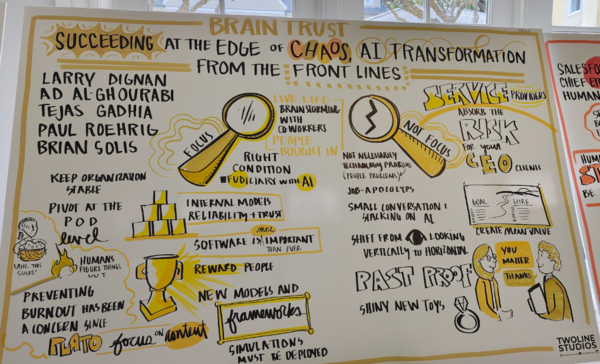
Trust is built from the ground up by humans. Gadhia said AI agents can take on grunt work and free humans up for brainstorming and design. However, trust disappears "the second you start saying we're going to go from 20 people to 12."
"The human touch is going to be a premium," said Gadhia.
Paul Roehrig, Executive Vice President, Chief Strategy and Marketing Officer at Ascendion, said trust also comes from meeting enterprises where they are in an AI transformation. "Our role is to de-risk AI, demystify it and simplify it," he said.
Be aware of burnout. The panelists were asked about managing through burnout as well as cognitive atrophy. Al-Ghourabi said there's a balance between relying too much on AI and using it as an enabler. "The more over reliance, the more cognitive atrophy, and then that same expertise now becoming of less value," said Al-Ghourabi.
Roehrig was more optimistic about burnout and said humans have shown repeatedly that they can evolve and manage new technologies. In other words, humans will figure it out. "I'm long on humans," he said.
Solis wasn't so sure. "Cognitive atrophy is a thing. We will figure this out, but it's going to come at a cost. So burnout is real," he said.
See AI as an amplifier of humans. Paula Goldman, Chief Ethical and Humane Use Officer at Salesforce, said AI "basically amplifies whatever intention you put on it." AI can deepen bias or flag inconsistent decisions.
"The difference between the disaster scenario and positive scenario is really just the intentionality with which it's deployed," said Goldman.
As a result, Goldman said she is moving toward positive alignment and AI that's designed to help people thrive including "positive friction" on high-stakes decisions to drive innovation.
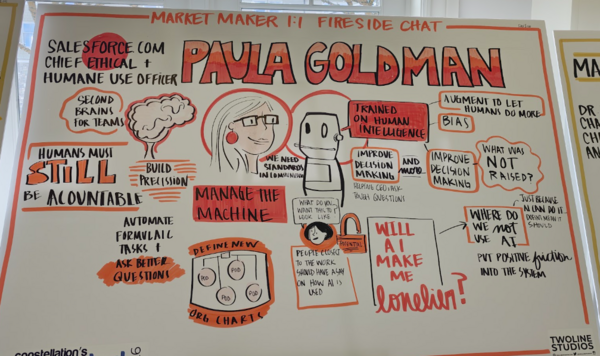
Humans need to be involved with accountability and design. Goldman said a human must remain accountable for an AI agent. "The people that are closest to the work should have a say in how that work gets changed by AI," said Goldman. "People don't want to feel like AI that is something happening to them."
Change incentives for AI and the outcomes required. Krishnamurthy said engineer pay has to change to ensure that outcomes not outputs are delivered. Krishnamurthy said firms want to be paid on outcomes but still pay staff for hours: 80–85% fixed base and 10–15% variable. He's proposing 50% base and 50% variable, plus profit sharing on each project.
"You got to start paying engineering people like salespeople: 50% base, 50% variable, and start to create a structure where you do profit sharing at a project level," he said.
How you measure success will change. Nagendra Bandaru, CEO of Wipro's AI-Native Business and Platforms Unit, said success will be measured differently for your teams. "Revenue per employee is a good metric. Consumption based revenue is one good metric. The amount of money that flows through more outcome based model is a good metric," said Bandaru.
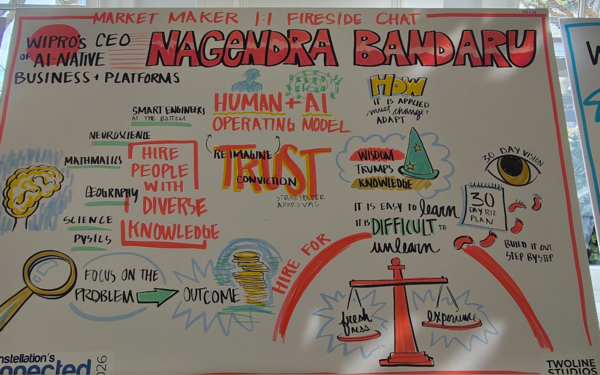
Hire different people. Bandaru said Wipro is hiring people with backgrounds that go well beyond computer science and engineer. He said:
"For the first time in the history of [Wipro], we hire people from different backgrounds. I hire people from neuroscience. I've hired people from mathematics and physics and geospatial intelligence. If you want geospatial intelligence or spatial intelligence, you need to marry geography with AI."
Structures will have to change. Constellation Research CEO R "Ray" Wang said structures will change to focus on work happening in pods of 7 to 8 people. Components of a pod will include someone who understands business processes, another on legacy technology, one with an applications background, another on cloud and the remainder interdisciplinary.
Bandaru said it also makes sense to focus on experience and the curiosity a newbie brings. He has been hiring interns and pairing them with smart veterans. "The way to retain talent is to hire smart engineers at the bottom and marry the legacy technology with experience," he said.
Your plans will focus on 30 days at a time. Bandaru said his group will focus on 30 days and "in AI you need focus on step-by-step progress in transforming an enterprise.”
Larry Dignan is Editor in Chief of Constellation Insights at Constellation Research, where he leads editorial coverage focused on enterprise technology, digital transformation, and emerging trends shaping the future of business. He oversees research-driven news, analysis, interviews, and event coverage designed to help technology buyers and vendors navigate complex markets with clarity and context. ...
Read morePublished
Author
