


Outcome based pricing: Pros, cons and nuances

Outcome-based pricing sounds good, but it is hard to put into a contract. However, there's enterprise buying interest in sharing risk with vendors and the likely end state is a hybrid model that includes a base fee, upside tied to outcome and milestones.
At Constellation Research's Connected Enterprise 2026 conference, I moderated a panel on outcome based pricing. Here's a look at the takeaways from Anil Cheriyan, Managing Partner at Phase IV Ventures, Minerva Tantoco, CTO at City Strategies LLC, and Alisha Thompson, CTO at Team Air Distributing.
The panel followed a workshop on aligning organizations for outcomes.
The art of outcomes. First, Tantoco said never confuse outcomes with metrics. "There's a big difference between outcomes and metrics… When you think about outcomes, you really think about business outcomes such as value created, productivity and customer satisfaction," she said.
Thompson said outcomes revolve around "taking away friction and pain from our customers, from our teammates, and does life and work look easier?"
Leave room for benefits you didn't plan for. Tantoco said defining outcomes too tightly upfront can hide unexpected gains. "If you predefine them, are you closing off the things that you might have unexpectedly been a benefit?" asked Tantoco.
More: Teamwork in the AI age: Pods, clusters, flocks
- An early read on your 2027 AI budget
- Management amid AI chaos: Takeaways from the field
- 2027 themes to watch and what you should do now
- Boomi CEO Lucas: Beware your zombie AI agents
Pricing for outcomes is hard. Cheriyan said that it's challenging to measure outcomes and attribute them to any one company. "Even cost savings get disputed inside the buyer's company," he said.
Thompson added that vendors generally avoid guaranteeing outcomes. "Vendors do not want to attribute outcomes. They want to attribute successful software installations and sign-off," she said.
Tantoco noted that any single metric can be gamed. For instance, a metric like time to close a case could be gamed by a system that simply rejected everyone. Processes with clear metrics and an established baseline are best for outcome-based deals.
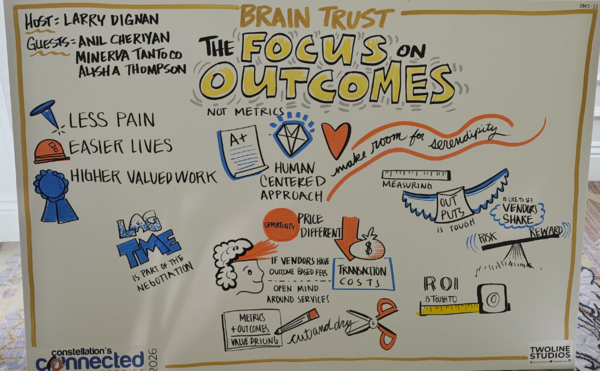
Keep an open mind. Thompson added that she keeps an open mind about outcome-based pricing. "I would like to see the shared risk and reward tied to an outcome-based deal," she said.
Tantoco added that an enterprise would want to model the best case first so you know how much you have to pay if the project is really successful.
Services firms may be best fit for outcome-based pricing. Cheriyan outlined a recent business process outsourcing deal where the vendor didn't charge by the person anymore. Instead, a deal was priced on transactions. For services firms, outcomes may give the vendor a chance to take lower revenue and participate in AI efficiency gains and possibly upside.
Hurdles remain. Cheriyan said attribution remains difficult and procurement teams need training. The default mode in procurement teams is to reject non-standard deal structures. For now, the answer to outcome-based pricing is that it depends. Thompson said:
"I think it all comes down to the deal and how much skin they have in the game, what exactly that we determine as a success metric, how much risk that we both have, and it would have to be in paper. We would both have to be sharing the risk.
Just because we haven't seen it before doesn't mean that it couldn't be beneficial for us, depending on the type of deal, the type of services."
More on outcome-based pricing:
- Outcome-Based Pricing, AI and the Future of Experience Management | CRTV Episode 141
- Oracle: Takeaways on AI value, outcome pricing, managing AI spend
- HubSpot sees turbulence ahead due to outcome-based pricing shift, AI budget scrutiny
- Salesforce takes a run at outcome-based Help Agent pricing
- Pegasystem's Ken Stillwell on Tokenomics and Outcome-Based AI
- Oracle eyes outcome-based pricing: Does it stand a chance?
- Pegasystems sees opportunity in runaway token costs, pitches outcome-based pricing
Larry Dignan is Editor in Chief of Constellation Insights at Constellation Research, where he leads editorial coverage focused on enterprise technology, digital transformation, and emerging trends shaping the future of business. He oversees research-driven news, analysis, interviews, and event coverage designed to help technology buyers and vendors navigate complex markets with clarity and context. ...
Read morePublished
Author
