


2027 themes to watch and what you should do now
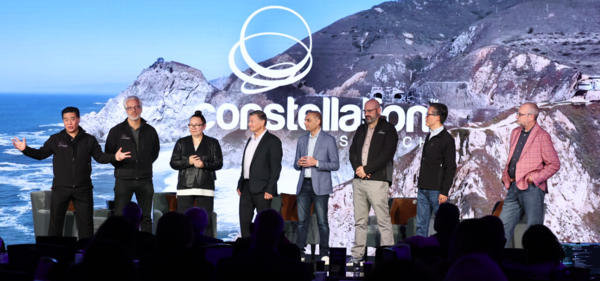
For 2027, the AI playbook is going to include a lot of volatility, build your own approaches, agentic AI at scale, governance headaches and a focus on humans on multiple fronts.
At Constellation Research Connected Enterprise 2026, each analyst outlined their 2027 themes and what CXOs should do right now. We'll flesh these rapid fire themes out leading into the end of the year.
Holger Mueller
In 2027, AI will get more agentic and you'll have to build things yourself to wrangle them, govern them and optimize them. "You'll definitely have to find out how to do things yourself," said Mueller, who noted that your SaaS vendors aren't going to innovate fast enough.
Training is also critical. He said:
"You have to look at your people. Training is the new social compact. If I know that my employer has my back and my will, if I'm willing and ready to work, I will have a learning opportunity with vastly changing skills needed to be successful, you will have loyal employees, which is the most important thing as you know from the past, and will be the most important in the future."
What to do now: Move to the public cloud as fast as possible. Why? You'll need to save your capex for things like robots and physical AI that will be more valuable.
Liz Miller
For 2027, Miller's themes in a nutshell:
- The least expected person on a team becomes the hero by building an agent whose impact shows up in margin and revenue.
- Security problems will make it harder to keep experience promises to customers and employees. Service and marketing teams should talk to security and IT now.
- A backlash against required AI tools that people don't want. Companies should listen to their people, not count tokens.
She said:
"You're going to be able to measure the impact of an AI agent in margin and in revenue, and that's going to be really exciting. The real impact will be in our ability to turn all of those experience promises that we keep making to our people, whether it's our customers or our employees."
What you should do now: Stop running big, risky AI experiments in sales, service and marketing where revenue and customers are at stake.
Chirag Mehta
Themes for 2027 include:
- Security permissions, roles and identities were designed for humans, and agents are breaking them.
- Companies are finding vulnerabilities faster than they can patch them.
- Software development is getting faster, but nobody is rethinking how software gets built.
Mehta said:
"We have now lived in this world for a while, and it turns out that we are building this agentic world on top of the infrastructure that was designed for human needs. All the security constructs, permissions, roles and identities were all designed with the assumption that humans are going to use them. Now humans are not going to use them, or we might use them, but agents are using them, and agents are breaking everything."
What to do now: If you can build almost anything, build something completely different, not the same thing faster.
Martin Schneider
Schneider's 2027 themes are:
- Pricing is still a mess. Vendors mix up outputs and outcomes when they talk about outcome-based pricing.
- When "everyone's a builder," it gets hard to standardize pitch decks, quotes and other sales and marketing content.
- Tech founders stall at $10 million to $15 million in annual recurring revenue (ARR) because product-led growth runs out. Getting to $50 million to $100 million takes real go-to-market skill.
He said:
"People are talking about outcome-based pricing are really talking about outputs. Some people who are talking about outcome-based pricing are talking about nothing because they don't have either of those. Pricing is still a mess."
What to do now: Stop thinking about the jobs humans do. Focus AI on the ones they can't, won't or don't want to do.
Mike Ni
Context and decision velocity is the theme for 2027.
- Context becomes situational, going beyond retrieving and grounding data.
- "Dashboards describe, decisions deliver." Data, AI, context and reasoning tools are merging, and every option forces buyers to accept trade-offs.
- Governance moves to runtime, and permission isn't the same as authority. His example: you may be allowed to give a 25% discount but only have authority for 15% in a given situation.
Ni said:
"I have the data, but the decision I need to make may be slightly different. The context has to change. That means that we're actually going to see a more sophisticated approach towards thinking about context. Everyone's been playing context. We're going to start to get sure as this stack features mature about how we actually use it to guide decisions."
What to do now: Design for decisions, not just process automation.
Esteban Kolsky
Kolsky's themes for 2027 were framed for boards and CEOs. Here's a look:
- How do I justify my AI spending? Say what the money buys and what it changes, rather than "spending on AI." Kolsky said return on investment isn't the measure.
- How much authority and trust should automated processes get, and who stops them when things go wrong?
- What kinds of problems can AI solve? Kolsky described a range from simple and complicated to complex, wicked and intractable. AI handles the first two so far.
What to do now: Write off this year and plan for June 2027 onward. Nothing started now will pay off before May or June.
He said:
"There's a spectrum of problems: simple, complicated, complex, wicked, and intractable. We tackle simple, we tackle complicated. How do you get to complex? This year is done. Stop worrying about it. You're working in June of next year and forward. Whatever you do now is not going to be actually alive or worthy or do anything before you know May to June of next year. So stop worrying about it and start focusing on next year."
R "Ray" Wang
Wang's themes for 2027 go like this:
- Experience matters more than expertise, which is becoming a commodity.
- Time is compressing because work now happens at machine scale.
- Organize around outcomes and decisions: departments give way to small teams ("pods").
Wang said:
"You need to align your orgs to outcomes. If you don't align your orgs to outcomes or decisions, which I'm probably going to switch to because that was really smart, align orgs to outcomes and decisions, you're not in the right place. That means departments go away. That means pods are kind of the dominant way to move forward, and we're not ready for that."
What to do now: Grab as much budget as you can and propose lots of projects, since they'll all change next year anyway.
As for my themes, I'm stunned that we haven't figured out how to price AI yet, but maybe that'll be figured out in the year ahead. Other themes:
- Governance is going to be a huge theme and you'll need to govern that sprawling AI estate.
- Nuance will also be a theme since I'm bullish on enterprise AI, but think AI infrastructure is a debt time bomb.
Larry Dignan is Editor in Chief of Constellation Insights at Constellation Research, where he leads editorial coverage focused on enterprise technology, digital transformation, and emerging trends shaping the future of business. He oversees research-driven news, analysis, interviews, and event coverage designed to help technology buyers and vendors navigate complex markets with clarity and context. ...
Read morePublished
Author
