


Oracle delivers strong Q4, but AI infrastructure kills free cash flow
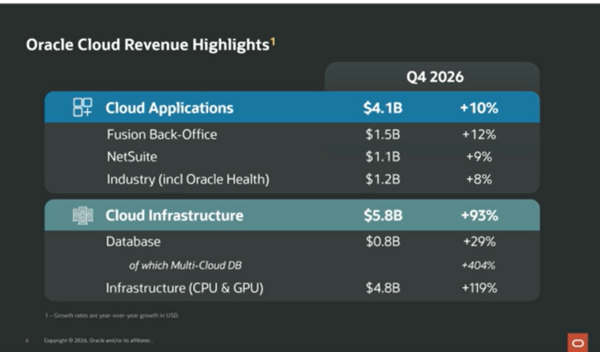
Oracle reported better-than-expected fourth quarter results, delivered 47% in cloud revenue growth compared to a year ago and 93% growth in infrastructure as a service.
The catch is that Oracle's record revenue growth is coming at a steep cost. The company said "free cash flow was negative $23.7 billion for fiscal year 2026 as Oracle continued to execute on investments to support the growth of its cloud infrastructure business."
Oracle reported fourth quarter earnings of $1.45 a share on revenue of $19.2 billion, up 21% from a year ago. Non-GAAP earnings for the fourth quarter were $2.11 a share.
Wall Street was expecting Oracle to deliver non-GAAP earnings of $1.96 a share on revenue of $19.09 billion.
By the numbers in the fourth quarter:
- Oracle's cloud revenue was $9.9 billion, up 47% from a year ago.
- IaaS revenue was $5.8 billion, up 93% from a year ago.
- SaaS revenue was $4.1 billion, up 10% from a year ago.
- Software revenue in the quarter was $6.8 billion, down 2% from a year ago, due to moves to the cloud.
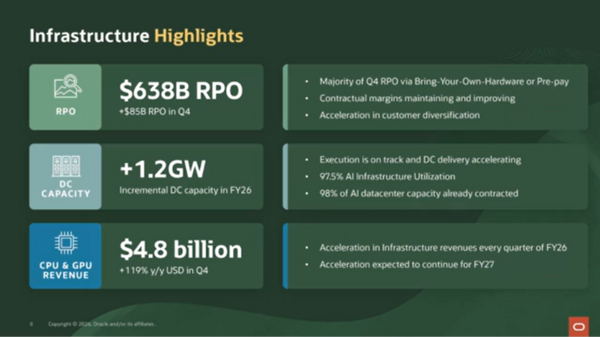
- Remaining performance obligations (RPO) at the end of the quarter were $638 billion, up 363% from a year ago. Oracle said: "Most of the RPO increase in both Q3 and Q4 were large scale AI contracts where the customer prepaid Oracle for the purchase of the GPUs, or the customer bought and supplied the GPUs to Oracle. The prepaid and customer supplied hardware portions of our large AI contracts now total $75 billion."
- Oracle said its Oracle Multicloud AI Database grew 404% in the fourth quarter.
- Oracle said its Oracle Health business is expected to grow at a double-digit percentage clip in fiscal 2027 due to a new Cerner hospital and clinic patient care management system.
For fiscal 2026, Oracle reported earnings of $5.83 a share on revenue of $67.4 billion, up 17% from a year ago. Cloud revenue for fiscal 2026 was $34 billion, up 39% from a year ago, with IaaS revenue of $18.1 billion, up 77%.
Going forward, Oracle said it raised $43 billion in debt financing and $5 billion in equity financing in fiscal 2026. In fiscal 2027, Oracle said it will raise $40 billion in debt and equity financing including $20 billion in at-the-market equity issuance.
As for the outlook, Oracle said first quarter revenue growth will grow 27% to 29% with cloud revenue growth of 57% to 63% in constant currency. Non-GAAP earnings for the first quarter will be $1.71 a share to $1.75 a share in constant currency.
For fiscal 2027, Oracle is projecting $90 billion in revenue with non-GAAP earnings of $8.05 a share.
Speaking on a conference call, Co-CEO Mike Sicilia said the full stack approach is driving application and broader AI conversations. He said:
"In addition to discussions around AI within our applications, I'm also having very interesting conversations with our customers around leveraging their own proprietary data sets with AI, much of this data already sits in an Oracle database or is generated by Oracle applications. For many enterprises, inferencing against decades of rich operations data is where the benefits of AI compound exponentially. Oracle's full stack offerings allow customers to get up and running quickly, leveraging AI together with their private data sets."
Enterprise models include AI that's built into applications as well as outcome based models on deck, said Sicilia
"We are working with our customers to deliver quick ROI within their AI budgets. To do so, we are simplifying how customers consume and pay for agented capabilities. Our new agented pricing aligns with customer value. Now, much of our AI innovation in our core applications continues to be included at no extra charge. However, customers can also purchase additional agentic capacity in a simple, predictable way by purchasing bundles of tokens that can be used across their application suites. We're also introducing outcome-based commercial models that align pricing directly to the value derived. For example, interview agents that are priced based on the number of candidates interviewed and hospitality upsell agents are priced on the percentage of end consumer upsale transactions."
Clay Magouyrk, Co-CEO and lead on Oracle Cloud Infrastructure, said Oracle signed $67 billion in AI infrastructure contracts in the fourth quarter. "Customers chose OCI to deliver their infrastructure, even when they are bringing the capital themselves. Design, delivery, and operation of this large scale infrastructure is extremely demanding," he said. "Our pace of delivery continues to accelerate with our FY 27 q1 delivery approaching one gigawatt, nearly the same capacity as we delivered in the previous four quarters combined."
Magouyrk emphasized that Oracle's AI infrastructure is delivering returns as soon as it is online. "We continue to diversify across our largest customers, with four customers contracting for more than $8 billion this quarter," he said. "Our global GPU utilization rate is 97.5%."
Analysts asked about component costs and Magouyrk said Oracle has adapted its contracts to account for inflation.
He said:
- When Oracle Cloud sells capacity in a time when there's certainty across costs (people, space, power, components) the company will offer fixed price contracts.
- If there's a situation where costs are volatile or a project is farther in the future, Oracle doesn't do fixed contracts and there's a mechanism where some costs float.
- "We have a very robust set of mechanisms that ensure that Oracle is not sitting there with reduced margins."
Larry Dignan is Editor in Chief of Constellation Insights at Constellation Research, where he leads editorial coverage focused on enterprise technology, digital transformation, and emerging trends shaping the future of business. He oversees research-driven news, analysis, interviews, and event coverage designed to help technology buyers and vendors navigate complex markets with clarity and context. ...
Read morePublished
Author
