


DeepSeek's real impact happening now
DeepSeek freaked out the LLM industry about 18 months ago and kicked off the US-China AI race in earnest. Then DeepSeek's buzz faded a bit as other Chinese open LLMs flooded the market. However, DeepSeek's real impact may be quietly happening now.
Let's rewind just a smidge. In January 2025, DeepSeek launched and rattled the US AI giants, which subscribe to a muscle-head approach and big token consumption. DeepSeek started a long and winding conversation about LLM value.
Here's what we said at the time about DeepSeek's impact.
January 2025 (wildly premature):
- GenAI prices to tank: Here’s why
- DeepSeek's real legacy: Shifting the AI conversation to returns, value, edge
- DeepSeek: What CxOs and enterprises need to know
Later:
- DeepSeek's paper latest evidence AI muscle head era coming to end
- DeepSeek's launch set off China's AI boom
Now that tokenomics has been revealed to be a bit of a sick joke for your budget, it's not that surprising that open models have earned their place in the mix.
- Here’s what we learned about AI projects from enterprise buyers so far
- Where’s tokenomics for the rest of us?
- AI inference costs are going to be a big concern: What's the fix?
And guess what? DeepSeek has earned its spot for agentic use cases.
OpenRouter recently outlined how DeepSeek V4 has earned a place in AI workloads. Key takeaways:
- DeepSeek released its flagship V4 models on April 24.
- DeepSeek has doubled its share of tokens on OpenRouter since January.
- DeepSeek has been the top open model since mid-May.
What's really notable is that DeepSeek's share on OpenRouter has been volatile with a low of 5% and a high of nearly 20%. Open model preferences can shift quickly. Perhaps Tencent's new model or the latest Qwen release changes usage again.
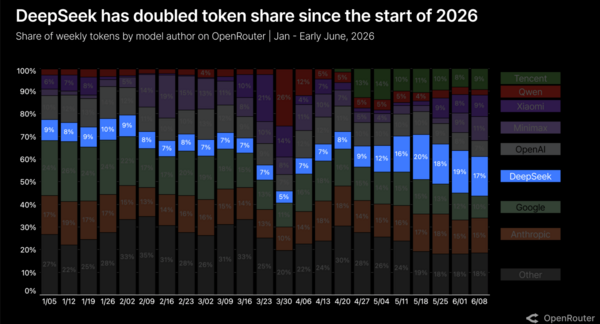
Add it up and DeepSeek is good enough for agentic AI workloads and now enterprises are starting to watch budgets it will only get more play. OpenRouter writes:
"DeepSeek V4 Flash, on the cheapest endpoint, costs $0.09 input / $0.18 output per million tokens. For comparison, GPT-5.5 is currently priced at $5 input / $30 output per million tokens.
So, it’s not a shock to see this sudden upsurge in token volume for V4 has not resulted in an identical spike in share of spend. The cost effectiveness to output quality ratio for V4 is best in class - it is good enough, in fact, that organizations of all sizes have begun trusting DeepSeek with real agentic work."
Simply put, this open model race is just getting interesting. Like all technology shifts, the hype gets the attention and then fades. In open source, the real impact happens well after the initial shock and awe. For those with a few gray hairs, recall how Linux was a Wall Street phenomenon and then was forgotten. No one can argue that the open source impact surpassed the initial hype while no one was looking. The same thing is playing out with open LLMs.
A few thoughts:
There's an urgency in the US for open LLMs. Nvidia's Nemotron's efforts highlight the urgency. Palantir CEO Alex Karp also sees the urgency.
- Why enterprise AI leaders need to bank on open-source LLMs
- Nvidia launches Nemotron 3 open models to enable multi-agent systems
- Nvidia's model parade: Llama Nemotron, Cosmos additions, Isaac GROOT N1
- Nvidia Nemotron: Much needed open-source model champion in US
US foundational model leaders are locked into the proprietary model race, raising funds and building massive data centers. The idea that Anthropic, OpenAI and Google are going to commoditize LLMs is laughable. Note that Google's Gemma models do well on OpenRouter.
Enterprises are managing costs and that means model routing. The rise of good enough models has started to commoditize LLMs.
The economics of LLMs aren't going to hold up just as Anthropic and OpenAI chase IPOs and valuations topping $1 trillion. Something will give, but it's a question of when.
Larry Dignan is Editor in Chief of Constellation Insights at Constellation Research, where he leads editorial coverage focused on enterprise technology, digital transformation, and emerging trends shaping the future of business. He oversees research-driven news, analysis, interviews, and event coverage designed to help technology buyers and vendors navigate complex markets with clarity and context. ...
Read morePublished
Author
