


Hitachi Digital launches HARC Compose
Hitachi Digital launched HARC Compose, an AI orchestration system designed to continuously improve AI execution in operations. Hitachi Digital was recently launched by Hitachi.
For Hitachi Digital, formed via the combination of GlobalLogic and Hitachi Digital Services, HARC Compose is the first product launch of the unified services unit of Hitachi.
According to Hitachi Digital, HARC Compose is a platform that brings together enterprise context, guardrails and intent and can be combined with Hitachi Digital forward deployed engineers (FDE) to deploy AI-native applications faster and leverage accurate AI agents. For Hitachi Digital, HARC Compose can add recurring revenue.
Anand Birje, CEO and Chairman, Hitachi Digital, said HARC Compose brings the company's engineering and operational expertise together and "allows clients to innovate at AI speed while running what they build with proven reliability."
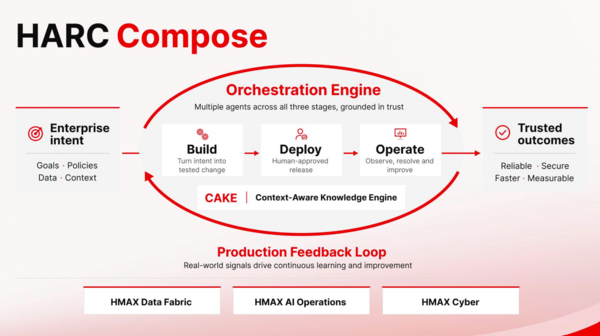
Key points about HARC Compose include:
- HARC Compose strengthens HMAX by Hitachi, which is a suite of applications designed to bring AI to infrastructure, and is coupled with HMAX Foundry and its data fabric, AI operations and cybersecurity offerings.
- HARC Compose is focused on the AI agent engineering process across the lifecycle of building, deploying and operating.
- HARC Compose includes Context-Aware Knowledge Engine, an orchestration engine and failure-conscious engineering to identify how a proposed chance could fail and test before releasing.
- Hitachi said HARC Compose is built on Hitachi Digital's outcome-forward engineering methodology which sees processes as one continuous system.
- Deployments so far cover finance, healthcare and technology with more on deck. The platform will add capabilities over time.
Hitachi Digital's strategy
Speaking on Hitachi's second quarter earnings call Oct. 28, Birje laid out Hitachi Digital's strategy and global plans.
"Everyone has been talking about the convergence of AI and the amount of opportunity and risks AI has created over the last 3 years. As we look forward to the market, we really believe that there's a convergence of three big factors that is driving change across the market," he said. "Cloud as a foundational transformation element to enable data and data foundations that are critical for enterprises to leverage the full value of AI. And then, of course, rethinking every business value chain across industry verticals that AI is making possible."

Birje acknowledged that each industry and enterprise will move at a different pace toward AI, but Hitachi Digital and its parent company see opportunities in enabling AI transformation. GlobalLogic focused on digital and product engineering services and complemented Hitachi Digital Services, which has strong cloud operations and IoT platforms.
Hitachi's core markets also are critical to the AI economy. "We are uniquely positioned in our domain expertise in the industries we currently operate in, which is energy, mobility and connected industries, but also industries we serve across the world in the mission-critical areas of telecom, automotive, banking, financial services and healthcare, life sciences," said Birje.
Birje said Hitachi Digital will be able to address a wide range of AI use cases in industries for everything from cloud operations to data and insights to agentic platforms and IoT and physical AI.
Indeed, Hitachi Digital has already been serving Hitachi business units focused on energy, rail and technology.
"We've been investing steadily over the years in our IP, which are both domain focused in the 7 industries that we focus on and also enabling ontologies for these industries to really enable and leverage AI for their business process transformation," said Birje. "We've been delivering both the physical layer and digital layer transformations in these industries, and we'll continue to do that, enabling these industries to take full value and full potential of AI in the coming years."
Birje added:
"In the last three years, there have been a lot of POCs created and a lot of interesting opportunities explored. As we look at the next 5 years, enterprises are looking for more realistic adoption."
Larry Dignan is Editor in Chief of Constellation Insights at Constellation Research, where he leads editorial coverage focused on enterprise technology, digital transformation, and emerging trends shaping the future of business. He oversees research-driven news, analysis, interviews, and event coverage designed to help technology buyers and vendors navigate complex markets with clarity and context. ...
Read morePublished
Author
