


Forward deployed engineers: The promise, peril in AI deployments
Enterprise software vendors and AI players are talking up forward deployed engineers as a turbo charger that gets companies to value faster in agentic AI deployments.
The appeal of the forward deployed engineer is obvious. Who doesn't want returns faster? The alarm is that FDEs are often used as a crutch to smooth over product immaturity. Nevertheless, FDEs are here to stay in AI implementations for now and likely a big 2026 theme.
FDEs sit at the intersection of process, model behavior, customer data and systems and business outcomes. Without FDEs, AI projects never leave the pilot stage. The real work is in the workflows and new architecture not APIs.
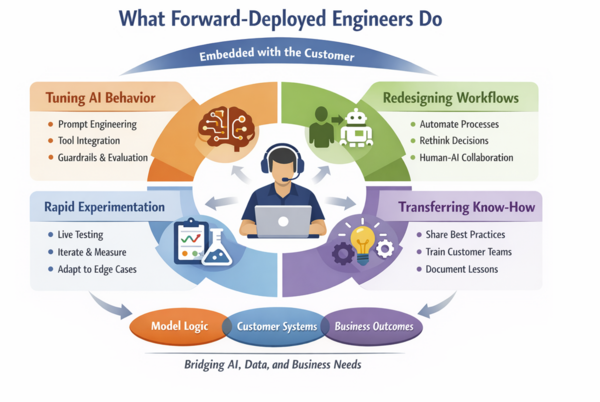
In recent weeks the chatter about forward deployed engineers (FDEs) has been deafening. FDEs created by Palantir and used in projects in the early 2010s to get customers to value quickly. The initial knock on Palantir's FDE model was that the company was more about consulting than software. Today, Palantir's FDE-fueled growth has minimized those concerns. FDEs are mainstream now as everyone cribs Palantir’s initial model.
A sampling of FDE announcements:
ServiceNow executives have noted FDEs of late. On ServiceNow's fourth quarter earnings call, President and CFO Gina Mastantuono noted that the company's FDEs "engaged with the leading American fast food chain to enable a path to scaling a agentic AI across their customer service operations. As a result, they expanded their Now Assist entitlement by 13x upon contract renewal in Q4 based upon anticipated value and usage."
CEO Bill McDermott said FDEs are a key because enterprises are reinventing processes across multiple functions.
Amit Zavery, President, Chief Product Officer & COO, ServiceNow, said at a recent investment conference that ServiceNow is investing in the FDE model for co-innovation with customers. An FDE is "really a AI black belt who can work very closely with customers on the AI expertise required for some of those use cases."
Manhattan Associates is using FDEs to customize use cases for customers. "Our approach is we're starting with proof of concepts or pilots with our customers. It's a 90-day proof of concept, and it will come with forward-deployed engineers that will make sure that they learn how to use all of the standard agents that they can turn on day one. And those forward deployed engineers will also help them build at least 1 or 2 custom agents using our Agent Foundry and train them how to build their own custom agents," said Manhattan Associates CEO Eric Clark on the company's fourth quarter earnings call. "When we get to the end of that 90-day proof of concept, we've got customers that say there's no way we can turn this off."
Accenture announced a partnership with Anthropic to create 30,000 consultants with Claude training. This small army includes FDEs to "help embed Claude within client environments to scale enterprise AI adoption." For what it's worth Accenture prefers to call FDEs "reinvention deployed engineers." Accenture is partnered with Anthropic and OpenAI.
Infosys said on its third quarter earnings call that it is ramping its FDE team to reinvent processes with AI. Salil Parekh, CEO of Infosys, said: "We are currently working on 4,600 AI projects. Our teams have generated over 28 million lines of code using AI. We've built over 500 agents. We're scaling our forward deployed engineer team.
Salesforce has also adopted the FDE model to speed up Agentforce deployments. Srinivas Tallapragada, President, Chief Engineering & Customer Success Officer at Salesforce, said FDEs get customers to value faster and create a feedback loop to help the product mature. Ultimately, Salesforce is working on agentic AI playbooks that can be used across industries. Tallapragada said Salesforce's FDEs train with system integration partners.
FDEs highlight how software companies are morphing into services firms to some degree. Meanwhile, services firms are producing their own applications.
- Decision Velocity in the Agentic Era: Architecting for Decision Automation
- Constellation Research's AI-First Service Firms
- How Should Executives Think of AI in 2026?
- AI agents, automation, process mining starting to converge
- Pondering the future of enterprise software
The big thing to remember about FDEs is that the trend is transitory. Ideally, agentic AI matures to the point where it becomes more like enterprise software that doesn't take a go-between to make everything work. The enterprise vendors that win will take what FDEs learn to embed them in products so you won't need FDEs anymore.
Here's a look at the state of play with FDEs.
- Agentic AI projects across processes and workflows will likely need an FDE. These projects don't have playbooks sketched out and feature lots of nuance.
- Vendors see FDEs as a strategic advantage and can deploy them for lighthouse customers that turn up at CEO keynotes. Vendors love FDEs because they can deliver value and allow them to help control the AI success narrative.
- Enterprise buyers will take the help from FDEs for now, but they aren't cheap. Look for the pricing of FDEs and remember that they may be part of a broader vendor dependency play.
- FDEs are there because the offerings are immature. FDEs can hide incomplete tooling, unstable APIs and so-so platforms. You could think of FDEs as human middleware. FDEs may be the new middle manager in an AI-driven world.
- CFOs may go along with the FDE model, but will ultimately ask for accounting transparency and demand you manage them along with your integrator resources. And FDE shouldn't be viewed as permanent staff, but a ninja to deliver outcomes.
- Co-creation of use cases will tell you whether FDEs are delivering. They should be redesigning workflows and teaching the customer. Otherwise, FDEs are glorified integrators.
- FDEs are throwbacks to the embedded engineer days where product, services and consulting went together. This model will work for a bit because value isn't delivered via models, platforms and integration by themselves.
- In the end, FDEs and their popularity means we're in a product transition from enterprise software to AI agents. FDEs are a means not the end state. The likely outcome is that FDEs won't be needed in a few years. Enterprise software and agentic AI will ultimately blend together too.
- One core theme to ponder is whether you can use FDEs without the vendor conflicts. Constellation Research analyst Esteban Kolsky highlighted in a recent newsletter riff about agentic commerce that there are emerging firms such as Quid offering FDE customization in a vendor neutral way.
This first appeared in Constellation Insights newsletter. You can get it here.
Larry Dignan is Editor in Chief of Constellation Insights at Constellation Research, where he leads editorial coverage focused on enterprise technology, digital transformation, and emerging trends shaping the future of business. He oversees research-driven news, analysis, interviews, and event coverage designed to help technology buyers and vendors navigate complex markets with clarity and context. ...
Read morePublished
Author
