How Should Executives Think of AI in 2026?
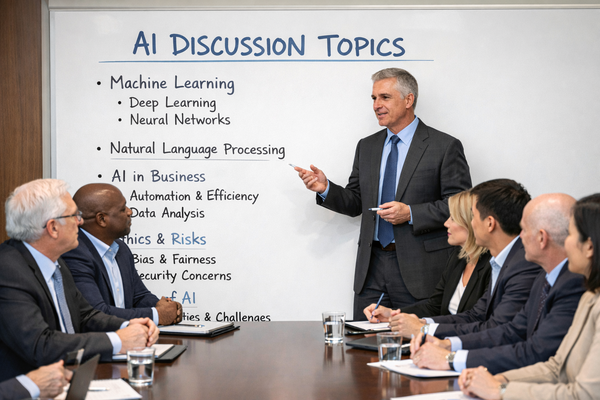
This post is a very short summary of the last three “Enterprise Technology Intelligence Briefing” books. In that monthly report, we track the enterprise technology topics that matter to executives and boards, and lately, it has been AI. Of course.
Much has been discussed, but succinctly, today's situation can be summarized in four points:
- Generative AI is reaching (has reached, could be argued) its natural limitations. Both on economic viability and on the potential to address an ever-smaller number of use cases.
- Agentic AI has promise, if only core governance issues can be resolved. The most critical ones are cybersecurity, privacy, autonomy, and availability.
- The enterprise infrastructure in place today is not ideal. After decades of technical debt sprawl and patch-up jobs, digital integration is the most critical problem.
- There is a bright future for AI in the enterprise, if only the multiple proper data models + technology infrastructure combinations can be quickly scaled and adapted to diverse use cases.
While the answer to this quandary will take far longer than 12 months to reach a conclusion -- this is after all a transformative event similar to the internet, cloud infrastructures, and digital transformation -- there are some things enterprises can do today to be prepared for the AI Transformation to come:
- Digital readiness
- Technology executives must understand and ensure that proper data flows across all stored data are available.
- Determine which tools have the necessary permissions and access to the required resources, and how the enterprise can retain control, not the host vendors.
- None of these matters if the outcomes are unsustainable. Monitor and enforce the economics of accessing, using, updating, and storing the data and processes.
- AI optimization
- There is not a single AI model or tool that can do it all. Explore Generative and Agentic AI as well as alternative models and solutions for redesigned use cases and processes.
- Explore frontier technologies like edge computing to evaluate the likelihood of sustainable AI operations and reduce operational costs.
- For cases where Agentic and Generative AI are the right solutions, optimize economics and outcomes by automating while ensuring proper human supervision.
- Infrastructure maturation
- Audit the technology stack. Update the documentation to focus on how to create a private platform; determine what else is necessary.
- Understand current contracts and economics of all cloud providers: vendors, providers, and hyper-scalers. Create a master strategy for private and public clouds.
- Document all places where privacy, access, rights, roles, and compliance are necessary, and centralize it into one common policy place. This is the base for the private platform.
- Strategic thinking
- As with all transformations, the technology is secondary to the strategy. Create one-year, three-year, five-year, and long-term plans for AI and digital needs.
- Determine the available and necessary talent to deliver on those strategies. This is the most common overlooked aspect of strategy creation: how to deliver them.
- In a recent study, actually, a few of them, the most striking finding was that executives don’t believe their fellow executives and their boards are sufficiently tech- and AI-savvy. Understand your enterprise situation.
If you are wondering how my organization can do all this over the next 12 months, the good news is that the next 12 months (2026, basically at the time of this writing) is about preparing for the long haul, not achieving all these outcomes. Audits, documentation, strategy alignment, and long-term planning are to be built on top of these blocks, and the enterprise will begin to lay out in the coming year. And maybe by then, geopolitical and economic uncertainties holding back the enterprise from investing heavily will become clearer, revealing their direction and outcome.
The north star for the enterprise's focus on AI in 2026 is adopting a private platform approach to the cloud, the internet, data, AI, and all things technology and processes. A combination of private- and public-cloud components that will enable the enterprise to leverage cloud providers and hyperscalers while retaining control and governance, the private platform is the core model on which AI (and Quantum, Robotics, and other technological evolutions in the next few decades) will be based.
The biggest concern? Creating the right strategy and ensuring Executive Tech Know-how is up to date. Secondary? Resources and talent.
Want to go deeper into these topics? Will continue doing so in this blog and in the ETIB reports throughout the year. Talk to us, we can help you.
To a great 2026! May your strategies align.
Esteban Kolsky spent the first part of his professional career working on the customer service front line and in management roles, culminating in early implementations of first-generation CRM tools. In 2000, he became a research analyst at Gartner, focused on CRM, customer service, customer experience management, enterprise feedback management, and voice of the customer, among topics that later became the basis for the current field of CX. During his tenure at Gartner, Kolsky assisted vendors and Global 2000 organizations with their customer strategies. He left Gartner to focus his career on strategic advisory services and influenced all the major software vendors, as well as many smaller vendors, in the CX industry and advised executive leadership teams across industries and countries…...
Read morePublished
Author