


Uber controls token spend, outlines AI use cases
Uber’s second quarter results and outlook were mixed, but the company did flesh out its AI use cases.
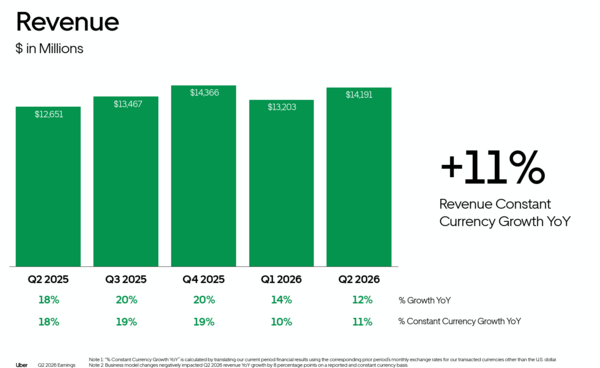
The company reported second quarter net income of $2.4 billion, or $1.17 a share, on revenue of $14. Billion, up 12% from a year ago. The results include a gain of $1.6 billion due to investments. Non-GAAP earnings were 81 cents a share. Uber missed Wall Street’s second quarter revenue target and was in line for earnings.
Uber said in the third quarter non-GAAP earnings will be 84 cents a share to 88 cents a share. Wall Street was looking for third quarter non-GAAP earnings of 91 cents a share. The outlook doesn’t include the $13.7 billion acquisition of Delivery Hero.
Here’s a look at the AI use cases highlighted by Uber CEO Dara Khosrowshahi and CFO Balaji Krishnamurthy.
Wrangling the AI budget: "On AI, we are optimizing token spend by setting better defaults for different use cases, moving certain tasks to lower-cost or open-weight models, and letting employees more clearly understand and manage their spend. As a result, cost per token has declined over the past several months, even as adoption has continued to increase, allowing us to keep overall AI spend broadly stable,” said Krishnamurthy.
Uber made news for blowing through its 2026 AI budget in four months and quickly backtracked on its token spending plans.
- Enterprise AI grows up, vendors are noticing
- Get ready for US open LLMs and just in time
- Rightsizing open models may cut your AI inference spend
- Here’s what we learned about AI projects from enterprise buyers so far
Freight Optimization: "We're investing in AI capabilities that help optimize transportation decisions on behalf of our customers. AI is increasingly helping identify shipment risks earlier and automate routine operational workflows, from responding to shipment inquiries to validating documents and correcting shipment data. Over time, we expect these capabilities to improve reliability and lower costs for our customers,” said Khosrowshahi.
- Uber launches Uber Autonomous Solutions, makes pitch to be AV commercialization, data layer
- Uber AI Solutions expands, targets enterprises
Grocery & Retail Experience: "Product innovations such as live shelf verification, smarter substitutions, and AI-powered shopping experiences are making Grocery & Retail even more intuitive and reliable, further strengthening engagement,” said Khosrowshahi.
Consumer Platform Efficiency: “AI is making Uber more intuitive for consumers while making our platform more efficient. Consumers are increasingly telling us what they need rather than searching by item, giving us a much deeper understanding of intent. We’re finding that Cart Assistant resonates most when consumers are planning larger Grocery & Retail purchases, where a conversational experience makes it easier to build a complete basket.," said Khosrowshahi.
Customer Support Automation: "We’re also beginning to see how AI transforms how we operate the platform. Rather than relying on predefined workflows, we’re deploying AI agents that can reason through increasingly complex problems. In English-speaking markets, for example, an AI agent can now call our mapping and GPS tools directly to reconstruct a trip, investigate the route, and resolve eligible fare disputes end-to-end, reducing friction for consumers while improving the speed and quality of customer support."
Autonomous Vehicles and Commercialization: "The evolution of the AI industry serves as a useful analogy. Increasingly, applications use the right model for the right task, and model providers distribute both directly and through third-party platforms. We believe autonomous mobility is likely to evolve in a similar way,” said Khosrowshahi."Earlier this year, we added another important capability with our AV Labs team, which is deploying hundreds of sensor-equipped vehicles capable of collecting millions of miles of high-fidelity driving data each month for our AV partners. The value is not simply the number of miles. It is the diversity of environments and the ability to identify, label, and retrieve the scenarios that matter most for rideshare specific scenarios."
Larry Dignan is Editor in Chief of Constellation Insights at Constellation Research, where he leads editorial coverage focused on enterprise technology, digital transformation, and emerging trends shaping the future of business. He oversees research-driven news, analysis, interviews, and event coverage designed to help technology buyers and vendors navigate complex markets with clarity and context. ...
Read morePublished
Author
