


A look at retailers’ tech, AI strategies ahead of 2026 holiday shopping
The code is frozen, the busiest shopping season of the year is here and retailers are pondering whether agentic commerce is a friend or foe. Here’s a look at what retailers are saying about their tech and AI stacks ahead of Black Friday and the holiday shopping race.
Walmart
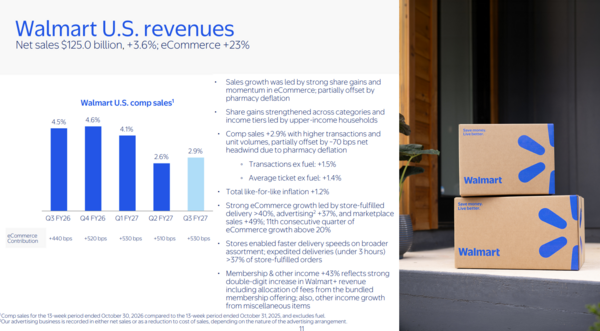
John Furner, President and CEO of Walmart, spent the company's third quarter earnings call talking about making shopping convenient through multiple channels. Simply put, Walmart is an e-commerce play now with a marketplace and high-margin advertising.
"We've spent years investing in our people-led, tech-powered omnichannel approach so we can better serve customers and members. That starts with our everyday low price philosophy and our commitment to invest in price. This, combined with the strengths of our stores, clubs, e-commerce and agentic experiences shows our value proposition transcends technological change by giving customers more of what they want, great value, a broad assortment and experiences that make their lives easier. We're seeing the benefits of this across the company," said Furner.
- Walmart, retailers tout AI, digital transformation efforts to argue they’re more than their stores
- Walmart's Sparky AI agent increases order value
He added:
"As shopping with us becomes more convenient, customers are turning to us more often. That grows our retail business and creates more opportunity for membership, marketplace and advertising. As those businesses grow, they improve our economics and strengthen our ability to invest in the customer experience."
The next step for Walmart is setting up for AI agents to complete shopping transactions. Furner said the plan went like this:
- Create an environment where agents can help a customer discover new items and decide what to buy.
- Connect that digital experience to a locations and inventory so orders can be fulfilled at the prices they expect.
- Walmart also plans to add new capabilities to its own shopping agent Sparky. The company has added the ability to use voice and images to shop with Sparky as well as new languages including Spanish and French. "In the U.S., usage grew 129% over last year, and we're seeing these baskets expand 40% as customers are able to find more of the items they want and need. We also recently launched Sparky in Mexico, Canada and at Sam's Club in the U.S. We also announced new ways for customers to shop and stay in control when they choose to shop with their own agent. By assigning profiles to agents, customers will be able to set permissions and spending limits, see agent purchases separately and turn access off at any time," said Furner.
- Walmart has also launched the Walmart Agent Gateway, which gives approved agents a way to interact while protecting customer information. The terms outline how an agent should operate and what it can and cannot do. "Whether customers shop directly with us or through an agent, they should be able to count on accurate pricing, reliable availability and clear delivery options," said Furner.
- The shopping experience for Walmart is a continuum between digital and physical. The company said 80% of its e-commerce orders in the US are fulfilled from stores including marketplace orders.
"We're looking across the company with that same omnichannel mindset, asking what else our assets can do for our customers, members and shareholders. As I look ahead, I see a strong business with more opportunities to grow and a team that's excited to pursue that growth. We're earning more of our customers' business, expanding what our assets can do and building capabilities we can take across markets. The opportunity is to keep bringing our advantages together in ways that improve both the customer experience and our economics," said Furner.
Twenty-five percent of Walmart's business is digital and is likely to expand to a bigger percentage in the years ahead.
Target
Michael Fiddelke, CEO of Target, spent much of 2026 getting its merchandising, design and value down after a rough 2025. Target is doing much better with same store sales growth in the third quarter of 5.6%.
- Target cuts deal with OpenAI as it plans customer experience overhaul
- Target gets new CEO, continuity in tech, AI strategy
Digital is playing a big role. Fiddelke laid out the following:
- "This momentum isn't coming from any one category or initiative. It's the cumulative impact of changes across our business as evidenced by our traffic growth across stores, digital and multiple categories. Simply put, we're giving our guests more reasons to shop us more often."
- "We're investing more than $1 billion incremental to last year in areas like store hours, training and technology to help our teams deliver a better guest experience. We also outlined our plans to invest around $5 billion in CapEx, which has supported the opening of 32 new stores and the complete remodel of more than 130 existing stores as well as investments in our supply chain and tech capabilities."
- "Technology underpins our entire strategy. For us, investments in tech will always be in service of our unique role in retail. It's about helping our teams do their best work and making shopping easier and more inspiring for our guests. We're modernizing the systems that support the foundation of our business while accelerating innovation too, from tools that improve product availability and team efficiency to guest-facing tools like Ask Target, our AI-driven shopping assistant. Ask Target is still in beta, but we're encouraged by early results and excited about the new capabilities we'll introduce in the months ahead."
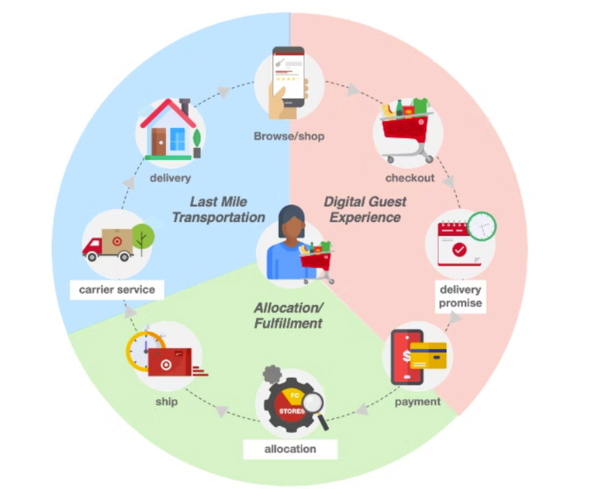
Lisa Roach, chief operating officer, said the technology investments have been about inventory and in-store availability. Roach said:
- "There's a lot that goes into improving on-shelf availability, from upstream technologies to processes in the backrooms of our stores. And there's still a lot of opportunity ahead of us, which is why we're taking a comprehensive look at how inventory moves through our entire system from purchasing and allocation to replenishment and execution on the sales floor. And increasingly, we're using AI and advanced data science to make those decisions smarter and faster."
- "We've expanded our modern science-led purchasing and replenishment capabilities from approximately 40% of our assortment last year to more than 90% today. We're also using more sophisticated allocation technology to better position inventory to meet demand, reducing manual work while improving our ability to capture sales."
- "We've invested behind our staffing, training and technology, and our supply chain is ready for peak demand. We've made fulfillment even faster and easier with 2/3 of our digital volume fulfilled through our same-day services. And with same-day delivery continuing to grow at double-digit rates."
Lowe's
Lowe's has been leveraging AI in earnest for the last 18- to 24-months and the returns are there.
In a better-than-expected third quarter, Lowe's CEO Marvin Ellison said online sales were up 17.4% for the home improvement retailer as both do-it-yourself consumers and pro customers are using digital channels.
Ellison and team were reserved about technology updates given the company is holding an analyst day Dec. 9. In the meantime, here are some of the takeaways on the technology strategy and returns.
Lowe's Marketplace. Ellison said Lowe's has added a Marketplace as part of its digital strategy. "It gives us an opportunity to offer customers value and luxury without adding inventory," said Ellison.
Pricing. Ellison said before Lowe's updated its systems starting in 2018 it didn't have visibility into pricing by region. "We've built a best-in-class pricing system that we think allows us to be really fair and price right for the consumer, but it also to ensure that we're understanding the competitive dynamics," said Ellison.
Mylow. Mylow, Lowe's shopping agent built on OpenAI models, is now seeing triple the conversion rate when comparing customers that use it and ones that don't.
See: Lowe's eyes AI agents as home improvement companion for customers | Lowe’s Is Betting on AI To Drive Customer Experience, Optimize Multiple Processes
Home Depot
Ann-Marie Campbell, Home Depot's president and chief operating officer, outlined a series of technology initiatives on a third quarter earnings call.
Home Depot delivered its sixth consecutive quarter of double-digit online same store growth. "These results are a direct reflection of the enhancements we have made on our site, including AI-enabled search, targeted marketing, expanded assortment and a faster experience from checkout to delivery," said Campbell. "Our stores serve as a critical hub for interconnected fulfillment with over half of our online orders fulfilled through our stores. Today, we offer customers a multitude of fulfillment options from buy online, pick up in store to scheduled job site deliveries to fast home delivery. But when projects are underway, we know that speed is paramount."
Enter express delivery. The company launched express delivery three months ago and has seen higher engagement with customers as well as customer satisfaction stores.
- How Home Depot blends art and science of customer experience
- Retailers double down on AI, see productivity and growth ahead
- The Big Picture Behind Ask Macy’s, a Google Cloud–Powered AI Agent
Home Depot is also investing in technology to support its professional customers. Campbell said:
"In terms of the Pro team, which is led by our Pro customer experience managers in our stores, we are building seamless connectivity between our dedicated in-store Pro desk teams and our outside sales organization. And we are supporting these teams with expanded insights and Pro CRM tools, giving our associates more robust project visibility and actionable insights into Pros' ongoing jobs.
By combining these enhancements with capabilities like our AI material list builder, project tools, complex delivery scheduling, trade credit and our Pro Xtra loyalty program, we are removing friction from every buying occasion. This integrated approach is creating a truly sticky relationship with our Pros and enabling us to grow wallet share."
Wayfair
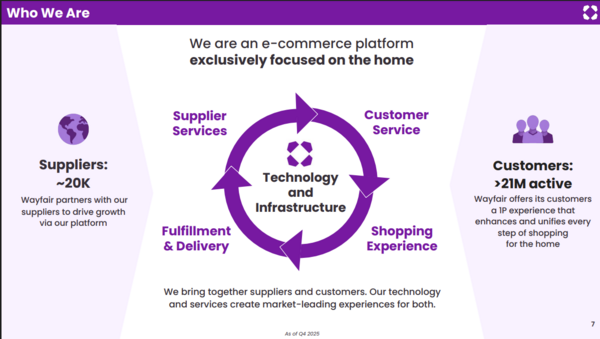
Wayfair's earnings reports run well ahead of the rest of the retailers so are often overlooked when the giants report. However, Wayfair is arguably the most tech savvy retailer outside of Amazon.
The company's third quarter highlighted how its investments in technology have paid off in what has been a slog of a home furnishings market. During Covid, the home furnishing market boomed and now it's bouncing along a bottom.
Wayfair's mission was to take share and extend its lead in technology.
CEO Niraj Shah said:
"At the start of this year, we told you we expected to take share in the U.S. at a pace we had not seen in several years. We entered 2025 with a U.S. share spread in the mid-single digits, widened it to high single digits by year-end and promised to push it into the double digits in 2026. With U.S. revenue growing double digits against a roughly flat category here in Q3, we've done exactly that. That growth was driven by orders, which were up 12% year-over-year."
The company has invested in its Wayfair Rewards loyalty program and before that Wayfair revamped its technology stack so it had the data foundation for AI.
- How Wayfair's replatforming sets it up for agentic AI commerce
- Wayfair starts to reap rewards from optimization, tech replatforming efforts
- BT150 interview: Wayfair CTO Fiona Tan on transformation, business alignment and paying down tech debt
Shah said the company is working to take advantage of agentic commerce:
- "In terms of AI applications and agents, our goal is simple, and the same is how we think of other surfaces. Wayfair's catalog should be available wherever shoppers are and optimized for the channel. To that end, we're working across the major AI platforms and agent applications rather than betting on any single one. We're confident that Wayfair is well positioned to compete here because we bring strengths we've spent two decades building. The broadest selection in the category, rich and accurate product information customer reviews, competitive pricing and fast reliable delivery."
- "We share tens of millions of products with these platforms, and we're using AI of our own to enrich that catalog data at scale. While AI assistance are a new place for customers to start, we're seeing that the destination is usually the same. Most shoppers who discover us through these tools continue their journey on Wayfair's own site and app. And even when a customer does buy inside an AI assistant, Wayfair remains the retailer. The order lives in our Wayfair account, and we own the delivery and service promise. Either way, the relationship is with us. It's still early, but this traffic is growing quickly."
- "Much of our progress here comes from working hand-in-hand with the platforms themselves. And from partnerships, with Google, OpenAI and Meta, and these show what this looks like. Google has been an important partner for nearly our entire history. Wayfair was a foundational partner in co-developing the Universal Commerce Protocol. With OpenAI, we're one of the first advertisers on ChatGPT and one of the first to launch a Wayfair branded shopping agent that customers can chat with directly inside the platform. We're also one of the first partners announced for Meta's Muse. Our full AI optimized catalog is now live in Muse, and we're partnering with Meta to explore richer agent-led experiences."
The Gap
The Gap's third quarter earnings call was focused on an unseasonably warm October and a mixed set of results from its brands (Gap, Old Navy, Banana Republic and Athleta).
Richard Dickson, CEO of The Gap, said:
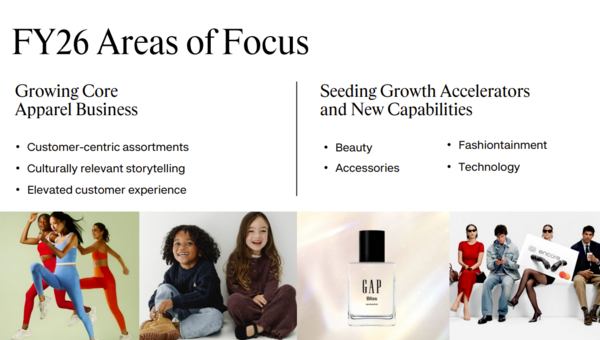
"We continue to seed our long-term growth accelerators, beauty and accessories, while advancing our fashiontainment and technology platforms to deepen customer engagement, strengthen our brands and enhance our operations."
Katrina O'Connell, CFO, said the technology details are coming. "Technology, in particular, is creating exciting possibilities to fundamentally reimagine how we operate, providing a runway to drive greater productivity through smarter, more effective ways of working. We look forward to sharing more next quarter on how these capabilities begin to shape our business in 2027 and beyond," she said.
When Dickson was asked about agentic commerce, he said:
"Digital plays a very important role in the portfolio as well as obviously in engaging with consumers, driving inspiration, discovery, personalization, convenience. We do have a scaled digital platform as the largest specialty apparel e-commerce business in the U.S.
We have approximately 1.6 billion visits over the last 12 months. Online represents nearly 40% of Gap Inc. sales. We continue to advance our digital and app capabilities, including agentic commerce and, of course, always exploring emerging platforms like TikTok. So look, our strategy is to meet customers wherever they choose to engage in stores or online, and we continue to focus both in parallel."
Williams-Sonoma
The company's third quarter noted multiple supply chain issues and how the company was leveraging technology to navigate them while providing a strong customer experience.
Laura Alber, CEO of Williams-Sonoma, has 10 strong brands and an integrated operating platform, but costs increased due to higher oil, gas, diesel and inflation for raw materials and transportation. Williams-Sonoma is looking to offset higher costs with efficiencies.
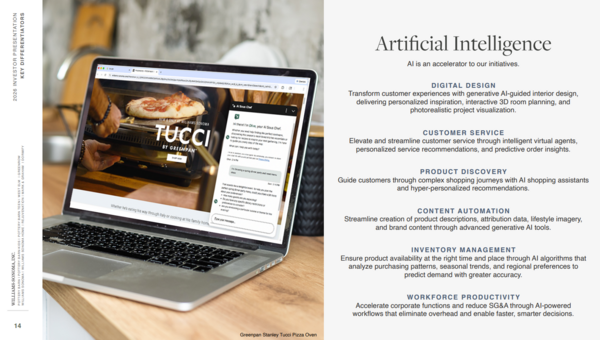
Alber said:
- "AI is also driving operational improvements, with broader adoption translating into measurable business results. Our AI assistants are now available across our brands, bringing our product knowledge and service expertise to customers when they need it. These experiences have supported more than 1 million customer chat visits since launch, helping customers discover products, evaluate their choices and shop with greater confidence."
- "Digital experience personalization is also driving stronger results. Through Q3, revenue per visit for customers engaging with personalized experiences was up substantially versus the site average and versus last year. We are expanding these personalized experiences across our websites and e-mails, making recommendations more relevant to each customer's shopping journey."
- "Our digital design platform now uses proprietary AI tools to turn a 3D plan of a customer's own room into a photorealistic image in seconds. Customers and designers can see their selected furniture and décor from our brands together in their actual space with its accurate layout and dimensions before making a purchase. Unlike generic AI design tools that may place furniture without exact product specifications, our platform uses the actual products a customer selects with their real dimensions so they can see precisely how those pieces fit and work together in their own room."
- "Across our corporate teams, AI is helping associates work more efficiently and amplify the impact of their expertise. Our in-house AI tools enable creative teams to showcase our products in a wider range of inspiring settings, scaling our brands' distinctive design perspective. AI is also giving business teams faster access to insights and automating repetitive analysis and reporting, freeing associates to focus on decisions and work that moves the business forward."
Larry Dignan is Editor in Chief of Constellation Insights at Constellation Research, where he leads editorial coverage focused on enterprise technology, digital transformation, and emerging trends shaping the future of business. He oversees research-driven news, analysis, interviews, and event coverage designed to help technology buyers and vendors navigate complex markets with clarity and context. ...
Read morePublished
Author
