


The great enterprise AI rewrite is starting
Enterprises are starting to rewrite themselves to become AI native. The efforts are just starting, but you can see the signs as a wide range of industries and companies start to rethink their technology stack as well as organization.
It’s unclear how these efforts will turn out, but few common threads have emerged:
- Those never-ending digital transformation chores of consolidating systems and creating data lakes are starting to pay off.
- Enterprises are moving AI from prototype to production and becoming a lot more savvy about returns.
- AI was seen as a big productivity play, but implementations are beginning to bet on growth.
The examples of enterprises starting the rewrite abound.
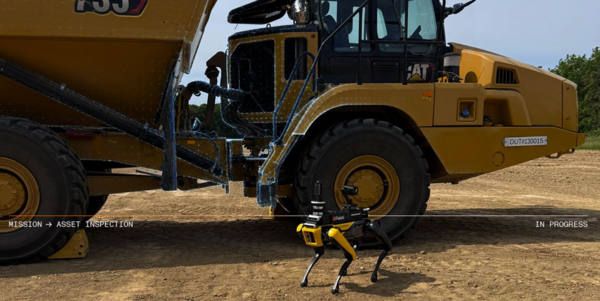
Caterpillar at the CoreWeave Fully Connected 2026 conference this week in San Francisco took center stage to talk about how it is working with the neocloud and Nvidia to make its equipment autonomous. If successful, Caterpillar’s model will be revamped. Also see: Caterpillar is going to enabled and revamped via physical AI.
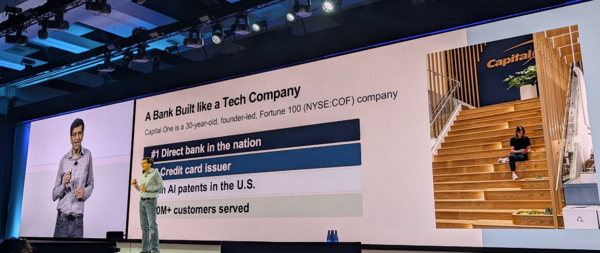
Capital One, a bank known for its tech savvy, is using CoreWeave to infuse AI throughout its organization and evaluate AI agents at scale. Capital One is a bank that sees itself as a technology company.
Maulin Patel, Managing VP of Product, AI and ML platforms at Capital One, walked through the company's agent evaluation processes in a regulated environment. "We serve more than 100 million customers. At that scale we cannot govern autonomous AI agents just by raising chats," said Patel. "We built an evaluation first architecture designed to deliver trust-moving outputs."
See: How Capital One evaluates, governs its AI agents
Eli Lilly's AI factory is seeing strong usage running experiments at scale and the company has been able to save on token expenditures with control over its models and data. See: Eli Lilly: Lessons from running an AI factory
And even McDonald's, which isn't known for its IT advances, said AI will be the accelerator for plans that span everything from restaurant operating systems to customer experience to marketing. See: McDonald’s strategy bets on AI, digital capabilities
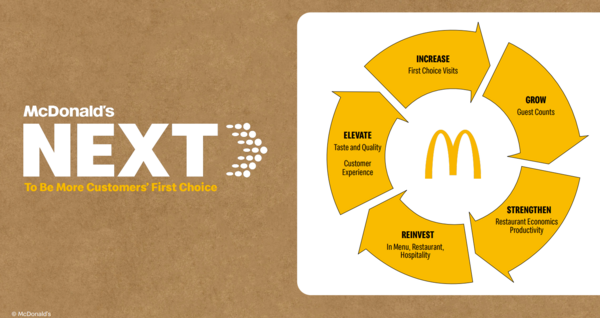
"AI serves as an accelerator, helps us understand customer behavior, innovate faster, simplify operations and make better decisions at scale," McDonald's CEO Christopher Kempczinski said.
Much of the focus today has been on startups and emerging companies that do more with AI and punch above their weight. The bigger impact is likely to come from those massive enterprises that can rewrite themselves with AI, restructure and drive business outcomes. The scale is already there and there are a lot of returns to mine with AI.
The challenge with the upcoming enterprise rewrite phase is going to be the same issues that always have plagued big transformation efforts: Culture and change management.
At Constellation Research's AI Forum in New York, multiple sessions touched on the next-gen enterprise. Sunil Karkera, Founder of Soul of the Machine, put it this way: "It's the third inning of AI inn capability and first inning in org design."
That take was prevalent at AI Forum. Panelists agreed that AI in terms of technology is well ahead of the organization.
Vijay Vijayasankar, Global Agentic AI Officer at Genpact, called this gap "a rewiring latency," where the time between leaders seeing the future and operations working that way isn't synched.
- Enterprise AI projects mature: What you need to know now
- Agentic AI deployments: What you should, and shouldn't do
There’s a lot we don’t know about this great rewiring and the biggest question is this: Can a large enterprise become AI native or is this just another decade long conversation about transformation? What follows is a synopsis of rewiring efforts and how to think about AI's impact on your org.
Organize around work instead of functions
Amit Bajaj, President North Americas at Tata Consulting Services, said AI is "a great management innovation."
Bajaj said the hierarchy of today's organizations were designed for specialization for the industrial revolution. "Today the work is organized around us, but tomorrow we will be organized around work," said Bajaj.
Enterprises need to think through jobs to be done over departments. In this construct, sales, supply chain, finance and customer service collapse into one process or workflow.
The entire team will adopt the model of agile product teams. Karkera said CxOs need to "rethink the org chart or you'll be a dinosaur."
Think small teams of AI agents and humans
Accenture's Ajoy Menon, Senior Managing Director, Digital Core Lead at Accenture, said a contract to cash project used to require 50 people and 40 weeks now takes about 15 people in pods of 5 to 6 in 10 weeks. Each pod features a forward-deployed engineer and strong business domain person.
This pod structure was repeated throughout AI Forum and teams are just getting smaller. David Giambruno, Managing Partner at Ancilla, said his software development team sizes have gone from six to eight people to four to five and now two. "Teams of one or two are becoming normal and two may be too much," said Giambruno, who noted that AI agents are being managed by one or two humans.
When agentic AI first started rolling (all of a year ago), the theory was agents would line up one-to-one with jobs, but that's not the case. Giambruno said he has one agent covering 30 roles across 15 processes.
Simply put, small teams will be the norm.
Humans lead and stay accountable
While enterprises will be rewritten there's always on big question: "Who gets fired for a bad decision?" asked Constellation Research analyst Mike Ni. In other words, the human will take the fall.
That reality is partially by design. Karkera said enterprises "can't subcontract accountability to the agent." Agents can do triage and handoffs but human checkpoints mean accountability.
Bottom line: The throat to choke if an AI agent doesn't deliver is yours.
Culture, trust and training
AI Forum attendees said roles will need to be rewritten, but that task should be done before training people. Rewrite operating procedures and job responsibilities first and then upskill.
Culture is what still hold companies together, even AI-first enterprises. An AI-first org is going to require a different type of manager. Someone who wants to be the smartest one in the room will struggle, but people who are orchestrators will do well. Giambruno noted his best coder was a QA person who never wrote code but understood every system and how they fit together.
Karkera noted that good judgement and accountability will be in short supply.
The North Star for the new AI enterprise is going to be business outcomes instead of use cases. The business outcome-first approach breaks silos down better than focusing on individual use cases.
Larry Dignan is Editor in Chief of Constellation Insights at Constellation Research, where he leads editorial coverage focused on enterprise technology, digital transformation, and emerging trends shaping the future of business. He oversees research-driven news, analysis, interviews, and event coverage designed to help technology buyers and vendors navigate complex markets with clarity and context. ...
Read morePublished
Author
