


Procter & Gamble puts AI at center of its growth strategy
Procter & Gamble is planning to build the "CPG company of the future" and deploy AI to develop products faster, target consumers more precisely and automate its manufacturing operations.
Shailesh Jejurikar, P&G's CEO, president and chairman, said the company knows how to win with innovation, execution and clear communication and funding growth through productivity. However, P&G is dealing with volatility.
Jejurikar said:
"Over the past couple of years, our growth and the underlying growth of our markets has slowed, driven by near-term pressures. These include geopolitics, inflation and economic slowdowns in different parts of the world, impacting consumer spending habits across the income spectrum. We are not satisfied with the 2% to 3% market growth or growing below market levels. We aim to stimulate and lead growth of these markets, growing the number of users of our brands and the usage in our categories to accelerate organic sales growth in a sustainable, market constructive and value-accretive way."
Technology will play a big role in powering P&G’s sprawling stable of brands.
"We have the strongest ability to authentically engage consumers directly or via LLMs, building on our trusted and loved brands with large user bases. Our supply chain is a differentiator where a resilient, agile supply chain is critical to respond to global supply volatility and pressures. We have widespread access to consumer path to purchase via strong retail partnerships. And we are fundamentally reinventing how we work, leveraging AI capabilities and digital tools to increase speed and focus on winning with consumers," said Jejurikar.
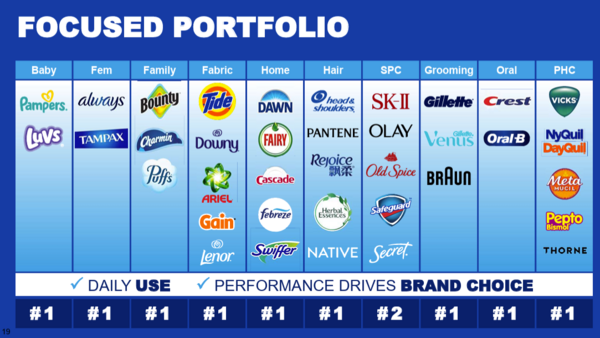
P&G added that talking about superiority is easy since the company leads in 9 out of 10 categories and is No. 2 in the other, but the challenge is delivering it consistently. P&G laid out plans to save an additional $10 billion from fiscal 2027 to fiscal 2030.
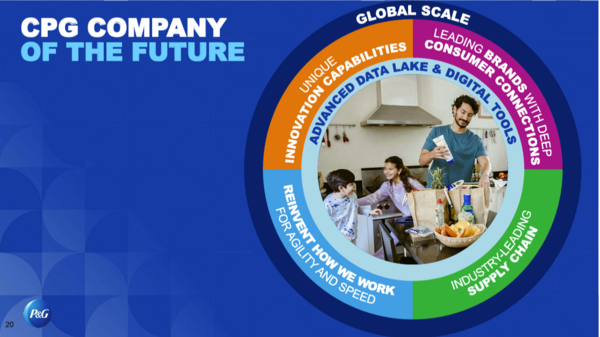
Here's a look at the various initiatives encompassing everything from P&G's data to AI to supply chain to marketing.
It all starts with data
Jejurikar repeatedly touted P&G's consumer data. "We have the largest set of consumer data in the world, a unique set of innovation capabilities and technologies, some of the world's most iconic and loved brands with big user bases, one of the largest creative brand-building ecosystems in the world and industry-leading flexible and agile supply chain," he said. "We've reimagined innovation into an always-on process, leveraging our unique innovation and AI capabilities, combined with continuous consumer engagement to anticipate consumer needs, accelerating our ability to deliver breakthrough products."
Simply put, "we have the largest and most comprehensive consumer knowledge and intelligence engine in the world," said the P&G CEO.
Key data points:
- P&G's database has 10 million consumer profiles.
- The company adds 3.5 million profiles each year.
- Data is supplemented by social media listening, consumer ratings and reviews and feedback from P&G's consumer relations team.
- P&G also collects data directly from consumers and how they live.
- Data is collected on consumer satisfaction, dissatisfaction and consumers' unmet wants and needs and then rounded out with data from millions of product tests, packaging, concepts, shelf tests, sales and supply chain information.
"With this data, we are using systems and AI tools to help us break down broad consumer groups into more specific consumer cohorts, which allow us to identify and develop jobs to be done by specific segment with much greater precision," said Jejurikar. "This is fundamentally reinventing how our entire enterprise operates from how we deeply understand consumers and sense demand to how we make decisions, innovate, build brands, go to market, manufacture and create value.
Seth Cohen, CIO of P&G, said the company's opportunity isn't collecting the data, but turning them into "faster, better management decisions across innovation, brand communication, retail execution and supply."
Cohen added that "AI gets all the headlines, but the underlying data is what makes us unique and provides our competitive advantage."
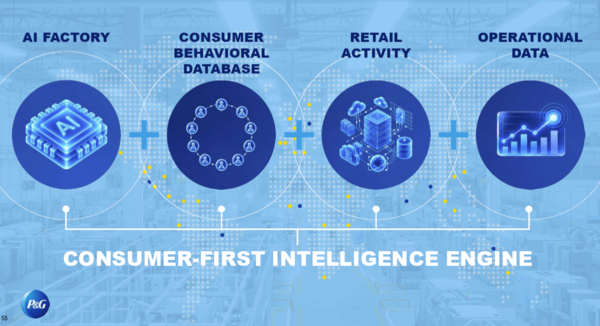
P&G has a core data lake that standardizes data from operations, retailers, suppliers, media platforms and other sources including consumer behavioral databases.
According to Cohen, this data foundation feeds P&G's AI factory. "Add with this foundation, our AI factory, allowing a capability proven in one place to scale across the entire company. This creates what we call our consumer-first intelligence engine. As AI models become commoditized, it is this combination that creates our advantage," said Cohen.
AI use cases
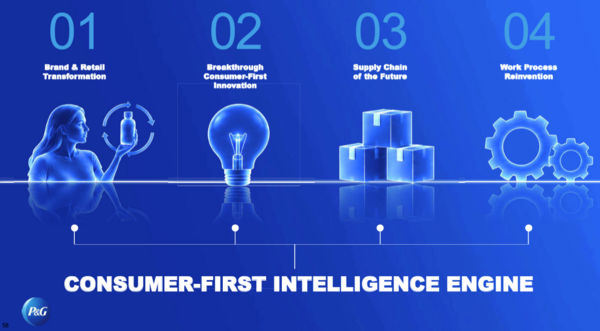
Cohen outlined four primary AI use cases including brand targeting, innovation via an AI-powered discovery suite, supply chain and processes.
Here's a look:
Consumer targeting. Cohen said that by combining data, P&G can "identify more granular cohorts, delivering advertising that appeals to the specific needs and connect those communications directly to the point of purchase data," he said.
Innovation. Molecular discovery typically takes 6 to 8 years, but P&G's AI discovery suite and the company's master scientists have cut discoveries down to about 6 months. "We are also utilizing digital twins to rapidly test, learn and refine ideas before validating the strongest concepts with real consumers," said Cohen.
Supply chain. Cohen said the same signals that indicate what consumers want also tells the company what to make and where to put it. This flywheel enabled by AI connect supply chain and demand. In addition, AI is enabling more automation. "We're taking automation further with unattended operations, enabling a more autonomous production while maintaining human accountability for outcomes. These capabilities no longer operate independently. A shift in consumer sentiment changes innovation, retail execution, supply decisions as one coordinated response," said Cohen.
Internal processes. P&G is using AI to reduce routine work, improve decision making and free up capacity. P&G IQ creates an enterprise contextual front door for employees. Cohen didn't name a vendor, but P&G has a long-term partnership with Microsoft, which just outlined Microsoft IQ.
Supply chain
Andre Schulten, CFO of P&G, said the company is nearly finished with a restructuring announced in June 2025. With that restructuring, P&G decided to protect investment in the business and continue to evolve.
Schulten said manufacturing and supply chain optimization have been critical to preserving profits especially as the company manages through cost headwinds from high-oil-related input costs. P&G calls its supply chain efforts Supply Chain 3.0.
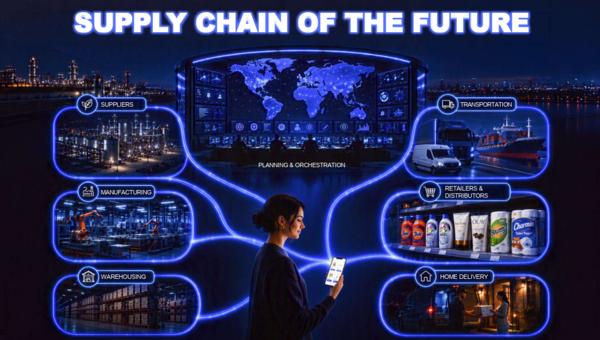
Luc Reynaert, chief product supply officer, said Supply Chain 3.0 "extends beyond P&G to suppliers and retail shelves, targeting 98% on-shelf and online product availability, up to $1.8 billion before tax in gross productivity savings annually and 90% or greater free cash flow productivity, all to meet or exceed total shareholder return targets."
Reynaert said supply chain agility is a requirement to compte. The company has navigated tariffs, oil price shocks and Middle East turmoil in the last four years.
P&G's supply chain transformation plan includes the following tenets.
- Ensure products are high quality and available wherever and whenever consumers shop, which is shifting online.
- North America is expanding its integrated network from 19 to 35 shipping points.
- Overlaying P&G's supply network with those of retailers and using AI to model transportation scenarios and optimize product flow and logistics cost.
P&G is also pushing into unattended operations. Reynaert said:
"Traditional supply chain operations require significant manual touches, limiting productivity as well as increasing costs. P&G is addressing this through our unattended operations program. We're now running at more than 15 sites with plans to further scale in fiscal '27. We are taking unattended operations to a whole new level using robotics, automation and digitization to improve safety, quality, reliability with the potential to deliver up to 20% productivity improvement by 2030, freeing up our employees for higher-value work."
P&G is also taking innovation from its other global units. For instance, China has a platform that combines internal and external data for real-time on-shelf visibility across more than 100,000 stores.
Reynaert added that sustainability also matters. "To reduce emission and exposure to natural gas price volatility, we're installing a geothermal system extending over 2,800 meters deep. The project is projected to reduce site greenhouse gas emissions by more than 90% from the 2010 levels, while improving long-term energy resiliency and lowering exposure to fossil fuel price fluctuations. The heat recovery system is currently being implemented with commissioning planned for spring '27," Reynaert said.
Innovation
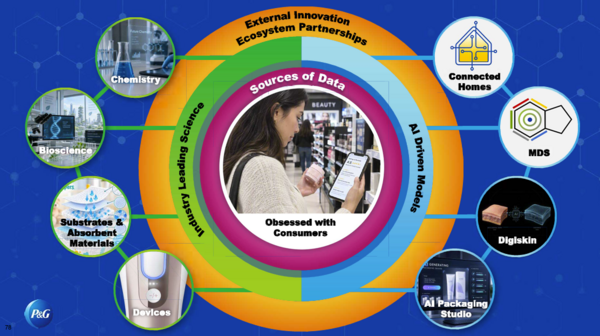
Victor Aguilar, chief research, development & innovation officer, said the company's innovation cadence has been improved with AI and P&G's data flywheel.
"We translate all of these insights into scientific challenges that guide the development. The best-in-class scientific expertise is our core competencies and a critical currency for our innovation ecosystem. This expertise, amplified by our global network of scientists, universities and research institute partnerships, enables consistent superior innovation. And as our vast network of scientists publish their data, it feeds LLMs to positively influence consumer preference, including agentic commerce," said Aguilar.
Aguilar outlined the following innovation points:
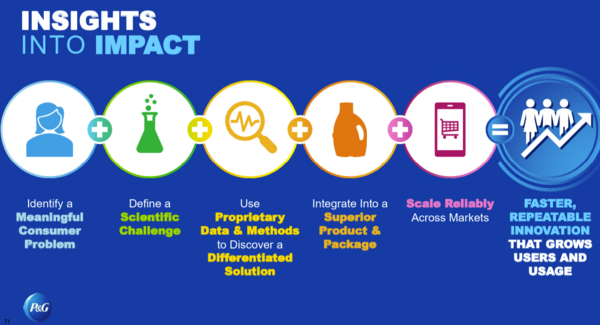
P&G identifies a meaningful consumer problem and then describes the scientific challenge. "We use proprietary data and method to discover a differentiated solution. We integrate into a product and package that is superior and will scale reliably across markets. The result is faster innovation that is repeatable, that grows users and usage of our brands," he said.
Connected devices in the P&G portfolio add measurement, diagnostic data and personalization. "The value is not in one innovation in one category, but in a scaling scientific platforms across consumer needs and combining them for breakthrough results," said Aguilar.
P&G's Molecular Discovery Suite uses AI to model, simulate and automate using the company's unique scientific and digital models to accelerate discovery and reinvent technical workloads. Aguilar said:
"With the Molecular Discovery Suite, we have found 5 new molecules in 6 months, and that's just in laundry, but the capability extends beyond laundry. We have now applied it to identify superior bioactives, first for skin care, then for baby care, fem care, grooming, hair care and personal care.
In the skin care, we combined a partner's dermatology device with a biomarker expertise and clinical data to power our digital skin AI model. And in the past 6 months, we identified 5x more exclusive ingredients and formulation approaches than in our prior track record."
Aguilar added that P&G's advantage isn't AI access, but scientific data, consumer data and category expertise. Each part and application sharpens P&G's models and data.
Consumer engagement
P&G is known for its brands and innovation, but marketing is also a core competency. Marc Pritchard, chief brand officer at P&G, said AI is being used to navigate a landscape with more media, content fragmentation and consumer tastes.
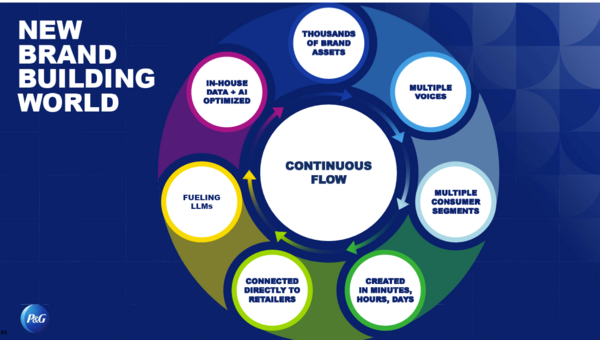
"The new world is a mass engagement model, a continuous flow of thousands of assets per brand delivered by multiple voices to multiple consumer segments; created in minutes, hours and days; directly connected to retail; fueling LLMs; and automatically optimized through in-house data and AI, all creating a compounding flywheel of engagement, awareness, trust, traffic and purchase," said Pritchard.
Pritchard said P&G is no longer targeting one broad consumer audience but "multiple consumer cohorts who share meaningful characteristics and behaviors across life stages, allowing our local brand teams to reach them more precisely in moments when and where they're most receptive."
He added that AI is driving P&G's Brand OS that automates brand building for Pantene and other products. Pritchard said:
"The path to purchase is shifting our understanding of every stage of the consumer journey from discovery to purchase and use. We bring together rich consumer insights and technical advances to deliver superior experiences and innovation that delights consumers. We can connect this understanding to distinct consumer cohorts for each brand, helping retailers address those consumer's specific needs to grow our categories. This is how we combine our breadth of capabilities, reach across consumer, decades of product leadership and trusted relationships to create a new source of competitive advantage in the AI era."
Larry Dignan is Editor in Chief of Constellation Insights at Constellation Research, where he leads editorial coverage focused on enterprise technology, digital transformation, and emerging trends shaping the future of business. He oversees research-driven news, analysis, interviews, and event coverage designed to help technology buyers and vendors navigate complex markets with clarity and context. ...
Read morePublished
Author
