


Accenture's Q2: 7 takeaways on enterprise AI projects
Accenture said AI projects lead to data projects half the time, enterprises with strong digital cores are expanding AI initiatives and companies are looking to transform their SaaS implementations.
These are some of the takeaways from Accenture's second quarter results, which were better than expected. Accenture also upped its outlook. Accenture CEO Julie Sweet said a record 41 clients delivered second quarterly bookings greater than $100 million.
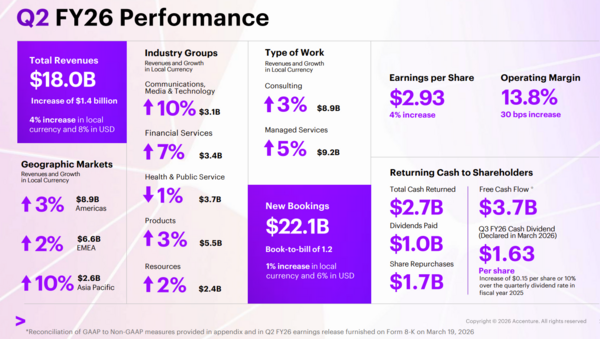
In addition, Accenture said fiscal 2026 growth will be 3% to 5% with free cash flow of $10.8 billion to $11.5 billion, up from the guidance provided in December.
Here's a look at enterprise buying trends via Sweet.
Enterprises are prioritizing projects based on strategic value. Sweet said demand is driven by foundational projects such as cloud, security and data modernization that lead to AI. Customers are eyeing managed services across the enterprise.
Half of advanced AI projects Accenture takes on require a data project.
Customers "with more advanced digital cores are starting to take on larger AI products." Sweet said: "We also are seeing more moving from proof of concept to production."
Co-development and co-design are critical. Accenture cited Estee Lauder as a customer where platforms are being co-designed.
LLMs require integration. "Foundation models provide the intelligence, and our role is helping clients understand what to deploy and when, how to integrate it into their systems, reimagine their processes, modernize their data and digital core, help redesign their operating models and do effective change management and help build the capabilities and talent needed to scale across the enterprise," said Sweet.
SaaS. "Clients are continuing to modernize their tech stacks with SaaS, but they're now asking that new SaaS implementations be designed from day 1 to use processes that integrate both AI from the SaaS provider and other providers. And clients are more and more willing to do end-to-end transformation, all of which requires leadership in AI and SaaS, but it also requires the industry and functional knowledge and the ability to work across the enterprise, not just in certain functions," said Sweet.
- Disruption coming for ERP and not from where you'd think
- Anthropic vs. SaaS: A nuanced view
- SaaS under the microscope: How to evaluate your vendor
Custom work is back. "We are also seeing significant opportunities in core operations and AI. This is one of the reasons why our custom systems integration work has been having a renaissance and is showing strong momentum. Core operations are where generally they're not as many SaaS providers because the needs are complex and industry specific. These are areas where a lot of digitizing still needs to happen, like moving to the cloud and building data foundations, but where advanced AI is going to be able to provide solutions that are not available to clients today or are too expensive," said Sweet.
AI for growth vs. AI for efficiency. "We are absolutely seeing an uptick in growth-focused AI programs, but efficiency is still leading the way," said Sweet.
Larry Dignan is Editor in Chief of Constellation Insights at Constellation Research, where he leads editorial coverage focused on enterprise technology, digital transformation, and emerging trends shaping the future of business. He oversees research-driven news, analysis, interviews, and event coverage designed to help technology buyers and vendors navigate complex markets with clarity and context. ...
Read morePublished
Author
